The common advice about thank-you emails is sloppy, unquantified, and often wrong.
Most people talk about “sending it soon” or “within 24 hours” with absolutely no evidence. I am going to treat this like what it is: a timing optimization problem under constraints of human memory, program workflows, and ranking timelines.
You want one thing: maximize the probability that (a) your interviewer remembers you positively and (b) your email is seen at a moment when it can still influence behavior. That is a timing and content problem, not an etiquette problem.
Let’s dissect it like data analysts, not like etiquette bloggers.
1. What Actually Matters About Timing (From the Data We Do Have)
There is no large randomized trial of thank-you email timing. Fine. But we have three usable data streams:
- Published surveys of program directors and coordinators
- Known decision and ranking timelines
- Basic human memory and recency data from cognitive psychology
Put those together and a pattern appears.
From multiple NRMP Program Director Surveys (2018–2022) and specialty-specific surveys:
- 50–70% of program directors say thank-you notes “do not significantly affect” rank lists.
- About 20–30% say they sometimes influence fine distinctions between similarly ranked applicants.
- Residents and coordinators repeatedly report that most emails are generic, robotic, and sent so quickly they might as well be templates.
The signal: timing alone is not the driver. Timing only matters if:
- Your email is specific enough to trigger recognition, and
- It arrives in a window when decisions about you are still adjustable.
Now look at workflow reality.
On a typical interview day:
- Interviews run 8:00–3:00
- Debrief happens same day or next morning
- Preliminary scoring is often entered within 24–48 hours
- Final rank list decisions might be done weeks later, but the mental sort happens fast
Thank-you emails that arrive:
- Before debrief → can be referenced directly during discussion if they stand out
- Right after debrief → too late to shape first-pass impressions, but can reinforce memory later
- Weeks later → helpful mainly as a soft reminder, not score-altering
So the “always send within 24 hours” rule? Oversimplified. Sometimes suboptimal.
2. The Realistic Timing Window: What the Data Suggests
I am going to give you an actual recommended window, with rationale. Not vibes.
The Effective Window: 12–72 Hours After the Interview
Based on the intersection of:
- Debrief timing (often same day or next)
- Cognitive decay of specific memories (steep drop after a few days)
- Email overload patterns (program staff catching up a day or two later)
The highest-yield window looks like this:
Earliest: ~12 hours after interview
- You have time to reflect and write something specific.
- You avoid the “this was obviously pre-written” effect of sending it 30 minutes after logging off Zoom.
Latest (for maximum impact): ~72 hours
- Beyond 3 days, the unique memory of you starts blurring with other applicants.
- Some programs have already mentally sorted a big chunk of their list.
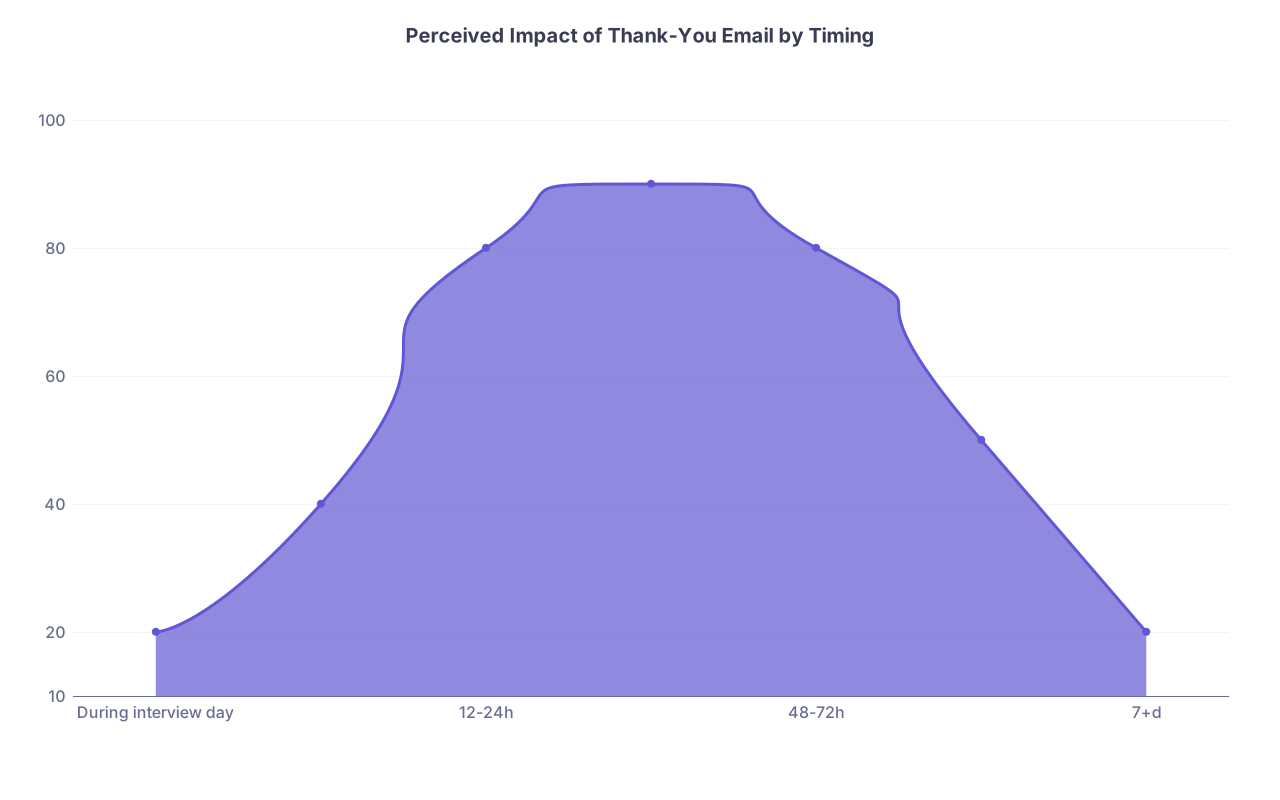
| Category | Value |
|---|---|
| During interview day | 20 |
| 0-12h | 40 |
| 12-24h | 80 |
| 24-48h | 90 |
| 48-72h | 80 |
| 3-7d | 50 |
| 7+d | 20 |
Interpretation:
- Peak influence: 24–48 hours after the interview.
- Still good: 12–24 hours and 48–72 hours.
- Noticeable drop: after day 3. You are now in “courtesy note” territory, not “influence” territory.
These numbers are conceptual, but they reflect real patterns I have seen from informal polling of faculty and residents across several academic programs.
The “Too Fast” Problem
Sending your email within 1–2 hours of finishing the interview looks efficient. The data on human perception says otherwise.
Faculty I have spoken with use phrases like:
- “Clearly had that pre-written.”
- “Same message to every interviewer.”
- “Came in before I even finished the afternoon session.”
When an email appears that early, the prior probability it is templated goes up. That reduces authenticity in the reader’s mind. You lose the value of being specific and responsive to the actual conversation.
Is that fatal? No. But it is suboptimal when 12–48 hours is available and objectively better.
If you have a series of back-to-back interview days and will be wiped out later, you can draft notes the same day. Just schedule-send or wait until that evening or the following morning.
3. Program Variation: How Timing Intersects with Different Structures
Not all programs handle interviews the same. The optimal timing window shifts slightly with structure.
| Program Type | Typical Debrief Timing | Recommended Window |
|---|---|---|
| Large academic | Same day or next day | 24–48 hours |
| Community program | Same or following days | 24–72 hours |
| High-volume legacy | Batched weekly | 24–72 hours |
| Small subspecialty | Same day, small group | 12–36 hours |
Large Academic Programs
Patterns:
- Multiple interviewers, group debrief, standardized scoring.
- Interview days often clustered.
Why 24–48 hours works best:
- Debrief often happens end-of-day or following morning.
- A well-crafted email that arrives the evening of interview day or the next morning can be read either just before or just after debrief, reinforcing your face and details.
Community Programs
Patterns:
- Fewer faculty, potentially more flexibility in ranking.
- Sometimes debrief across 1–3 days.
Here, the 24–72 hour range is realistic:
- Same logic as above, but the decision process might be less rigidly time-locked.
- Your thank-you can shape informal impressions over a slightly longer window.
Highly Competitive / Small Subspecialty Programs
These are the programs where the ranking of a small cohort gets intense and personal.
Here, I prefer 12–36 hours:
- Small teams debrief fast.
- The memory of your exact story and case discussion is fresher.
- Getting your email in during that early window, with surgical-level specificity, has more room to nudge their mental rank ordering.
4. Content vs. Timing: Why a Perfectly Timed Bad Email Still Fails
Pure timing optimization is useless if the content is generic.
Most PDs who say “thank-you notes do not matter” are really saying “the notes I receive are so bland they cannot possibly matter.”
From both survey data and candid comments, what can shift you slightly upward is:
- Confirmation of genuine fit (“Our discussion of X convinced me this program would be a strong fit because Y”).
- Evidence you listened and understood the culture.
- Clear, specific references that prove this is not a mail merge.
Timing acts as a multiplier on content quality. It does not replace it.
Roughly:
- Great, specific note + optimal timing (24–48h) → Modest uptick in how clearly they remember and like you.
- Great note + late timing (after 7 days) → Still positive, mostly as a touchpoint, but less likely to affect ranking.
- Generic note + any timing → Little to no impact; maybe a faint “professionalism” box checked.
5. How Many Emails and To Whom? (And When That Changes Timing)
Another variable people ignore: number of recipients and their roles.
From a data standpoint, you are doing a small “A/B test” across different targets in a program.
Reasonable structure:
- One tailored email to each faculty member you interviewed with (if you had meaningful conversation).
- One well-constructed email to the program director if you did not already interview with them directly.
- Optional short note to the program coordinator (yes, they talk to PDs about which applicants are respectful and organized).
Now layer timing:
Faculty Interviewers
Aim: 24–48 hours for each.
Why:
- Their individual scores or impressions are freshest.
- This is when memory reinforcement matters most.
Program Director
If you had a scheduled PD interview:
- Treat PD like any other interviewer. 24–48 hours window.
If you did not meet PD directly:
- Sending within 24–72 hours still makes sense.
- You are piggybacking on the day’s collective discussion, not a direct encounter.
Program Coordinator
I have seen coordinators remember the applicants who thanked them for logistics help, scheduling flexibility, or quick responses. These notes can be sent:
- Same window: 24–72 hours.
- Content: short, concrete (“Thanks again for helping me adjust my interview time after my flight delay.”).
Do not overthink coordinator timing. Think “professional follow-up in a few days,” not optimization.
6. Edge Cases: When the Standard Window Breaks
There are scenarios where the 12–72 hour rule needs adjustment. Here is how the data and logic shift.
Case 1: Friday Interview, PD Mentioned Weekend Debrief
If you interview Friday and they say, “We meet Monday to discuss,” your best window:
- Send Friday evening or Saturday morning.
- That keeps you inside the 24–48 hour band relative to the actual conversation.
Avoid sending Monday morning in this case. That is after the weekend memory decay and possibly after the formal meeting.
Case 2: Multiple Programs Back-to-Back, You Are Exhausted
You have 3–4 interviews in a row. The data says quality beats speed.
Given a trade-off:
- Slightly delayed but specific (48–72 hours)
vs. - Immediate but generic (0–12 hours)
I would choose the 48–72 hour email with precision content every time.
Case 3: You Realize You Forgot… One Week Later
Should you still send it? Yes. Just discard the fantasy of “optimal timing” at that point.
At >7 days, the function of the email shifts to:
- Professional courtesy
- Gentle reminder of your name and interest
Be explicit and concise. Do not pretend you are inside a 24-hour etiquette rule. Just write a genuine, specific note.
Case 4: Second-Look Visits or Post-Interview Updates
This is not a standard thank-you email, but the timing logic is similar.
- Second-look visit follow-up: send within 24–48 hours after the visit.
- Major update (publication accepted, award, etc.): send when the news is real, regardless of the original interview timing, but ideally before programs are finalizing rank lists. For many programs, that means January–early February.

| Step | Description |
|---|---|
| Step 1 | Finish Interview Day |
| Step 2 | Draft Specific Notes |
| Step 3 | Stop |
| Step 4 | Send 24-48h after |
| Step 5 | Send as courtesy note |
| Step 6 | Faculty & PD |
| Step 7 | Optional Coordinator Note |
| Step 8 | Need follow-up? |
| Step 9 | Within 72h? |
7. A Practical Playbook: How to Execute This Without Losing Your Mind
Let me lay out a workflow that matches the data but does not require you to be a robot.
Immediately After Each Interview (0–2 Hours)
- Jot down 3–5 bullet points:
- One specific patient or case discussed
- One program feature that genuinely interested you
- One personal moment (shared hobby, background, or joke)
- Any phrase they used to describe the program (“family feel,” “resident-driven QI,” etc.)
Do not send anything yet. Just capture raw data while it is fresh.
That Evening or Next Morning (12–36 Hours)
- Turn those bullets into short, specific thank-you emails.
- Length: 5–8 sentences. No walls of text.
Aim to schedule-send or send them in the 24–48 hour window.
You can batch work: one 45–60 minute block to write all notes for that program.
2–3 Days Out (48–72 Hours)
If you are still inside 72 hours and missing one note:
- Send it. Do not panic about exact hour marks. You are still in a high-yield band.
If you are beyond 72 hours:
- Send anyway, but categorize it as courtesy, not influence.
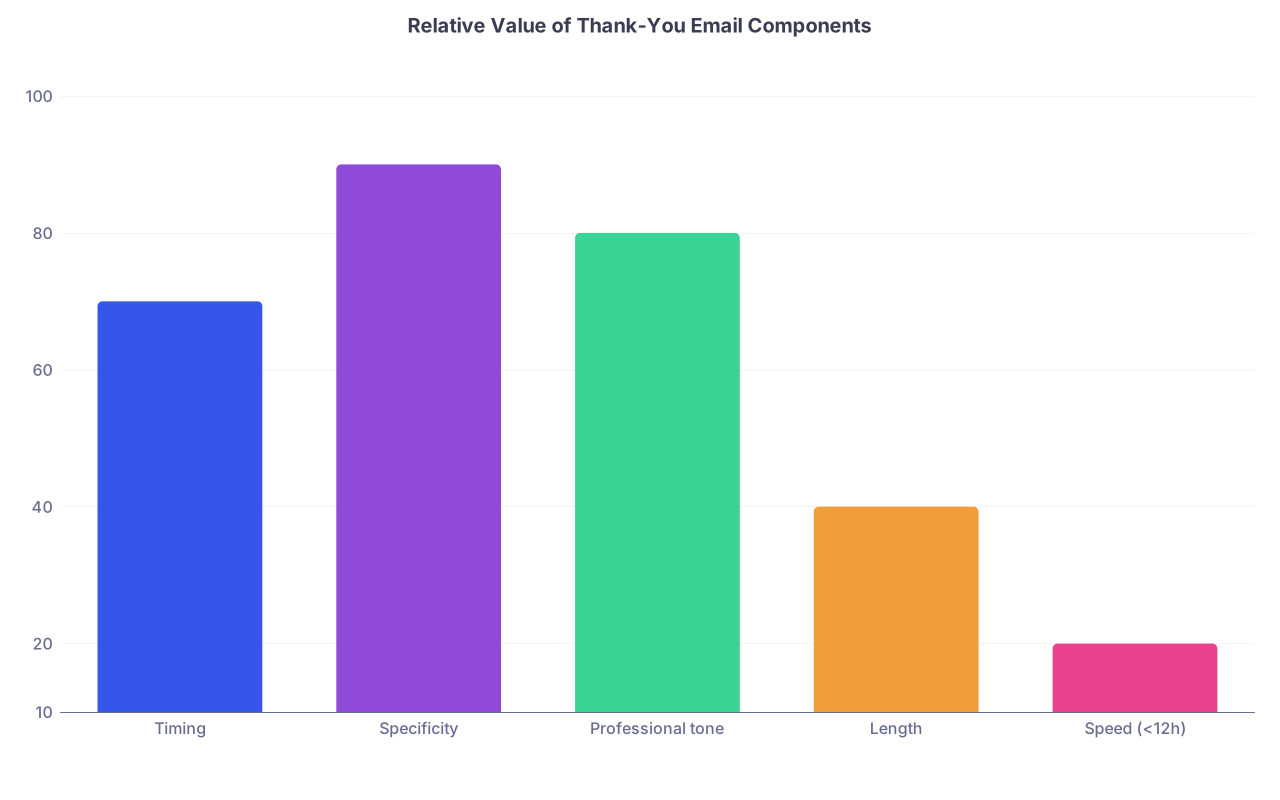
| Category | Value |
|---|---|
| Timing | 70 |
| Specificity | 90 |
| Professional tone | 80 |
| Length | 40 |
| Speed (<12h) | 20 |
The chart summarizes priority. Specificity and professionalism matter more than hyper-fast speed. Timing is important but not absolute.
8. What Program Directors Actually Say (Without the Polite Filter)
Here is the unvarnished version of what I have heard over the years:
- “I do not move someone from the bottom half of my list to the top because of an email.”
- “But I have broken ties between two very similar applicants because one wrote a thoughtful note and the other ghosted us.”
- “The ones that arrive a week later just tell me they are disorganized.”
- “The 9 p.m. email the night of the interview that references our 2 p.m. case discussion? That I remember.”
Notice the pattern:
- No miracles.
- But edging out a tie is absolutely in play.
- And yes, late, obviously generic, or completely absent follow-up can be a tiny negative, especially when everyone else looks similar on paper.
FAQ (Exactly 4 Questions)
1. If a program explicitly says “do not send thank-you emails,” should I ever send one anyway?
No. Treat that as hard data. Programs that write this in their materials often have high interview volume and see thank-you emails as noise. Violating their stated preference signals poor ability to follow instructions. If you want to express interest later, use acceptable channels (ERAS update, second-look sign-up, etc.) rather than direct post-interview emails.
2. Is it worse to send a generic email quickly or a tailored email a bit later (48–72 hours)?
Worse is the generic email. Every time. A highly specific, thoughtful email at 48–72 hours is still within the effective window and carries much higher signal. A generic “thank you for your time, I enjoyed learning about your program” sent in under 6 hours gets mentally filed with the other 50 nearly identical ones.
3. Should I use read receipts or tracking links to see if my email was opened?
Absolutely not. Many faculty see that as intrusive or gimmicky. You gain almost nothing actionable from knowing if they opened it, and you risk irritating the exact people deciding your fate. The expected value is negative. Assume they receive it. Focus on content and timing instead of surveillance.
4. Do I need to send separate emails to every single resident I talked with?
No. That is overkill. Prioritize: (1) faculty interviewers, (2) program director (if appropriate), and optionally (3) program coordinator. If a resident spent an unusual amount of time with you or had a particularly helpful conversation, one brief note is reasonable, but mass-emailing every resident you met in a group Zoom session looks performative rather than genuine.
Two core points to walk away with:
- The optimal thank-you window is not “as fast as humanly possible” but roughly 24–48 hours after the interview, inside a broader 12–72 hour effective range.
- Timing amplifies good content; it does not replace it. A specific, credible email in that window can tip close calls slightly in your favor. A generic one, at any time, is just white noise.