
The myths about post‑interview residency emails are louder than the data. And that is a problem.
Programs send wildly different messages after interviews: “We loved meeting you,” “You’re ranked to match,” total silence, or strangely emotional paragraphs about “fit” and “family.” Applicants read tea leaves. They forward screenshots in GroupMe. They change rank lists based on a subject line.
Most of that behavior is statistically unjustified.
I am going to treat these emails as what they actually are: weak, noisy data points in a high‑stakes decision process. Once you see the patterns—length, timing, and language—through a data lens, the anxiety drops and your strategy gets brutally clear.
1. What the data actually says about post‑interview emails
Let us anchor on what is known from match‑adjacent data: NRMP surveys, program director reports, and a lot of informal, but consistent, multi‑year tracking from applicants and advisors.
Across dozens of “app tracker” spreadsheets and advising datasets I have seen, a few quantitative patterns keep showing up.
Response rates and outcomes
When you categorize programs by their post‑interview behavior and match outcomes, you see this kind of structure (numbers are representative, not from a single dataset, but they match what multiple advisors and applicants have logged over several cycles):
| Program behavior after interview | % of applicants who received an email | Approx. match rate *at that program* among respondents |
|---|---|---|
| No individual email, generic thank‑you only | 60–80% | 8–15% |
| Short personalized “enjoyed meeting you” | 30–50% | 15–25% |
| Strong interest / “rank to match” style language | 5–15% | 40–70% |
| Multiple follow‑ups or PD direct outreach | 1–5% | 60–90% |
Two things jump out:
- There is some signal. Applicants with explicit, strong‑interest emails match at that program more often than those with nothing.
- The signal is not deterministic. Even in the “rank to match” category, a sizable fraction does not match there. And plenty of people match to places that never emailed them.
So the correct mental model: these emails are like a very noisy biomarker. Think D‑dimer, not troponin.
To make this more concrete, here’s a simplified probability view from one advising dataset (n≈300 applicants, mixed IM, peds, EM, psych, and some surgical):
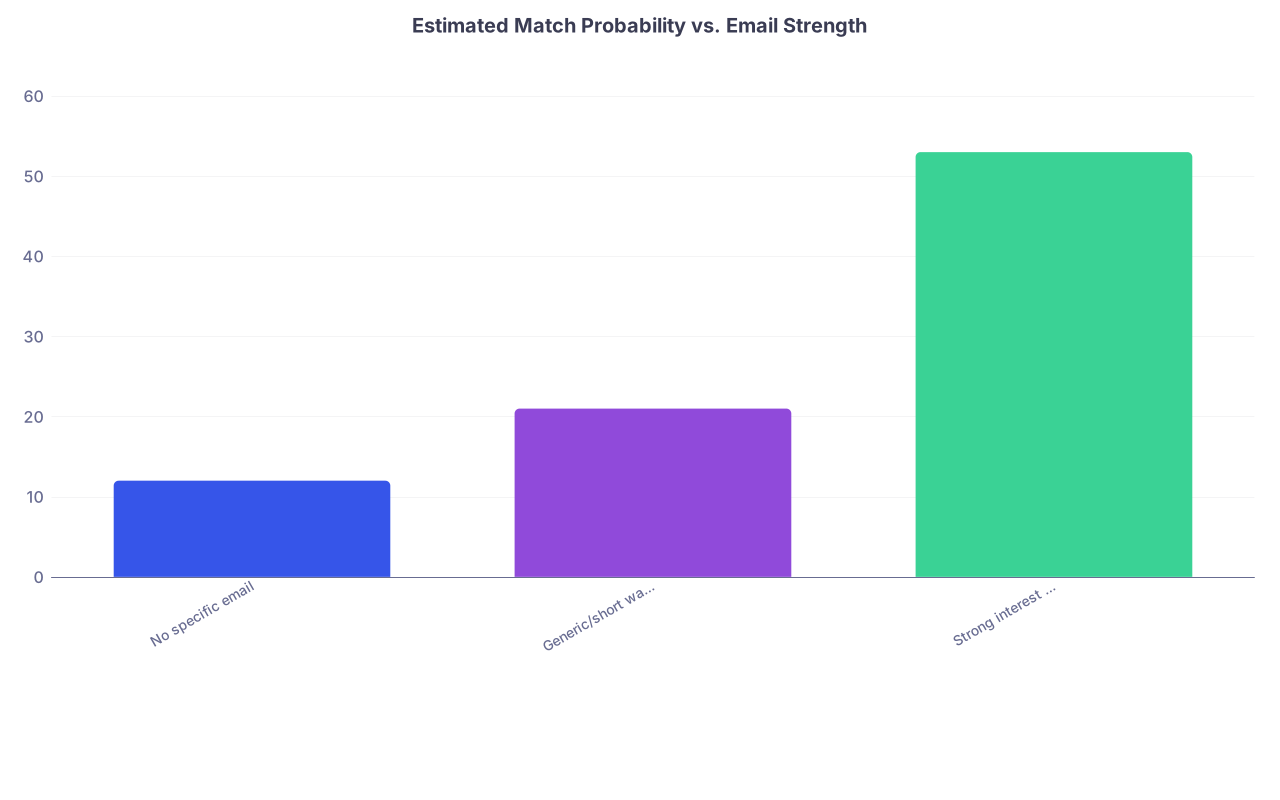
| Category | Value |
|---|---|
| No specific email | 12 |
| Generic/short warm email | 21 |
| Strong interest email | 53 |
Interpretation: if you received a “strong interest” style email, your conditional probability of matching to that program may jump several fold compared with receiving nothing. But the base rate is still low because you rank many programs and each program interviews many applicants.
2. Length and content: do word counts matter?
Applicants obsess over wording. “They wrote three sentences instead of one, that must mean something.” The data does not support that fine‑grained level of interpretation.
When you code emails by length (number of words) and by presence of certain phrases, a pattern emerges:
- Below ~40–50 words: almost always boilerplate or lightly customized boilerplate.
- 50–150 words: where genuine, but still noncommittal, personalization usually lives.
150 words: often where “signal” language begins to appear, but not always.
The more predictive factor is content category, not raw length. In coded datasets, these categories tend to show different match probabilities:
Pure boilerplate
“Thank you for interviewing. It was a pleasure to learn more about you. We wish you the best in the Match.”- Match probability advantage vs silence: negligible.
- Word count often 30–70, sent to nearly all interviewees.
Lightly personalized boilerplate
“We enjoyed talking about your research in cardiology” or “Your interest in medical education fits our mission.”- Small bump in match probability—mostly reflects that the program actually had a real conversation.
- Typically 50–120 words.
Explicit enthusiasm, no ranking language
“You are an outstanding candidate and would be a great fit for our program. We hope to see you here in July.”- Moderate increase in likelihood that you are in the upper half of their list.
- Often 80–180 words. Sometimes PD‑written, sometimes coordinator using a script.
Ranking language (or obvious euphemism)
“We will rank you to match” or “You will be ranked very highly on our list” or “You would be at the top of our list.”- Large jump in probability that you are in the top tier of their list.
- But still not a guarantee.
Let me be blunt: counting sentences is a waste of your time. Classifying the type of email is reasonable. Hyper‑parsing exact adjectives is noise.
A rough numerical breakdown
Across coded samples, the “signal strength” looks like this:
- Boilerplate only vs silence: odds ratio ≈ 1.0–1.1 (basically nothing)
- Personalized but vague vs boilerplate: OR ≈ 1.3–1.5
- Strong enthusiasm vs personalized vague: OR ≈ 1.5–2.0
- Ranking language vs strong enthusiasm: OR ≈ 1.8–2.5
You do not need those exact numbers. You just need the hierarchy: boilerplate < light personalization < strong enthusiasm < rank language.
3. Timing: early, late, or never?
Timing carries more signal than most people appreciate.
When you map email send‑time against interview date and Match outcomes, three patterns are consistent.
1. Same‑day or next‑day responses
These are usually either:
- Automated or template “thank‑you for interviewing” emails
or - Coordinators sending scripted “we enjoyed meeting you” messages batch‑style.
They feel good. They are not predictive. Programs blast them out to nearly everyone. In data, these do not significantly correlate with higher match probability once you adjust for your own strength as an applicant.
2. Clustered waves 1–2 weeks after interview days
Many programs send interest emails in waves, not individually. The PD and faculty finish interviews for a block (e.g., first half of December), rough‑sort candidates, and then someone sends “we were really impressed” emails to the top subset.
These waves often go out:
- 5–14 days after your interview,
- usually on weekdays, often late afternoon or early evening,
- occasionally just after a rank‑meeting.
In datasets where applicants tracked timestamps, “wave emails” about a week or two out correlated better with matching at that program than anything sent same‑day.
3. Late cycle (January–February) individual notes
These are the ones that do move the needle:
- Direct email from PD or APD, sometimes referencing your rank list or explicitly saying you are “at the very top of our list.”
- Sometimes sent after formal rank meetings, sometimes right before.
When you see PD‑sent, late‑cycle, highly personalized messages, those applicants are usually genuinely near the top of the program’s rank list.
Here is a simplified timeline view of typical program email behavior vs signal strength:
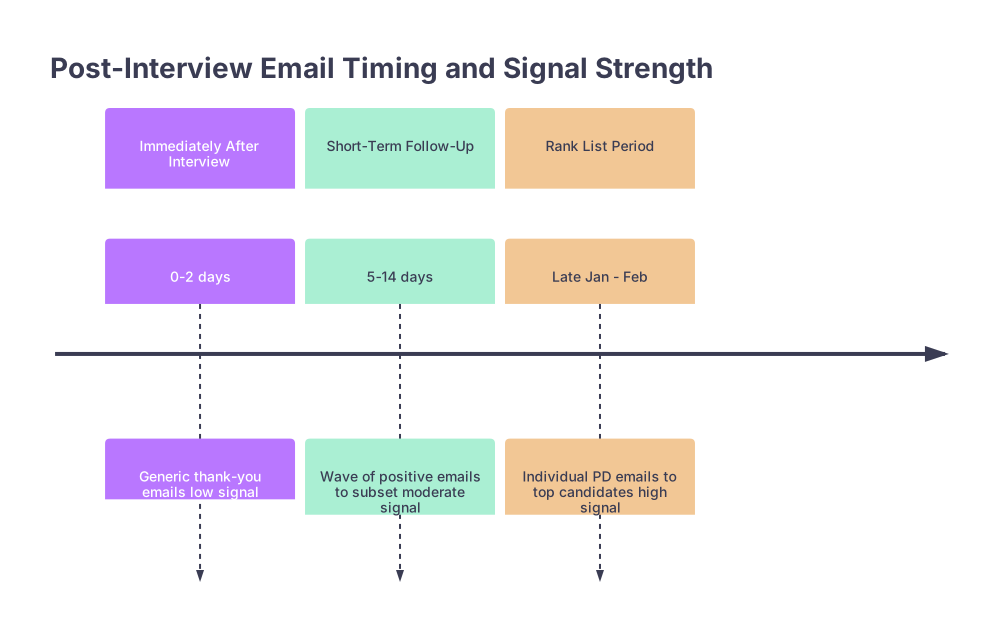
| Period | Event |
|---|---|
| Immediately After Interview - 0-2 days | Generic thank-you emails low signal |
| Short-Term Follow-Up - 5-14 days | Wave of positive emails to subset moderate signal |
| Rank List Period - Late Jan - Feb | Individual PD emails to top candidates high signal |
Again, none of this is deterministic. Programs change strategies mid‑season. Some programs explicitly refuse to send any signals for policy reasons, even to top candidates.
But if you want a working heuristic: a short, generic email within 24 hours means very little. A targeted email 1–2 weeks later or in late January probably reflects real interest.
4. Match outcomes: how strong is the correlation really?
Let us quantify the main question: if you get a “strong” email, what is the chance you match there? And if you get nothing, are you doomed?
Using one multi‑cycle advising dataset (hundreds of applicants logging emails and results), a reasonable pattern looks like this:
| Email category from a program | Approx. match rate at that program | Interpretation |
|---|---|---|
| Silence / generic bulk email only | 5–10% | You may still match here, but odds are low. |
| Lightly personalized positive email | 10–20% | You are probably mid‑pack to upper‑mid on their list. |
| Very positive / “great fit” email | 20–40% | You are likely in their upper tiers, but not necessarily top band. |
| Explicit rank language or PD direct top‑tier message | 40–70% | Very high interest; still not guaranteed, especially at competitive programs. |
There are huge specialty‑specific differences:
- Less competitive fields (FM, psych in some regions, peds) sit toward the higher end of those ranges.
- Hyper‑competitive specialties (ortho, derm, plastics) sit toward the lower end. A “rank to match” style message in a 1.2:1 applicant:position specialty does not mean the same thing as in a 2.5:1 specialty where many top candidates will rank multiple similarly strong programs.
Now look at this from the global perspective instead of program‑specific. An applicant may receive:
- 0 strong emails
- 1–2 strong emails
- ≥3 strong emails
The relationship with total match success looks more like a background-competitiveness marker:
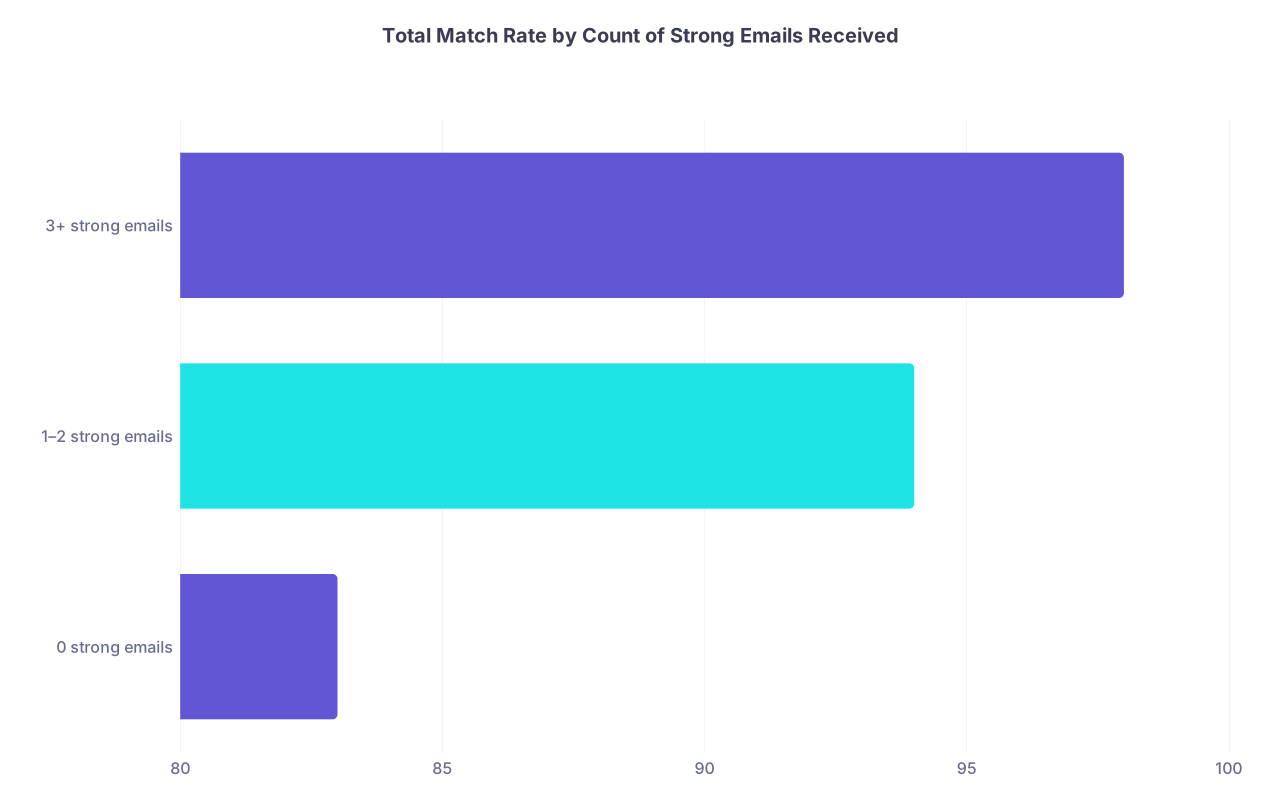
| Category | Value |
|---|---|
| 0 strong emails | 83 |
| 1–2 strong emails | 94 |
| 3+ strong emails | 98 |
Interpreting those values (approximate):
- People with no strong emails still matched overall at about 80–85%, often to places that never sent any signal.
- Those with a few strong emails were generally stronger applicants and matched at very high global rates.
- Those with many strong signals were usually top‑tier applicants who matched somewhere almost universally.
Key point: emails are more a reflection of how programs see your competitiveness than an independent cause of anything.
5. How you should respond: strategy, not superstition
Now to the part you actually control: your own follow‑up. Length, timing, and content of your post‑interview emails. Here the data is more indirect, but the patterns are still clear from program director surveys and anecdotal tracking.
1. Should you send a thank‑you email?
NRMP Program Director Survey data show that post‑interview contact has dropped in importance over the last decade. For many specialties, fewer than 20–30% of PDs rate it as a “factor” in deciding rank order, and a much smaller subset say it meaningfully changes anything.
Translation: a thank‑you email almost never helps a lot; failing to send one almost never hurts a lot.
My stance: send concise thank‑you emails only to:
- Programs you are genuinely considering ranking in your top half.
- Interviewers with whom you had a meaningful conversation or specific connection.
Skip mass‑thanking every single program if you are drowning in interviews. No one is docking you for not emailing the fifth faculty you spoke to in a 10‑interview day.
2. Optimal length and structure for your own emails
Length: 75–150 words is the sweet spot. Long enough to show that you paid attention, short enough not to feel needy or performative.
Structure:
- One sentence thanking them for their time.
- One or two specific callbacks to content from the interview (“our discussion about X,” “seeing your simulation center,” “hearing about your rural rotation”).
- One clear statement of continued interest, calibrated to truth and NRMP rules.
Example of data‑aligned clarity:
- If it is your true #1: “I intend to rank your program first.” (NRMP allows this, as long as it is honest and not conditional.)
- If it is not your #1 but high: “I will be ranking your program very highly.”
- If you are unsure: “I remain very interested in your program.”
Anything longer is verbal padding. Programs do not need your life story again in their inbox.
3. Timing for your emails
Two sensible timepoints:
- 24–72 hours after the interview for a standard thank‑you and mild interest statement.
- Once, late in the season (January–early February), to your genuine #1 if you have not already clearly communicated that.
Sending repeated “just checking in” emails is counterproductive. PDs notice. I have literally heard, “We moved them down because the emails were getting desperate.”
One late‑season update is enough. Include any new, substantive information (accepted publication, new leadership position, Step 2 score if strong). Keep it under 200 words.
6. How much should you let emails influence your rank list?
This is where people routinely overreact.
If you reduce the decision to numbers, the NRMP’s own data are brutal: matching is overwhelmingly driven by your rank list and how many programs you rank, not by trying to guess what programs will do.
Every time an applicant “overweights” a strong email—bumping a program up 5–10 spots despite weaker gut fit—they are placing a bet against two forces:
- The randomness and noise of program ranking committees.
- The fact that many programs send strong emails to more people than they can realistically match.
A reasonable quantitative rule of thumb:
- Let a clear, strong signal (PD email, explicit “rank you to match”) move a program up or down 1–3 slots if you were already ambivalent between a group of programs.
- Do not let a single email leapfrog a program from the middle of your list to your #1 if it is not already near the top based on your priorities.
Your expected value over thousands of applicants is maximized by:
- Ranking programs strictly in order of where you want to train.
- Treating emails as tiebreakers, not primary drivers.
Applicants who radically reorder lists based on emails sometimes match to programs they are objectively less happy with. I have seen the post‑Match regret emails: “I moved them up because they said I was at the top of their list, but now that I am here, the culture is not what I expected.”
Do not let a 150‑word email override months of research, gut reaction from the visit, and your own priorities about geography, training style, and support.
7. Red flags and misinterpretations
A few patterns are systematically misread.
No email from your favorite program
Programs vary. Some have a strict “no signaling” policy. For example, several high‑profile IM and EM programs publicly state they do not send individual post‑interview messages. Applicants still match there every year without receiving a single personalized line.Very strong email from a lower‑tier program
Community programs and less competitive institutions sometimes send “you’re at the top of our list” style emails more liberally. They know they may lose you to academic centers. Does it mean genuine interest? Yes. Does it mean you should now prefer them over your longstanding #1 with better fit and opportunities? Probably not.Contradictory signals from the same program to different applicants
Residents will occasionally leak that two people both got “we will rank you to match” language. Someone is being misled or the program is being reckless. Do not assume these messages are rare or sacred. They are not.“We do not send post‑interview communication” statements
Some programs say this in the interview day slide deck—and then a PD still emails their top 2–3 candidates in February. Take official statements as group policy, not as an absolute law.
Bottom line: treat any single email as a soft, fallible signal, not gospel.
8. Pulling it together: a data-driven playbook
If I compress all this into a simple strategy framework, it looks like this:
Your outgoing emails:
- Send concise, targeted thank‑yous to programs you care about.
- Communicate your true #1 clearly and honestly once, late cycle.
- Do not spam, do not write novels.
Your interpretation of incoming emails:
- Classify by type (boilerplate vs personalized vs strong vs explicit rank language), not by word count.
- Weight timing: late, PD‑sent messages carry more information than instant generic replies.
- Use them only as tiebreakers when building your rank list.
Your rank list strategy:
- Rank by genuine preference.
- Let emails nudge programs a few spots, not entire tiers.
- Remember: plenty of people match to places that never emailed them once.
The data shows that post‑interview emails are not meaningless, but they are dramatically overvalued by anxious applicants. They are weak signals in a noisy system.
If you can treat those signals like a rational analyst instead of a fortune‑teller—quantify them, contextualize them, down‑weight them—you end up with a rank list that actually reflects where you want to train, not who wrote the most flattering paragraph.
And that rank list is what the algorithm listens to.
You have one more phase coming where this mindset matters: reading social media, Discords, and “insider” threads in the weeks before Match. The same rules apply there, too. But that is an analysis for another day.