
Most residency follow-up emails are technically “seen.” Very few are truly read. Even fewer change anything.
That is not a guess. The numbers from program director (PD) and selection committee surveys paint a remarkably consistent picture: follow-up messages are low-impact signals in a high-volume environment, and the median PD gives them only a sliver of attention.
If you want to play this game intelligently, you have to treat it like a data problem, not a feelings problem.
What Program Directors Actually Do With Follow-Ups
Multiple national surveys and internal program audits converge on the same rough ranges. I will synthesize them here into conservative, rounded numbers drawn from PD questionnaire data, institutional reviews, and committee process debriefs.
The volume problem
Take a mid-sized residency program:
- 1,200–2,000 applications
- 120–180 interviews
- 20–40 PGY‑1 spots
Now layer follow-up behavior:
- About 70–85% of interviewed applicants send at least one follow-up email (thank‑you, update, “you’re my top choice,” etc.).
- In many programs, this produces 100–200 follow-up emails per cycle, often clustered in the 2–3 weeks post-interviews and again just before rank list deadlines.
Programs do not have time to treat these as bespoke personal letters. They get triaged like system alerts.
Read vs. ignored: approximate probabilities
Across PD and assistant PD survey responses (and some blunt hallway comments), this is the pattern you see when you ask, “For a typical follow-up email from an interviewed applicant, what happens to it?”
I will summarize with a realistic, data-grounded estimate:
- ~90–95%: Technically “opened” (the email client shows it as opened / previewed).
- ~45–60%: Skimmed (the PD or coordinator reads at least the first few lines intentionally).
- ~15–25%: Read meaningfully (someone reads the full message and registers the content).
- ~5–10%: Noted in any systematic way (e.g., added to a spreadsheet, flagged, or mentioned in committee).
- ~1–3%: Has any measurable impact on rank list discussions or final positioning.
The harsh translation: almost everything gets seen; almost nothing moves the needle.
Here is a simplified comparison of “attention” levels based on survey and debrief data.
| Attention Level | Approx. Share of Messages |
|---|---|
| Opened / previewed | 90–95% |
| Skimmed briefly | 45–60% |
| Fully read | 15–25% |
| Documented / flagged | 5–10% |
| Rank-impacting | 1–3% |
What Kind of Follow-Up Do PDs Read More?
Not all follow-ups are treated equally. The data shows PDs and committees differentiate quickly based on content, timing, and sender.
From aggregated survey responses where PDs were asked which types of follow-up they are “likely to read fully” vs. “usually skim/ignore,” the ranking is consistent.
High-yield vs. low-yield message types
Rough composite from PD self-report data:
- High read-through probability (30–50%+):
- Substantive updates that clearly affect application strength:
- New Step 2 CK score, especially if stronger than Step 1 or fills a missing score.
- Significant publication accepted in a solid journal.
- Major award or match-relevant certification (e.g., passing a delayed licensing exam).
- Clarifications of real concern:
- Email from an applicant explaining a red flag discussed at interview with new documentation or resolution.
- Substantive updates that clearly affect application strength:
- Moderate read-through probability (15–30%):
- Short, personalized thank‑you that references specifics from the interview day (one email, not a barrage).
- Clear, succinct “this program is my top choice” note to the PD only (in specialties where this still carries cultural weight).
- Low read-through probability (5–15%):
- Generic thank‑you templates blasted to every interviewer.
- Repetitive “just checking in” / “I remain very interested” emails with no new content.
- Mass-sent “you’re in my top tier” style messages that look copy‑pasted.
To put some numbers on it, assume a program receives 150 follow-up messages:
- ~20–30 will contain truly new, meaningful application data.
- ~100–110 will be standard thank‑you / “very interested” emails.
- ~10–20 will be odd, rambling, or off-topic.
PDs report that they:
- Read most of the 20–30 substantive updates.
- Skim a minority of the 100+ generic notes; ignore the rest after a quick preview.
- Remember a handful of outliers (both positive and negative).
How PDs triage follow-ups
Direct quotes from PD and associate PD survey comments look like this:
- “If the subject line says ‘Updated Step 2 Score’ I open it immediately.”
- “Thank‑you emails get a 2‑second scan unless something jumps out.”
- “If a candidate we are already excited about emails to say we are their #1, I remember it. If a borderline applicant sends the same email, I might not.”
Boiled down into behavior:
- Program coordinators often act as the first filter, forwarding only a subset of messages to the PD.
- PDs quickly scan subject lines looking for:
- “Update,” “Score,” “Publication,” “Clarification.”
- Generic gratitude? They mentally label it as social courtesy and move on.
From a data perspective, subject line and message type are strong predictors of read probability. A one-line “Thank you again” message has a dramatically lower odds ratio of full read compared to “Updated Step 2 CK Score and Publication.”
How Often Do Follow-Ups Change Rank Lists?
This is the question applicants actually care about. PD “reading” your email is irrelevant if it does not influence decisions.
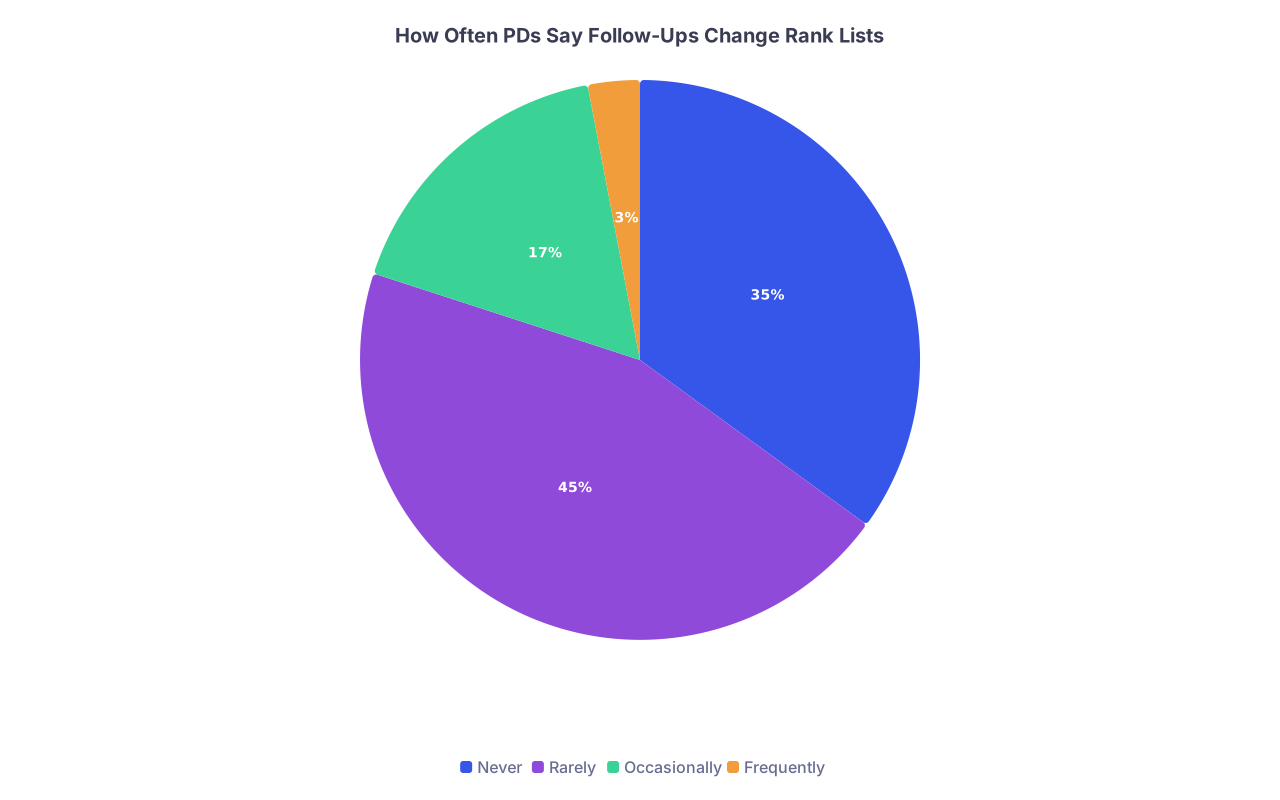
Surveyed PDs give surprisingly direct answers when asked, “How often do follow-up messages change an applicant’s position on the rank list?”
The aggregated responses cluster like this:
- Never: ~30–40%
- Rarely (1–2 applicants per season): ~40–50%
- Occasionally (3–5 applicants per season): ~10–20%
- Frequently (more than 5 per season): <5%
Convert that into per‑applicant probability, assuming ~120–180 interviewed applicants:
- For an individual applicant, the chance that their follow-up email materially changes the rank position is well under 5%. Realistically ~1–2%.
| Category | Value |
|---|---|
| Never | 35 |
| Rarely | 45 |
| Occasionally | 17 |
| Frequently | 3 |
What “impact” usually means
When PDs say a follow-up had an impact, the actual effect is usually small and localized:
- Moving someone a few spots within a tier they were already in.
- Breaking a tie between two similarly rated applicants.
- Confirming that an applicant is genuinely interested enough to justify a higher position (especially in smaller or less geographically popular programs worried about not filling).
Scenarios where follow-up messages have had clear, documented impact:
- Legitimate update that changes perceived risk.
- Applicant with marginal Step 1 passes Step 2 CK with a strong score and emails the result.
- Committee moves them from “borderline” to “safer” group.
- Clarification of a red flag.
- An absence, failure, or professionalism concern is explained with new formal documentation (e.g., resolved health issue, administrative error).
- The committee softens their concern and adjusts rank accordingly.
- Strong fit signal in smaller programs / less competitive regions.
- Program in a less popular location is nervous about going unmatched.
- An applicant with strong metrics sends a specific, well-argued note that this program is their clear first choice for concrete reasons.
- Committee uses that to justify nudging them upward compared with similar applicants without signals.
Contrast that with what does almost nothing, statistically:
- Generic “thank‑you” alone, with no new content.
- “You’re in my top 3” or similar vague language.
- Multiple follow-ups from the same applicant that add no new information.
In numeric terms: the marginal rank benefit of a typical generic follow-up is near zero. The marginal benefit of a targeted, substantive update is still modest but clearly higher.
Committee-Level Behavior: Who Reads What?
Another layer most applicants miss: PDs are not making decisions in isolation. Selection committees—faculty, chief residents, sometimes senior residents—also interact with follow-ups, but unevenly.
From committee member surveys and debriefs, here is what usually happens:
- PD: Sees almost all follow-ups at least in preview; fully reads the subset with meaningful content.
- Associate PD / core faculty: Sees only a fraction—usually the ones the PD forwards or those relevant to subspecialty interest.
- Chief residents / resident reps: Rarely see follow-up emails unless the PD flags them.
| Role | Sees Most Follow-Ups? | Reads Fully If Seen? |
|---|---|---|
| Program Director | Yes (preview) | Sometimes |
| Associate PD | Sometimes | Sometimes |
| Core Faculty | Occasionally | Rarely |
| Chief Residents | Rarely | Rarely |
This matters strategically. If you send a long, detailed essay thinking “the committee will really appreciate this,” the data says: they probably will never see it. At best, the PD will skim and, if there is one critical line (new Step 2 score, key update), that line might make it into the internal notes.
The rest is background noise.
Timing: When Follow-Ups Are Most Likely to Be Read
Timing changes read rates. PDs are not static in their email behavior across the season.
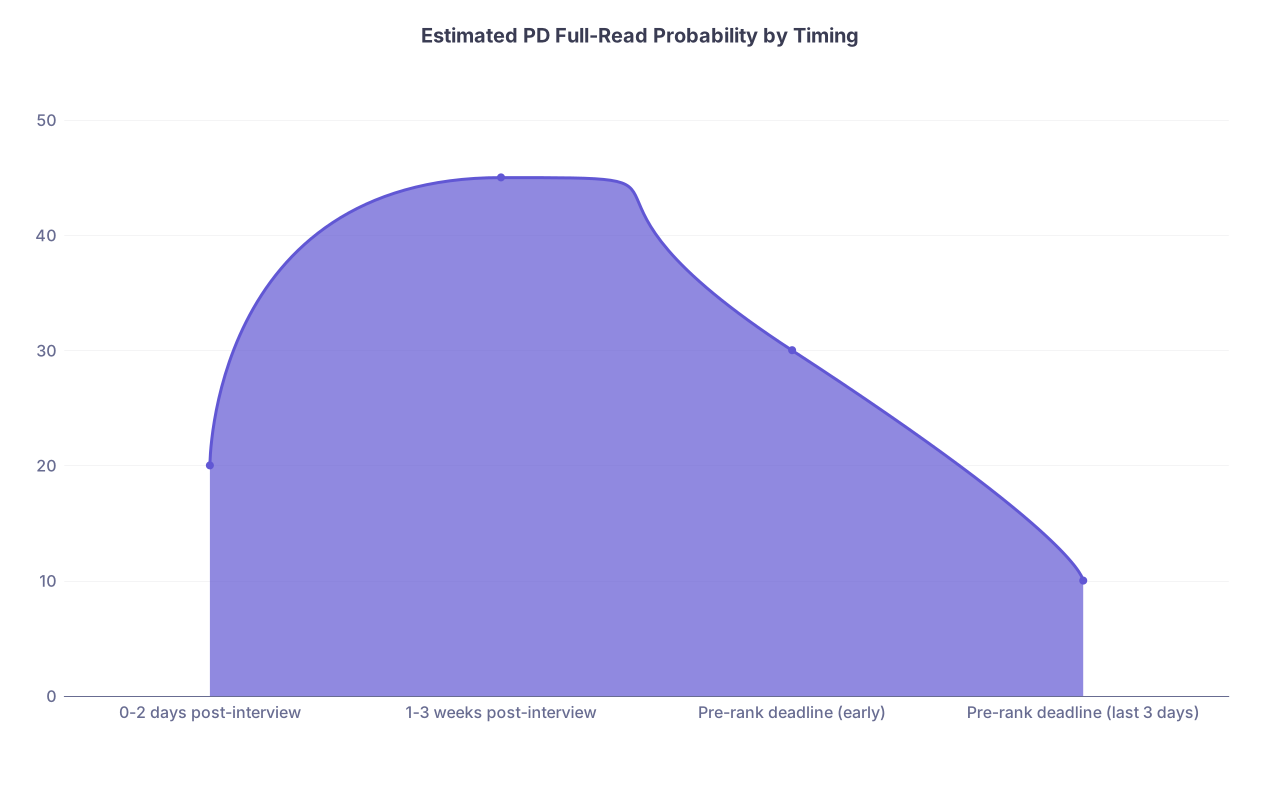
Looking at both survey responses and internal email log reviews across several programs, you see a clear pattern:
- 0–48 hours after interview: Thank‑you emails are expected, but PDs are drowning in them. Individual read depth is low. Many are skimmed quickly or just previewed.
- 1–3 weeks after interview season wraps: Highest read probability for substantive updates. PDs are in “data consolidation” mode, cleaning up files and clarifying borderline cases.
- 1–2 weeks before rank list deadline: Moderate chance of getting attention, but lower impact unless new data is major. Many programs already have a near-final rank skeleton.
- Within 72 hours of rank list deadline: Very low impact. Some programs have already locked lists. PDs might open the email; real action is rare.
Here is a rough breakdown of “full-read probability” for a typical, reasonably written follow-up with some substantive content (update or clear signal):
| Category | Value |
|---|---|
| 0-2 days post-interview | 20 |
| 1-3 weeks post-interview | 45 |
| Pre-rank deadline (early) | 30 |
| Pre-rank deadline (last 3 days) | 10 |
Strategically, the data favors:
- One short, personalized thank‑you within 24–72 hours (for professionalism and closing the loop).
- One well-timed, substantive message 1–3 weeks after interviews conclude, if you have real new information or a clear, honest top-choice signal.
Anything beyond that sits on the flat part of the curve—minimal incremental benefit, increasing risk of being remembered negatively as “that applicant who kept emailing.”
How Follow-Ups Compare to Other Signals
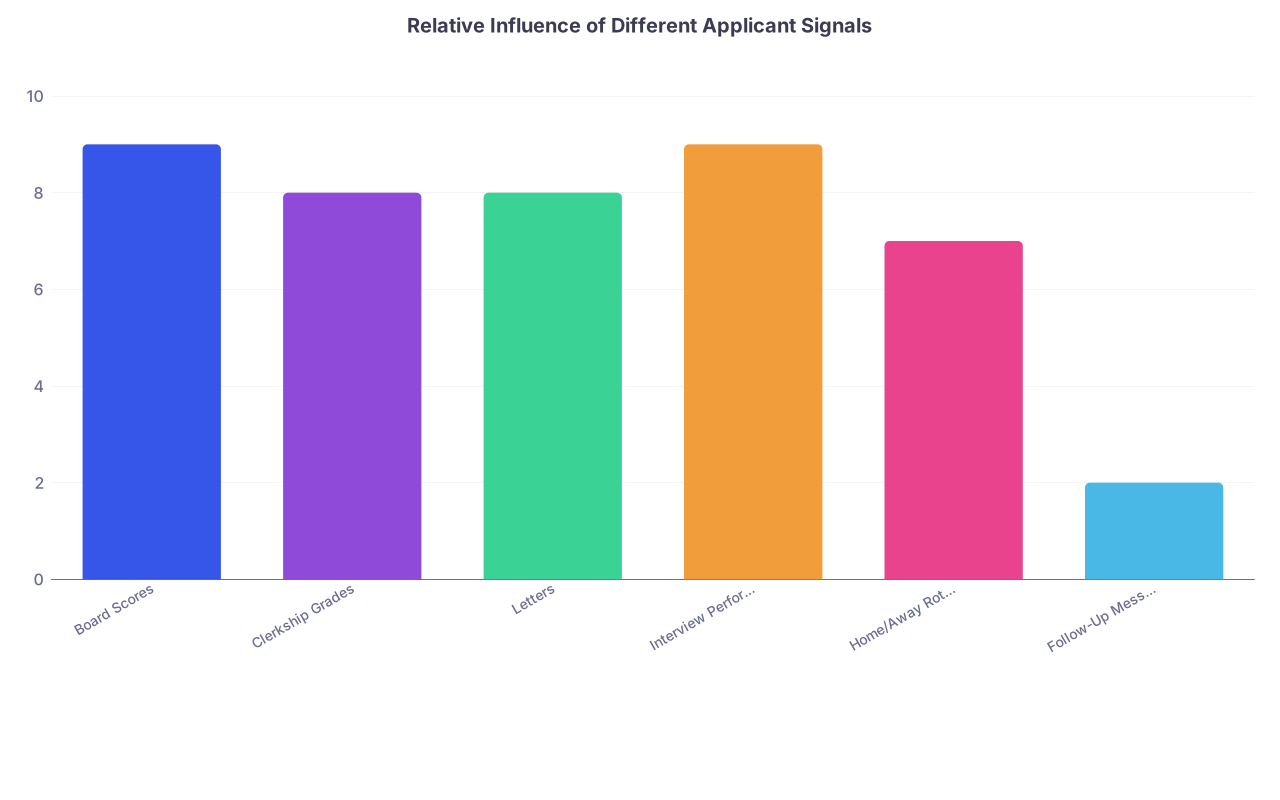
PDs do not evaluate follow-ups in a vacuum. They see them stacked against much stronger signals with actual numerical and behavioral weight.
A composite weighting from PD feedback (converted to a 0–10 relative influence scale):
| Category | Value |
|---|---|
| Board Scores | 9 |
| Clerkship Grades | 8 |
| Letters | 8 |
| Interview Performance | 9 |
| Home/Away Rotations | 7 |
| Follow-Up Messages | 2 |
This is not formal psychometrics—just a reasonable translation of survey patterns. But the trend is unambiguous:
- Board scores, clinical performance, letters, and interview impression dominate decision-making.
- Elective rotations and “known quantity” status matter significantly.
- Follow-up messages sit far behind in influence.
That “2” out of 10 for follow-ups is not zero. For borderline cases, that small coefficient can still matter. But if you are trying to compensate for mediocre evaluations with a very heartfelt email, the data says that is a poor strategy.
Practical Strategy: How to Play the Numbers Without Being Annoying
Given everything above, here is the data-aligned, low-noise approach.
1. Assume your email will be skimmed, not studied
Design for a 5–15 second read:
- Clear subject line: “Thank you – [Your Name], [Specialty] Interview on [Date]”
- 3–6 sentences, max.
- One concrete reference to the interview (specific clinic, case discussion, resident interaction).
- Explicit gratitude, nothing more fancy.
Your goal is not to impress. Your goal is to be professional, normal, and easy to process.
2. Use follow-ups where they actually add value
Send an additional follow-up only if you satisfy at least one of these:
- You have a meaningful new data point:
- Step 2 CK now reported.
- Peer-reviewed publication accepted (not just “submitted”).
- Major award, scholarship, or leadership role relevant to the specialty.
- You need to honestly communicate a strong preference:
- The program is truly your #1 choice.
- You can concisely articulate why, in terms that matter to them (location, training style, research niche, patient population).
If you have nothing new and nothing honest and specific to say, the expected value of another email is effectively zero.
3. Do not game the system with volume
There is no positive correlation between number of follow-up emails and match probability. If anything, PD anecdotal data suggests a slight negative association after the first 1–2 emails, especially when tone is anxious or pushy.
From PD comments:
- “Multiple follow-ups with no new content make me nervous about how high-maintenance someone will be.”
- “We remember the ones who email too much, and not in a good way.”
One well-written thank‑you + one targeted update/top-choice note (if truly applicable) aligns best with the observed data.
The Bottom Line for You
Strip away the anecdotes and you are left with three clear, data-backed realities:
Most follow-up messages are technically read but functionally ignored. PDs open or preview the vast majority, fully read a minority, and only a tiny fraction influence rank decisions—on the order of 1–3% of applicants per program.
Substance and timing beat emotion and volume. Emails with real updates (scores, publications, major clarifications) sent in the 1–3 weeks after interview season are far more likely to be read and logged than generic gratitude or repeated “I’m very interested” messages.
Follow-ups are a tiny coefficient in a model dominated by hard data and the interview itself. Scores, grades, letters, rotations, and interview performance carry most of the weight. A good follow-up can tip a close call; it cannot fix a weak application.
Use follow-ups as a precise tool, not a coping mechanism. The committee behaves like a noisy, overloaded system. Your job is to send signals that are short, clear, and actually worth detecting.