Most program directors are not sitting around judging your font choice in a thank‑you email. Or tracking whether you wrote one note or five. The mythology around post‑interview follow‑up is wildly inflated compared with what PDs actually care about.
Let me be blunt: sending (or not sending) individualized notes to every single interviewer almost never makes or breaks your rank position. The arms race of “hyper‑personalized” follow‑up is largely applicant‑driven anxiety, not program‑driven expectation.
You’re in the slog of residency applications, people are whispering in hallways, GroupMe threads are on fire: “You have to send separate notes to each interviewer.” “Use a template and tweak it.” “If you don’t, they’ll think you’re not interested.”
Most of that? Noise.
Here’s what the data, PD surveys, and real‑world behavior actually show.
What PDs Actually Say About Post‑Interview Contact
Let’s start with evidence instead of vibes.
NRMP surveys program directors regularly. They ask about what matters for interview offers and rank lists. Step scores. Clerkship grades. MSPE. Letters. Class rank. Research.
Guess what’s not on those lists: “quality of thank‑you note” or “number of individualized post‑interview emails.”
Does that mean follow‑up is worthless? Not quite. But it does tell you where it lives on the priority ladder: far below your application core.
A few key realities from PDs and faculty I’ve heard over and over in meetings and debriefs:
Many PDs do not track thank‑you notes at all.
There’s no spreadsheet. No box to check. Some literally never even see them because coordinators triage or ignore them.Some PDs mildly appreciate a short, professional follow‑up.
Emphasis on “mildly”. “Nice to see, but doesn’t change where I rank them,” is a direct quote I’ve heard more than once.A small minority will say over email or at panels that they “like” notes.
Usually they mean: “I enjoy them on a human level.” Not: “I will bump you five spots for remembering I mentioned my dog.”
Here’s the key distinction students miss: what PDs like as humans vs what they actually use as selection criteria.
| Category | Value |
|---|---|
| Not at all | 65 |
| Rarely | 20 |
| Occasionally | 13 |
| Frequently | 2 |
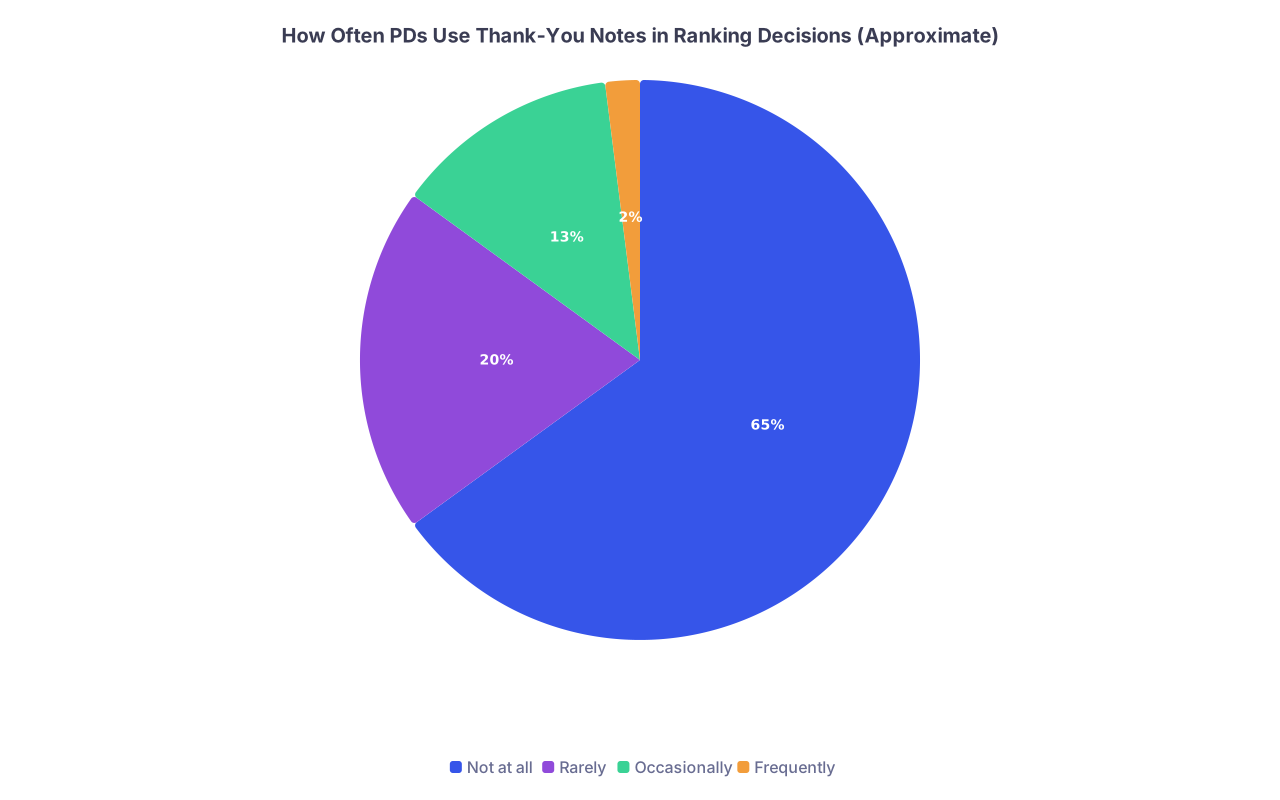
Are these exact numbers from one canonical paper? No. They’re a reasonable synthesis of published surveys, PD panel comments, and the fact that thank‑you notes are basically invisible in formal selection frameworks. The big picture is the point: most PDs don’t use them in decision‑making.
So no, there is no universal expectation that you churn out a hand‑crafted epistle for every single interviewer. Programs rarely have the bandwidth—or the interest—to micromanage your follow‑ups.
The Biggest Myth: “No Personalized Note = You Don’t Care”
This is the anxiety engine behind half the neurosis: “If I don’t send custom emails to every faculty member, they’ll assume I’m not interested and drop me.”
Let’s dismantle that.
On any given interview day, faculty see 8–16 applicants. During the season, they may do that 10–20 times. That’s ~80–300 applicants, on top of full clinical and academic work. Then the season ends and everyone sort of vaguely remembers: “The IMG who did global health,” “The med‑peds‑maybe med‑peds‑maybe IM person,” “The one who asked about the VA ICU.”
What they are not doing is sitting in January with an Excel sheet saying:
“Applicant 146: did not email Dr. X, sent generic thanks to coordinator only → drop them from the top 10.”
What faculty actually infer your interest from:
- Showing up prepared on interview day
- Asking specific, thoughtful questions
- How you talked about your career plans
- How you interacted with residents
- Whether, if needed, you later communicated genuine interest or intent in a professional way
Notice what’s not there: “degree of email customization.”
The “you must personalize every note” myth is fueled by three things:
- Applicants sharing the most extreme advice they’ve heard, not the median.
- A cottage industry of overcomplicated “match strategy” talk.
- Survivorship bias: someone did personalized notes, matched, then assumes that’s why.
I’ve seen plenty of applicants match their top program after sending zero emails. Not one. I’ve also seen people send immaculate, hyper‑tailored novel‑length messages and still land at #4 on their list. Because the program had 150 other strong applicants.
Your follow‑up can reinforce a good impression. It rarely rescues a weak one. And it does not exist in isolation.
The Real Question: What’s Smart Follow‑Up, Not Maximalist Follow‑Up?
Let’s stop asking, “What do PDs expect?” and ask the better question: “What’s the most efficient, low‑risk way to follow up that might help a little and won’t hurt me?”
That’s a different answer than “personalize every note to every person.”
Here’s the sane middle ground most PDs quietly prefer, whether they ever say it out loud or not.
1. One concise email to the PD (or PD + APD) is enough at many programs
A short, specific, non‑needy message to the PD or APD after the interview is often the best ROI. Something like:
- 3–5 sentences
- Reference one or two specific aspects of the program that resonated with you
- Reaffirm interest, but don’t lie about rank intentions
- No emotional oversharing, no attachments, no “here’s my updated Step score” unless they explicitly asked for it
It shows you’re professional and thoughtful. It lands where it matters most. It doesn’t consume your life.
Many programs are quite literally structured around the PD/APDs and the resident voices. Individual faculty interviewers may strongly advocate for someone they especially liked, but even that’s usually based on their memory of the interaction, not whether you wrote them an email.
2. Optional individual notes to select interviewers
Not all interviewers are equal in your mind. You know this. They know this.
I’d reserve personalized notes for:
- Someone you strongly connected with
- A faculty member whose niche exactly matches your interests (e.g., you’re obsessed with inflammatory bowel disease and you spent 30 minutes with the IBD director)
- A resident who clearly went to bat for you and gave you candid advice
Even then, these notes should be light and quick. Two to three sentences, tops. “Thank you, I appreciated X, I left even more excited about Y.” That’s it.
What you should not do is treat this like a wedding thank‑you card spreadsheet where you go down the list and write a forced, overlong variation to all 7 people you met, just to check the mythical “personalized” box.
3. A single note to the coordinator is polite and underrated
The unsung hero of interviews is the coordinator. PDs know exactly how much the coordinator shoulders. Some of them actually mention when applicants treat the coordinator well—or badly.
A short “thank you for organizing the day” email or reply is enough. You’re not trying to game anything. You’re just not being the person who forgets there’s a human behind the Zoom logistics.
What Actually Moves the Needle vs What Just Feels Productive
The dangerous thing about thank‑you emails is they feel like “doing something” for your rank list prospects. They’re concrete, controllable, and fall into the “work more = do better” mindset medicine trains into you.
Reality is much less satisfying. After interview day, your actual leverage is limited.

Here’s what PDs consistently say influences rank decisions after interviews, roughly descending in importance:
- Interview performance and perceived fit
- Application strength (scores, MSPE, letters, experiences)
- Resident feedback from interview day interactions
- Big red flags (unprofessional behavior, dishonesty, weird comments)
- Genuine, clear communication of strong interest or intent—from some programs’ point of view
- Everything else, including thank‑you notes
That second‑to‑last one is where things get murky. Some PDs say, “If someone tells me we’re their #1, I’m more comfortable ranking them highly because I know they’ll be happy here.” Others say, “I don’t trust any of it; I rank based on my list and let the algorithm do its thing.”
But that’s different from a generic “thank you for your time.” We’re talking about explicit interest/intent communications, which are their own mess of ethical and logistical issues.
To make this concrete:
| Action | Real Impact on Rank | Time/Stress Cost |
|---|---|---|
| Improving interview skills early in the season | High | Moderate |
| Being engaged and prepared on interview day | High | Moderate |
| Brief, honest email to PD expressing strong interest | Low–Moderate (program dependent) | Low |
| One short thank-you note to PD/APD | Low | Very Low |
| Personalized notes to every interviewer | Very Low | High |
| Long, emotional “you’re my dream program” essays | Risk of backfire | High |
The highest yield move is not obsessing over 7 slightly different thank‑you notes. It’s doing more mock interviews earlier in the season so that when you’re in front of PDs, you’re actually better. That part you can change.
Common Follow‑Up Mistakes That Actually Annoy PDs
If you’re going to worry about anything, worry about not doing these. Because these are the situations where PDs and faculty roll their eyes, and occasionally, yes, it gets mentioned in rank meetings.
The resume‑update spam
“Since we met 8 days ago, I have 2 new poster acceptances, a new job, and a new hobby. See attached updated CV.”Unless a program has told you they care about updates, this usually feels like overcompensation. It also creates extra admin work for people with zero incentive to process it.
The quasi‑binding promises
“I plan to rank you very highly.” “You’re one of my top programs.”Vague, hedged interest sounds like politics. If you’re not comfortable saying they’re truly your #1, just say you were impressed and would be thrilled to train there. Don’t try to game language you think PDs won’t see through. Many of them do.
The bad copy‑paste
I’ve seen this happen: “I especially loved hearing about your rural training sites” … sent to the urban safety‑net program with zero rural component. Or they forgot to switch program names.That does get noticed. And not positively.
The essay‑length manifesto
PDs read emails on their phones between cases or meetings. Five tight lines? Read. A wall of text about your life journey? Skimmed, if you’re lucky.The pressure email near rank deadline
“I just want to reiterate you’re my #1 and I hope I’m yours too.”They are not allowed to respond with reciprocal promises. You’re putting them in an awkward spot and making yourself look naïve about match rules.
Timing, Logistics, and How Much Is “Enough”
Let’s make this brutally simple.
- If you’re going to send any thank‑you at all, do it within 48–72 hours. After that, it’s fine but increasingly irrelevant.
- One email per program is enough for etiquette purposes. That can be to the PD, PD+APD, or PD cc’ing the coordinator. You do not need to triple‑send separate copies.
- If you had a particularly strong conversation with one or two faculty or residents, and it feels natural to follow up, do it. If you’re forcing it, skip it.
You’re not graded on an “email completeness checklist.” There is no secret PD Slack channel where they say, “Applicant A sent 6 individual messages, Applicant B only sent 2—automatic top 5 for A.”
What they do talk about is: “Who seemed normal?” “Who seemed painfully awkward?” “Who asked genuine questions instead of reading from a list?” “Who would I want on my team at 2 a.m.?”
Your emails are background radiation compared with that.
A Quick, Realistic Template You Can Adapt
Not because templates are magic, but because overthinking is where you’ll burn hours.
For the PD/APD:
Subject: Thank you – [Your Name], [Specialty] Interview on [Date]
Dear Dr. [Last Name],
Thank you for the opportunity to interview at [Program Name]. I appreciated hearing more about [specific feature—e.g., “your commitment to resident autonomy in the MICU” or “the structured mentorship for clinician–educator careers”].
The conversations I had with you and the residents reinforced that [Program Name] is a place where I could see myself growing as a [specialty] resident. I would be excited to train there.
Sincerely,
[Name], [Med School]
Two paragraphs. Doesn’t oversell. Specific enough to not look like a mass mail merge.
For a faculty/resident you really clicked with, cut it down even more:
Dear Dr. [Last Name],
Thank you for taking the time to speak with me during my interview at [Program]. I especially enjoyed our conversation about [specific thing]. It gave me a clearer picture of what training at [Program] is like, and I left even more enthusiastic about it.
Best,
[Name]
If writing that for someone feels weird or forced, skip it. Silence is not offensive.

| Step | Description |
|---|---|
| Step 1 | Interview Day |
| Step 2 | Done |
| Step 3 | 1 brief email to PD/APD |
| Step 4 | Optional 1-2 short notes |
| Step 5 | Stop here |
| Step 6 | Done |
| Step 7 | Send any follow-up? |
| Step 8 | Strong connection with specific faculty/resident? |
International Grads, Competitive Specialties, and Edge Cases
Someone’s already thinking: “Sure, but I’m an IMG applying to derm/anesthesia/ortho/whatever—do I need to do more?”
You need a stronger application and often stronger advocacy, yes. You do not need a more baroque thank‑you ritual.
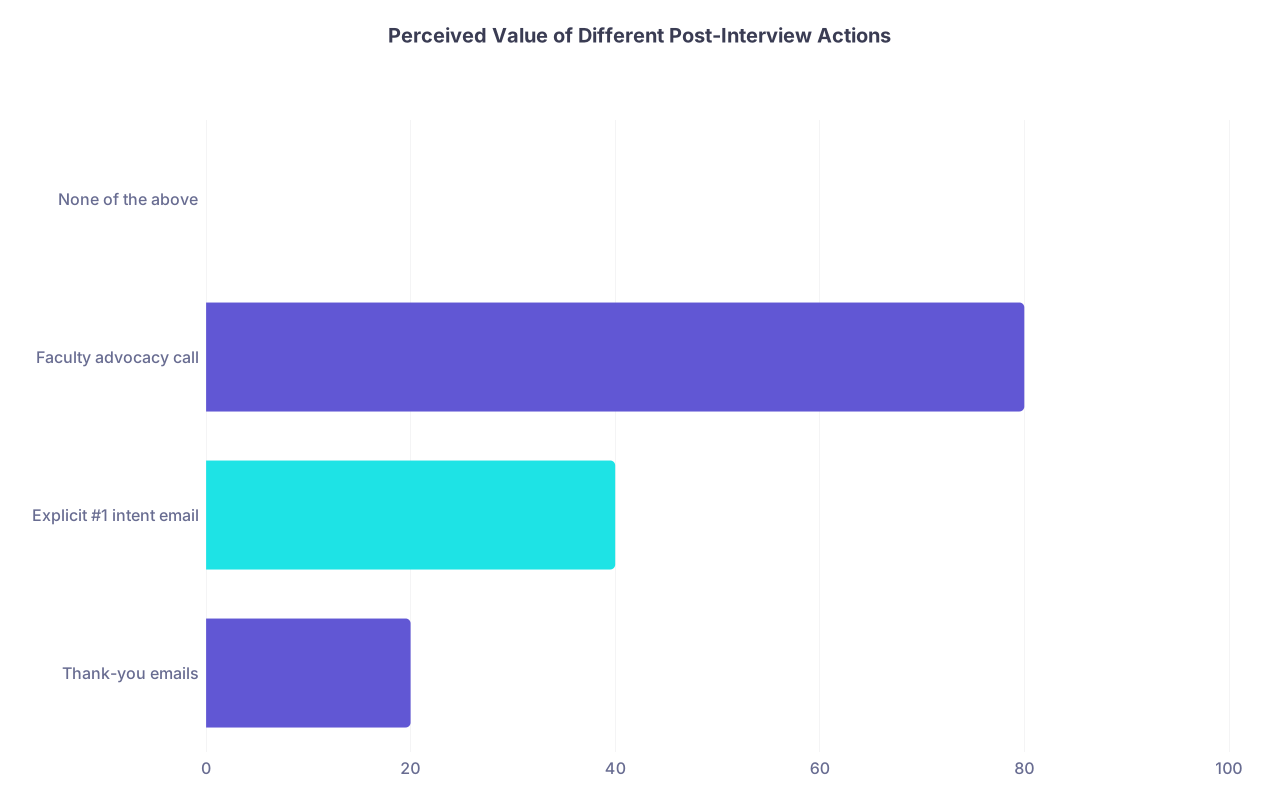
In hyper‑competitive specialties, the role of advocacy (faculty at your home school calling or emailing on your behalf) can be real. That’s not the same as you badgering every interviewer with tailored notes. Programs listen more to colleagues they know than to a flurry of student emails.
I’ve seen PDs in competitive fields say variations of:
- “A short note is polite, but I’m not ranking someone higher because they figured out how to craft a better thank‑you.”
- “I pay more attention to a call from a mentor I trust than to any email from the applicant.”
So if you’ve got excess emotional energy to spend, spend it strengthening relationships with mentors who might advocate for you when it actually matters—not tinkering with synonyms in your seventh follow‑up email of the night.
| Category | Value |
|---|---|
| Thank-you emails | 20 |
| Explicit #1 intent email | 40 |
| Faculty advocacy call | 80 |
| None of the above | 0 |
Again, these numbers are illustrative, not from a single sacred table. But if something moves the needle most, it’s often behind‑the‑scenes advocacy, not your own follow‑up fireworks.
The Bottom Line: What You Actually Need to Do
Strip away the myths, the Reddit panic, the overconfident “advice” from that one intern who definitely does not see the rank list.
Here’s the reality:
- PDs do not universally expect personalized notes to every interviewer. Many don’t track thank‑you notes at all, and even those who enjoy them rarely use them to change rank positions.
- A single, concise, genuine email to the PD or leadership after the interview is sufficient at most programs. Optional short notes to one or two people you truly connected with are fine—but not mandatory, and not a secret ranking lever.
- Your rank outcome will be driven by how you performed during the interview and the strength of your application, not by how many slightly varied “thank you for your time” messages you sent. Stop treating follow‑up emails like a second application.
Write a couple of thoughtful lines, then close the laptop. The work that mattered most already happened in the interview room.