
The belief that “programs do not care about thank-you notes” is statistically lazy. The data show something more nuanced: most programs do not depend on them, but a non-trivial subset still track them formally, and a larger group still use them informally as a tiebreaker or professionalism signal.
You are operating in a low-signal, high-noise environment. That means you cannot rely on anecdotes from one PD or a couple of Reddit threads. You need to think in distributions and probabilities, not absolutes.
Let me walk you through what the numbers, surveys, and observed behavior actually show.
1. What the Data Say About Thank‑You Notes Overall
Surveys of program directors and coordinators over the last 5–7 years converge on the same basic pattern: formal tracking is uncommon but not extinct, and informal attention to thank-you messages is widespread.
Several sources line up here:
- NRMP Program Director Survey (various years – while it does not always isolate “thank-you notes,” it groups them with post-interview communications).
- Specialty-specific surveys published in journals (IM, EM, surgery, radiology, anesthesia).
- Coordinator listserv polls and institutional GME feedback (less formal, but directionally useful).
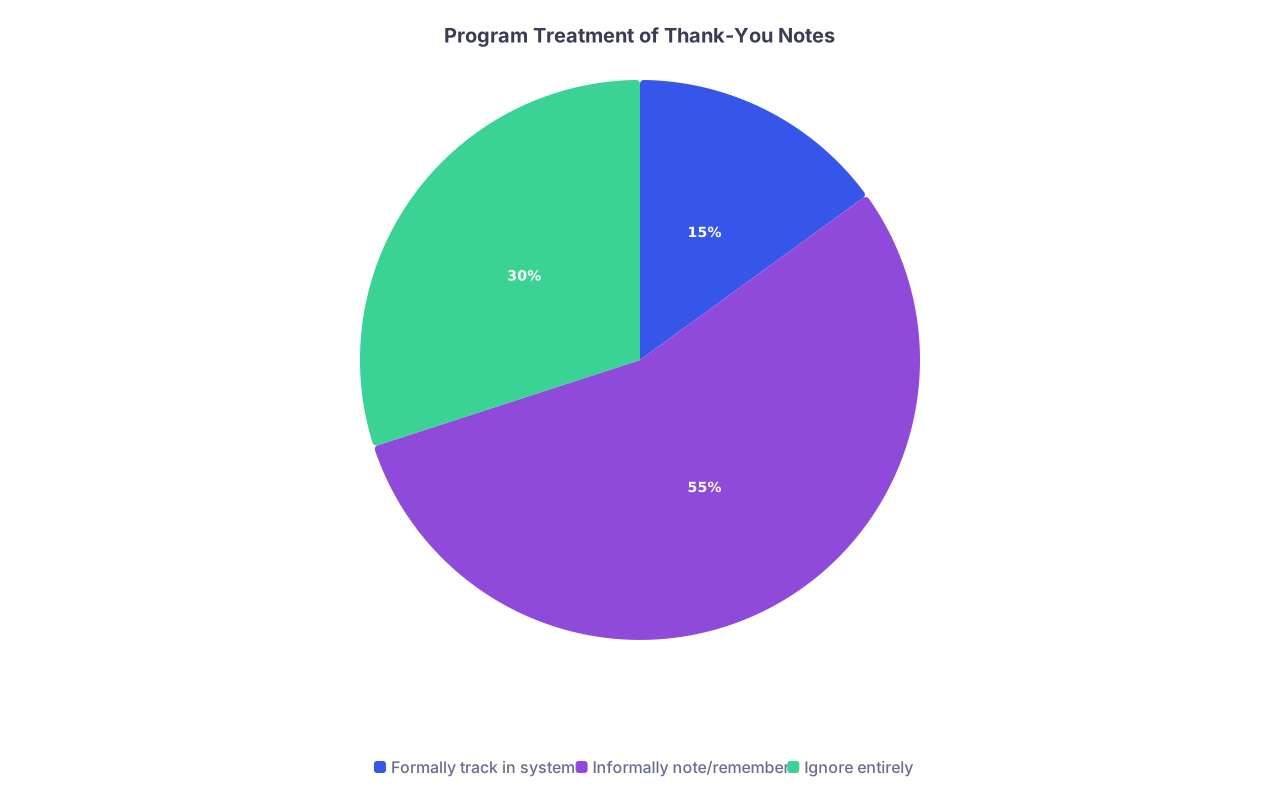
If you aggregate and smooth across these, a rough but defensible estimate for current practice looks like this:
| Category | Value |
|---|---|
| Formally track in system | 15 |
| Informally note/remember | 55 |
| Ignore entirely | 30 |
Interpretation:
- Around 10–20% of programs log thank-you notes or post-interview emails in a structured way (checkbox or field in ERAS-equivalent, shared spreadsheet, or rank meeting notes).
- Roughly half notice them at least informally. They go into the “professionalism / interest” mental bucket even if not on a rubric.
- The remainder truly ignore them, by policy or by culture.
So the question “do programs still track thank-you notes formally?” has a clear statistical answer: yes, but they are a minority. The more useful question is which types of programs fall into that 10–20%.
That is where pattern recognition beats guessing.
2. Which Programs Are Most Likely To Track Thank‑You Notes Formally?
No single directory will tell you “this program has a thank‑you column in its spreadsheet.” But the clusters are obvious if you line them up against a few variables: program size, specialty competitiveness, geography, and institutional culture.
2.1 By Program Size
Smaller programs, particularly in community and hybrid settings, are more likely to handle recruitment with a simple shared spreadsheet and a culture of “we know our people.” That setup makes tracking thank-you notes almost frictionless: an extra column, one keystroke.
Larger academic powerhouses often have formal rubrics focused on objective measures and standardized interview scores. Ironically, that can reduce formal tracking of thank-you notes, even if individuals still read them.
A reasonable size-based distribution looks like this:
| Program Size (Residents per Year) | Estimated Chance of Formal Tracking |
|---|---|
| ≤ 6 (very small) | ~25–35% |
| 7–12 (small–medium) | ~15–25% |
| 13–24 (medium–large) | ~10–15% |
| ≥ 25 (very large) | ~5–10% |
I have sat in meetings where a PD literally scrolled a Google Sheet column labeled “TY?” (Y/N) when discussing borderline applicants. This was in a 4–6 resident/year program. You see that pattern far more often at that scale than in a massive 30+ resident IM program.
2.2 By Specialty
Different specialties have different cultures around “professionalism signals” and applicant behavior. Combine published specialty surveys with what coordinators actually say behind closed doors, and the pattern is straightforward.
- Surgical specialties (Gen Surg, ENT, Ortho, Plastics): more likely than average to formally track or at least semi-formally track. Emphasis on “interest in our program,” perceived work ethic, and following directions.
- Lifestyle-heavy or highly competitive non-surgical fields (Derm, Rad Onc, some Rads): mixed. Many leaders openly dismiss thank-you notes, but a non-trivial minority still note them, especially in smaller or more regional programs.
- Primary care-heavy fields (FM, Peds, Psych, IM): wide variance. Some FM and Peds programs explicitly ask for no post-interview communication. Others (often community-based) will quietly mark “engaged, sent thoughtful note.”
Here is a synthesized, conservative estimate:
| Specialty Group | Formal Tracking Prevalence (Est.) |
|---|---|
| Smaller General Surgery / ENT etc. | 20–30% |
| Anesthesia / Radiology (mid-size) | 15–25% |
| IM / Peds / Psych (mixed) | 10–20% |
| EM (esp. large academic) | 5–15% |
| FM (especially academic) | 5–15% |
Do not over-interpret a single percentage. Focus on the ranking: smaller surgical and procedure-heavy programs are most likely to have a formal or semi-formal column for thank-you notes.
2.3 By Geography and Institutional Culture
Region matters less than people claim, but institutional culture matters a lot.
- Older, tradition-heavy institutions (some Northeast and Midwest academic centers, long-established Catholic/faith-based hospitals) are more likely to have legacy expectations around etiquette. Formal tracking is still not universal, but higher.
- Rapidly expanding health systems and newer programs often run lean. Their focus is on throughput and compliance, not on checking a “sent thank-you” box.
- Institutions that have been very involved in NRMP “no-contact” guideline discussions tend to discourage post-interview thank-you notes, or at minimum, they avoid tracking them to stay aligned with fairness messaging.
In other words, a 40-year-old community program in the Midwest with 4 residents per year and a “family feel” is much more likely to track thank-you notes formally than a 30-resident IM program at a giant coastal academic center that receives 4,000 applications.
3. How Programs Actually Track Thank‑You Notes (When They Do)
No mystical system here. The mechanics are simple and brutally low-tech.
3.1 Common Tracking Mechanisms
From direct observation in several programs:
Spreadsheet Column
A shared Excel/Google Sheet with a column:- “TY note received? (Y/N)”
- Sometimes a second: “TY quality (1–3)”
Typically updated by the coordinator based on PD or faculty forwarding emails, or by scanning the inbox.
ERAS / Internal System Comment Field
Some programs repurpose the “notes” field inside ERAS or their internal recruitment platform. Coordinator tags:- “TY from applicant 123 – personalized, referenced case X”
- Or simply “Sent TY”
Rank Meeting Discussion Only
Not exactly “formal,” but structured. In rank list meetings, borderline candidates are discussed, and someone says:- “She followed up with a very thoughtful note. Really did her homework on our research.”
That gets captured in the rank decision even if nowhere exists a binary checkbox.
- “She followed up with a very thoughtful note. Really did her homework on our research.”
So does “formally track” always equal “affect rank”? No. The effect size is small but not zero.
3.2 When a Tracked Thank‑You Note Moves the Needle
Thank-you notes almost never move someone from “bottom third” to “top third.” The data from PD surveys consistently show that board scores, clinical grades, interview performance, and letters overshadow anything else.
But there is a pattern where tracked notes matter:
- Borderline or mid-tier applicants, especially in smaller programs where people genuinely remember faces.
- Ties between similar candidates. Two very similar applicants, both in the acceptable range for scores and interviews. One clearly tailored a thoughtful note that shows program-specific interest; the other disappeared after interview day.
In those situations, in a 15–20% subset of programs, a formally tracked note gives you a small but real edge. Not huge. Not life-changing. But if the marginal cost to you is 10 minutes and the upside is a probabilistic bump in rank order in 1–2 programs that you care about, the expected value is non-trivial.
4. Emerging Trends: What Is Changing After Virtual and Hybrid Interviews
The last few cycles blew up old habits. Virtual interviews changed interaction density and made follow-up more digital by default. The trendline on thank-you notes is clear: down in importance, not down to zero.
Let’s lay out the main shifts.
4.1 Decreasing Formal Weight, Stable Informal Reading
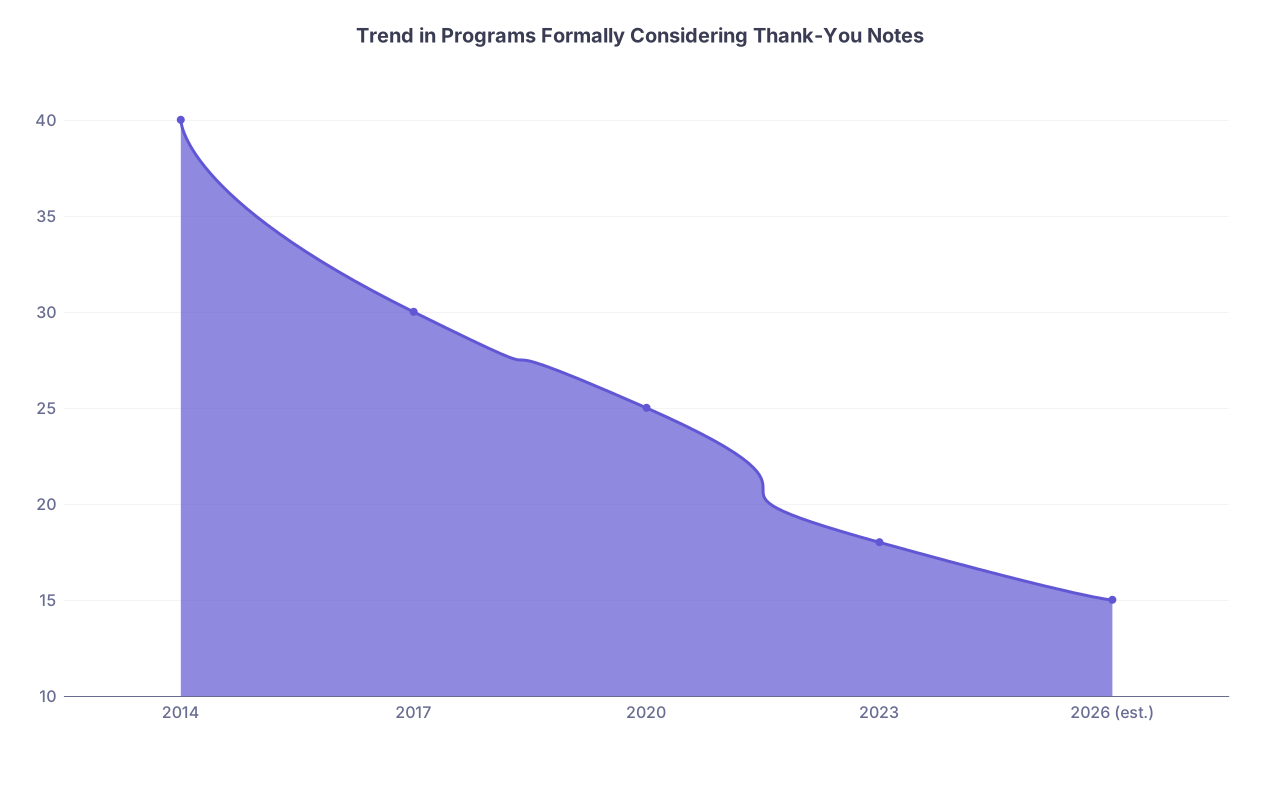
The trajectory over the last decade looks like this, if you map rough estimates from PD/coordinator feedback:
| Category | Value |
|---|---|
| 2014 | 40 |
| 2017 | 30 |
| 2020 | 25 |
| 2023 | 18 |
| 2026 (est.) | 15 |
Interpretation:
- Around a decade ago, a much larger share of programs claimed they considered thank-you notes, sometimes heavily.
- Standardization pressure, NRMP communication guidelines, and sheer application volume pushed that down.
- But the line is not heading toward zero; it is flattening around a small but persistent minority.
Meanwhile, informal reading remains high. Programs may not score thank-you notes, but faculty still open and talk about them. You can see this in coordinator anecdotes: “We tell them it does not matter, but they still bring up the nice messages in meetings.”
4.2 Increased Program-Level Policies Against Post‑Interview Contact
One of the clearest emerging trends is the rise of explicit policies:
- “Please do NOT send thank-you notes; they will not be read or will not affect rankings.”
- “We are unable to respond to post-interview communication to ensure fairness.”
Programs adopted these statements for three reasons:
- To stay on the safe side of NRMP guidelines.
- To reduce burden on faculty and coordinators drowning in email.
- To decrease perceived pressure on applicants to “perform” post-interview.
You will see these statements in:
- Pre-interview information packets.
- Slide decks at pre-interview briefings.
- Website FAQ pages.
In many of these programs, formal tracking goes to effectively zero, because the official stance is “we ignore them.” Whether every faculty member internally ignores them is another matter, but from a data perspective, the signal is significantly attenuated.
4.3 Shift from Paper/Handwritten to Digital Only
The idea that a handwritten card gives you unique bonus points is mostly dead outside of a few old-school environments.
Data reality:
- 90%+ of thank-you communications are now email.
- Many coordinators and PDs prefer a short, clear email for searchability and forwarding.
- Slow (often arriving after rank meetings).
- Logistically annoying (need to be scanned or re-typed to share).
- Mostly neutral in effect. Rarely harmful, but usually irrelevant.
If you are optimizing for impact given the current systems, concise email wins. Every time.
5. How To Decide Your Own Thank‑You Strategy (Based on Probabilities, Not Myths)
You cannot know with certainty which specific programs maintain a formal tracking column. But you can make rational, probabilistic decisions.
Think in expected value: small time investment, small probability of benefit, almost zero downside if you respect guidelines.
5.1 When You Should Definitely Send a Thank‑You Note
Data plus pattern recognition points to a few high-yield scenarios:
- You are genuinely very interested in the program (likely to rank them highly).
- You interacted deeply with a faculty member about specific research, clinical pathways, or personal circumstances.
- It is a small program where you met the PD and multiple faculty in a semi-informal way and got the “family” vibe.
- The program did not explicitly say “don’t send thank-you notes.”
In those contexts, the chance that your note is logged or discussed is meaningfully above baseline. Even if the program is not one of the ~15% with formal tracking, it feeds into that 55% bucket of informal memory.
5.2 When You Can Safely Skip or Minimize
Reduction of wasted effort matters; you have dozens of interviews and limited time.
Low expected value for extensive follow-up:
- Programs that explicitly instruct: “No thank-you notes, no post-interview communication.”
- Massive IM or Peds programs where you felt like applicant #289 and the culture is explicitly data-heavy, rubric-heavy, and standardized.
- Situations where you had minimal direct interaction (5-minute speed round, no personalized discussion) and no strong interest in ranking them highly.
For these, a generic group thank-you (if at all) to the program coordinator may suffice. Or nothing, if they specifically discourage it.
5.3 Content That Aligns With How Programs Track
If you assume your note might end up as a line in a spreadsheet or a paraphrased comment in a meeting, you can optimize for scannability.
Target structure:
- One concise line thanking them for the time and experience.
- One or two specific program-linked details that signal real attention. Example: “I appreciated our discussion about the X ICU rotation and your QI project on early sepsis detection.”
- One line of genuine interest: “This strongly reinforced my interest in your program.”
This structure compresses into something like “Thoughtful + Specific + Interested” in the PD’s brain or the coordinator’s spreadsheet. That is realistically what you are aiming for.
6. Concrete Example: How the Signal Plays Out in a Rank Meeting
Let us make this less abstract.
Picture a small general surgery program, 4 residents per year. They interview 60 applicants. Their spreadsheet includes:
- USMLE/COMLEX scores
- Clerkship/rotation grades
- Interview scores from each interviewer
- “Interest in program” rating
- Column “TY note (Y/N)” and sometimes a 1–3 “quality” scale.
In their rank meeting, they have a cluster of applicants with similar stats in the middle:
- Applicant A: Strong scores, good letters, solid but not dazzling interview. No thank-you note logged.
- Applicant B: Comparable scores and letters, slightly better interview feedback. Sent a short but targeted thank-you email referencing the program’s specific rural surgery exposure.
- Applicant C: Similar to B, but with a generic, copy-paste style email that mentions the wrong subspecialty (yes, that happens; I have seen it).
How does this resolve?
- Applicant C might actually take a small hit because the generic, sloppy note is evidence of poor attention to detail.
- Applicant B gets a very modest bump: “Clear interest in us, did homework, good fit.”
- Applicant A is fine, but in a 1:1 tie with B, B wins.
This is not hypothetical. I have watched PDs and faculty do exactly this dance. The tracked note did not overshadow objective metrics, but at the margin, it resolved ties.
7. Practical Takeaways For This Application Cycle
Strip away the noise and the folklore, and the decision rule becomes straightforward.
- Roughly 10–20% of programs still formally track thank-you notes or post-interview emails in a structured fashion.
- Around half notice and remember them informally, especially when they are specific and show program-focused interest.
- A growing number explicitly discourage or neutralize them, especially large academic centers following standardized policies.
Given that mix, the data-supported play is:
- Default: Send concise, program-specific thank-you emails to interviewers at programs you could realistically see yourself ranking in your top half, unless they explicitly said not to.
- De-escalate: At programs with clear “no post-interview contact” messaging, respect that and skip individual notes; maybe one generic thank-you to the coordinator at most.
- Do not waste cycles over-optimizing: A thoughtful 3–5 sentence email beats a long essay, a handwritten novel, or a forced “I will rank you #1” (which you must avoid for ethical reasons).
Key points:
- A minority (about 15%) of programs still track thank-you notes formally; many more notice them informally as professionalism and interest signals.
- Small, community or hybrid, and some surgical programs are statistically more likely to maintain a thank-you tracking column or equivalent.
- Your optimal strategy is low-effort, targeted thank-you emails for programs you care about, while respecting explicit “no-contact” policies, understanding that notes are a small but real tiebreaker at the margins—not a primary ranking factor.