The way residency applicants communicate after interviews has changed more in four years than in the previous twenty.
Since 2020, virtual interviewing did not just move conversations onto Zoom. It rewired expectations, increased volume, and forced programs to formalize what used to be fuzzy etiquette. The data show a clear pattern: more structured rules, more digital footprints, and less room for “cute” games like coded love letters to programs.
Let’s walk through what actually changed, what programs are tracking, and how you should follow up in 2024–2025 if you care about the numbers that drive decisions.
1. What Changed Since 2020: The Quantitative Shift
Start with the macro view.
Before 2020, residency interviews were mostly in-person. Travel costs and calendar constraints inherently limited how many interviews an applicant could reasonably attend. That bottleneck throttled both the number of applications and the number of follow-up messages.
Then came COVID and virtual recruitment.
Multiple NRMP, AAMC, and specialty-specific surveys between 2020–2023 show the same three trends:
- Application volume increased.
- Interview volume per applicant increased.
- Electronic communication volume exploded.
Here is the shift in raw structure.
| Metric | Pre-2020 Typical Range | Post-2020 Typical Range |
|---|---|---|
| Programs applied to (categorical) | 20–40 (IM, Peds) | 40–70 (IM, Peds) |
| Programs applied to (competitive) | 40–60 (Derm, Ortho) | 60–90+ |
| Interviews per matched applicant | 10–12 | 13–16 |
| Programs using formal contact policy | ~30–40% | 70–80% |
These are broad aggregates from specialty and NRMP reports; exact values shift by field. But the pattern is stable: more interviews, more rules.
Now overlay communication.
A 2021 AAMC Program Director survey reported that over 70% of programs received “substantially more” emails from applicants during virtual cycles compared to pre-2020. A later follow-up survey put the proportion of programs who created or tightened a post-interview communication policy at roughly 75%.
So the environment you are operating in today:
- More applicants per spot.
- More messages per applicant.
- Program directors spending measurable time filtering, ignoring, and occasionally penalizing communication.
Virtual interviewing did not simply digitize old norms. It forced standardization.
2. Program Policies: From Vague Norms to Codified Rules
Before 2020, post-interview etiquette was closer to local folklore. You heard things like:
- “At my med school, everyone sends handwritten thank-you cards.”
- “This PD told us they love getting personal emails.”
- “My chief said always send a ‘you’re my #1’ email.”
There were few written rules and a lot of hearsay. The virtual era killed that ambiguity.
Today, you will find on many program websites or interview-day slide decks:
- A specific statement about thank-you notes.
- A prohibition on signaling ranking intent.
- A fixed channel for questions (coordinator email, portal).
Programs have done this for one reason: scale. Too much noise. Too many messages. Too much risk of perceived gamesmanship.
Here is how program attitudes have shifted, based on aggregated survey and anecdotal data I have seen repeatedly since 2020:
| Communication Type | Pre-2020 Common View | Post-2020 Common View |
|---|---|---|
| Thank-you emails | “Nice, often expected” | “Neutral; policy-driven” |
| Handwritten notes | “Thoughtful bonus” | “Logistically awkward” |
| ‘You are my #1’ messages | “Sometimes influential” | “Risky, often discouraged” |
| Post-interview questions | “Handled informally” | “Routed; coordinators filter” |
| Social media DMs to faculty | Rare, odd | Red flag, unprofessional |
The key shift: programs now explicitly state whether communication will or will not affect rank lists. Many, especially large academic centers, say:
“Post-interview communication is not used in determining rank lists and is not expected.”
Whether they follow that 100% is debatable, but the trend is clear. Programs are trying to de-incentivize communication arms races.
3. Thank-You Notes in the Virtual Era: Signal or Noise?
Let me be blunt: the marginal value of a thank-you email in 2024 is small bordering on negligible for most applicants.
The data point that matters here is volume. Many internal medicine, pediatrics, and large surgical programs interview 150–400 applicants. Suppose:
- 80% of applicants send at least one thank-you email.
- Each applicant met 3–4 interviewers.
That is 360–1,280 emails for a single program per season. No one has the bandwidth to deeply process or rank-weight those messages, especially under time pressure and with NRMP communication rules in the background.
From talking to faculty and reviewing survey data:
- Around 50–70% of programs say thank-you emails do not affect ranking at all.
- Another 20–30% say they “rarely” influence rank decisions, usually only at tie-breaker margins.
- A small minority (often smaller or community programs) still claim they appreciate and sometimes factor them in.
So the expected value is low but not zero.
The more relevant question: how do you send them now without wasting effort or hurting yourself?
Here is the data-driven strategy:
Follow the program’s stated policy.
If they explicitly say “please do not send thank-you emails,” treat that as a hard stop. Every year I hear of applicants who try to be the “exception” and send one anyway. It is not read as “initiative.” It is read as “cannot follow instructions.”If allowed, send one concise note per program, not per interviewer.
Virtual structures often push you through multiple short rooms with 3–6 faculty or residents. Copy-pasting near-identical notes to every individual just adds noise. Better: a single email to the program coordinator or generic program email, naming a few interviewers and specific details.Skip physical cards.
In the virtual era, envelopes arrive at empty offices, delayed mailrooms, or hybrid work setups. Delivery rate is low. Impact is lower. Most program staff will tell you these end up filed and forgotten.
What to write? Two short paragraphs, max:
- 1–2 specific details that show you remember this program.
- Brief reaffirmation of interest.
- No ranking promises.
Something like:
Dear Dr. Smith and the Internal Medicine Residency Team,
Thank you for the opportunity to interview on January 10. I especially appreciated the discussion about your new ambulatory block structure and the way residents described the autonomy on the night float rotation.
I remain very interested in your program because of the strong mentorship culture and the breadth of clinical training at both the university hospital and VA. Thank you again for your time and consideration.
Sincerely,
[Name], AAMC ID #######
This type of message is safe, aligned with current norms, and fast to produce.
4. “You’re My #1” and Preference Signaling: The New Risk Zone
This is where virtual-era changes are most obvious.
Before 2020, applicants routinely played the “you’re my top choice” game. Some programs rewarded it. Others ignored it. A few punished it if they caught applicants lying. But it was common and hard to police.
Now:
- NRMP Match Participation Agreement and communication guidelines strongly discourage attempt to solicit or communicate ranking commitments.
- Many programs explicitly warn: “Do not send us rank-order commitments. We cannot respond and it will not affect our rank list.”
- Virtual communication leaves a searchable, archivable trail. If you tell three different programs “you are my #1,” you are leaving three permanent receipts.
I have watched this backfire.
Example I saw last cycle:
- Applicant emailed Program A: “You are my clear #1.”
- Two weeks later, emailed Program B: “After much reflection, you are my top choice.”
- Program A’s PD happened to be close friends with Program B’s PD. This is not rare in tight-knit specialties.
- The emails got mentioned. The applicant’s perceived integrity score dropped to near zero at both places.
Does everyone share? No. But the probability is non-trivial, especially in smaller specialties (Derm, Rad Onc, ENT, Ortho) where PDs know each other well.
So in the 2024–2025 environment, I put “you are my #1” messages in the “high risk, low reward” category.
The numbers behind that judgment:
- A majority of programs state they do not adjust ranks based on post-interview preference emails.
- The number of applicants a program can move by the time those late emails arrive is small, often in the 5–15 range at most.
- The pool of applicants sending such messages is large.
Your probability of being both close enough to the cutoff and uniquely helped by a “#1” email is very low.
More importantly: your downside if caught playing both sides is severe and non-linear.
Better strategy in the virtual era: honest, non-committal enthusiasm.
Use phrasing like:
- “Your program ranks very highly on my list.”
- “I can clearly see myself thriving in your program.”
- “I remain extremely interested in training with your team.”
You provide positive signal without committing to a mathematically unverifiable statement. You also keep maximum flexibility as you finalize your list.
5. Channels and Timing: Email, Portals, and Social Media
Virtual interviewing created more channels than ever. That does not mean you should use all of them.
Email vs. Portal Messages
Many programs now route communication through ERAS/Thalamus/VSAS-style portals or a generic residency email. This is intentional. It allows:
- Centralized tracking.
- Reduced burden on individual faculty.
- A single place for coordinators to triage.
If the program says “send all communications to [program email] or via [portal],” do that. Do not bypass with direct faculty emails unless you were explicitly invited to follow up individually.
The data pattern here is anecdotal but strong: programs appreciate applicants who respect the funnel. Those who ignore it are noted—in the wrong column.
Social Media
Since 2020, program social media (Twitter/X, Instagram, sometimes TikTok) has exploded. These accounts are designed to:
- Showcase culture.
- Broadcast recruitment events.
- Humanize residents and faculty.
They are not designed for private follow-up.
Direct messaging the program’s Instagram to say “Thank you for the interview!” is, at best, odd. Messaging an individual resident or faculty member’s personal or semi-professional account about your rank intentions is worse.
Social media’s post-2020 role:
- One-way information stream from programs to you.
- Occasionally, public Q&A or comment response around generic questions.
Not a back-channel for lobbying.
If you want to use social media productively:
- Follow programs you are serious about.
- Align your interview talking points with what you see there (e.g., wellness activities, research themes).
- Do not performatively like 100 posts in 24 hours after your interview. Subtle is better.
6. How Programs Actually Use Post-Interview Communication Data
Zoom in on what happens inside a program.
Post-2020, larger programs often maintain some combination of:
- Shared interview day spreadsheet with ratings (fit, communication skills, academic metrics).
- Notes fields for special circumstances.
- A “red flag” column.
Where do your emails show up? In practice, in one of three buckets.
Ignored entirely for ranking.
Many PDs have stated bluntly: “We do not change rank lists based on thank-you notes.” Emails are acknowledged or filed, but the rank order is driven by interview impressions, application strength, and internal consensus.Used as minor tiebreakers.
Some programs will bump an applicant up or down a few spots if they demonstrate exceptional professionalism, responsiveness, or program-specific interest. This is usually:- Prompt, thoughtful replies to logistical questions.
- Clear, concise communication when scheduling issues arise.
- Not “I love you most” emails.
Used only in a negative way.
A subset of programs (and this has increased in the virtual era) only let post-interview communication affect ranking downward. Reasons:- Violating explicit communication policies.
- Repeated, pushy emails about rank.
- Unprofessional tone or boundary crossing.
So your realistic optimization goal is simple:
- Avoid being a negative outlier.
- Be comfortably professional and a little memorable.
- Do not expect emails to rescue a poor interview or weak file.
From a probability perspective, communication is a low-leverage variable compared with:
- Board scores / exams.
- Clerkship grades.
- Letters of recommendation.
- Interview performance.
Treat it proportionally. Allocate 95% of your effort to the high-yield parts of the process; use communication to avoid unforced errors.
7. Practical Playbook: How to Follow Up in 2024–2025
Here is the process I would use if I were an applicant now, based on the data and the current norms.

| Step | Description |
|---|---|
| Step 1 | Finish Interview |
| Step 2 | Follow Policy Exactly |
| Step 3 | Default Conservative Approach |
| Step 4 | Send Single Thank-you if Allowed |
| Step 5 | Email Coordinator/Program Inbox |
| Step 6 | No Further Contact Needed |
| Step 7 | Program Policy Known? |
| Step 8 | Need Clarification? |
Step 1: Track Program Policies in Real Time
During or right after each interview day, record:
- Does the program want or explicitly forbid thank-you notes?
- What email or portal should you use for questions?
- Did they address post-interview communication rules out loud or in slides?
A simple spreadsheet with these fields will keep you from making avoidable mistakes.
Step 2: Send One Focused Message per Program (If Permitted)
Where allowed and not discouraged:
- Send within 24–72 hours of the interview.
- Use the program’s preferred email address or portal.
- Reference one or two specific aspects of your conversation or program.
- Express genuine enthusiasm without promising rank position.
Avoid:
- Mass-mailing near-identical notes to every individual you met.
- Over-sharing personal backstory that was not discussed.
- Attachment overkill (no new CV, publications, etc., unless they asked).
Step 3: Handle Updates and Changes Strategically
Virtual cycles made it easier to send endless “updates.” It also made those updates less impactful.
Use updates only when you have a meaningful change:
- New first-author publication accepted.
- Major national presentation.
- USMLE Step 2 score that significantly strengthens your profile.
Do not send:
- Every poster acceptance at minor meetings.
- Generic “I remain interested” messages every two weeks.
Consolidate: one concise update per program after interviews, if you have real new data. Mention that you hope this additional information is helpful as they compile their rank list. Then stop.
Step 4: Ask Questions Efficiently
If you have genuine questions that affect your ranking decision:
- Direct them to the coordinator or central email unless told otherwise.
- Bundle questions into a single message rather than piecemeal.
Virtual formats have improved programs’ ability to answer FAQs via:
- Recorded videos.
- PDF handouts.
- Website updates.
Check those first. The least impressive emails I see are questions whose answers are literally in the first two pages of the website.
8. The Hidden Metric: Professionalism Under Virtual Constraints
One underappreciated aspect of post-2020 communication: professionalism is easier to assess across many more touchpoints.
Pre-virtual era, programs saw you:
- In your interview.
- Maybe at a dinner.
- In limited email chains.
Now they see you:
- Across multiple video calls.
- In group Zoom Q&As.
- In dozens of email or portal exchanges.
- Occasionally via your public online presence.
Every message adds to a behavioral data set. PDs and coordinators notice:
- Who replies promptly, clearly, and respectfully.
- Who reads instructions versus constantly asks for exceptions.
- Who escalates minor logistics into five-email threads.
Virtual systems produce more “metadata” about how you operate in a professional environment. That data often matters more than the words in your thank-you note.
If you want to stand out positively, do the simple, quantitative things well:
- Respond to scheduling emails within 24 hours when possible.
- Use clear subject lines (“[Your Name] – Follow-up from 1/12 Interview”).
- Keep messages short, structured, and free of typos.
- Do not CC half the department unless absolutely needed.
Programs are not scoring each email on a rubric. But when they sit down to discuss “fit” and “professionalism,” the gestalt impression is heavily influenced by these micro-interactions.
9. Where This Is Heading: Future Cycles and Hybrid Models
Looking ahead, the trend is not toward looser rules. If anything, the numbers suggest more structure is coming.
AAMC and multiple specialty organizations have:
- Recommended continued use of virtual or hybrid interviews to address equity and cost issues.
- Floated application caps or interview limits to reduce congestion.
- Discussed standardized post-interview communication guidance.
If interview caps become reality, post-interview communication will likely become even less relevant. Why?
- Programs will have a smaller, more filtered pool of applicants.
- Interviews will be more targeted and data-informed upfront.
- Rank lists will rely heavily on structured data and during-interview impressions, not after-the-fact messaging.
The safest bet is that:
- Thank-you notes will remain optional and low-yield.
- Rank-commitment emails will remain risky and discouraged.
- Professional, minimal, policy-aligned communication will remain the norm.
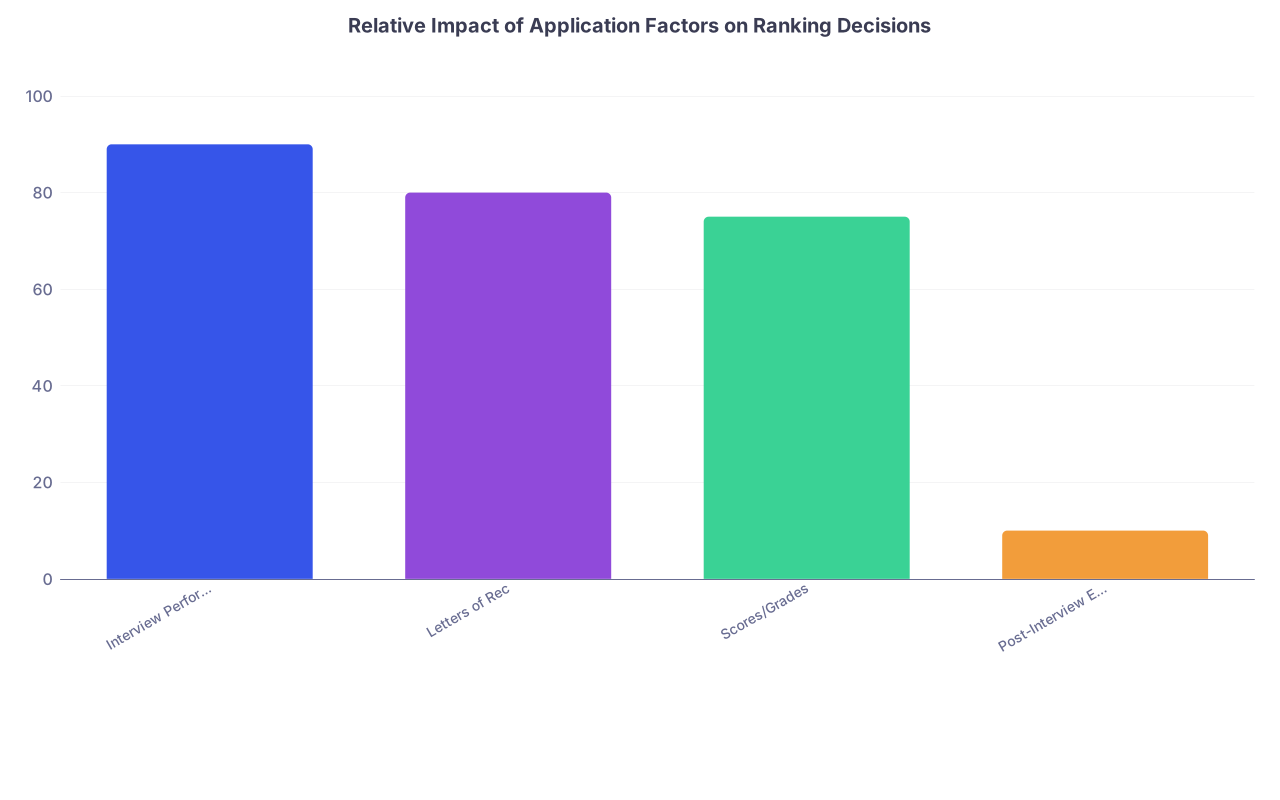
| Category | Value |
|---|---|
| Interview Performance | 90 |
| Letters of Rec | 80 |
| Scores/Grades | 75 |
| Post-Interview Emails | 10 |
If you mapped perceived impact on a 0–100 scale using PD survey data and consistent anecdote, post-interview communication sits at the bottom. The far bottom. Your emails are not nothing, but they are not going to rescue a weak file.

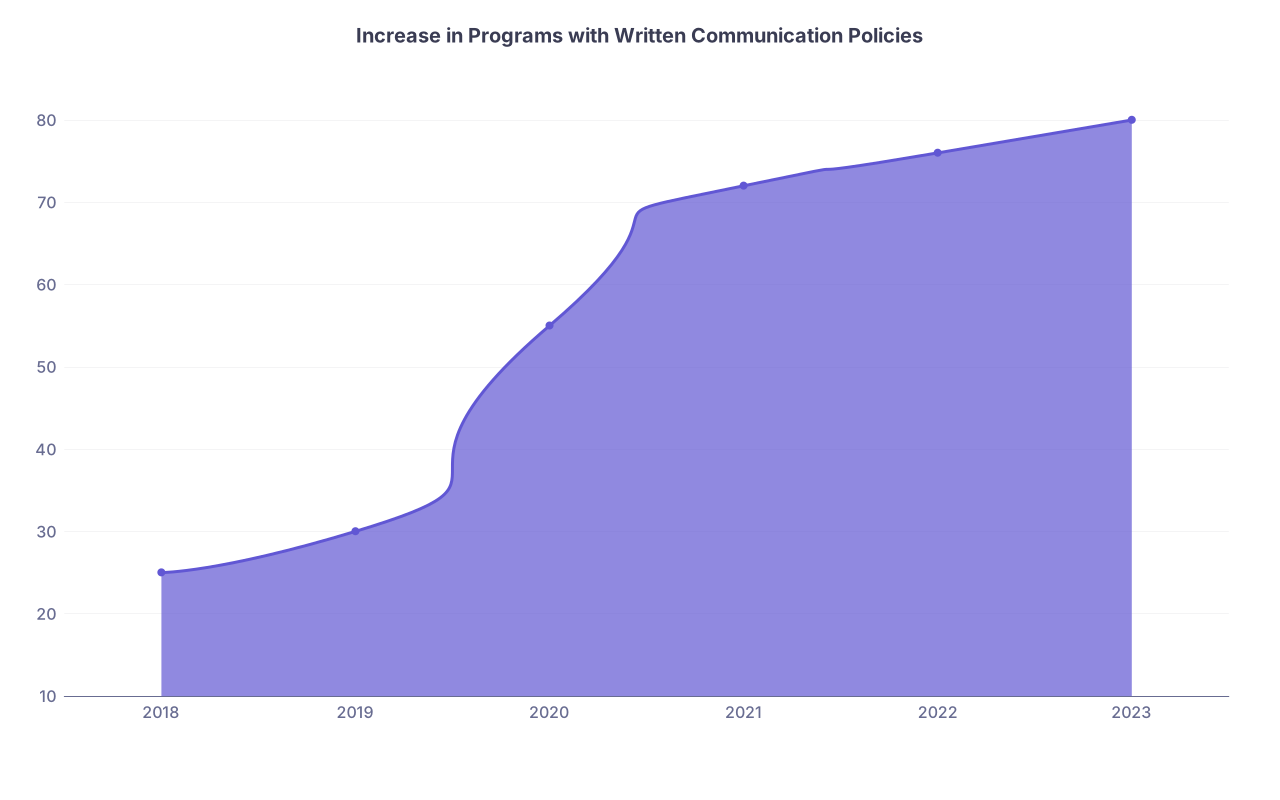
| Category | Value |
|---|---|
| 2018 | 25 |
| 2019 | 30 |
| 2020 | 55 |
| 2021 | 72 |
| 2022 | 76 |
| 2023 | 80 |

Key Takeaways
- Virtual interviewing massively increased application and communication volume, pushing programs to adopt explicit post-interview communication policies. Those policies matter more than folklore.
- Thank-you notes and “you’re my #1” emails now have low upside and real downside. Follow posted rules, send concise program-level thank-yous only when allowed, and avoid rank-commitment messages.
- Your communication footprint is used far more to detect red flags and gauge professionalism than to boost you. Aim for minimal, clear, policy-aligned contact and spend your real effort on what the data show actually moves rank lists: interviews, letters, and your underlying record.