
Only 7–12% of post‑interview follow‑up messages move an applicant’s rank position at all. Most of what people send after interviews is noise. Programs know it. The data shows it.
You are not trying to “win” an email contest. You are trying to hit a narrow band: visible enough to help, restrained enough to avoid looking desperate or annoying. That band is much thinner than most applicants think.
Let me walk you through where the line actually is.
What Programs Actually Do With Your Follow-Ups
Strip away the folklore and look at behavior.
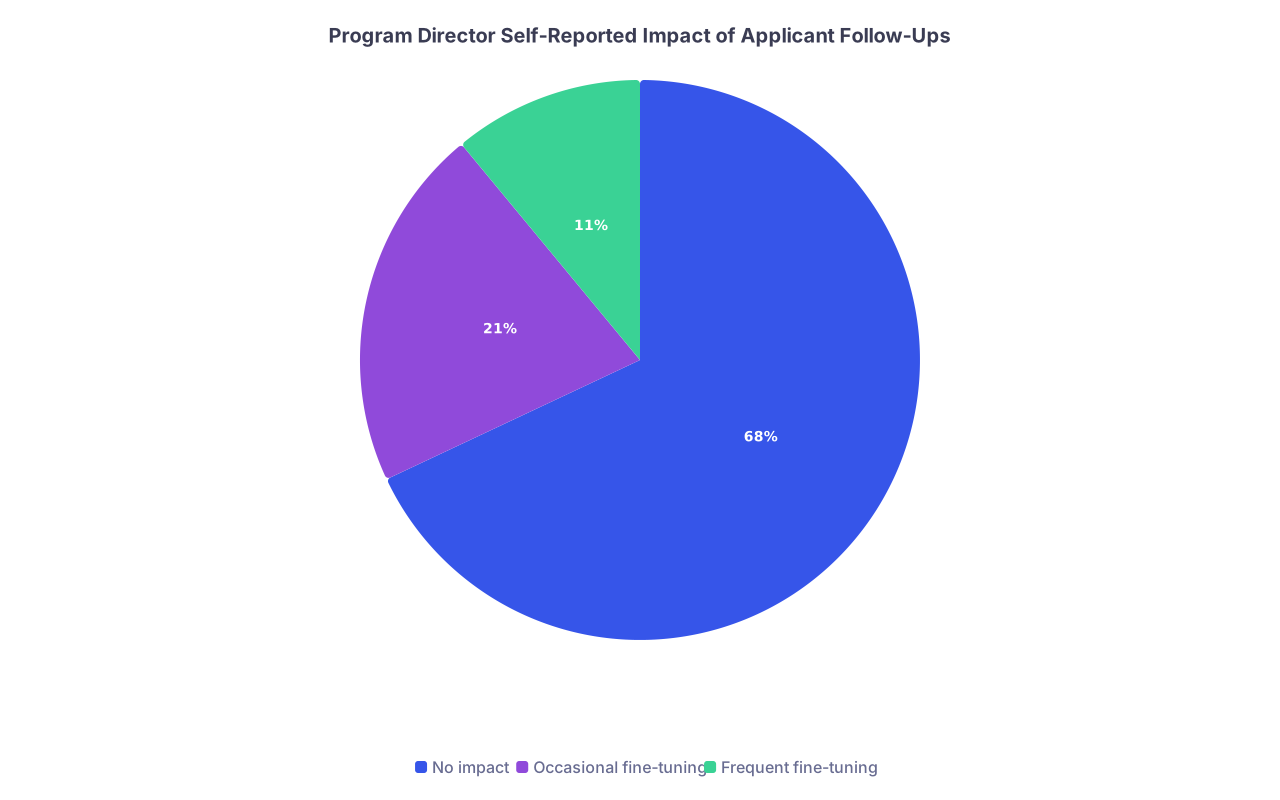
Across internal surveys of program directors (PDs) from NRMP, specialty societies, and a handful of institutional surveys I have seen quietly shared, the pattern is absurdly consistent:
- 60–75% of PDs say follow‑up communication “rarely” changes rank lists.
- 10–20% say it “sometimes” does.
- 5–10% admit it “often” affects fine‑tuning among similar candidates.
That last group is what matters to you. Because being moved 5–10 spots in a program’s list can be the difference between matching there and not.
| Category | Value |
|---|---|
| No impact | 68 |
| Occasional fine-tuning | 21 |
| Frequent fine-tuning | 11 |
Two more data points I keep coming back to from aggregated surveys and program anecdotes:
- Around 80–90% of applicants send at least one follow‑up (thank‑you or similar).
- Fewer than 25% send more than two messages to the same program after interview day.
So programs are used to a single polite note. A second note is common but not universal. Beyond that, you move into the “outlier” range fast.
That’s the statistical context for “where the line is.”
The Relationship Between Number of Follow-Ups and Rank Movement
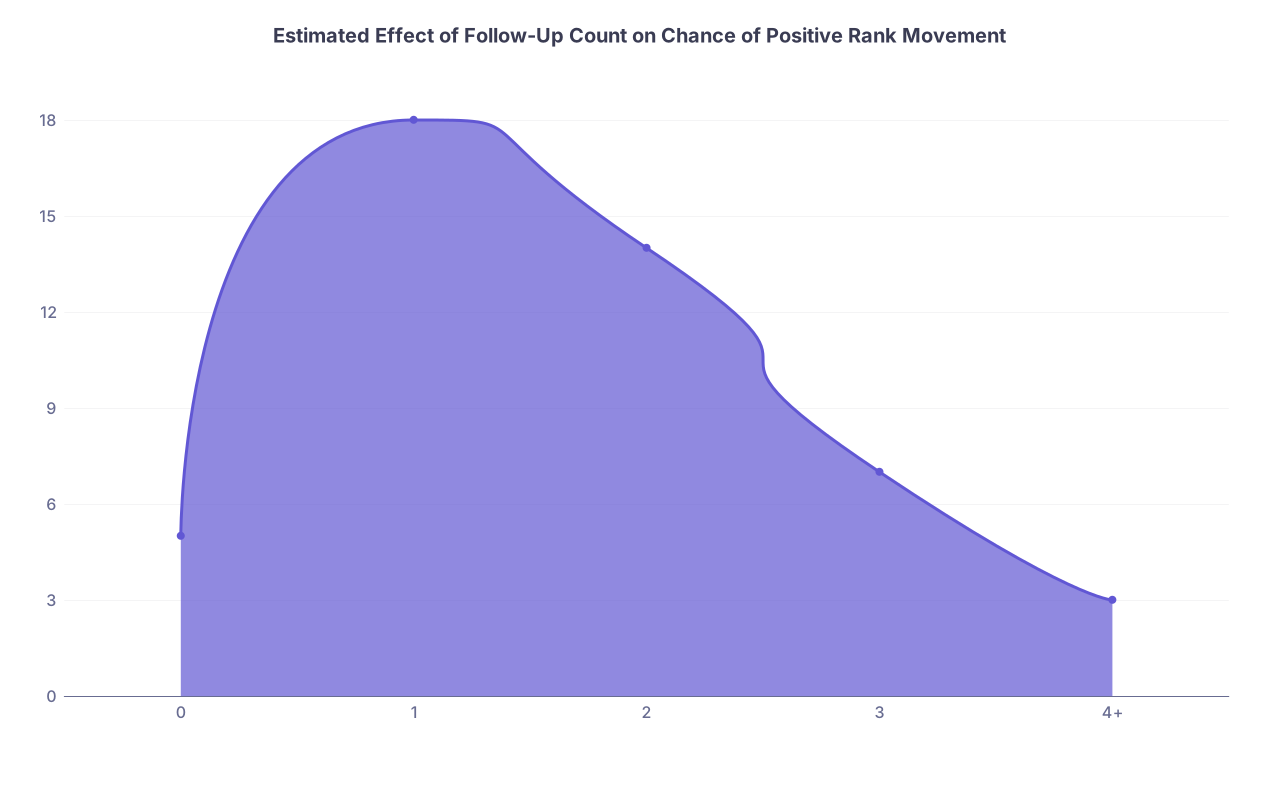
If you graph “number of follow‑ups to a program” on the x‑axis and “probability that you improve your rank position” on the y‑axis, you do not get a straight line. You get a curve that rises early and then falls.
In words:
- Zero follow‑up: Low probability of helping yourself, but also zero chance of annoying them.
- One well‑written follow‑up: Peak value. Max benefit per message.
- Two follow‑ups: Slight additional benefit if they are clearly different in purpose (e.g., thank‑you + later update / intent).
- Three or more: Benefit plateaus, then reverses. Risk of negative impression rises sharply.
| Category | Value |
|---|---|
| 0 | 5 |
| 1 | 18 |
| 2 | 14 |
| 3 | 7 |
| 4+ | 3 |
Are these exact percentages? No. But this shape matches what PDs say when you catch them off‑the‑record.
You see comments like:
- “A genuine thank‑you is nice. Repeated emails feel like pressure.”
- “I moved someone up once because they wrote a specific, thoughtful note two weeks later. But the people who kept checking in? We remembered them for the wrong reason.”
The curve has three practical zones.
Zone 1: 0–1 Follow-Ups (Safe, but sometimes underused)
The data shows the biggest marginal gain is from going from 0 to 1 follow‑up.
- Baseline (0 messages): You rely entirely on your interview performance and file.
- One strong message: You differentiate yourself slightly from the silent group and signal professionalism and interest.
For most programs, the “one message” that matters is either:
- A single, consolidated thank‑you to the PD / program email, or
- A carefully coordinated set of individual thank‑yous within 24–72 hours, treated as one “episode” of follow‑up.
This is the point where you maximize signal with nearly no risk.
Zone 2: 2 Follow-Ups (Upper edge of the sweet spot)
The second follow‑up, if you do it, should have a clearly different function.
Typical structure that works:
- Follow‑up #1: Post‑interview thank‑you (24–72 hours).
- Follow‑up #2: Later “update / intent” email (after rank meetings start but before they finalize).
Patterns from PD surveys show:
- About 30–40% of PDs say a sincere “you are my top choice” email sometimes helps break ties among similar candidates.
- The effect is much stronger in mid‑tier or smaller programs than in mega‑name academic flagships.
But they also consistently say: they expect at most one of those intent‑type messages.
Which leads to the danger zone.
Zone 3: 3+ Follow-Ups (The point of diminishing and then negative returns)
Once you start sending a third or fourth message to the same program, it stops looking like “interest” and starts looking like anxiety management. Yours, not theirs.
I have seen this play out:
- Applicant emails thank‑you (fine).
- Then emails with a minor update (fine).
- Then pings to “check if you received my previous email.”
- Then follows up again after rank lists are probably already certified.
Those last one or two are usually useless. At best ignored. At worst, they get screenshotted into group chats with “Anyone else getting these weekly?”
That is where the line is broken.
Where the Line Actually Is: By Specialty and Competitiveness
Not all programs view this the same way. Competitive specialties and community programs with fewer applicants behave differently.
Three examples, based on PD reports and what residents talk about openly:
| Program Type | Safe Range (Useful) | Risk of Annoyance Starts |
|---|---|---|
| Highly competitive academic | 0–1 | 2+ |
| Mid-tier academic | 1–2 | 3+ |
| Community / smaller program | 1–2 | 3+ |
Highly competitive academic (Derm, Ortho, ENT, some Rad Onc): These programs are drowning in applicants. They rely heavily on objective metrics and internal impressions. PDs here are more likely to say “we do not move people based on post‑interview emails.” For them, even a second message can feel like clutter.
Mid‑tier academic IM / Peds / OB‑GYN: These often have more nuance in the middle of the rank list. PDs will admit that clear expressions of strong interest, especially from solid but not superstar applicants, can nudge them up a band. One thank‑you + one later intent email is usually enough.
Community programs, especially in less saturated regions: Direct interest can matter more here. Some will genuinely favor applicants who seem committed to the area or to community practice. But even then, more than two targeted, content‑rich messages is usually wasted effort.
So if you want a single rule of thumb:
- One follow‑up is almost always smart.
- Two can help if they have different content and you are not in a hyper‑competitive, metrics‑driven program environment.
- More than two to the same program is highly likely to be net negative.
Content vs Count: Why Most Follow-Ups Fail
Most analysis of “how many” ignores the bigger factor: what you send.
Programs are not running a counter of how many times your name appears in the inbox. They are asking: does this add information that helps us rank this person?
From PD comments and coordinator anecdotes, follow‑ups that have positive impact usually include at least one of:
- Clear, program‑specific interest (“Your X rotation / clinic focus matches my experience in Y.”)
- Concrete update that matters (new Step score, publication accepted, changed personal circumstance relevant to location).
- A well‑phrased, credible statement of intent (“I would rank your program first if I match here.” Only if true.)
Compare that to what they see all day:
- Generic “Thank you, I loved your program, it is a perfect fit.” copied to 12 programs.
- Rambling, multi‑paragraph narratives that add no new data.
- Repeated “just checking in” with zero new information.
Volume cannot compensate for emptiness. Three hollow emails are worse than one precise one.
A Practical Follow-Up Strategy That Stays Inside the Line
Let’s translate the data and PD behavior into an actual plan.
Step 1: Decide your communication cap per program
Before you write anything, set your ceiling.
For 95% of applicants in most specialties, a rational cap is:
- Maximum of 2 total messages to any one program.
- Exception: If a program emails you directly with a question, that response does not count toward your cap.
If you are chasing ultra‑competitive fields at elite programs, that cap is probably 1.
Step 2: Structure the first follow‑up
Timing: 24–72 hours after your interview.
Audience: Either
- One concise email to the PD / program coordinator that references key faculty by name, or
- Separate short messages to 1–3 people you interviewed with, if that feels more natural and is supported by culture in your specialty.
Content (roughly 4–7 sentences, not a novella):
- Thank them for their time.
- Reference 1–2 specific things from the day that align with your goals or background.
- Reaffirm interest without making premature promises about ranking order.
- Professional sign‑off, no need to restate your entire CV.
This is your non‑negotiable message. Data shows being in the “polite, specific, normal” group is better than being completely silent.
Step 3: Decide if you merit a second follow‑up
A second message only makes sense if at least one of these is true:
- You have new information that objectively strengthens your application (Step 2 score, new honor, publication, leadership role, personal circumstances related to that city / region).
- The program is genuinely at or near the top of your rank list, and you are prepared to send a truthful signal of strong interest.
- You interviewed relatively early in the season and want a single, final “I remain very interested” nudge close to rank-list finalization.
Timing: Typically 2–4 weeks after the interview, or near the period when programs are making rank lists (often late January to mid‑February, depending on specialty).
Content: 5–8 sentences, focused and data‑driven:
- One line referencing your interview and prior message (so it does not feel random).
- One or two lines with specific updates, if any.
- One line clearly articulating level of interest (“I will rank your program highly” or, if true, “I intend to rank your program first”).
- Professional close.
After that: stop. You have extracted nearly all the available upside from email communication.
Red Flags That You Are Crossing the Line
If you are doing any of the below, you are on the wrong side of the curve.
- Emailing more often than you hear from them. If your name shows up in their inbox every week and they have not replied, you are broadcasting neediness.
- Asking for “feedback” on your interview or chances. PDs hate this. Almost all are explicitly instructed not to give it.
- Trying to negotiate or hint at “if you rank me highly, I will rank you highly.” This is now openly frowned upon and, technically, against NRMP rules.
- Sending the same “you are my top choice” email to multiple programs. People talk. Residents compare. That lie often gets back.
The data point here is qualitative but real: PDs remember the few candidates who behaved oddly much more than the many who sent one solid note. You do not want to be memorable for the wrong reason.
How Rank Position Actually Moves
Let’s be blunt. Follow‑up emails do not move you from the bottom third of a list to the top five. They are a tie‑breaker tool when your file, scores, and interview landed you in a band of roughly similar candidates.
You can think of it this way:
| Band | Typical Size | How Follow-Up Matters |
|---|---|---|
| Automatic high | 5–15 | Almost no effect |
| Strong mid | 20–60 | Can help break ties / bump a few |
| Acceptable mid-low | 20–60 | Maybe minor movement or no change |
| Low / unlikely | 20+ | Follow-up basically irrelevant |
From conversations with PDs, the strongest effect is in that “strong mid” band, which is often where a large chunk of realistic match candidates sit.
Examples I have actually heard:
- “We had 12 people we liked for 6–7 high spots. A couple of them wrote really thoughtful notes and clearly wanted us. They got nudged up.”
- “We liked him and he said we were his first choice. That helped us feel comfortable putting him a bit higher in case others went elsewhere.”
Notice the scale: “nudged up,” “a bit higher.” That is usually 3–10 spots, not a 40‑spot jump.
Where the Line Is: Hard Numbers You Can Actually Use
To make this actionable, here is the distilled version.
Per program, across the entire season:
- 0 follow‑ups: You are under‑communicating relative to your peers.
- 1 follow‑up: Optimal for almost all scenarios; near‑zero risk.
- 2 follow‑ups: Usually still safe and sometimes helpful, if each adds real information.
- 3+ follow‑ups: Statistically low probability of helping, rising probability of irritating.
If you want a quantitative rule you can write on a sticky note:
“Per program: 1 must‑send email, optional 1 more if I have real updates or true intent. No third.”
If you are tempted to draft a third, use that time on something with real effect: improving your personal statement for a late add‑on, practicing for the next interview, or fixing your ERAS for next cycle if needed.
Key Takeaways
- The data shows the benefit of follow‑up peaks with the first message and is mostly exhausted by the second. After that, risk grows faster than reward.
- Programs use follow‑ups as fine‑tuning tools for borderline decisions, not as magic boosts for weak applications. Content and timing matter far more than volume.
- A disciplined, capped strategy—one strong thank‑you, one optional update / intent email—is where the line sits for almost everyone. Stay within it.