
You are walking out of a residency interview day. Suit slightly wrinkled, brain fried, fake smile muscles exhausted. On the way to the parking lot, one moment keeps replaying in your head on a brutal loop:
- You blanked on a clinical question you should have nailed.
- You overshared a weird personal detail.
- You rambled. Or interrupted. Or made a joke that landed like a brick.
Now you are sitting at your laptop, staring at a blank follow-up email, thinking: “Do I ignore it? Apologize? Explain? Did I just tank my chances?”
Here is the truth: that awkward moment is not automatically fatal. I have seen applicants recover from worse. What separates the ones who salvage their impression from the ones who quietly disappear is how they handle the follow-up.
This is about turning that moment into evidence of your maturity, self-awareness, and composure under stress.
Let us fix this properly.
Step 1: Diagnose What Actually Went Wrong (Not What You Are Catastrophizing)
Before you write a single word of follow-up, you need a clean, unemotional read of what actually happened.
Most applicants do one of two dumb things:
- Pretend nothing happened and hope it vanishes.
- Over-apologize and make the issue bigger than it was.
You are going to do neither.
A. Categorize the awkward moment
Write down, in one sentence, what happened. Then decide which bucket it falls into:
Content gap
- You gave an incorrect or incomplete medical/clinical answer.
- Example: Attending asks, “How would you manage new-onset A-fib in an otherwise stable patient?” and you fumble the rate vs rhythm discussion.
Communication / performance issue
- Rambling answer, talking in circles, freezing, visibly nervous.
- Example: “Tell me about a time you had a conflict on the team” and you spend 4 minutes wandering with no clear point.
Professionalism / judgment concern
- Inappropriate joke, poorly worded comment about another program, oversharing personal issues, something that could raise a professionalism flag.
Logistical / interaction awkwardness
- Came in late to Zoom breakout, tech issues, accidentally talked over the PD, mispronounced someone’s name and moved on awkwardly.
Each category has its own best recovery strategy.
B. Reality check: is this fatal or fixable?
Brutal honesty:
Fixable (most common):
Content gaps, minor communication issues, mild awkwardness, normal interview nerves. Programs expect those.Potentially serious but salvageable:
A comment that could be misinterpreted, a joke that did not land, criticism of another program, visible frustration.Red flag territory:
Anything that sounded discriminatory, dismissive of patients, disrespectful to staff, or ethically questionable. Still addressable, but your follow-up needs to be very tight and very mature.
Do not guess in the abstract. If you can, debrief with:
- A trusted resident you know at that program.
- A mentor who does interviews for their own department.
- A friend who will not sugarcoat.
Summarize what happened in 2–3 sentences and ask: “If a student did this in your interview, would you want them to follow up, and how?”
Step 2: Decide Whether to Address It in Your Follow-Up
Not every awkward moment belongs in your thank-you note. A decent rule:
- If it bothered you but likely did not register as a big deal for them → you probably do not need to bring it up.
- If it could affect their perception of your knowledge, judgment, or professionalism → you address it briefly and directly.
Here is a simple decision flow.

| Step | Description |
|---|---|
| Step 1 | Awkward Moment |
| Step 2 | Do NOT mention it in follow-up |
| Step 3 | Leave it, focus on strengths in thank-you |
| Step 4 | Address it briefly in thank-you or separate email |
| Step 5 | Could it affect how they judge my competence or professionalism? |
| Step 6 | Can I clearly clarify or correct it in 2-3 sentences? |
When you should NOT mention it
Do not explicitly bring it up if:
- It was just garden-variety nerves (mild rambling, small pauses).
- You stumbled over one word and corrected yourself.
- You felt awkward but nothing objectively problematic came out.
Your follow-up should reinforce your strengths, not re-center their memory on something they might have forgotten.
Step 3: Structure Your Follow-Up Email the Right Way
Now to the actual writing. Most people overcomplicate this. You need three things:
- A proper thank-you.
- A targeted clarification or correction (if needed).
- A closing that reinforces your fit.
Core structure (for almost everyone)
Use this skeleton and adjust:
- Subject line
Keep it simple and searchable for them.
- “Thank you – [Your Name], [Specialty] interview [Date]”
- “Follow-up and thanks – [Your Name], [Specialty]”
- Opening
- Thank them for their time.
- Reference something specific from your conversation or the day.
- The fix (if you are addressing the awkward moment)
- One or two sentences max.
- Direct, calm, zero drama.
- Reinforce interest and fit
- Mention 1–2 specific aspects of the program you are genuinely excited about.
- Brief, focused.
- Professional closing
- “Sincerely,” or “Best regards,”
- Full name, AAMC ID (optional but helpful), contact.
Step 4: How to Correct Different Types of Awkward Moments
Here is where we get surgical. Different problems require different tools.
1. Fixing a content gap or wrong answer
This is the easiest one to turn into a strength.
What you are showing:
- Intellectual humility.
- Ability to recognize and correct gaps.
- Motivation to look things up independently.
What NOT to do:
- Do not send a three-paragraph mini-review article.
- Do not sound panicked or overly apologetic.
How to do it:
Example scenario: You mismanaged a question about DKA treatment and forgot to mention potassium monitoring.
Sample paragraph you can adapt:
During our conversation, you asked how I would manage a patient with DKA. After reflecting on my response, I realized I did not clearly emphasize the importance of early and ongoing potassium monitoring and replacement as insulin therapy is started. I reviewed our institution’s protocol that evening to reinforce this point. I appreciate the opportunity to think more carefully about that scenario.
Notice:
- One sentence to acknowledge.
- One sentence to correct.
- One short sentence showing you followed through.
You are not groveling. You are doing what a good resident does on rounds the next day.
2. Cleaning up a communication / performance issue
You cannot “undo” rambling. But you can reframe yourself as self-aware and reflective instead of just awkward.
Here you avoid obsessing over the moment. You simply:
- Acknowledge your nerves if they were obvious.
- Re-anchor them to the substance you wanted them to hear.
Sample approach:
I appreciated your question about a time I received constructive feedback. I realized afterward that my answer during the interview was longer than it needed to be. The core example I meant to highlight was the feedback I received about my ICU sign-outs, which led me to create a more structured checklist and significantly improved handoff safety on our team.
That does three things fast:
- Admits you know you were a bit long-winded.
- Shows you actually have insight.
- Re-delivers the key takeaway in one clear line.
You are not begging for forgiveness. You are tightening the signal-to-noise ratio after the fact.
3. Repairing a professionalism / judgment concern
This one you do not wing. You think carefully.
If your comment:
- Could be reasonably construed as dismissive
- Touched on sensitive topics (politics, religion, gender, race)
- Sounded negative about other residents, programs, or patients
…then you address it explicitly, briefly, and with real ownership.
Bad response:
“I am sorry if anyone was offended by…”
That signals nothing except defensiveness.
Better structure:
- Own what you said.
- Clarify your actual intent.
- Show what you learned or how you would approach it now.
Example:
I wanted to briefly clarify a comment I made during our group discussion about burnout and work hours. I mentioned that “some residents just need to toughen up,” which on reflection was a poor choice of words and does not reflect my actual view. What I meant to convey is that I value resilience while also believing strongly in supporting colleagues who are struggling and advocating for sustainable work conditions. I appreciate the chance to clarify this, as creating a supportive team culture is very important to me.
You are not over-explaining. You are correcting the record.
If what you said was close to a real red flag (e.g., sounded biased toward a patient population), I would run your draft by a trusted mentor before sending.
4. Handling logistical / interaction awkwardness
Late Zoom log-in. Mic not working. You talked over the PD three times because of lag. Annoying, but rarely fatal if the rest of the day was solid.
You can address this extremely briefly. Something like:
Thank you again for your flexibility with the brief audio issues at the start of our conversation. I appreciated your patience, and I am grateful we were still able to talk in more depth about the program’s QI curriculum.
Or for a minor interruption, like the fire alarm or roommate walking in on Zoom:
I also appreciate your understanding about the brief interruption during our interview. Thank you again for your patience.
Do not write a paragraph about how mortified you were. They have had worse.
Step 5: Model Emails for Different Situations
Let us put it all together with full examples.
A. Straight thank-you + content correction
Subject: Thank you – [Your Name], Internal Medicine Interview 11/15
Dear Dr. Smith,
Thank you very much for taking the time to speak with me during my interview at [Program Name] on November 15. I especially enjoyed hearing about your work in the resident-run clinic and how residents are involved in QI projects from their intern year.
During our conversation, you asked how I would approach initial management of new-onset atrial fibrillation. Reflecting on my answer afterward, I realized I did not clearly state that rate control and anticoagulation would be my focus in a hemodynamically stable patient, with rhythm control considered based on symptoms, comorbidities, and duration of AF. I reviewed our institutional guidelines that evening to reinforce this approach.
My interest in [Program Name] only strengthened after meeting the residents and faculty. The combination of strong clinical training, robust ambulatory experience, and a clearly supportive culture stood out to me. I would be excited to train in such an environment.
Sincerely,
[Your Name]
[Med School], Class of 2025
AAMC ID: XXXXXXXX
B. Professionalism clarification + sincere interest
Subject: Follow-up and thanks – [Your Name], Pediatrics Interview 11/10
Dear Dr. Lee,
Thank you again for the opportunity to interview at [Program Name] last Friday. I appreciated hearing how your residents are involved with the community outreach mobile clinic and how the program supports residents interested in advocacy work.
I wanted to briefly clarify a comment I made during our group discussion about caring for families with limited resources. I used the phrase “noncompliant families,” which on reflection was not the language I aim to use. What I meant to convey is that I am interested in understanding the barriers families face and working creatively with them to improve adherence, rather than placing blame.
The emphasis your program places on serving a diverse patient population and teaching residents to address social determinants of health aligns closely with how I hope to practice pediatrics. Thank you again for your time and consideration.
Best regards,
[Your Name]
[Med School], Class of 2025
That is it. Clean. Direct. No five-paragraph essay on your philosophy of public health.
Step 6: Timing, Recipients, and Program-Specific Nuances
When to send the follow-up
- Best window: 24–72 hours after the interview.
- If it is a serious clarification (professionalism / red flag territory), I prefer closer to the 24-hour mark. You want to correct the record while the day is still fresh.
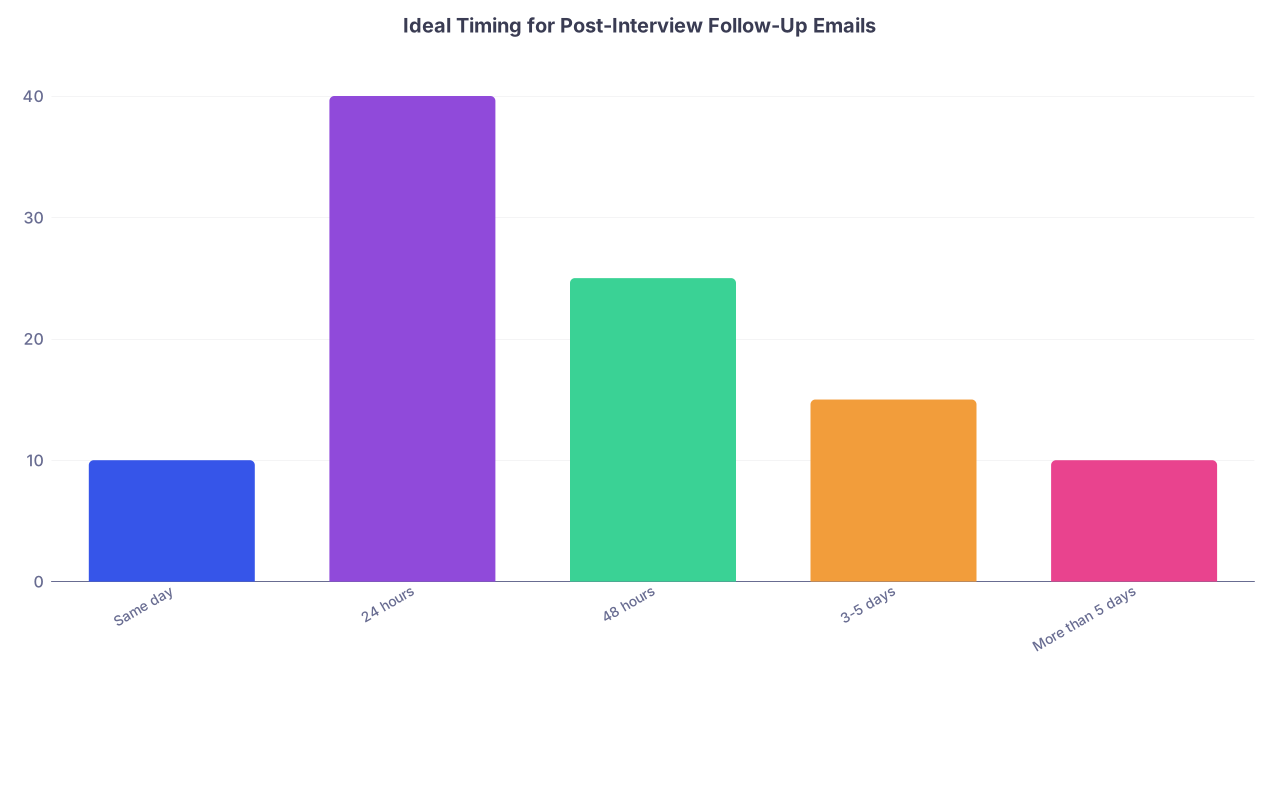
| Category | Value |
|---|---|
| Same day | 10 |
| 24 hours | 40 |
| 48 hours | 25 |
| 3-5 days | 15 |
| More than 5 days | 10 |
Whom to email
- Content correction: Email the specific faculty who asked the question. CC the program coordinator only if that is standard for thank-yous in that program.
- Professionalism clarification that affected a group (e.g., group interview): You can:
- Email the main interviewer you were assigned and reference “during the group discussion,” or
- If there was a clear leader (PD or APD), send to them and CC no one else.
Priority: avoid spamming half the faculty with five variations of your mea culpa.
Step 7: Turn the Moment into a Talking Point (If It Comes Up Later)
Many applicants never think about this: your awkward moment can become one of your strongest “growth” stories.
If you addressed it and learned from it, you can later talk about it as:
- A time you received implicit feedback (from yourself) and acted on it.
- A moment you realized how your words could be interpreted.
- An example of catching a knowledge gap and fixing it quickly.
If someone brings it up—“Tell me about a time you struggled in an interview / talk / patient encounter”—you can say:
- Briefly describe the moment.
- Explain how you felt afterward (2 sentences, max).
- Explain what you did: researched, clarified, changed your phrasing, adapted your preparation next time.
- Finish with how it changed your behavior going forward.
That is how grown professionals talk about mistakes. Interviewers know who is actually ready for residency by how they process failure and awkwardness, not by pretending they have never had any.
Step 8: Preventing a Repeat on Your Next Interview
You are not doing this recovery operation repeatedly if you can help it. So build a quick pre- and post-interview protocol.
Pre-interview: tighten up your weak spots
Have 3–5 polished stories ready
- Conflict on the team
- Mistake you made
- Feedback you received
- Leadership scenario
- Difficult patient / family
Practice communicating under mild stress
- 3–4 mock interviews with a resident or faculty, not just classmates.
- Record one of them. Painful but effective.
Have a pause strategy
If you tend to ramble, rehearse phrases like:- “Let me think about that for a moment.”
- “There are a few ways I could answer that; I will start with…”
Short pause now beats long unraveling later.
Post-interview: 15-minute debrief routine
Immediately after each interview day:
Write down:
- 2–3 questions you answered well.
- 1–2 that felt weak or awkward.
- Any true “uh-oh” moments.
For each weak spot, do one concrete action:
- Look up a guideline.
- Rewrite the story in bullet form, tighter.
- Ask a mentor, “How would you have answered this?”
This is how you show measurable improvement from one interview to the next.

| Step | Description |
|---|---|
| Step 1 | Finish Interview Day |
| Step 2 | 10-15 min debrief notes |
| Step 3 | List strong answers |
| Step 4 | List weak/awkward moments |
| Step 5 | Decide if follow-up needed |
| Step 6 | Draft and send email in 24-72h |
| Step 7 | Convert into practice scenario |
| Step 8 | Adjust prep for next interview |
Quick Comparison: When to Ignore vs Address vs Escalate
| Situation Type | Example | Response Strategy |
|---|---|---|
| Mild nervousness / small ramble | Slightly long answer, but coherent | Ignore in email, adjust prep |
| Clear knowledge gap / wrong answer | Missed key step in management | Brief correction in follow-up |
| Questionable phrase / poor wording | “Noncompliant patients”, “toughen up” | Clarify intent and values |
| Possible red flag (bias/ethics) | Comment about certain patient group | Careful clarification; mentor review |
FAQ (Exactly 4 Questions)
1. If I had multiple awkward moments, do I address all of them in one email?
No. Pick the single most important one—the one most likely to affect their view of your competence or professionalism. Address that clearly and briefly. If you try to catalog every stumble, you will look anxious and amplify issues they might not have noticed. The rest should go into your private debrief and become prep material for the next interview, not email content.
2. What if the interviewer was the one who seemed awkward or dismissive—do I mention that in my follow-up?
Do not critique or “correct” the interviewer in a thank-you email. If you felt something crossed a real line (blatant discrimination, inappropriate personal questions), document the interaction for yourself and discuss it with your dean’s office or advisor. They can help you decide whether to report it to the program or NRMP. Your follow-up to that interviewer, if you send one at all, should remain neutral and professional. Do not use it as a complaint channel.
3. Can a strong follow-up email actually change my position on their rank list?
Sometimes, yes. I have seen applicants move from “unsure” to “comfortable to rank” because their follow-up showed maturity, insight, and accurate self-correction after a shaky moment. It will not turn a disastrous day into a guaranteed match, but it can convert a borderline impression into a positive one. Programs are choosing future colleagues, not test-taking robots. How you handle imperfection matters.
4. What if I already sent a generic thank-you and only later realized the problem?
You can still send a second, short, focused email. Subject line like: “Brief clarification – [Your Name], [Interview Date].” Go straight to the point: one or two sentences reminding them who you are, then your clarification or correction. No need to re-thank them for the interview in depth. Late is not ideal, but a concise, thoughtful correction is still better than letting a major misunderstanding sit unchallenged.
Open your notes from your last interview and write down the single most awkward moment that is still bothering you. In one sentence, define what type of problem it was (knowledge, communication, professionalism, logistics). Then draft a 2–3 sentence correction or clarification you could send if appropriate—whether you decide to send it or just use it to sharpen your next answer. That act alone shifts you from replaying the moment to actually fixing it.