Discover how personalized Thank-You Notes can enhance your residency applications, showcase professionalism, and reinforce your personal branding after interviews.
Why Thank-You Notes Still Matter in Residency Applications
In an era of ERAS uploads, virtual interviews, and automated emails, a simple, well-crafted thank-you note might seem optional. In reality, it remains one of the most effective—and underused—tools for professional communication in residency applications.
Done well, post-interview thank-you notes:
- Reinforce your interest in the program
- Strengthen your personal branding as a thoughtful, detail-oriented applicant
- Help interviewers remember you and specific moments from your conversation
- Offer a professional way to clarify points or add something you forgot to mention
Many programs will explicitly say that Thank-You Notes are not required and will not affect ranking. You should always respect program policies. But when they are allowed, thoughtful follow-up can still subtly influence perceptions—especially in close decisions where applicants appear similar on paper.
Key Reasons Thank-You Notes Are Worth Your Time
1. They demonstrate professionalism.
Residency is a professional job, not just a training position. A polished, timely note signals:
- Respect for faculty and staff time
- Ability to communicate clearly and courteously
- Appreciation for mentorship and teaching
These traits matter to programs that want colleagues they can trust and enjoy working with.
2. They reiterate genuine interest.
Interviewers often ask themselves after a full interview day: “Is this person truly excited about our program?” Your thank-you note is a chance to:
- Explicitly restate your enthusiasm
- Mention specific program features that impressed you
- Signal that you’re picturing yourself training there
3. They help you stand out from similar applicants.
Many strong candidates skip this step or send generic, copy-paste notes. A personalized message:
- Makes you more memorable among dozens of applicants
- Refreshes the interviewer’s memory with details (“You’re the one who…”)
- Humanizes your application beyond scores and CV bullets
4. They help build authentic connections.
Residency is a small world. Faculty you meet now may later be fellowship directors, colleagues, or references. A thoughtful note:
- Begins a professional relationship on the right foot
- Signals that you value mentorship and dialogue
- Shows emotional intelligence and awareness of others’ efforts
Core Structure: How to Organize an Effective Residency Thank-You Note
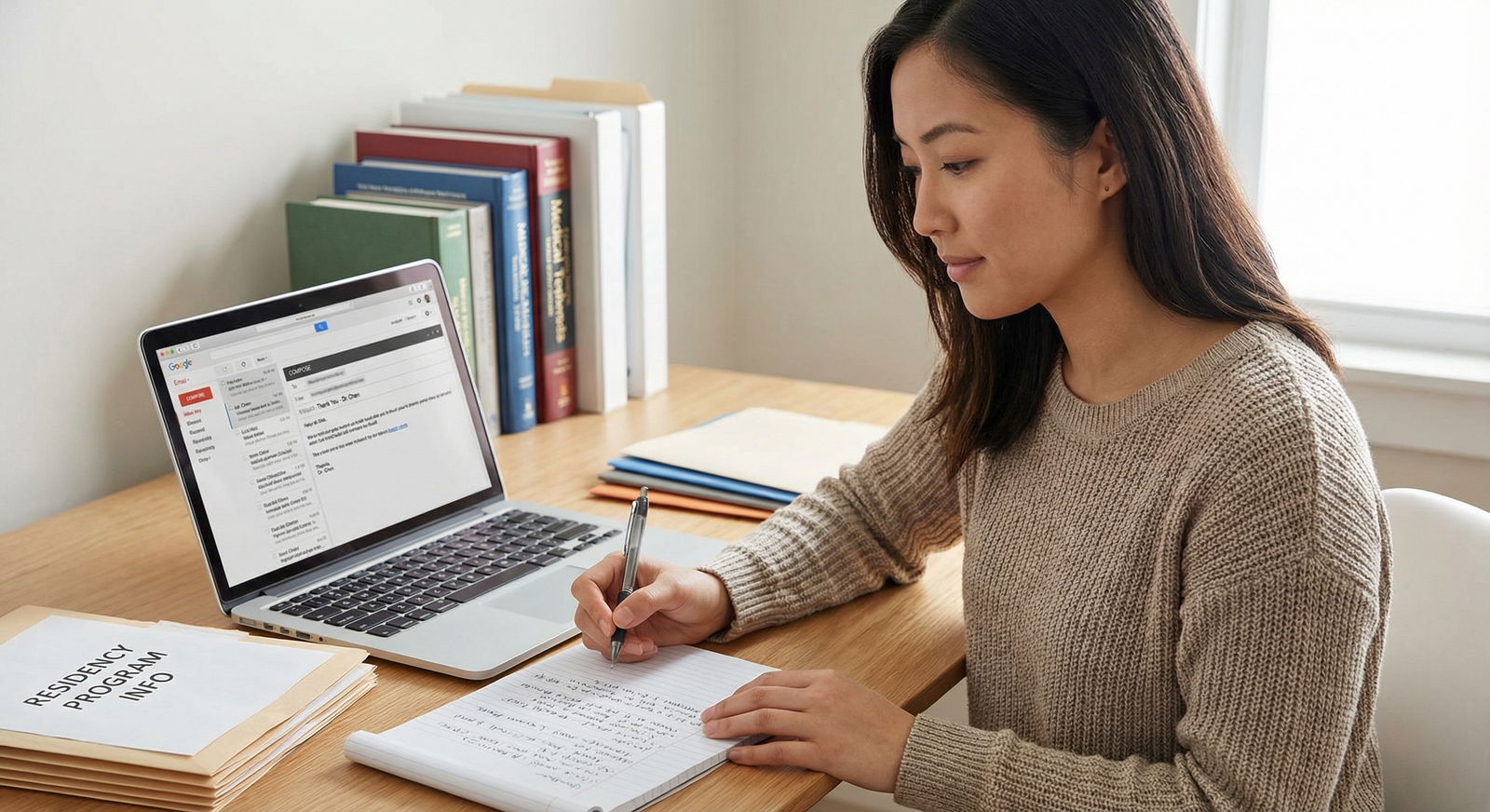
Whether you’re writing to a program director, faculty interviewer, resident, or program coordinator, most effective Thank-You Notes share the same basic structure. Keep it concise (usually 150–250 words) but intentional.
1. Open with a Clear, Direct Expression of Gratitude
Start immediately with appreciation:
- “Thank you for taking the time to speak with me on…”
- “Thank you for the opportunity to interview for the [Program Name] residency…”
Avoid long, elaborate introductions. Professional communication respects the reader’s time and gets to the point.
Example opening lines:
- “Thank you for taking the time to interview me on January 19 and for sharing more about the Internal Medicine Residency at [Institution].”
- “I truly appreciate the opportunity to learn about your program and to speak with you about your work in addiction medicine.”
2. Recap a Specific Personal Connection or Conversation
This is where personalization and personal branding begin to shine. Mention a concrete detail that proves you were engaged and listening:
Consider details like:
- A clinical case or teaching approach they described
- Their advice on fellowship, research, or career paths
- A shared interest (e.g., global health, medical education, advocacy)
- Something distinctive about program culture, conferences, or curriculum
Weak:
“I enjoyed our conversation about the program.”
Stronger, more memorable:
“I especially appreciated your description of Morning Report and how residents are encouraged to voice diagnostic uncertainties in a supportive environment.”
If you had a group interview, highlight something unique from that interaction (e.g., “I enjoyed hearing from the resident panel about camaraderie on night float.”).
3. Highlight Your Fit and Reinforce Your Personal Brand
Use 2–3 sentences to make the connection between you and them explicit. This is where you tie their program’s strengths to your goals, values, and experiences.
You might:
- Link your prior experiences to their patient population
- Connect your career goals to their fellowship match or scholarly opportunities
- Emphasize alignment with their culture (e.g., teamwork, wellness, service)
Example language:
- “Your emphasis on caring for patients with limited access to healthcare aligns closely with my work at the student-run free clinic and my long-term goal of practicing in underserved communities.”
- “Our discussion about structured mentorship for women in cardiology resonated deeply with my interest in pursuing an academic cardiology career.”
This step is crucial for personal branding. You’re not just “grateful”—you are intentionally positioning yourself as someone who belongs in their program.
4. Close Warmly, Professionally, and With Forward-Looking Interest
End with:
- A brief restatement of gratitude
- A clear but professional expression of enthusiasm
- A courteous closing line
Examples:
- “Thank you again for your time and for such an insightful conversation. I would be honored to train at [Program Name] and hope to have the opportunity to work with you in the future.”
- “I appreciate your consideration and look forward to the possibility of joining your residency program.”
Appropriate sign-offs include:
- “Sincerely,”
- “Best regards,”
- “Warm regards,”
Then include your full name and basic contact info (email, optionally phone).
Personalization Strategies: Turning Generic Notes into Powerful Professional Communication
The difference between an average and an outstanding thank-you note is personalization. The goal is not length—it’s relevance and specificity.
1. Address Each Interviewer Correctly by Name and Title
This seems basic, but errors here can undermine an otherwise strong note.
- Confirm correct spelling and title (Dr., Program Coordinator Ms./Mr., etc.)
- Use “Dr. [Last Name]” unless they explicitly invited first-name use
- For residents, “Dr.” or first name is usually acceptable; match their level of formality from the interview
Keep a running list during or immediately after interview day:
- Names, roles, and emails (if provided)
- Notes on what you discussed
- Any standout phrases or topics
2. Use Specific, Concrete Details from the Interaction
Specific details make your note feel genuine instead of formulaic. Think:
- “Your description of the night float system and how seniors mentor interns…”
- “The way your residents participate in quality improvement projects on the pulmonary service…”
- “The longitudinal clinic model you described, which allows continuity with complex patients…”
Instead of:
“I enjoyed hearing about your program’s strong research opportunities.”
Try:
“I appreciated hearing about your residents’ involvement in clinical research on COPD readmission reduction and how they receive structured support when presenting at national conferences.”
3. Match a Professional Yet Warm Tone
Your thank-you note reflects your professional communication style. Aim for:
- Polite, direct, grammatically correct writing
- Warmth without over-familiarity
- Confident language (not overly apologetic or anxious)
Avoid:
- Slang or text-style abbreviations
- Excessive flattery (“Your program is the absolute best in the country, better than all others…”)
- Overly casual closings (“Cheers,” “Take care!”) unless the culture clearly supported that tone
4. Send Notes Promptly and Strategically
Timing:
- Ideal: within 24–48 hours after the interview day
- Acceptable: within 3–4 days if travel or scheduling makes it difficult
If you’re interviewing at multiple programs back-to-back, block a short daily time slot to review notes and send messages while the conversation is still fresh in your mind.
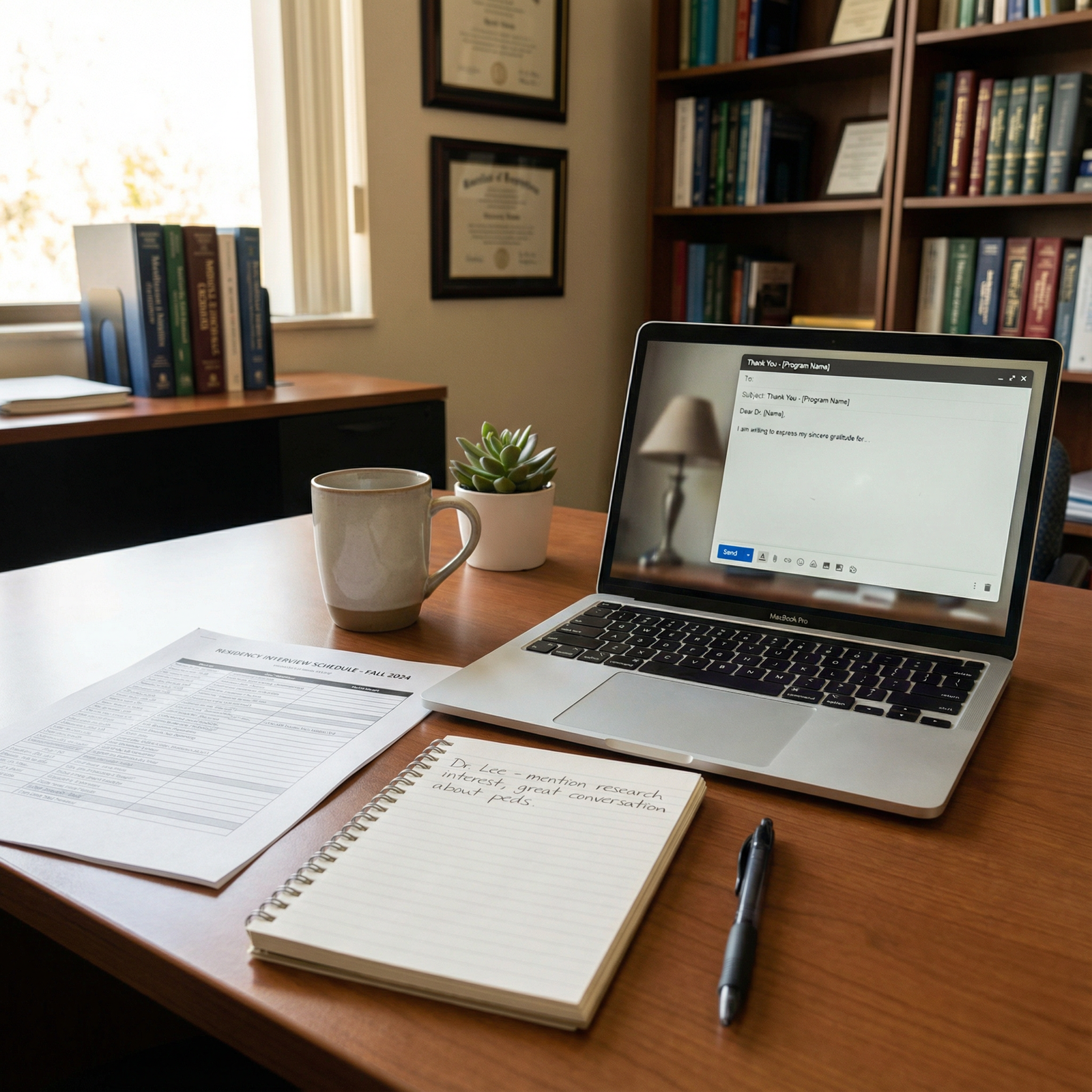
Pro tip: Draft short bullet points right after each interview—key topics, memorable moments, and program features. Turn those into full notes later the same day.
5. Choose the Right Medium: Email vs. Handwritten Notes
Most residency Thank-You Notes are now sent by email for practical reasons:
Email advantages:
- Fast, easy to send within 24 hours
- Less likely to get lost or delayed
- Works well for virtual interviews
- Easier to proofread and revise
Handwritten note advantages:
- More personal and memorable
- Can be appropriate for especially meaningful mentorship conversations or away rotation attendings
- May resonate in smaller or more traditional programs
If the program has explicitly said they don’t want follow-up or thank-you messages, always respect that request—even if other programs welcome them.
6. Proofread Meticulously
Spelling or grammar errors won’t necessarily sink your application, but they can send the opposite message of what you intend.
Before sending:
- Double-check names, titles, and program names
- Read the note out loud to catch awkward phrasing
- Ensure you didn’t paste the wrong program name or interviewer name from another template
- If English is not your first language, consider having a trusted friend glance over one sample template to refine your tone
Sample Thank-You Note Templates You Can Customize
Use these as starting points. Always personalize based on your actual conversation and each program’s culture.
Sample 1: Faculty Interviewer (Program Director or Core Faculty)
Subject: Thank You – [Your Full Name], [Specialty] Interview
Dear Dr. [Last Name],
Thank you for taking the time to interview me on [date] and for sharing more about the [Program Name] [Specialty] Residency. I truly appreciated hearing your perspective on how the program supports resident growth, from intern year through fellowship preparation.
Our discussion about [specific topic—e.g., longitudinal care for underserved patients at the community clinic] resonated with my experiences at [your medical school or clinic] and reinforced my interest in training in a program that prioritizes both clinical excellence and advocacy. I was especially impressed by [another specific detail—e.g., the way residents are encouraged to pursue scholarly projects with protected time and mentorship].
I am very excited about the possibility of joining your program and contributing to the collaborative, patient-centered culture you described. Thank you again for your time and consideration.
Warm regards,
[Your Full Name]
[Email Address]
[Phone Number (optional)]
Sample 2: Resident Interviewer
Subject: Thank You for the Conversation – [Your Full Name]
Dear Dr. [Last Name] / Hi [First Name],
Thank you for speaking with me during my interview day at the [Program Name] [Specialty] Residency. It was incredibly helpful to hear your honest perspective on the day-to-day resident experience, particularly regarding [specific detail—e.g., how seniors support interns during busy night shifts].
I appreciated your description of the program’s culture as [e.g., close-knit, supportive, academically rigorous yet balanced] and your examples of how residents find time for [e.g., wellness activities, families, research, hobbies]. Your comments helped me picture myself as part of the resident team at [Institution], and they strengthened my enthusiasm for your program.
Thank you again for sharing your insights and for being so candid about your experiences. I hope to have the opportunity to work alongside you in the future.
Best regards,
[Your Full Name]
Sample 3: Program Coordinator or Administrative Staff
Subject: Thank You – Interview Day Coordination
Dear [Ms./Mr./Mx.] [Last Name],
Thank you very much for organizing the interview day for the [Program Name] [Specialty] Residency and for all of your help with scheduling and logistics. The day ran smoothly, and I appreciate the effort you put into coordinating the interviews, virtual sessions, and communication with applicants.
Your clear instructions and prompt responses made the process much less stressful and allowed me to focus on learning about the program. I am very grateful for your support.
Sincerely,
[Your Full Name]
You can adapt these templates while keeping the key elements: gratitude, personalization, clear interest, and professional tone.
Advanced Tips: Using Thank-You Notes Strategically in Your Residency Application Journey
As you move through the interview season, Thank-You Notes can support broader Professional Communication and personal branding goals.
Use Notes to Clarify or Briefly Add Key Information
If you forgot to mention something important—but relevant—during the interview, your note can briefly address it:
- A specific research project that directly relates to the program’s focus
- A new publication, leadership role, or award that occurred recently
- A concise clarification of a question where your answer felt incomplete
Example:
“In our conversation about quality improvement, I realized afterward that I didn’t mention my role in our hospital’s sepsis protocol project. This experience further strengthened my interest in systems-based practice and QI initiatives like the ones you described.”
Keep additions short and directly connected to what you discussed. Avoid turning the note into a “second personal statement.”
Align Each Note with Your Overall Personal Brand
During the residency application and match process, you are communicating a consistent narrative about who you are as a future physician. Your Thank-You Notes should reinforce—not contradict—that narrative.
If your branding emphasizes:
- Commitment to underserved care → highlight clinics, populations, advocacy
- Interest in academic medicine → emphasize teaching, research infrastructure
- Focus on procedural skills or subspecialty interest → connect to faculty or rotations you discussed
Respect Program Policies and Boundaries
Some programs explicitly state that Thank-You Notes:
- Are not necessary, or
- Will not be placed in applicant files, or
- Should not be sent at all
In those cases:
- Always follow instructions—ignoring them can hurt more than any potential benefit of a note
- You can still keep private notes for your own ranking process and reflection

FAQs: Residency Interview Thank-You Notes
1. How long should a residency interview thank-you note be?
Aim for about 150–250 words. That’s enough space to:
- Express genuine gratitude
- Mention 1–2 specific details from your conversation
- Reiterate your fit and interest
Interviewers are busy; concise, high-yield messages reflect strong professional communication.
2. When is the best time to send my Thank-You Notes?
Within 24–48 hours after your interview day is ideal. This timing:
- Keeps you fresh in the interviewer’s memory
- Shows enthusiasm and professionalism
- Allows you to reference details while they’re still clear
If necessary, sending within 3–4 days is still reasonable, particularly if you had back-to-back interviews.
3. Should I send a thank-you note if the program said they don’t require or don’t read them?
Yes—if they say “not required,” but no if they explicitly say “please do not send thank-you notes” or “we do not accept post-interview communication.”
- “Not required” means optional but allowed; sending a thoughtful note won’t hurt and may still positively influence interpersonal impressions.
- “Do not send” or “not accepted” should be taken at face value. In these cases, respect for instructions and boundaries is itself a form of professionalism.
4. Do I need to send individual Thank-You Notes after a group or panel interview?
If you interacted meaningfully with several people individually (even as part of a group):
- Ideally send separate notes to each interviewer for whom you have contact information
- Personalize each note with a distinct detail from your conversation or their portion of the session
If you only have a general program email, you can send a single note thanking the group and asking that your appreciation be shared with everyone involved.
5. Can Thank-You Notes influence my rank on a program’s list?
Officially, programs base ranking decisions on the overall application, interviews, and internal criteria. Many explicitly state that Thank-You Notes do not affect ranking.
However, in practice, notes can still:
- Strengthen interviewers’ memory of you
- Contribute subtly to positive or negative interpersonal impressions
- Tip perceptions in close calls between otherwise similar candidates
Think of Thank-You Notes as one element of your broader professionalism and personal branding—not as a magic tool to change your rank, but as a way to ensure your best self is remembered accurately.
Thoughtful, personalized Thank-You Notes are a small investment of time that can pay significant dividends for your residency applications. They highlight your professionalism, reinforce your enthusiasm, and help interviewers remember the unique strengths you bring to their program—exactly the kind of strategic follow-up that can make a real difference in a competitive residency match and application process.