Does Silence After a Thank-You Email Mean You’re Out? What Evidence Shows
Silence after a thank-you email tells you almost nothing about your chances. People just pretend it does so they feel more in control.
You send your carefully crafted thank-you note. You refresh your inbox. Nothing. A day. A week. Still nothing. Your brain starts doing what anxious brains do: “They hate me.” “They forgot me.” “I’m definitely not ranked.”
Let me be blunt: that narrative is almost entirely made up.
Programs’ email behavior is one of the worst “data points” you could use to predict your match chances. It feels meaningful because it’s personal and immediate. It’s actually noise. And I’m going to walk through why—using what we actually know from NRMP data, program director surveys, and the reality of how interview season runs behind the curtain.
What Silence Actually Usually Means
Most of the time, silence after your thank-you email means one of three boring things:
- The program has a policy of not replying to thank-you emails.
- Your interviewer is drowning in clinical work, other interviews, and administrative nonsense and isn’t answering anyone.
- Your email was read, appreciated for 7 seconds, and then mentally filed as “done” without a response.
None of those equals “you’re out.”
Here’s a dose of reality: many programs have been explicitly told by their GME offices or legal departments to avoid anything that could be interpreted as recruitment promises, post-interview communication, or preferential signaling. You know what falls straight into that gray zone? Replying to thank-you emails with anything that looks like enthusiasm.
So what do busy attendings and PDs do? They choose the lowest-risk option: be cordial on interview day, and then go dark.
That’s not cruelty. That’s risk management plus time pressure.
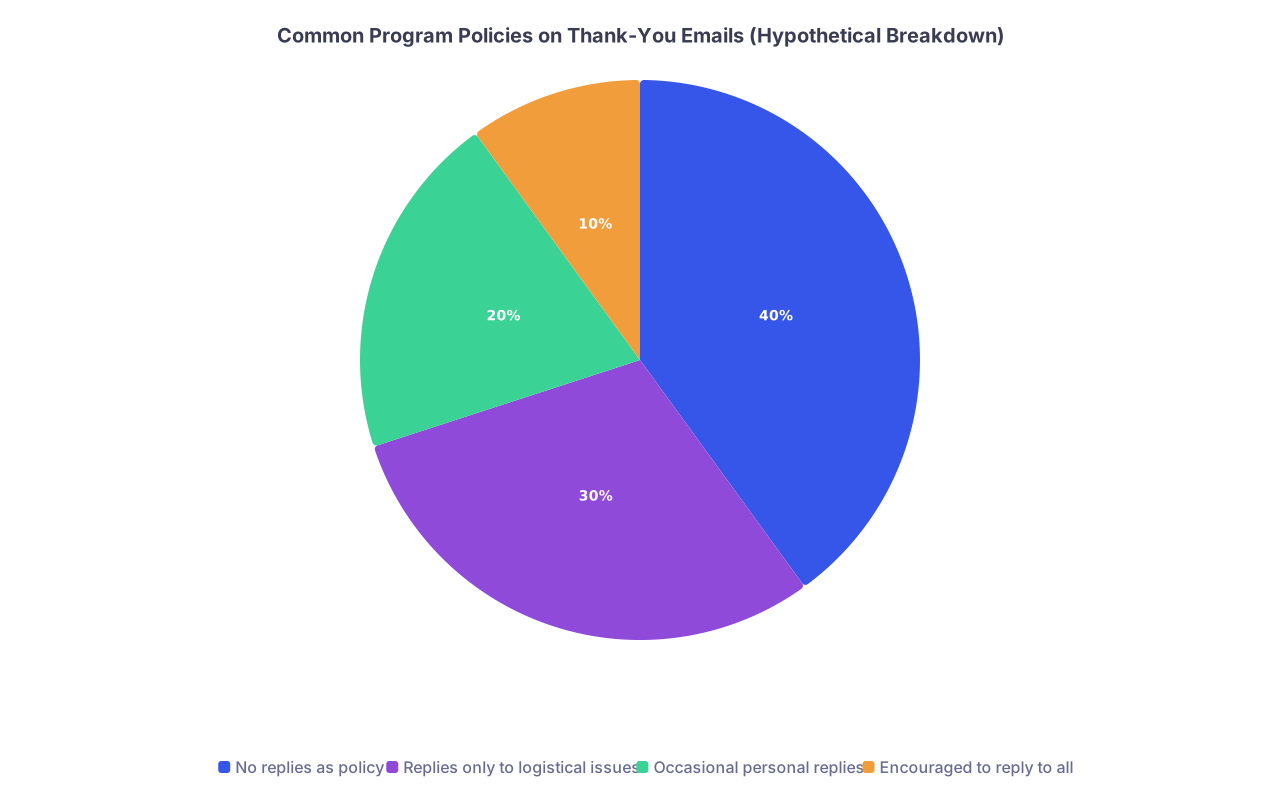
| Category | Value |
|---|---|
| No replies as policy | 40 |
| Replies only to logistical issues | 30 |
| Occasional personal replies | 20 |
| Encouraged to reply to all | 10 |
Exact national percentages vary, but this pie chart reflects what I’ve seen across multiple programs and what program director panels openly admit at conferences: most programs trend toward silence or minimal response, by design.
What the Match Data Actually Cares About
The NRMP publishes something applicants bizarrely ignore while they obsess over emails: the Program Director Survey. It asks PDs what actually matters for offering interviews and ranking applicants.
Do they ask, “Did the applicant send a thank-you email?” No. Not once.
They do ask about:
- USMLE/COMLEX scores
- Clerkship grades
- Class rank/AOA
- Letters of recommendation
- MSPE/Dean’s letter
- Interview performance
- Perceived fit with the program
Thank-you notes and email exchanges don’t just rank low. They are functionally absent.
| Factor | Approximate Importance (PD Surveys) |
|---|---|
| Interview performance | Very high |
| Clinical grades / MSPE | High |
| Letters of recommendation | High |
| USMLE/COMLEX scores | Moderate–high |
| Research (for some specialties) | Moderate |
| Thank-you emails / replies | Essentially none |
I’ve sat in actual rank meetings. Here’s what gets said:
“Great clinical evals.”
“Faculty really liked her on interview day.”
“Concern about professionalism on the rotation.”
“Strong letters, but scores borderline for our cutoffs.”
Here’s what does not get said:
“He didn’t get a reply to his thank-you email, so let’s drop him 20 spots.”
It’s not in the conversation. At all.
Why Silence Feels So Loud (Psychology 101 of the Match)
Your brain is playing tricks on you. Two big ones:
- Negativity bias – You weigh the one silence heavier than the three normal interviews where you walked out feeling fine.
- Pattern-matching desperation – The process is opaque, so you start looking for patterns in meaningless details: who replied fast, who sounded “warm,” who used exclamation points.
This is how myths like “no reply = rejection” spread. A few people don’t match and retroactively notice: “Come to think of it, the places I didn’t match didn’t reply to my emails.” They conveniently ignore that a bunch of programs they did match or rank highly also didn’t reply. That’s called survivorship bias.
Let me make this painfully clear: you cannot back-solve your rank list position from email behavior.
I’ve seen applicants get:
- Zero replies → match at that program.
- Effusive “we really enjoyed meeting you!” replies → not even ranked to match.
- Mixed signals, vague “best of luck” emails → ranked high anyway.
The signal (your actual performance and fit) is happening in a totally different channel than the one you’re obsessing over (your inbox).
Do Thank-You Emails Matter At All?
Here’s the uncomfortable middle ground.
Sending thank-you notes is:
- Mildly professional
- Sometimes appreciated
- Occasionally useful if you include something memorable or clarifying
But in most cases, it’s a rounding error in your application. And the presence or absence of a reply is a rounding error on a rounding error.
Where they might matter a bit:
- Very small programs (1–3 residents per year) where the PD and faculty know every applicant personally.
- Community programs that are more relationship-driven and less bureaucratically constrained.
- When your email isn’t just “thank you” but adds something meaningful: a clarified research interest, a follow-up on a specific case discussed, a succinct explanation of a gap the interviewer asked about.
Even then, the value is almost entirely in reminding someone who already liked you that you exist—not in converting a “no” to a “yes.”
And again: the value comes from the content and timing of your interactions overall, not whether you got a digital pat on the head.
When (and How) You Should Actually Follow Up
Very different question: if silence doesn’t mean you’re out, when is it reasonable to send a follow-up that isn’t just another thank-you?
Think in three buckets:
1. Pure Thank-You After Interview
- Send within 24–48 hours.
- Short, specific, non-needy.
- Expect nothing in return.
Something like:
“Dear Dr. X,
Thank you for taking the time to speak with me on [date]. I especially enjoyed our discussion about [specific service, project, patient population]. Our conversation reinforced my interest in [program name]’s emphasis on [X].
Best regards,
[Name, AAMC ID]”
That’s it. Not: “I’m very interested in ranking your program highly” (most programs hate this and ignore it anyway).
If they don’t respond, you’re not supposed to interpret it. You’re supposed to move on.
2. Logistical / Clarification Follow-Up
Here’s where follow-up actually matters, and programs will often reply:
- You realized you mis-scheduled something.
- You need to clarify start dates, visa issues, research options.
- You have an actual question not clearly answered in their website or pre-interview material.
That’s not emotional follow-up. That’s operational.
This kind of email should:
- Go to the coordinator or main program email first.
- Be clear, concise, and specific.
- Not be a Trojan horse for “and by the way, your program is my #1.”
Programs are used to this and do not ding you for it.
3. Post-Interview Interest / Update Emails
This is where people overstep and where a lot of garbage advice floats around on Reddit and from older residents who matched in a different era.
Here’s the evidence-based, contrarian view:
- Programs are not supposed to solicit or respond to “I will rank you #1” declarations.
- Many will completely ignore post-interview “updates” unless something truly material changed (new Step 2 score, major publication, significant award).
- Overly eager emails can hurt if they feel pushy or desperate.
If you have a genuine update that matters:
“Dear Dr. X,
Since we met on [date], I received my Step 2 CK score (###) and had a manuscript accepted in [journal] on [brief topic]. I remain very interested in [program name] because of [specific X].
Thank you again for the opportunity to interview.
Best,
[Name]”
Send it once. Then stop.
No reply? Fine. It still got seen. They update your file or they don’t. The rest is outside your control.

| Step | Description |
|---|---|
| Step 1 | Interview Completed |
| Step 2 | Send 24-48 hr Thank-You |
| Step 3 | Stop. Wait for Rank/Match |
| Step 4 | Email Coordinator or PD Once |
| Step 5 | Send One Update Email |
| Step 6 | Need Clarification or Update? |
| Step 7 | Major New Info Later? |
Notice what’s missing from that flowchart: “Check whether they replied to your thank-you. Adjust anxiety levels accordingly.” Because again, that part is noise.
What I’ve Actually Seen In Rank Meetings
Let me pull back the curtain a bit.
In rank meetings I’ve attended, the real mechanics often look like this:
- The spreadsheet with interview scores, notes, and file summaries is up.
- Faculty give quick impressions: “strong interpersonal skills,” “seemed disengaged,” “great fit for our patient population,” etc.
- Maybe someone mentions that the applicant is from the region or has family nearby.
- Sometimes someone vaguely says, “They followed up with a nice note,” but usually as an aside, not a decision point.
I have never seen:
- A column labeled “Thank-you received?” or “Reply sent?”
- A debate about whether to move someone because they or we didn’t send a post-interview email.
- A ranking shift because of how email communication “felt,” unless it crossed into clear unprofessionalism (way too frequent messages, boundary issues, inappropriate tone).
If emails are mentioned, it’s usually in the “red flag” direction. Not because of silence, but because of:
- Repeated pestering about rank status.
- Attempts to get PDs to violate NRMP communication rules.
- Emotional oversharing, manipulation, or implicit bargaining (“I’ll rank you #1 if…”).
You’re far more likely to hurt yourself with over-communication than with radio silence.
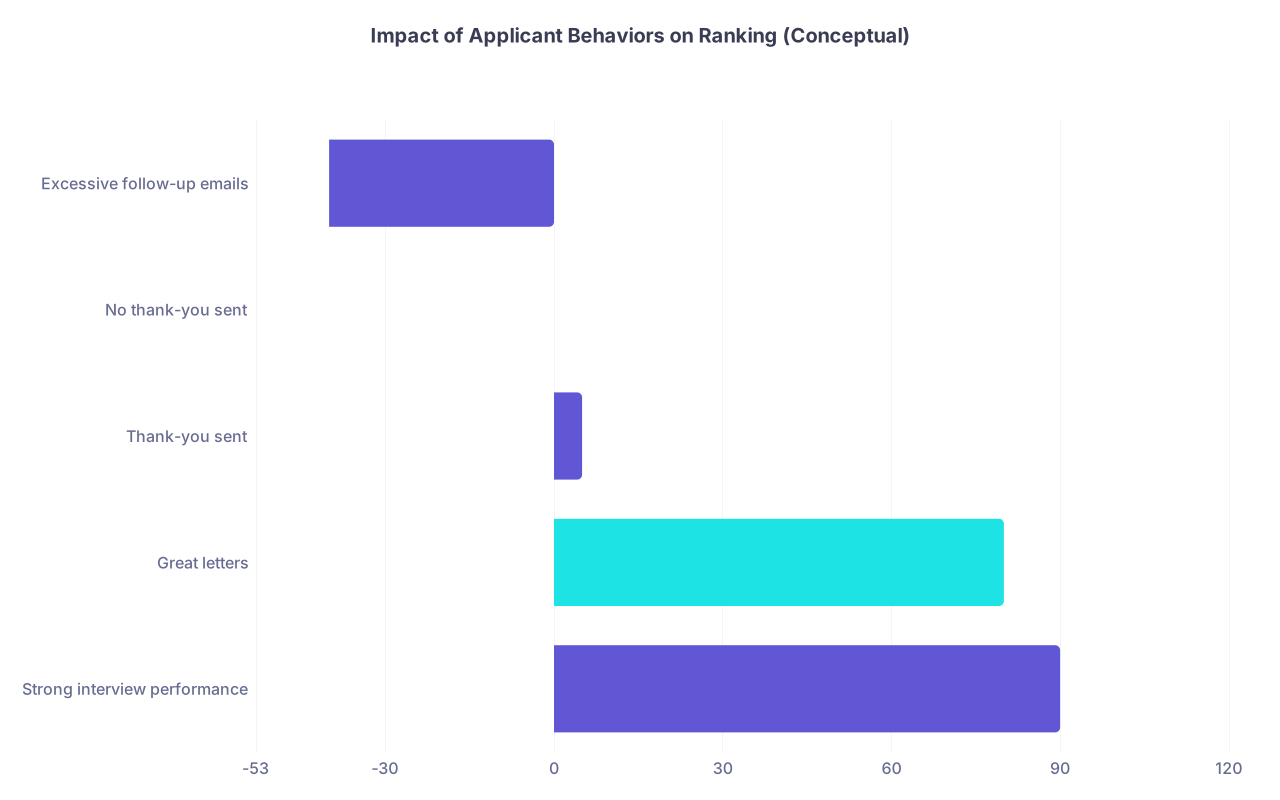
| Category | Value |
|---|---|
| Strong interview performance | 90 |
| Great letters | 80 |
| Thank-you sent | 5 |
| No thank-you sent | 0 |
| Excessive follow-up emails | -40 |
These numbers are conceptual, but the pattern is real: thank-you behavior is a tiny blip; overeager or boundary-crossing behavior is actively harmful.
So What Should You Actually Do?
Strip this down to a sane, low-drama system:
- Send a brief, specific thank-you within 24–48 hours. No emotional fishing, no ranking talk.
- Assume most people will not reply because of time and policy. Don’t chase.
- Use follow-up only for:
- Logistical questions
- True material updates (scores, publications, major awards)
- Send each type of follow-up once. Then leave it alone.
- Judge programs on:
- Interview day vibe
- Resident happiness
- Fit with your career goals
- Training quality and case volume
Not on how quickly someone answered your email at 11:37 pm on a Tuesday in peak interview season.

The Hard Truth About Control
Silence after a thank-you email feels terrifying because it reminds you of the truth: you don’t control this process as much as you’d like.
So you over-read signals. You invent stories. You scrape meaning out of empty inboxes.
Let me be direct: you control your prep, your performance on interview day, the authenticity of your rank list, and the professionalism of your limited follow-up. That’s it.
Programs control the rest. And they’re not revealing their hand in your Gmail notifications.

Key Takeaways
- Silence after a thank-you email is almost always a policy or time issue, not a secret rejection. It tells you essentially nothing about your rank position.
- Thank-you and follow-up emails have minimal positive impact unless they convey truly important new information; excessive or needy emails can actively hurt you.
- Your match odds are determined by your file and interview performance, not your inbox. Send one professional thank-you, follow up only when there’s a real reason, and stop trying to decode silence as a signal.