Follow-Up After Your Residency Interview: What to Say, How to Say It, and Why It Matters
Completing a residency interview day often feels like crossing a finish line—but in reality, you’re only at the end of one important stage of the residency application process. What you do in the 24–72 hours after your interview can subtly yet meaningfully influence how programs remember you.
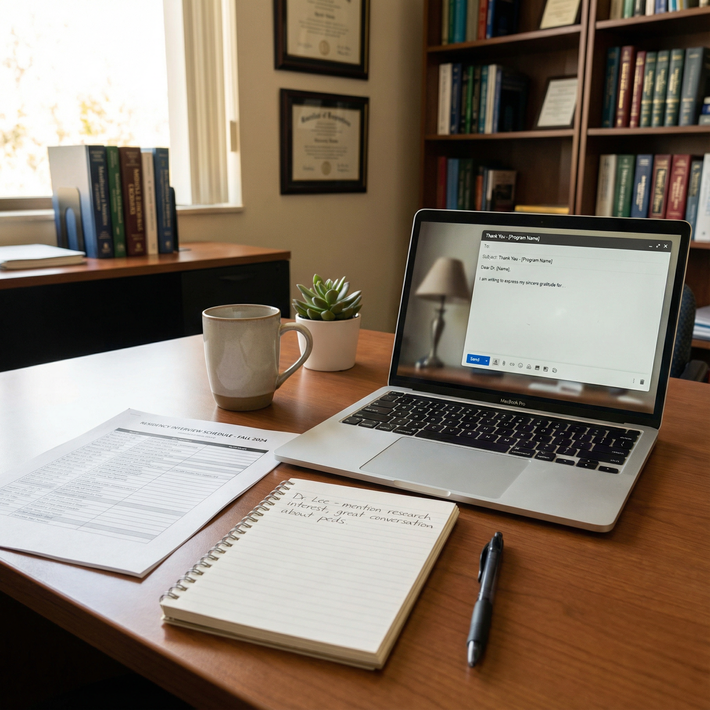
Thoughtful, professional communication after a Residency Interview:
- Reinforces your genuine interest
- Demonstrates maturity and professionalism
- Clarifies aspects of your candidacy
- Keeps you memorable among many strong applicants
This guide breaks down how to follow up after a residency interview, what to say (with examples), and how to maintain professional boundaries while still advocating for yourself and your Medical Career.
Why Following Up After a Residency Interview Matters
A follow-up message is not about “schmoozing” or trying to game the Match. It’s about professional communication and closing the loop in a respectful, polished way.
1. Demonstrate Professionalism and Respect
Residency interviewers—program directors, faculty, chief residents, and coordinators—invest significant time reviewing applications, planning interview days, and meeting with you. A concise, appreciative follow-up:
- Acknowledges the time and effort they invested
- Shows that you understand academic and clinical professionalism
- Mirrors the kind of communication expected in residency (e.g., following up with teams, attendings, and patients)
Programs often note how candidates communicate. A clear, concise, respectful email reflects the maturity they’re looking for in future residents.
2. Reinforce Genuine Interest in the Program
After interview season, programs review many strong candidates who may start to blur together. A strong follow-up can:
- Remind them of who you are and what you bring
- Reiterate specific reasons their program fits your goals
- Gently keep you “top of mind” without being pushy
You’re not trying to “convince” them with a single email, but you are making it easier for them to remember your strengths when ranking decisions happen later in the Application Process.
3. Clarify or Expand on Your Interview
Even stellar candidates have moments they wish they’d answered differently:
- You forgot to mention a recent publication or project
- You gave a rushed or incomplete response
- You realize later that you could better connect your experience to the program’s strengths
Your follow-up email is a professional space to briefly clarify or expand, such as:
“Upon reflection on our conversation about research, I wanted to share one additional project I recently completed…”
This can round out your application narrative without seeming defensive or apologetic.
4. Build and Maintain Professional Connections
Residency is not just a training program—it’s also the beginning of your professional network in medicine. Follow-up emails can:
- Open the door to future mentorship
- Make it easier to reach out later about research, electives, or fellowship advice
- Demonstrate that you communicate like a colleague
Maintaining a professional connection—through email or platforms like LinkedIn—can help you long after Match Day.
5. Distinguish Yourself from Other Applicants
Not every applicant follows up thoughtfully. When done correctly, your message can subtly differentiate you by showing:
- Attention to detail and follow-through
- Self-awareness and gratitude
- Clear alignment between your goals and the program’s mission
In a highly competitive environment, these small touches can make a difference.
Mastering the Timing: When to Follow Up (and When Not To)
Timing is a critical part of effective, professional communication.
Ideal Timing for Your Thank-You Email
For most programs, the sweet spot is:
- Within 24–48 hours after your Residency Interview
- While details are still fresh for both you and the interviewers
- During regular business days/hours when possible
Sending a message the same day is acceptable, especially if interviews end before lunch and you write it later that afternoon or evening. Just ensure your message is thoughtful and not rushed.
What If You’re Interviewing Back-to-Back?
If you have several interviews in a row:
- Block 15–20 minutes at the end of each day to draft or send emails
- Keep a quick note on each program (specific faculty, rotations, or features you want to reference)
- Use a base template but personalize each message substantially
When Is It Too Late to Follow Up?
If more than 7–10 days have passed, a thank-you email is still better late than never, but:
- Acknowledge the delay indirectly by focusing on gratitude and reflection, not excuses
- Keep it extra concise
- Avoid multiple follow-up messages unless asked for additional information
If rank list deadlines are approaching or have passed, you can still send a brief note of appreciation, but do not ask about your position on their list or press them for updates.
How to Craft a Professional Residency Interview Follow-Up Email
Your follow-up email should be polished, specific, and easy to read. Think of it as a brief, structured clinical note about your interaction with the program.
Core Components of a Strong Follow-Up Message
- Clear, professional subject line
- Personalized greeting
- Specific, sincere expression of gratitude
- Brief reinforcement of fit and interest
- Optional clarification or added insight
- Professional closing and signature
Let’s break these down with examples and practical tips.
1. Subject Line: Clear and Searchable
Your subject line should help busy faculty or coordinators identify you quickly. Effective examples include:
Thank You – [Your Name] – [Specialty] Residency InterviewAppreciation for Interview – [Your Name], [Program Name]Follow-Up from [Your Name] – [Date] Interview, [Residency Program Name]
Avoid vague or casual subjects like “Thanks!” or “Following up.”
2. Greeting: Use Correct Titles and Names
Use the title “Dr.” unless you are certain the person prefers another form of address.
Examples:
- “Dear Dr. Patel,”
- “Dear Dr. Rodriguez and the [Program Name] Team,”
- “Dear Dr. Lee, Dr. Nguyen, and Ms. Johnson,” (if you’re writing to multiple people)
If you had multiple interviews, you can:
- Send a primary message to the program director and/or associate program director, and
- Optional, more tailored messages to individual faculty or residents who made a strong impression on you (particularly if you discussed specific projects or interests)
3. Opening: Express Specific Gratitude
Thank them for both the opportunity and something concrete from your interview day.
Example:
“Thank you for the opportunity to interview with the [Program Name] Internal Medicine Residency on November 15. I appreciated learning more about your longitudinal clinic model and the way your residents are integrated into the community health center.”
This shows you were engaged and attentive.
4. Reinforce Your Interest and Fit
Next, connect what you learned about the program to your goals and strengths.
You might write:
“Our conversation about your emphasis on ambulatory training particularly resonated with me. I hope to build a career in primary care serving underserved populations, and I believe your strong community partnerships and mentorship culture would provide an ideal environment for that path.”
Make this section:
- Specific (mention distinct features of the program: curriculum, culture, research, patient population)
- Aligned with your long-term goals (academic medicine, community practice, global health, etc.)
Avoid generic statements like “I like your program because it is strong clinically and academically.”
5. Clarify or Add Key Information (Optional but Valuable)
If applicable, briefly address anything you wish you had explained more clearly:
- A project or leadership role you didn’t fully describe
- A research experience that has recently updated (accepted paper, new poster, etc.)
- A clarification of an answer that felt incomplete
Example:
“After reflecting on our discussion about research, I realized I did not mention that our manuscript on diabetic foot care was recently accepted for publication in the Journal of General Internal Medicine. This project further deepened my interest in quality improvement in chronic disease management, an area I would be excited to explore during residency.”
Keep this to 2–4 sentences; you’re adding value, not rewriting your entire CV.
6. Close Professionally and Confidently
End with another note of appreciation and a forward-looking, but not presumptive, closing.
Example:
“Thank you again for your time and consideration. I would be honored to train at [Program Name] and contribute to your resident community.”
Then add a professional sign-off:
Best regards,
[Full Name]
[Medical School], Class of [Year]
Phone: [Number]
Email: [Address]
(Optional) LinkedIn: [URL] or professional website
Sample Residency Interview Follow-Up Emails
Use these as templates and adapt them to your voice, specialty, and experience.
Example 1: General Post-Interview Thank-You Email
Subject: Thank You – Alex Chen – Internal Medicine Residency Interview
Dear Dr. Gomez,
Thank you for the opportunity to interview for the Internal Medicine Residency at Riverside University Hospital on December 5. I enjoyed learning more about your program’s commitment to resident autonomy and its strong emphasis on caring for underserved communities.
Our conversation about the resident-led quality improvement projects particularly resonated with me. Throughout medical school, I have been drawn to initiatives that improve transitions of care for vulnerable patients, and I believe Riverside’s supportive environment and diverse patient population would offer an ideal setting to continue this work. I am excited about the possibility of growing as a clinician-educator in a program that values both rigorous clinical training and community engagement.
Upon reflection, I also wanted to briefly highlight a recent development in my research experience. The manuscript from our project on reducing 30-day readmissions in heart failure patients was recently accepted for publication. This experience has further reinforced my interest in quality improvement, an area I would be enthusiastic to pursue during residency.
Thank you again for your time and consideration. I would be honored to train at Riverside and contribute to your resident team.
Best regards,
Alex Chen
Medical University School of Medicine, Class of 2025
(555) 987-6543
[email protected]
Example 2: Follow-Up to a Specific Faculty Interviewer
Subject: Thank You – Pediatric Residency Interview, [Your Name]
Dear Dr. Malik,
Thank you for speaking with me during my interview day at the Children’s Health Pediatric Residency on January 8. I appreciated our discussion about your continuity clinic model and the ways residents are encouraged to take ownership of their panels early in training.
Hearing how your residents partner with families over several years reinforced my interest in primary care pediatrics. My experiences working in our student-run clinic have shown me how meaningful long-term relationships can be for both families and physicians. I am particularly drawn to Children’s Health’s emphasis on developmental screening and behavioral health integration, which align closely with my goal of providing comprehensive outpatient pediatric care.
I am grateful for the time you took to share your perspective on resident education and look forward to the possibility of joining your program.
Sincerely,
[Your Name]
[Medical School], Class of 2025
[Contact Information]
Example 3: Addressing a Missed Point or Clarifying an Answer
Subject: Follow-Up from Emergency Medicine Interview – [Your Name]
Dear Dr. Rivera,
Thank you for the opportunity to interview for the Emergency Medicine Residency at Harbor Medical Center on December 12. I especially enjoyed our conversation about your ED’s role as a regional trauma center and the strong procedural training your residents receive.
After reflecting on our interview, I realized that I did not fully describe my experience with ultrasound-guided procedures. During my sub-internship, I completed a focused skills elective in point-of-care ultrasound and assisted with several ultrasound-guided paracenteses and central line placements. This experience further confirmed my interest in emergency medicine and my desire to continue developing procedural expertise during residency.
I remain very enthusiastic about the possibility of training at Harbor Medical Center and appreciate your time and consideration.
Best regards,
[Your Name]
[Contact Information]
Professional Networking and Ongoing Communication After the Interview
Beyond the initial thank-you email, you may consider additional professional communication—when appropriate and within NRMP guidelines.
Connecting on LinkedIn or Other Professional Platforms
It can be reasonable to connect with:
- Program coordinators
- Residents you spoke with extensively
- Faculty/interviewers with shared academic interests
If you connect:
Include a short, tailored note:
“Thank you again for speaking with me during my interview at [Program Name]. I appreciated your insights about [topic] and would be happy to stay connected professionally.”
Keep your profile professional (photo, headline, and content aligned with your medical career)
Avoid:
- Repeated messages asking about rank position or acceptance chances
- Overly personal comments or informal communication
When (and Whether) to Send a “Love Letter” or Update Letter
Some applicants consider sending:
- A letter of interest: stating you are very interested in a program
- A letter of intent: stating a program is your top choice
Before sending:
- Review current NRMP and program-specific policies
- Ensure you are honest and not sending “top choice” claims to multiple programs
- Keep your language professional and non-coercive
If you send a letter of intent:
- Do so once, typically after most interviews are complete
- Be truthful and clear
- Avoid pressuring language (e.g., “I will rank you #1 if you rank me highly in return” is inappropriate)
Common Pitfalls to Avoid in Residency Interview Follow-Ups
Thoughtful follow-up can help you; poorly executed follow-up can hurt you. Watch out for these missteps.
1. Overly Long or Repetitive Emails
Your follow-up is not a second personal statement. Aim for:
- 150–300 words in most cases
- Focus on gratitude, fit, and one or two key points
If a program director or coordinator has to scroll multiple times, your message is likely too long.
2. Generic, Copy-Paste Messages
Programs can often spot generic emails. Avoid:
- Sending identical paragraphs to every program
- Mixing up program names or details (a common and damaging error)
To prevent mistakes:
- Double check the program name, specialty, and any named individuals before sending
- Save customized templates and update them carefully for each program
3. Pressuring or Inappropriate Language
Never:
- Ask, “Where am I on your rank list?”
- Suggest ranking arrangements (violates Match policies and professionalism norms)
- Make emotional appeals (“I need this spot more than others do”)
Instead, focus on:
- Your interest
- Your fit
- Your gratitude
4. Multiple Uninvited Follow-Up Messages
One well-written thank-you is usually sufficient. Additional messages are appropriate only if:
- You have a significant update (e.g., major publication, award, Step score, or degree)
- The program requests more information
- You are sending a single, well-considered letter of interest or intent
Frequent, unsolicited follow-ups can feel intrusive and unprofessional.
FAQ: Follow-Up After Residency Interviews – Practical Answers
1. Do I need to send a follow-up to every program I interview with?
It is highly recommended to send at least one concise, professional thank-you email to each program. You do not need to email every single resident or faculty member you met, but you should:
- Email the program director, associate program director, or the designated contact
- Consider separate emails to key individuals (e.g., a research mentor you hope to work with) if your conversations were substantial and you can reference something specific
2. What if I forgot to mention something important during my interview?
You can absolutely address this in your follow-up email. When doing so:
- Keep it brief and focused (“I wanted to briefly mention…” or “I realized I did not fully describe…”)
- Frame it positively, without apologizing excessively
- Connect it back to how it strengthens your preparation for their program
Avoid sending multiple emails for every small omission; prioritize what is most impactful (e.g., research, leadership, significant clinical experience).
3. Is it okay if my follow-up is more personal or casual?
Your tone should remain professional yet warm. You can:
- Reference a shared interest (e.g., medical education, global health, a particular subspecialty)
- Mention a specific moment from the day you appreciated
But avoid:
- Slang or overly casual phrasing
- Personal compliments unrelated to the program or professional context
Think of your tone as how you’d speak to a respected attending you’ve gotten to know over a few days of working together.
4. How do I follow up if I don’t receive any response?
Most programs receive many emails during interview season and may not respond to individual thank-you notes. This is normal and not a negative sign.
You generally should not:
- Send a second email just to ask if they received your first message
- Interpret no response as lack of interest
It’s appropriate to send another message only if:
- They specifically requested additional materials and you’re providing them
- You have a major, meaningful update to your application (e.g., Step score, publication)
- You are sending a one-time letter of intent or high interest later in the season
5. Can a follow-up email change my position on a program’s rank list?
A follow-up email alone rarely moves an applicant dramatically on the rank list. However, strong professional communication can be one of several positive factors when committees discuss candidates, including:
- Interview performance
- Application strength
- Perceived fit with the program’s mission and culture
- Professionalism in all interactions (including emails)
Think of your follow-up as reinforcing a positive impression rather than trying to create one from scratch.
Thoughtful follow-up after your Residency Interview is a small but important piece of the overall Application Process. By communicating clearly, professionally, and authentically, you demonstrate the same qualities that will make you an effective, collegial resident—and that’s exactly what programs are looking for as they build their next class.