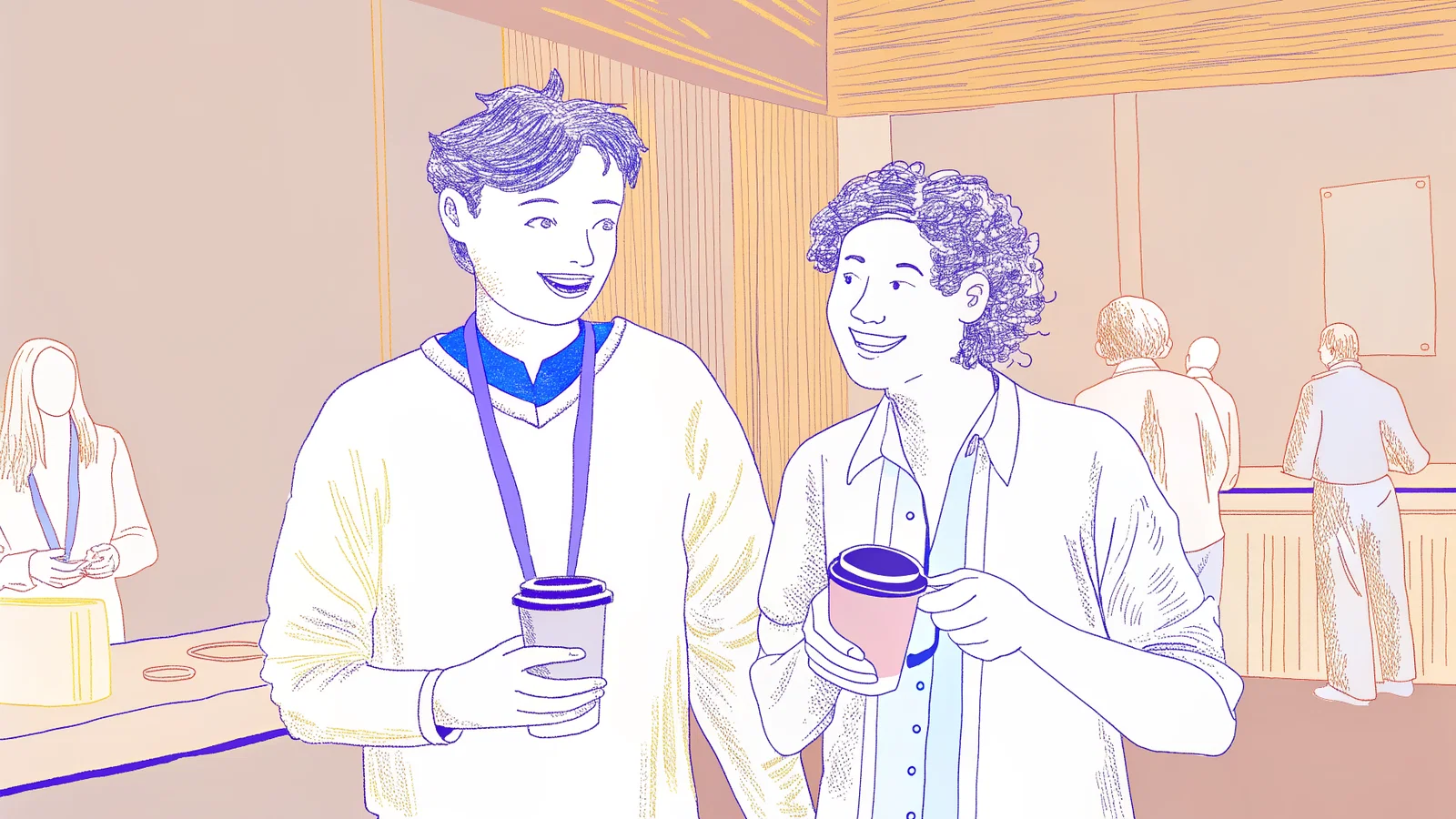
Remember that moment in your residency interview when the conversation suddenly stopped feeling like an interview?
You were talking about your research, or your rotations, and then they mentioned they ran the Chicago Marathon last year. And you lit up. You ran it too. Or maybe you both got into rock climbing during med school. Or you discovered you both obsess over obscure immunology papers on transplant tolerance.
For 90 seconds, you weren't applicant #47. You were just two people who actually liked talking to each other.
And now you're home, staring at a blank thank-you email, thinking: do I mention that? Will it look like I'm trying too hard to be their buddy?
You should mention it. Absolutely. This is the best thing that could have happened to you on interview day, and most applicants completely waste it.
That Moment When You Realized You Had Something in Common
If you're in this situation, you hit it off over something real, not just polite small talk, you've already cleared the hardest hurdle.
Most interviews blur together. Same questions, same rehearsed answers. Program directors will tell you privately that after a full day, most candidates sound identical. Great stats, nice personal statement, said all the right things.
But that natural, engaging detour where you actually connected? That's memorable.
So what do you do with it? You don't ignore it and send the same sterile "Thank you for your time, I was impressed by your program" email that 100 other people sent.
You also don't write a gushing fan letter about how amazing it was to meet a fellow ultra-runner.
Here's the move: you treat it like a normal human interaction, because that's what it was. Your secret weapon isn't the shared interest itself. It's that you can prove you were listening, you were present, and you'd actually be pleasant to work with at 2 a.m. on call.
Why That Shared Interest Connection Matters
Let me be blunt. Your USMLE score got you in the door. It will not get you ranked highly.
Interviewers meet dozens of qualified people. What they remember at the ranking meeting isn't your Step 2 score. It's: "Oh, that's the applicant who also builds bikes" or "the one who actually knew about my work on CAR-T exhaustion."
When you bond over something genuine, you stop being a file and become a person. That's not fluff. That's fit. And fit is what programs are desperately trying to assess.
Program directors want residents who will mesh with their current team, who will contribute to the culture, who won't be miserable for three to seven years. A shared interest is shorthand for: we could actually get along.
Generic thank-you emails get skimmed, if they get opened at all. Personalized ones with a specific callback? They get a reply. I've seen applicants turn a middle-of-the-list impression into a top-10 rank just by sending one email that didn't sound like it was copy-pasted.
That 45% isn't magic. It's just human nature. People respond to people who remembered them.
The Natural Follow-Up Framework
If you bonded over something real, you need a follow-up that feels real. Not strategic. Not calculated. Natural.
Here's the framework I give every applicant in this exact scenario. Four parts. Keep it under 150 words total.
1. Start with genuine gratitude, but make it specific. Not "thank you for your time." Try "Thank you for talking with me yesterday about the ICU rotation structure, and for the trail recommendations around [City]." See the difference? One is wallpaper. One proves you were there.
2. Reference the conversation naturally, name what you bonded over. One sentence. Early. Something like "Really enjoyed swapping stories about training for Chicago" or "I appreciated hearing about your work on clonal hematopoiesis."
Don't hide it in paragraph three. Put it in the first two lines.
3. Add a touch of substance, share something related. This is where most people mess up. They just say "it was great to talk about running!" and stop. That's empty.
Add one small thing. An article you mentioned. A race you're considering. A paper they should see. Not a homework assignment for them, just a small deposit into the conversation.
Example: "You mentioned the West Loop trail, I looked it up, looks perfect for long runs."
4. Keep it short. This is not an essay. It's a signal. Grateful, specific, warm, done.
If your email is longer than your personal statement paragraph, you've already lost.
Email Template: When You Bonded Over a Shared Interest
Enough theory. Here's what this actually sounds like. Two versions, because a hobby and a research interest hit a little differently.
Version 1: When you bonded over a hobby (running, climbing, baking, whatever)
Subject: Thank you, [Program Name] interview
Dr. Patel,
Thank you so much for speaking with me yesterday, I especially enjoyed hearing about your experience running Chicago and swapping training disaster stories.
You mentioned the lakefront trail near the hospital, I checked it out and it looks ideal. Maybe I'll see you out there if I'm lucky enough to match at [Program].
I came away even more excited about [Program Name], particularly the exposure to [one specific thing].
Thanks again, [Your Name]
Notice what it does. No fluff. It's written like you'd write to a senior resident you actually liked. Collegial, not fangirling.
Version 2: When you bonded over a research / academic interest
Subject: Thank you, enjoyed our conversation
Dr. Chen,
Thank you for your time yesterday. I really appreciated our conversation about your work on T-cell exhaustion in the tumor microenvironment, it overlaps a lot with the project I worked on at [Your Institution].
I went back and read the recent Nature Immunology paper you mentioned. The approach you took with the PD-1 timing was really clever, would love to learn more.
[Program Name]'s focus on [specific thing] is exactly what I'm looking for.
Best, [Your Name]
The principle in both: mention it like you'd mention it to a colleague, not a hero. Don't say "I was SO inspired to meet another person who loves climbing!!!" That reads as manipulative. You're not leveraging a connection. You're continuing one.

What NOT to Do When Following Up on a Connection
This is where good intentions go off the rails. I've seen applicants torpedo a great impression with a bad follow-up.
Don't do this:
- Don't over-inflate it. Saying "That was the best conversation I've had on the interview trail" or "I felt an instant connection" is too much. Way too much. You talked for 15 minutes. Keep perspective.
- Don't force it if it was minor. If they mentioned they like dogs and you have a dog and that was it, three seconds of "oh, I have a lab too", that's not a bond. Don't manufacture depth where there wasn't any. It reads as desperate.
- Don't create work for them. Don't end with "Would you be able to send me that paper / connect me with Dr. X / tell me more about..." You just added a task to a busy person's inbox. The thank-you is a gift, not a request.
- Don't follow up multiple times. One clear, warm message is enough. One. If they don't reply, that is normal. Do not send a "just following up!" nudge. That turns a nice moment into an annoyance.
- Don't skip the standard thank-you part. This personalized note is in addition to being professional and grateful, not instead of it. You still need to thank them for the program specifics. The shared interest is a line or two, not the whole email.
When to Skip the Personalized Approach
Okay, real talk. Sometimes you should NOT mention the shared interest.
If you're in any of these situations, stick to a standard, professional thank-you:
If it felt forced. You know when it does. You mentioned you like hiking, they said "oh cool," and you both moved on. That's not a connection. That's filler. Pretending it was meaningful makes you look out of touch.
If you didn't actually connect meaningfully. Don't invent a bond because you want an edge. People can tell immediately when you're faking familiarity. Authenticity wins. Every time.
If the interviewer was strictly professional. Some interviewers are warm and chatty. Others keep a hard boundary. That's their prerogative. If they didn't lean into the personal chat, respect that boundary. Don't try to force collegiality on someone who was clearly in evaluation mode.
Simple test: would it feel natural to mention it if you ran into them in the hallway? If yes, include it. If you'd feel weird bringing it up, don't.
So here's what you're going to do:
1. Send it within 24-48 hours. Not a week later. That's when you're still fresh in their mind. Set a reminder on your phone the night of the interview.
2. Keep it to 100-150 words. Write it, then cut it by 30%. If you can't say it briefly, you don't understand it clearly enough.
3. Use the two-sentence test. Does your first two sentences contain a specific thank-you AND the specific callback to your shared interest? If not, rewrite.
4. One and done. Send it. Log it in your tracker. Move on. Don't stalk your inbox.
5. Be honest with yourself. If the connection was real, use it naturally. If it wasn't, don't manufacture it. A solid, professional thank-you is always better than a cringey fake-personal one.
You had a human moment in a very un-human process. That's rare. Don't waste it by being generic, and don't ruin it by being weird about it. Just be normal, be grateful, and let them remember you as the person they actually enjoyed talking to.