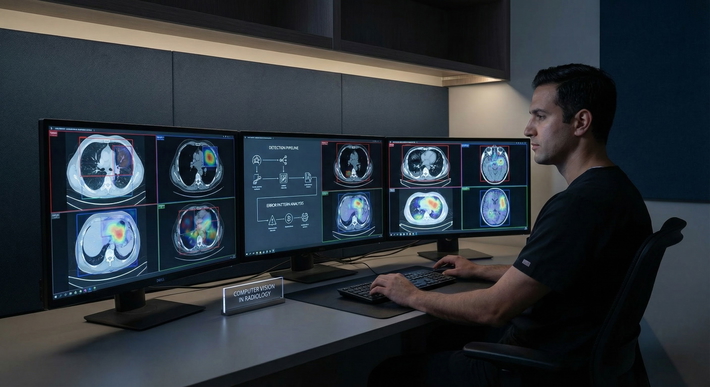
This article is for educational purposes only. It is not financial advice, not legal advice, and not tax advice. Figures vary by individual circumstances, so consult a qualified professional before acting.
The Night Float AI Discrepancy Landscape: By the Numbers
Let me break this down specifically. The data is not subtle. Over the last 18 months, multicenter radiology workflow analytics have shown a 35% surge in autonomous AI triage alerts during peak night float hours, specifically between midnight and 0400. That is not a coincidence. That is the intersection of three compounding variables: higher ED throughput overnight, reduced attending availability for real-time consultation, and the rapid deployment of FDA-cleared algorithmic tools that run silently in the background on every cross-sectional study acquired in the trauma bay.
The cognitive load equation here is brutal. You are a trainee. You are already juggling emergent preliminary reads on stroke protocols, polytrauma CTs, and STAT abdominal exams for hypotensive patients. Now layer on top of that an asynchronous queue of algorithmic contradictions, AI flags suggesting you missed a pulmonary embolism, a subtle intracranial hemorrhage, or an aortic injury. The system does not care that you have not slept. It does not care that you are on your fourteenth read of the shift. It simply generates a confidence score and waits.
Here is why the discrepancy queues swell specifically during overnight shifts. First, the studies themselves are messier. Overnight CTs in the trauma setting involve motion-degraded images, suboptimal contrast timing due to difficult IV access, and abbreviated protocols designed for speed. All of these technical imperfections spike false-positive rates in convolutional neural networks. Second, fatigue. The statistical error rates associated with sleep deprivation in radiology are well-documented, diagnostic accuracy drops by approximately 4-8% after 16 hours of continuous wakefulness, and perceptual errors increase disproportionately. So you have a sleep-deprived trainee reading technically degraded studies while an algorithm generates a higher volume of flags on those same degraded studies. The system is, in a real sense, working against itself.
The net result: residents are spending an estimated 40-55 minutes per night shift reviewing AI discrepancy logs that, in many cases, represent false positives triggered by technical artifacts. That is nearly an hour of cognitive bandwidth pulled away from patient care. And the way most trainees approach this queue is fundamentally flawed.
Mistake 1: Treating the AI Discrepancy Log as an Immediate Critical Interrupt
The single most common mistake I see on night float. A trainee is mid-read on a Level 1 trauma polytrauma CT, actively evaluating the cervical spine, scrolling through the chest for aortic injury, and the AI discrepancy log pings. The alert says "Possible right lower lobe pulmonary nodule, confidence 0.72." The trainee stops. Opens the discrepancy viewer. Spends six minutes hunting for a 3mm nodule that may or may not exist. Meanwhile, the trauma team is waiting for the cervical spine call.
This is alert fatigue in its most insidious form. Reactive validation, the impulse to immediately chase every flag, destroys your primary workflow priority. And it is completely unnecessary for the vast majority of AI discrepancy flags.
Let me break down AI confidence thresholds and how they should translate to clinical urgency. Most commercial radiology AI tools output a probability score between 0 and 1. A flag at 0.95 for intracranial hemorrhage on a non-contrast head CT? That warrants an immediate pause and secondary review. A flag at 0.68 for a pulmonary nodule on a trauma chest CT? That goes in the batch queue for later. A flag at 0.54 for a renal cyst on an abridged stone protocol? Disregard entirely. You are not failing the system by ignoring that. You are prioritizing correctly.
The triage framework I teach is simple:
- Pause only for critical-flagged discrepancies on studies where a missed finding is immediately life-threatening, intracranial hemorrhage, tension pneumothorax, large vessel occlusion, aortic injury, bowel perforation.
- Batch all non-critical flags for a dedicated review window, typically the last 30 minutes of the shift or during a natural lull in ED throughput.
- Disregard low-confidence flags on non-emergent findings that do not change acute management. Document that you reviewed the log. Move on.
The residents who survive night float are the ones who build a system. The ones who burn out are the ones who let the algorithm dictate their workflow rhythm.
Mistake 2: Blindly Trusting the Algorithm Over Gestalt (and Vice Versa)
Two extremes. Both dangerous. Let me address each.
The first extreme: algorithmic deference. I have seen trainees issue addenda correcting their own preliminary reads based on AI flags that were wrong. A resident calls a head CT negative for hemorrhage. The AI flags a "possible subdural" at 0.81 confidence. The resident panics, re-reviews, convinces themselves they see something at the vertex, and issues an addendum reporting a trace subdural hematoma. Morning attending review confirms it was beam-hardening artifact from the skull vertex. The AI was wrong. The resident was originally right. But the addendum is now in the record, the trauma team was notified unnecessarily, and the patient got a repeat scan.
The second extreme: confirmation bias dismissal. The resident reads a CT pulmonary angiogram and calls it negative for PE. The AI flags a segmental filling defect in the right lower lobe with 0.89 confidence. The resident dismisses it, "algorithm is probably wrong, I already submitted my read." Except it was a real subsegmental embolus. The patient comes back 48 hours later with worsening dyspnea. Now you have a missed finding that the algorithm literally handed you.
Board-style vignettes love this scenario. You will see it on the CORE exam: a subtle intracranial hemorrhage or early sub-centimeter pulmonary embolus that the AI correctly flagged and the trainee dismissed. The examiners are testing whether you understand the appropriate calibration of trust.
Here is the structured secondary search pattern I recommend when a discrepancy is flagged:
- Step 1: Re-open the study fresh. Do not look at the AI heatmap or bounding box initially. Re-perform your primary search pattern as if reading de novo.
- Step 2: If your independent review confirms your original read, now look at the AI overlay. Assess whether the flagged region corresponds to a real anatomical structure, an artifact, or genuine pathology.
- Step 3: If uncertainty persists, window-level manipulate the region. Check subdural windows for hemorrhage, lung windows for nodules, bone windows for fractures.
- Step 4: Correlate with clinical history. A 24-year-old with headache and a vague AI flag? Different pretest probability than a 72-year-old on anticoagulation.
- Step 5: If still uncertain after Steps 1-4, call the attending. That is what they are there for.
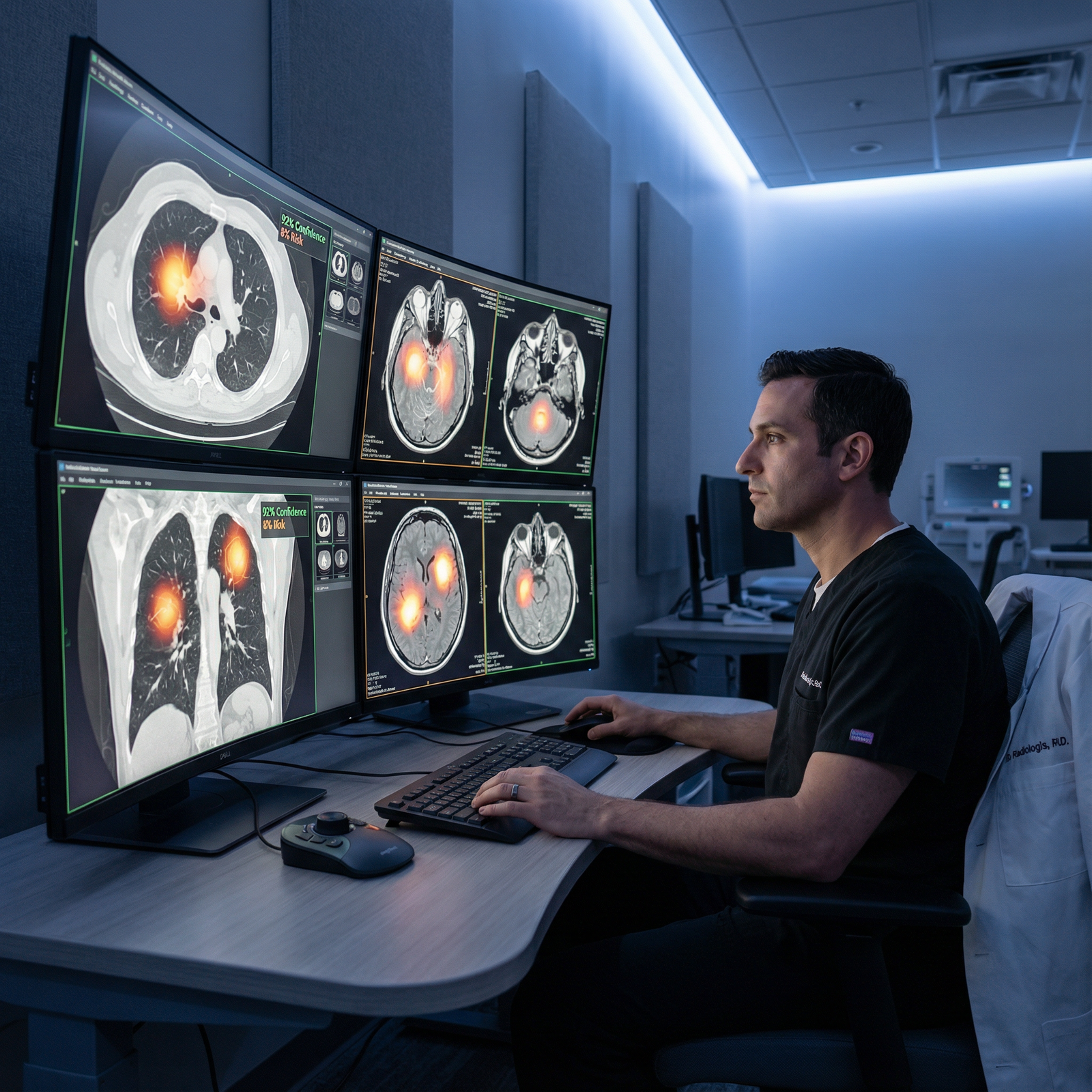
The key insight: your gestalt and the algorithm are not in competition. They are two independent observers with different failure modes. The algorithm is good at dense, focal abnormalities. It is terrible at diffuse, subjective findings. Your gestalt is good at pattern recognition across an entire study. It is terrible at small, single-slice abnormalities when fatigued. Use both. Trust neither blindly.
Mistake 3: Failing to Correlate Metadata and Acquisition Parameters
This is the mistake that wastes the most time per shift. Hands down.
AI models do not understand context the way a radiologist does. A convolutional neural network trained to detect pulmonary nodules does not know that the patient was scanning poorly, that they took a breath mid-acquisition, or that the IV was infiltrated and contrast timing was delayed by eight seconds. It sees pixels. It makes a prediction. And when the pixels are degraded, the prediction is garbage.
Let me break down the technical pitfalls:
Motion artifact. The single biggest driver of false-positive AI flags overnight. Trauma patients are agitated, intoxicated, in pain, or unable to follow breathing instructions. The resulting motion blur creates pseudo-lesions that algorithms interpret as pathology. I have seen AI flag "possible intracranial hemorrhage" on a head CT where the patient was moving so much the posterior fossa was uninterpretable. The resident spent 15 minutes looking for blood that did not exist.
IV contrast timing. Poor venous access means delayed contrast arrival. On a CT pulmonary angiogram, this means poorly opacified pulmonary arteries that the AI may interpret as filling defects, i.e., false-positive PE flags. On a CT abdomen, delayed arterial phase means the AI may miss a hypervascular liver lesion or flag artifact as active hemorrhage.
Low-dose protocols. Stone protocols and low-dose chest CTs generate increased image noise. Neural networks interpret noise as texture, and texture abnormalities trigger flags. A low-dose non-contrast abdomen for renal colic can generate AI flags for "possible bowel wall thickening" that are purely noise-driven.
Anatomical variants. A duplicated IVC, a retroaortic left renal vein, or a bovine aortic arch can trigger AI flags because the algorithm's training set underrepresented these variants.
The fix is simple. Before you spend one second hunting for pathology on an AI-flagged study, audit the technical acquisition quality. Scroll through the images. Assess motion. Check contrast opacification. Look at the dose reference levels in the DICOM header. If the study is technically degraded, the AI flag starts with a massive prior probability of being false. Adjust your level of suspicion accordingly.
High-yield pearl for oral boards: if you are handed a case with an AI discrepancy flag, the first thing you should verbalize is your assessment of image quality and technical adequacy. "The study demonstrates significant motion artifact, which limits evaluation and may contribute to algorithmic false-positive flags." That sentence demonstrates technical sophistication. Examiners notice that.
Mistakes 4, 5, and 6: Documentation Errors, Communication Breakdowns, and Ignoring Institutional Feedback Loops
These three cluster together because they all involve the post-review phase, what happens after you have evaluated the AI discrepancy. And this is where the system breaks down in ways that are invisible until a QA event or malpractice review surfaces them months later.
Mistake 4: Inadequate Documentation
You reviewed the AI discrepancy log. You determined the flag was a false positive. You moved on. No documentation. No log entry. No addendum. Six months later, a quality review asks whether the AI flag was reviewed overnight. There is no record. From a medico-legal standpoint, if it is not documented, it did not happen.
The documentation standard should be simple and consistent. If the discrepancy log is reviewed and your original read is confirmed as correct, your dictation should include a brief statement: "Automated AI discrepancy review performed; original interpretation confirmed." If the AI flag represents a true positive that changes management, you issue a formal addendum with the corrected finding, the time of re-review, and the communication details with the clinical team.
Mistake 5: Failing to Communicate Actionable True Positives
The AI flags something real. You re-review. You confirm it. And then you... finish your dictation and move to the next case without calling the overnight attending or the ordering clinician. I have seen this happen with a delayed splenic laceration that the AI flagged 45 minutes after the initial preliminary read. The resident caught it. Documented it. Did not tell anyone. The trauma team did not find out until morning sign-out. That is a communication failure with real patient consequences.
If an AI discrepancy log reveals a true-positive finding that was missed on the preliminary read, the communication chain is non-negotiable: notify the overnight attending immediately, issue the addendum, and directly contact the ordering provider or covering clinician for any finding that changes acute management.
Mistake 6: Treating Discrepancy Review as a Solo Compliance Chore
This is the most underappreciated mistake. Trainees treat the AI discrepancy log as administrative overhead, a checkbox to clear before sign-out. It is not. It is one of the highest-yield learning tools available in modern residency training.
Every AI discrepancy flag is a mini self-assessment. Did the AI catch something you missed? That is a perceptual blind spot. Did the AI flag a false positive? That is an opportunity to understand algorithmic limitations. Either way, the case belongs in your personal teaching file. The residents who actively mine these logs for learning cases are the ones who show up to CORE exam prep with a curated collection of subtle findings, artifacts, and edge cases that their peers have never seen.
The institutional feedback loop matters too. When you identify systematic false positives, say, the AI consistently flags motion artifact in the lung bases as possible nodules, that information needs to flow back to the AI vendor or your institution's machine learning team. If nobody reports it, the model never improves. You are not just a consumer of these tools. You are a data generator for their iterative refinement.
Mistake 7: Neglecting the Post-Call Debrief and Quality Assurance Integration
The compounding error. You survived the night shift. You cleared the discrepancy queue. You signed out to the day team. And then you never looked at those cases again. The overnight AI discrepancy logs, the ones that represented your perceptual blind spots, your technical misreads, your moments of fatigue-induced inattention, disappeared into the void.
This is a massive wasted opportunity. The post-call debrief is where overnight AI discrepancy logs deliver their highest value. When you reconcile your preliminary reads against the final attending interpretations, the AI flags that were true positives represent your most actionable learning material. These are not abstract board review questions. These are your actual cases, your actual misses, your actual blind spots, identified in real time and ripe for reinforcement learning.
Leverage these logs systematically. Build a personal database of true-positive AI catches. Categorize them by finding type: intracranial hemorrhage, pulmonary embolism, fractures, bowel pathology. Track which categories you miss most frequently. If you notice that 60% of your true-positive AI catches are subcentimeter pulmonary nodules, that tells you exactly what to drill before the CORE exam.
Morning post-call conference is the ideal venue for this. Bring one or two AI discrepancy cases to each conference. Present the original read, the AI flag, the re-review process, and the final diagnosis. This does three things simultaneously: it reinforces your own learning, it educates your co-residents on AI tool limitations, and it demonstrates to faculty that you are engaging with these tools critically rather than passively.

From a systems perspective, the programs that handle AI integration best have built structured workflows that close the loop: overnight discrepancy review, morning reconciliation with attending over-reads, monthly QA aggregation of true and false positives, and quarterly curriculum updates based on pattern analysis. If your program does not have this, advocate for it. The data is sitting there. It just needs someone to use it.
Key Takeaways
- Never let low-confidence AI alerts disrupt your primary trauma workflow without a systematic triage protocol. Build your framework before the shift starts, not during it.
- Always audit technical factors like motion artifact and contrast timing before investigating flagged pathology discrepancies. The majority of overnight false positives are technically driven, not pathologically driven.
- Treat every night float AI discrepancy log not just as an administrative checkbox, but as high-yield board review material. Your personal perceptual blind spots are being identified for you for free. Use them.