
The riskiest “new hire” in your ED is not the intern. It is the black‑box AI triage system your hospital just bought on a glossy slide deck.
Let me break this down specifically: AI triage in the ED is not mainly a math problem. It is a risk‑allocation, bias‑amplification, and legal‑exposure problem wrapped in math. If you do not understand how the model was trained, what risk scores mean operationally, and who owns the error, you are flying blind.
1. What “AI triage” in the ED actually is (and is not)
Most vendors pitch “AI triage” like it is a sentient nurse at the front desk. That is nonsense. What you actually have, in almost every real deployment I have seen, is some variation of:
- A risk prediction engine that produces a score (e.g., risk of ICU admission, mortality, sepsis, or “clinical deterioration” within X hours).
- A workflow layer that maps that score to an action (e.g., higher triage level, fast‑track to labs, trigger sepsis bundle, page rapid response).
- A user interface bolted onto your EHR or a separate screen your nurses will hate for the first month.
The model itself is usually one of three families:
Traditional statistical model repackaged as “AI”
- Logistic regression, gradient boosting, or random forests trained on EHR data.
- Often indistinguishable from a sophisticated risk score like NEWS2 or MEWS, just with more variables and nicer marketing.
Machine‑learning risk score
- XGBoost, LightGBM, random forests, or neural nets fed vitals, labs, demographics, chief complaint, sometimes free‑text triage notes.
- Outputs: probability of event (e.g., death, ICU admission, 30‑day revisit).
- Calibrated (allegedly) so that “0.2” ≈ 20% risk in the training population.
“Symptom checker” / chat front‑end
- Large language model (LLM) or decision‑tree–style symptom checker that assigns acuity before the patient hits the ED.
- Usually patient‑facing (portal, kiosk, app), then mapped to a triage score or recommendation.
What it is not:
- It is not a licensed practitioner.
- It is not “practicing medicine” in any legal sense your hospital wants to admit to.
- It is not a substitute for ESI, CTAS, MTS, or other established triage frameworks; it is a layer on top or beside them.
The subtlety here: The math is often decent. The integration, governance, and accountability are usually poor. That is where you get hurt.
2. Risk scores: how they are built and how they get weaponized
AI triage lives and dies by risk scores. If you misunderstand these, you will mis‑allocate care, reinforce bias, and blow up your malpractice risk.
2.1 How ED risk models are actually trained
Most ED triage models are trained on retrospective EHR data with very specific choices:
- Population: Often a single health system, sometimes one large academic ED.
- Inputs:
- Demographics (age, sex; sometimes race/ethnicity, insurance).
- Triage vitals (HR, BP, RR, O2 sat, temp).
- Chief complaint text and structured codes.
- Arrival mode (ambulance, walk‑in).
- Basic labs if available within first hour (lactate, creatinine, troponin, WBC).
- Outcomes (labels), common examples:
- 24‑ or 72‑hour ICU admission.
- In‑hospital mortality.
- Need for critical intervention (e.g., intubation, vasopressors).
- Or a composite “deterioration” endpoint.
Here is the trick vendors often gloss over: the labels themselves are biased. If a system historically under‑admitted certain groups to ICU, the model “learns” that pattern. No fairness post‑processing will fully fix corrupted ground truth.
The performance is then quoted in ROC‑AUC terms: “Our model has an AUC of 0.89 for predicting ICU admission within 24 hours, compared to 0.78 for ESI.” Sounds impressive. But AUC is insensitive to prevalence and cost asymmetry. In the ED, missing 1 in 100 catastrophes is not the same as 1 in 100 over‑admissions.
2.2 Thresholds and operational meaning
The moment you pick a threshold, you stop talking statistics and start talking policy.
Say your model outputs a score from 0 to 1 for “critical event within 24 hours.” Your vendor suggests:
- Score ≥ 0.30 → trigger “High Risk” banner, recommend ESI 2, fast‑track physician assessment.
- Score 0.10–0.29 → “Moderate Risk.”
- Score < 0.10 → “Low Risk.”
Under the hood, someone set that 0.30 cut‑off to hit a sensitivity of, say, 0.85 and a specificity of 0.75 in the test data.
Clinically that might mean:
- You catch 85% of high‑risk patients (15% still missed).
- You “up‑triage” a lot of borderline patients, straining resources.
Legally, threshold choice is where you will be grilled:
- “Doctor, you knew a score of 0.42 meant a high risk, yet you left the patient in the waiting room 90 minutes. Why?”
- “Why did your hospital pick a threshold of 0.30 instead of 0.20, knowing that lower thresholds improve sensitivity for life‑threatening events?”
Once scores get turned into color‑coded flags or auto‑generated recommendations, they take on a life of their own. I have watched nurses on night shift say, verbatim, “If the box is red, I bump the triage level. If it’s green, I don’t.” That is delegation of clinical judgment to a system that is not legally accountable.
2.3 Calibration, drift, and the quiet decay of accuracy
Models are calibrated to a specific setting and case‑mix. Change the environment, and they drift. Classic sources:
- New patient mix (e.g., your ED opens a freestanding satellite, or your trauma designation changes).
- New protocols (e.g., aggressive early sepsis screening raises early ICU admits).
- Coding and documentation changes.
- Pandemic, seasonal, or demographic shifts.
If nobody is running monthly or quarterly calibration checks, your “0.30 = 30% risk” assumption is fantasy. This matters for both care and liability: a miscalibrated model that systematically underestimates risk for certain groups is a slow‑motion train wreck.
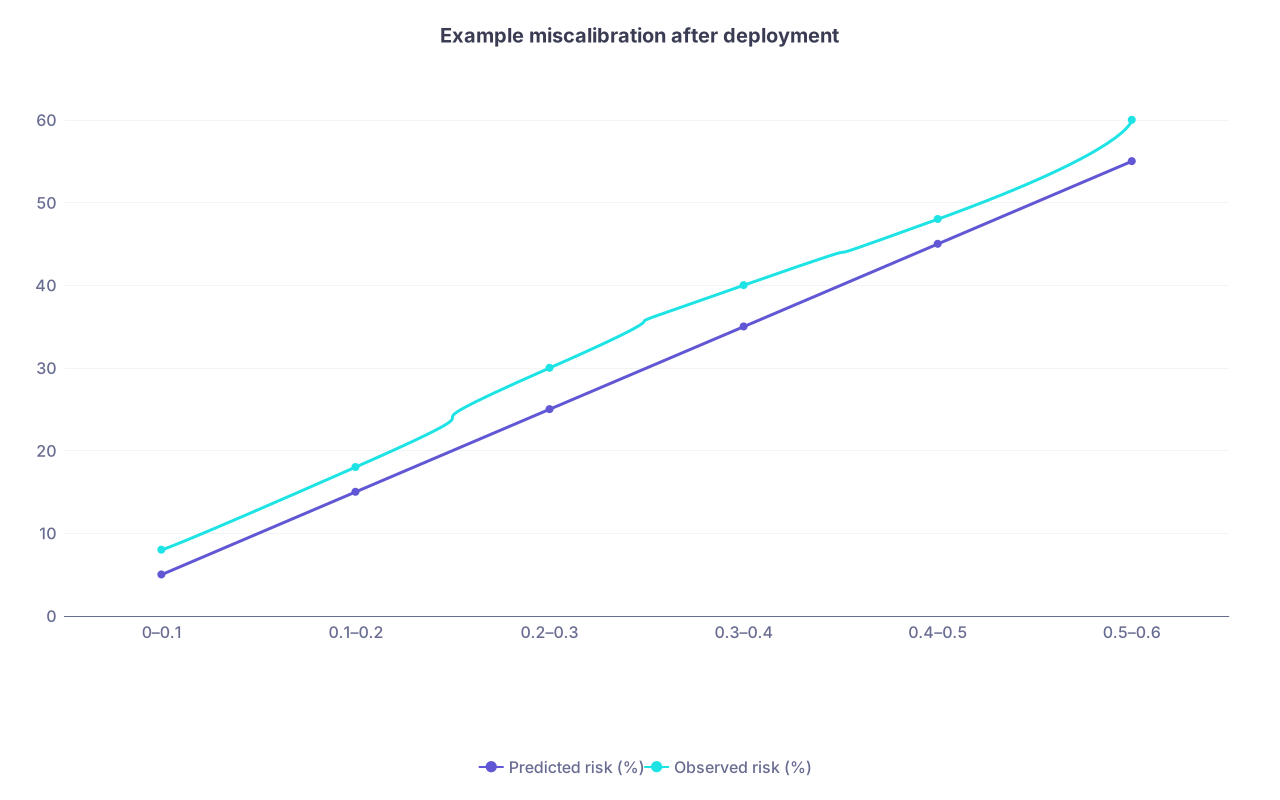
| Category | Predicted risk (%) | Observed risk (%) |
|---|---|---|
| 0–0.1 | 5 | 8 |
| 0.1–0.2 | 15 | 18 |
| 0.2–0.3 | 25 | 30 |
| 0.3–0.4 | 35 | 40 |
| 0.4–0.5 | 45 | 48 |
| 0.5–0.6 | 55 | 60 |
When the model underestimates real‑world risk like this, “following the AI” is not a safe harbor.
3. Bias: how AI triage can magnify inequities you already have
Most administrators still think “bias in AI” is an abstract ethics seminar topic. It is not. It shows up as real patients waiting longer, getting less aggressive workups, or being labeled “low risk” when they are not.
3.1 The training data trap
If your historical care was biased, your model will be biased. Full stop.
Examples I have seen:
- A model for “need for ICU” trained on a system where Black patients in respiratory distress were systematically under‑admitted to ICU relative to severity. The model “learned” that they were less likely to need ICU, simply because they had not been given ICU care before.
- A risk score that included insurance status and neighborhood socioeconomic index. Result: patients from wealthier zip codes surfaced as “higher risk” in subtle ways, mainly because they had more diagnostic data and more complete follow‑up.
This is not hypothetical. The well‑known Obermeyer et al. paper showed a widely used commercial health risk algorithm was racially biased because it used cost as a proxy for illness. Similar dynamics occur in ED triage when you use “ICU admission” or “resource utilization” as your ground truth.
3.2 Feature choices that quietly encode bias
Even if you strip explicit race/ethnicity out of the model, you probably left in proxies:
- Zip code or “distance from hospital.”
- Insurance type.
- Primary language.
- Prior utilization patterns.
The model then reconstructs race and socioeconomic status through correlations. So you get “race‑blind” features with race‑loaded behavior.
Also: language and communication barriers. Free‑text chief complaint fields differ. “SOB, CP, diaphoresis” vs “not feeling well.” Models often over‑rely on strongly predictive phrases that are more common in certain patient subgroups (educated, English‑fluent, health‑literate).
3.3 Differential error rates = differential harm
Even if your overall AUC is great, you care about subgroup performance:
- False negatives (missed high‑risk patients) by race, age, sex, language.
- False positives (unnecessary up‑triage) by those same groups.
| Subgroup | AUC | Sensitivity (High Risk) | Specificity (High Risk) |
|---|---|---|---|
| Overall | 0.88 | 0.85 | 0.78 |
| White patients | 0.90 | 0.87 | 0.80 |
| Black patients | 0.82 | 0.76 | 0.81 |
| Latinx patients | 0.84 | 0.79 | 0.79 |
If your model misses more Black patients at the same threshold, you are not “AI‑enabled.” You are algorithmically encoding disparities. In a discovery process, those numbers will look terrible.
3.4 “Human overrides” do not magically remove bias
Hospitals love to say, “The AI just provides guidance; clinicians can override it.” That line will not save you if:
- Overrides are rare due to cognitive load, time pressure, or UI friction.
- Overrides themselves are biased (clinicians more likely to trust or distrust AI based on patient appearance, language, demeanor).
I have sat in meetings where leadership assumed “we have a human in the loop, so it’s safe.” That is magical thinking. You need actual monitoring of override patterns by subgroup to see whether the loop is helping or hurting.
4. Legal exposure: where the lawsuits will come from
Let me be blunt: the law is behind the technology, but plaintiffs’ attorneys are not stupid. They will go after whoever looks careless, opaque, or dismissive of risk.
4.1 Who is on the hook?
Right now, practical liability for AI triage systems rests with:
- The hospital or health system (corporate negligence, failure to supervise, negligent adoption of technology).
- Individual clinicians (if they followed or ignored AI advice in ways that can be portrayed as unreasonable).
- Potentially the vendor (product liability), but vendors are working hard to frame their software as “clinical decision support,” not a medical device practicing medicine.
In malpractice cases, plaintiffs will argue some version of:
- The clinician ignored a high‑risk AI flag (and that flag was reasonable).
- The clinician trusted a “low risk” label that was obviously wrong given observable signs.
- The hospital put in place a system with known or knowable bias or poor performance and failed to monitor it.
4.2 Standard of care and AI: use, misuse, and disuse
We are heading toward a world where not using reasonable AI support might itself be considered below standard of care in some contexts. But we are not there yet in ED triage. More often, the risk is in how you use it:
- Blind reliance: “The computer said ESI 4, so I downgraded.” That is hard to defend if vital signs and chief complaint suggested otherwise.
- Selective attention: Using AI to justify resource withholding but ignoring it when it suggests escalation.
- Inconsistent use: Only some clinicians or some shifts pay attention to AI flags; others ignore them entirely. That creates variability plaintiffs can exploit.
Courts will look at:
- How similar institutions use or do not use comparable technology.
- What guidelines and policies your own hospital published.
- Training materials, user manuals, and alert designs.
If your written policy says “AI risk scores are informational only and do not supersede clinical judgment,” but your workflow effectively makes them mandatory (e.g., triage nurses are evaluated on “adherence” to AI suggestions), you have a problem.
4.3 Documentation: the smoking gun (or shield)
Documentation around AI use in the ED is currently a mess. Some realities:
- Many systems do not store the risk score in the legal medical record, only in logs.
- Explanations / rationale (“model said high risk due to tachycardia + hypotension + chest pain”) often never surface to the clinician, so they cannot document it.
- Overrides may not be explicitly marked as such in the record.
For legal defensibility, you want:
- Risk scores and key recommendations time‑stamped and stored.
- A clear way to document: “AI system predicted low risk; clinician judged high risk based on X; triage level set to 2 despite low score.”
- Clear, accessible logs of model performance reviews, updates, and governance decisions.
If you think “fewer records = fewer lawsuits,” you are wrong. Lack of records looks like negligence, not safety.
4.4 Regulatory landscape (briefly, but specifically)
The regulatory environment is evolving, but a few anchors matter:
- In the US, FDA:
- Some high‑stakes ED decision support tools may be SaMD (Software as a Medical Device). Many vendors dance around this by claiming “non‑determinative decision support” where the clinician can independently review the information used by the algorithm.
- Adaptive / learning systems after deployment are under active FDA scrutiny; continual learning models in the ED are not yet standard.
- EU:
- The AI Act will classify high‑risk AI systems in healthcare with explicit obligations: risk management, data governance, transparency, human oversight, robustness, and post‑market monitoring.
- State / national data protection laws:
- GDPR, CCPA, etc., with restrictions on automated decision‑making and profiling, especially for vulnerable populations.
If your AI triage is effectively making (or gatekeeping) decisions about timely access to emergency care, you will be hard‑pressed to argue it is “low risk.”
5. How to deploy AI triage in the ED without stepping on a landmine
Now the practical part. If you are an ED director, CMIO, or risk officer, here is what I would actually do.
5.1 Define one thing clearly: what decisions the AI touches
You must anchor exactly where the AI touches patient flow:
- Pre‑arrival (online symptom checker that recommends “ED vs urgent care vs home care”).
- Front‑door triage (ESI level suggestion, placement in waiting room vs main ED).
- Ongoing risk stratification (flags for deterioration in the waiting room or ED).
- Disposition prediction (likelihood of admission vs discharge).
Each of those has different risk profiles. A symptom checker that discourages ED use has different liability than a model that prioritizes bed assignment.

| Step | Description |
|---|---|
| Step 1 | Patient arrival |
| Step 2 | Human triage nurse |
| Step 3 | AI risk score generated |
| Step 4 | Immediate rooming or resus |
| Step 5 | Standard ED bed |
| Step 6 | Waiting room or fast track |
| Step 7 | Ongoing monitoring with AI alerts |
| Step 8 | Risk category |
If you cannot sketch a diagram like that for your deployment, you do not understand your own risk.
5.2 Governance: you need an AI oversight body, not a “project team”
The ED cannot do this alone. You need, at minimum:
- Clinical leads from ED (physician and nursing).
- Data science / informatics leads who actually understand model development.
- Legal / compliance / risk management.
- Patient safety / quality improvement.
- Someone explicitly responsible for fairness and equity analysis.
Their job is not to rubber‑stamp a vendor demo. Their job is to:
- Review training data description, model performance, subgroup metrics.
- Approve operational thresholds and associated actions.
- Set the override policy and documentation requirements.
- Demand a monitoring plan with specific metrics and timeframes.
If your vendor cannot supply explicit performance by subgroup and a clear retraining / versioning plan, that is a red flag.
5.3 Design the UI and workflow to preserve human judgment
This is where many systems fail. You must:
- Avoid deterministic phrasing.
- Bad: “Assign ESI 2. High risk.”
- Better: “Model assesses elevated risk of clinical deterioration based on current vitals and complaint. Consider higher acuity triage.”
- Surface key factors driving the score in human‑readable terms (no proprietary magic, just the major contributors).
- Make override easy and normal, not a hassle.
- A button or quick selection: “Override recommended acuity – reason: clinical gestalt / additional data / error in vitals.”
- Ensure the AI does not slow triage. If it adds >10–15 seconds per patient, clinicians will ignore it under real ED pressure.
You are trying to find the sweet spot: enough influence that the tool helps, but not so much that people default to “the system knows best.”
5.4 Monitor like you would monitor a high‑risk medication
AI triage is not a static protocol. It is more like starting a new high‑risk anticoagulant across your hospital. You monitor. Aggressively.
Key metrics you actually need:
- Clinical performance
- Sensitivity and PPV for your key events (ICU admission, cardiac arrest, sepsis).
- Time to physician evaluation for high‑risk patients with and without AI flags.
- Rate of adverse events in “low risk” patients.
- Operational impact
- Changes in ESI distribution and boarding times.
- Impact on ED throughput and LWBS (left without being seen).
- Equity
- Subgroup performance metrics (AUC, sensitivity, PPV by race, age, sex, language, insurance).
- Differences in time to reassessment or escalation in waiting room by subgroup under AI vs baseline.
- Overrides
- Frequency and direction (clinicians upgrading or downgrading recommendations).
- Patterns by clinician, by shift, by patient subgroup.
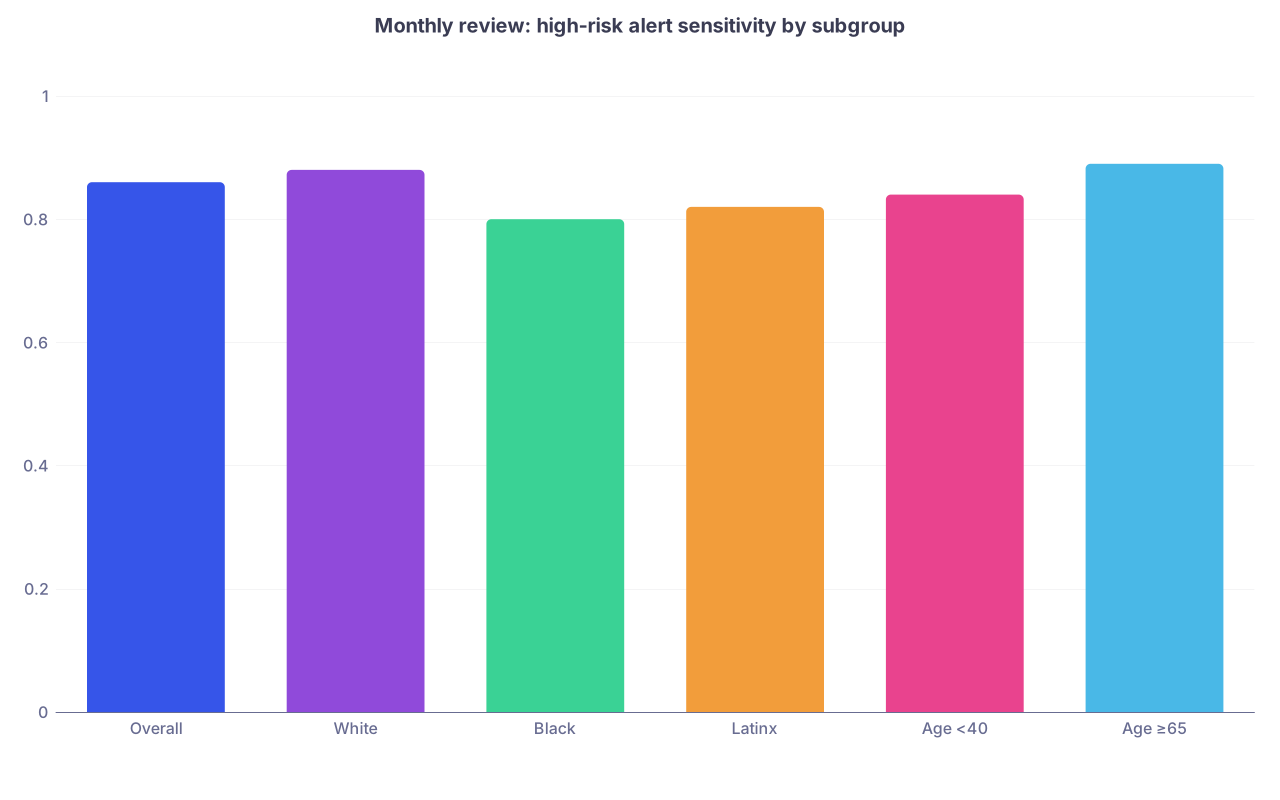
| Category | Value |
|---|---|
| Overall | 0.86 |
| White | 0.88 |
| Black | 0.8 |
| Latinx | 0.82 |
| Age <40 | 0.84 |
| Age ≥65 | 0.89 |
If you see performance degrading or inequitable patterns, you do not wait for the next vendor upgrade cycle. You adjust thresholds, retrain, or suspend components.
5.5 Documentation and policy: make your position explicit
You need clear written policies that are actually followed:
- Purpose statement:
- “This AI system provides risk estimates to assist triage; it does not replace clinician judgment or institutional triage scales.”
- Use rules:
- Who is expected to view scores.
- When and how scores should influence triage level or bed assignment.
- Override rules:
- Explicit support for overrides and examples.
- Requirement to document overrides in specific scenarios (e.g., high‑risk score but downgrading triage).
- Incident handling:
- How AI‑implicated adverse events are reviewed (M&M, root cause analysis including the model and its outputs).
This documentation does two things: it guides clinicians in real time, and it gives your legal team a coherent story when something goes wrong.
6. The future trajectory: where this is actually going
Let us talk about the next 5–10 years, not the sci‑fi decade.
6.1 From single‑task risk scores to multi‑task “ED copilots”
Today’s models mostly do one thing: predict X within Y hours. The next wave will:
- Jointly predict multiple outcomes:
- Mortality, ICU, need for emergent procedure, 72‑hour bounceback, etc.
- Suggest differential diagnoses based on triage text, vitals, and history.
- Recommend initial order sets (labs, imaging, consults) based on risk.
Think of a system that, on arrival, surfaces:
- “High probability pulmonary embolism vs low probability ACS vs moderate probability sepsis.”
- “Suggested: D‑dimer, CT‑PA, troponin, lactate; page ED attending for bedside assessment within 10 minutes.”
The legal exposure here rises sharply because it starts to look like clinical decision‑making, not just risk scoring. Regulatory bodies will probably classify many of these as high‑risk SaMD.
6.2 Adaptive learning and the “moving target” problem
Vendors are already pitching “continually learning” systems that update their parameters as new data come in. That is a nightmare for auditing and litigation if you do not have extremely tight version control:
- You must be able to say, “On May 12, 2028, version 3.4 of the model was in use, with these performance metrics.”
- You need a rollback plan if a new version performs worse or behaves unpredictably.
If your ED is not ready to manage this, you should demand frozen models with periodic, controlled updates, not live adaptive learning in production.
6.3 Patient‑facing AI triage before the ED
The other frontier is upstream:
- Health‑system apps that triage “Do I need to go to the ED?”
- Payer apps that subtly discourage ED use unless certain criteria are met.
- Public health portals that route people to ED vs telehealth vs urgent care.
Legally, these systems live in a gray zone between clinical advice and general information. But from a risk and ethics standpoint, if your hospital brands the app, you will own the backlash when someone with an atypical MI stays home because a chatbot said “monitor at home.”
7. Three things you cannot outsource to the algorithm
Let me end bluntly. There are three responsibilities you cannot offload to AI, no matter what the sales pitch suggests:
Duty of care to the individual patient.
The patient in front of you is not a data point in a risk distribution. If your clinical assessment screams “sick” and the model says “low risk,” you are obligated to treat the patient, not the average case. Judges and juries understand this instinctively.Duty to mitigate known biases.
If you have any awareness (and by now you do) that historical data and algorithmic systems can produce inequitable care, you must take active steps to monitor and correct. Saying “the model is race‑blind” will not cut it if outcomes are not.Duty to maintain and govern your tools.
AI triage systems are not “install and forget” IT projects. They are high‑risk clinical interventions that need version control, surveillance, and governance comparable to high‑risk medications or new invasive procedures.
If you remember nothing else:
- AI triage risk scores are only as good as their targets, thresholds, and calibration in your real patient population.
- Bias does not magically vanish in code; it usually gets cleaner, faster, and harder to see.
- Your legal vulnerability will come less from “using AI” and more from using it casually, without governance, documentation, or a defensible clinical role.
Treat AI triage like a powerful but dangerous drug. Indications, contraindications, monitoring, and informed clinical judgment. Or it will hurt your patients—and then it will hurt you.