
The belief that more medical data automatically leads to better care is wrong. Sometimes, more data just means more noise, more workload, and more opportunities to screw up.
We’ve turned “big data” into a kind of secular religion in healthcare. Hospital execs love to say “data-driven,” vendors promise “AI-powered insights,” and clinicians are told that if they just collect a little more data, the machine will figure it out.
That story sells software. It does not match what actually happens at the bedside.
Let me pull this apart.
The Myth: More Data = Better Decisions = Better Care
The neat story goes like this:
Collect massive amounts of patient data → feed it into sophisticated algorithms → generate precise, personalized insights → doctors make perfect decisions → outcomes improve and costs drop.
Sounds great. Reality looks different.
In real hospitals and clinics, big data usually means:
- EHRs bloated with half-useful, half-garbage documentation.
- Alerts firing constantly, most of them irrelevant.
- Dashboards nobody has time to read.
- “Predictive” scores that either state the obvious or are so opaque that nobody trusts them.
Let’s look at what the evidence actually shows, not what the pitch decks say.
Where Big Data Really Works (With a Ton of Caveats)
I am not anti-data. I’m anti-hype. Big data has real wins—but they’re narrower, more fragile, and more context-dependent than the marketing implies.
Example 1: Sepsis Prediction Tools
Several hospitals implemented machine learning models to predict sepsis hours before clinicians would normally recognize it. On paper, fantastic idea. Catch sepsis early, save lives.
Here’s what happened in practice:
- A 2021 study in JAMA Internal Medicine evaluated a widely used EHR vendor’s sepsis prediction model across multiple hospitals. Sensitivity was mediocre; it missed most sepsis cases. Specificity was worse; it flagged tons of patients who didn’t have sepsis.
- Many alerts were either redundant (the patient was already being treated) or wrong. Result: alert fatigue. Clinicians started ignoring them.
More data + more computing power did not automatically equal better care. It sometimes added noise to an already overloaded system.
Example 2: Early Warning Scores and Deterioration Monitoring
Hospitals love early warning scores—NEWS, MEWS, custom machine learning deterioration scores—based on vitals, labs, nursing notes, and so on.
Some systems do reduce cardiac arrests or ICU transfers. But dig into those success stories and you always see the same pattern:
The improvements come from the workflow, not just the data model.
- Clear escalation protocols.
- Rapid response teams that actually respond.
- Training nurses and residents to act on the score.
- Social permission to call for help early.
Same data. Very different outcomes depending on how humans use it.
Big data is an amplifier. It magnifies good systems and bad systems. It doesn’t fix either.
The First Real Limit: Signal vs Noise
Healthcare isn’t suffering from a lack of data. It’s suffering from a lack of usable signal.
Right now clinicians are drowning in numbers but starving for meaning.
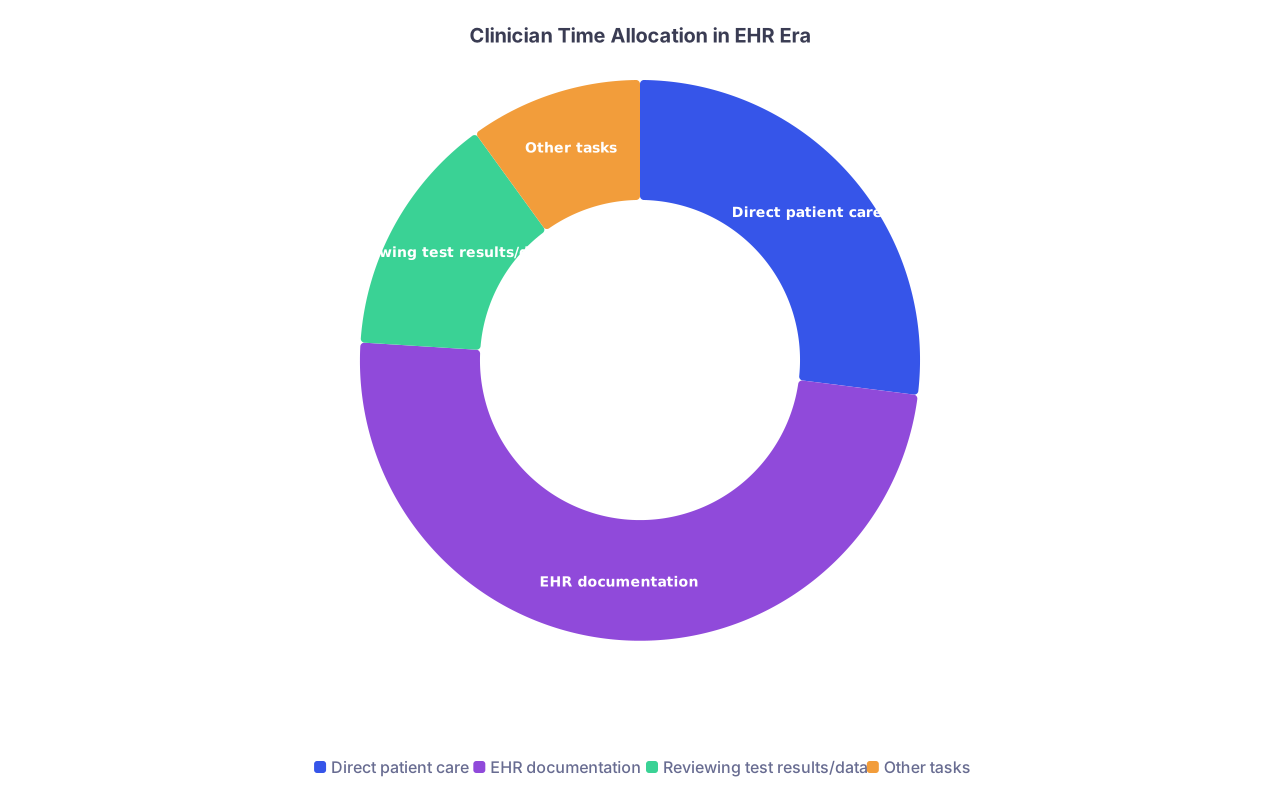
| Category | Value |
|---|---|
| Direct patient care | 27 |
| EHR documentation | 49 |
| Reviewing test results/data | 14 |
| Other tasks | 10 |
Multiple time-motion studies have shown attendings and residents spending roughly half their time on documentation and electronic tasks. Not “data-driven insights.” Clicking boxes, fighting interfaces.
The more you log, the less anyone can see. Classic signal-to-noise problem.
The fantasy is: add more data streams—wearables, ICU monitors, genomic data, social determinants, pharmacy claims—and magical patterns will emerge.
The reality: unless you’re ruthless about:
- What data actually changes decisions
- How it’s presented
- Who sees it when
…you just make the haystack bigger and congratulate yourself on having “more hay.”
The Second Limit: Data Without Context Is Dangerous
Healthcare data is rarely self-explanatory. It needs context, clinical reasoning, and judgment. Big data tools often tear it out of that context.
Confounding and Bias Are Not Academic Problems. They’re Daily Landmines.
You’ve probably seen the classic example: risk prediction models that label Black patients as “lower risk” because they historically used less healthcare, not because they were actually healthier.
That’s not a theoretical concern. It’s been documented.
Another one: readmission prediction tools. They’re often trained on past admissions and resource use. Patients who don’t come back (because they don’t have transportation, or do not trust the system) look “low risk” in the data. Until they crash in someone else’s ER.
The point: big datasets encode structural bias. If you do not explicitly fight that, you quietly bake it into “smart” tools and call it innovation.
The Third Limit: Human Bandwidth Is the Bottleneck
The scarcest resource in healthcare is not storage, compute, or bandwidth. It’s human attention.
We’ve already passed the point where clinicians can reasonably keep up with all the data generated on a single complex patient, much less a full panel.
You can see the absurdity in ICUs. A sedated patient is surrounded by:
- Continuous telemetry, blood pressure, respiratory rate
- Arterial lines, central venous pressures
- Ventilator curves
- Drips with titration protocols
- Labs every few hours
- Imaging results
- Consult notes, progress notes, nursing notes
If raw data volume equaled quality, ICU care would be flawless. It isn’t. Because attention, cognition, and time are finite.
What actually helps in those settings:
- Fewer, better alerts
- Smart suppression of noise
- Simple, clear displays of trend rather than pages of numbers
- Tools that synthesize and prioritize
Instead, many “big data” tools just throw more things onto the screen.
The Fourth Limit: The Wrong Incentives Driving Data Collection
Here’s the part people avoid saying out loud: a lot of healthcare data is collected for billing, compliance, and liability, not for patient care.
This is how you end up with:
- Note bloat: 10–20 page clinic notes generated by copy-paste and templates so every billing box is checked.
- Mandatory fields for things that do not change what you do.
- Structured fields for nuance-free checkboxes and free text for the parts you actually care about.
We have “big data” on whether the sepsis bundle checkbox was ticked within 3 hours. Much less on the quality of the exam, the weight of clinical suspicion, or the nuance of shared decision-making.
So when vendors brag about models built on “millions of patient encounters,” be skeptical. A lot of that data is noise, distortion, and gaming of documentation.

The Fifth Limit: Overfitting to Yesterday, Missing Tomorrow
Machine learning models are great at one thing: finding patterns in past data.
Medicine has a nasty habit of changing under their feet.
- New drugs change disease courses.
- New guidelines alter practice patterns.
- Pandemics show up and invalidate half your assumptions.
Many hospital-readmission or risk models quietly decay over time because the environment they were trained on no longer exists.
Retuning and recalibration are not optional. They’re rarely done properly in practice.
And the bigger the dataset, the worse the overconfidence. “We trained on 10 million patients” sounds impressive, but it just means you’ve captured 10 million instances of how things used to be done.
Where More Data Actually Helps
Now for the nuance. There are areas where more data can drive genuinely better care—if handled correctly.
1. Population-Level Trends and Policy
Big datasets are extremely useful when:
- You’re asking relatively simple questions
- At large scale
- With clear, measurable outcomes
For example:
- Tracking vaccine effectiveness across millions of people
- Identifying rare but serious drug side effects
- Understanding which hospitals or regions consistently underperform
Public health surveillance, pharmacoepidemiology, and policy evaluation all benefit from big data done right.
But that’s different from promising that your ICU dashboard will “revolutionize bedside care” because it ingests 500 variables instead of 50.
2. Narrow, Well-Defined Clinical Tasks
When the task is narrow and well-posed, big data can shine.
Think:
- Image classification (radiology, dermatology, pathology)
- Specific risk scores with clear endpoints (e.g., 30-day mortality after PCI)
- Dose adjustment suggestions for specific meds in defined populations
These tasks have a relatively clean ground truth and a clear “user” (radiologist, cardiologist, pharmacist). The trick is that these win stories are narrow and not magic. They’re tools, not oracles.
3. Operational Optimization
Hospitals as systems—not individual patients—respond well to data.
- OR scheduling efficiency
- Bed-management and flow prediction
- Staffing needs
- Supply chain and drug inventory
Here, more historic data really can reveal patterns humans can’t see easily. The risk is less about harming an individual and more about whether it actually reduces costs or simply shifts them.
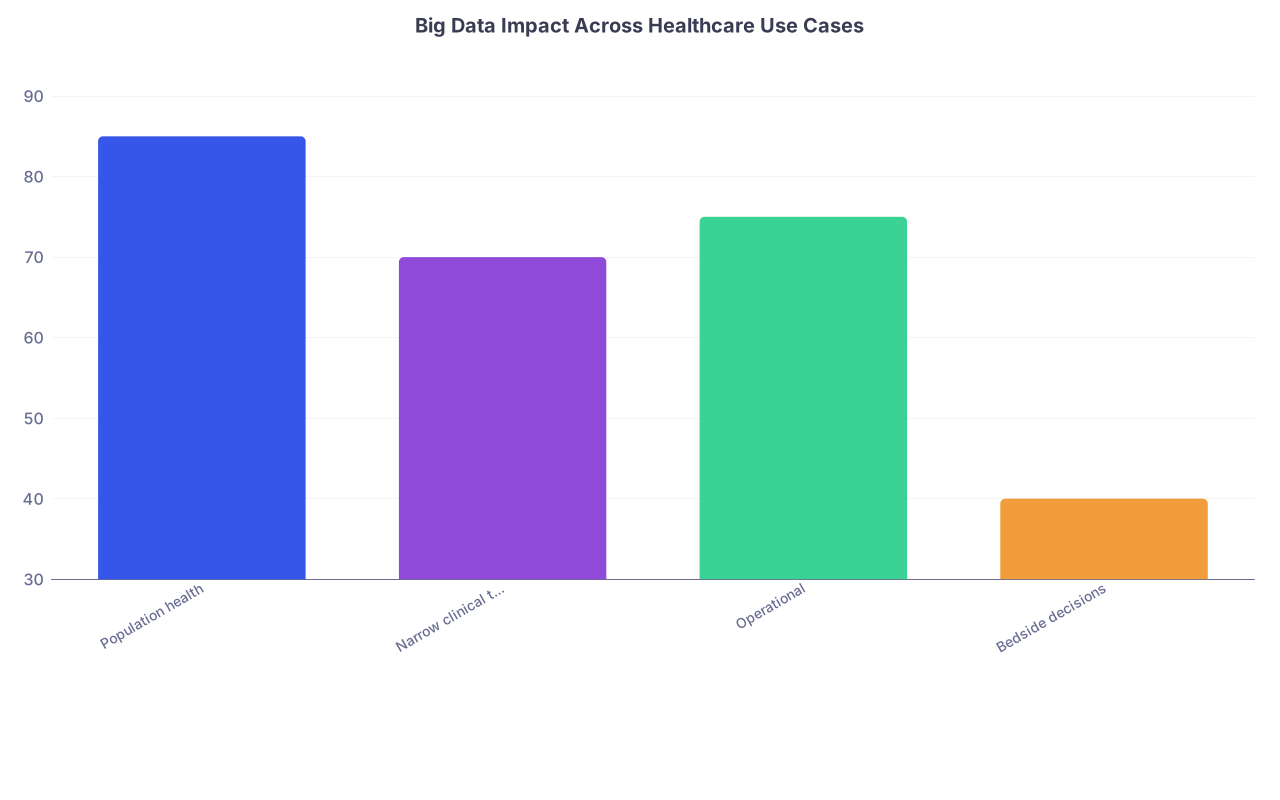
| Category | Value |
|---|---|
| Population health | 85 |
| Narrow clinical tasks | 70 |
| Operational | 75 |
| Bedside decisions | 40 |
(Think of those numbers as relative “fit” scores, not exact percentages.)
The Most Dangerous Myth: “The Algorithm Knows Best”
One of the most corrosive side effects of big data hype is de-skilling.
I’ve seen clinicians start to defer to risk scores they barely understand because “it’s what the system recommends.” It feels safer medicolegally. If something goes wrong, you followed the algorithm.
That’s backwards. Tools should be second opinions, not the boss.
The right mental model is this: every model is a biased, lossy compression of reality, trained on incomplete and sometimes skewed data, brittle to new circumstances, and blind to values and preferences.
That does not make them useless. It means they must be interrogated, not obeyed.
So What Actually Makes Data Improve Care?
Here’s the unsatisfying truth: more data helps only when several unfashionable, human things are done well.
| Claim | What Actually Matters |
|---|---|
| More data improves predictions | Better chosen, cleaner features do |
| Larger models are more accurate | Calibration, validation, and monitoring |
| AI reduces clinician workload | Workflow redesign and task redistribution |
| Dashboards improve decisions | Focused, prioritized, actionable displays |
| Data is objective | Data collection and labeling are biased |
The units that tend to succeed with data in healthcare:
- Start small. One concrete decision, one team, one outcome.
- Measure before and after with brutal honesty.
- Involve frontline staff in designing how information shows up.
- Kill tools that add burden without clear benefit.
- Accept that some clinically relevant nuance will never be fully captured in codes and checkboxes.
Big data is not a shortcut around doing the unsexy work of good clinical systems design.
The Future: Smarter, Smaller, More Selective Data
If you want a useful mantra for the future of healthcare tech, it is not “more data.” It is “less but better data.”
I expect the next serious wave of health tech to move in that direction:
- Strong emphasis on data minimization: only collecting what changes care.
- Intelligent filtering: systems that hide low-value data by default.
- Personalization of signal: what a senior intensivist needs to see is not what a first-year resident or outpatient PCP needs.
- Transparent models with clear failure modes, not black boxes that shrug and say “high risk.”

| Step | Description |
|---|---|
| Step 1 | Raw data streams |
| Step 2 | Curated meaningful data |
| Step 3 | Context aware models |
| Step 4 | Clear prioritized insights |
| Step 5 | Integrated into workflow |
| Step 6 | Changed clinical decisions |
| Step 7 | Improved outcomes |
| Step 8 | Noise and overload |
| Step 9 | Alert fatigue |
| Step 10 | Ignored tools |
| Step 11 | No impact |
The fork in that diagram is where most current efforts fail. They stay on the noise/overload branch and then blame “clinician resistance to innovation” when adoption stalls.
The fault is usually not resistance. It is that the system makes their day worse.
FAQ: The Limits of Big Data in Healthcare
1. So should we stop investing in healthcare data and AI?
No. But we should stop treating size as the main metric of value. Better datasets beat bigger ones. Thoughtful integration beats fancy models. If a tool cannot clearly show improved outcomes or reduced burden in a pilot, it does not deserve a broad rollout, no matter how “advanced” it is.
2. Are there examples where big data has clearly improved patient outcomes?
Yes, but they’re narrower than the hype. Some large insurers and integrated systems have used big claims and EHR datasets to improve vaccination rates, manage chronic disease at scale, and catch medication issues. Certain ICU early-warning tools, when paired with aggressive response teams, have reduced mortality. The common thread: tightly defined goals and serious workflow redesign.
3. How can clinicians protect themselves from bad or overhyped data tools?
Ask three questions: What exact decision is this changing? What evidence shows it improves outcomes (not just prediction accuracy)? What happens when it is wrong? If vendors or administrators cannot answer clearly, push back. Refuse to let a black box quietly become the standard of care.
4. Is the problem mostly technical (bad models) or cultural (bad adoption)?
Both, but the cultural and organizational side is usually the real bottleneck. Even a decent model is useless if it fires alerts at the wrong time, to the wrong people, or with no clear action attached. Conversely, a simple risk score can be powerful if it is trusted, well understood, and built into daily routines.
5. What should health systems actually prioritize with data right now?
Clean up existing data quality, reduce documentation burden, and focus on a small number of high-impact use cases: medication safety, a few key deterioration or risk scores, and operational efficiency. Ruthlessly shut down dashboards and tools that nobody uses. The future is not about collecting everything. It is about curating what matters, and then getting out of clinicians’ way.
In the end, three points: more data does not automatically mean better care; human attention, not storage, is the true limiting factor; and the systems that win with data are the ones disciplined enough to say no to most of it.