
AI will not save burned‑out clinicians from a broken workload. In some settings so far, it’s actually making things worse.
Let me be blunt. The dominant narrative in conference keynotes and vendor decks is: “AI will reduce documentation burden, restore joy in medicine, and solve burnout.” That story is comforting, marketable, and only partially supported by data. When you look at the actual studies, you see something messier: pockets of benefit, plenty of neutral results, and a hard ceiling imposed by staffing ratios, visit volume, and regulatory insanity.
If you try to fix structural overload with software alone, you just get more sophisticated misery.
What burnout research actually shows (before you sprinkle AI on top)
You cannot judge AI’s impact on burnout if you do not understand what’s driving burnout in the first place. And no, it’s not just “too many clicks.”
Across large surveys and systematic reviews, the causes are remarkably consistent: workload, loss of control, and misalignment between values and incentives.
The 2019 National Academy of Medicine consensus report on clinician burnout pulled together dozens of studies. They highlighted:
- Workload and job demands as primary drivers
- Inefficient practice environments (EHR friction, poor workflows)
- Loss of autonomy and lack of control over schedule and decisions
Notice the order. Technology is in there, but it’s a multiplier, not the root.
The Medscape national physician burnout and depression surveys, year after year, show 50%+ of physicians reporting burnout. The top self‑reported causes: too many bureaucratic tasks, too many hours, lack of respect, and EHRs. AI is essentially a layer on top of that environment.
So when a vendor says “our ambient scribe cut burnout 30%,” your first question should be: compared to what, over how long, and in what context? Because every effect size lives inside a system that may be fundamentally unsustainable.
The AI documentation myth: it helps, but not how the marketing claims
The most popular burnout‑reduction promise right now is ambient AI documentation. Microphones in exam rooms, transcripts fed to large language models, structured notes popping out “automatically.” The pitch is simple: less typing, fewer late‑night notes, happier clinicians.
Let’s look at actual data instead of glossy demos.
What studies actually report
The early evidence is mixed but interesting.
A 2023 prospective evaluation in primary care of an AI ambient scribe (think DAX‑like tools) showed reduced after‑hours EHR time and high reported satisfaction. Another multi‑site implementation study found physicians self‑reported less documentation burden and more ability to focus on the patient during the encounter.
So far so good. But dig into the details and patterns emerge:
- Most studies:
- Are short-term (weeks to a few months)
- Rely heavily on self‑reported satisfaction, not validated burnout scales
- Occur in settings that chose to adopt the tool (i.e., more tech‑friendly, usually better‑resourced clinics)
When you use more rigorous measures, the story softens. Some early evaluations using the Maslach Burnout Inventory show modest reductions in emotional exhaustion sub‑scores, but not earth‑shattering reversals of burnout rates.
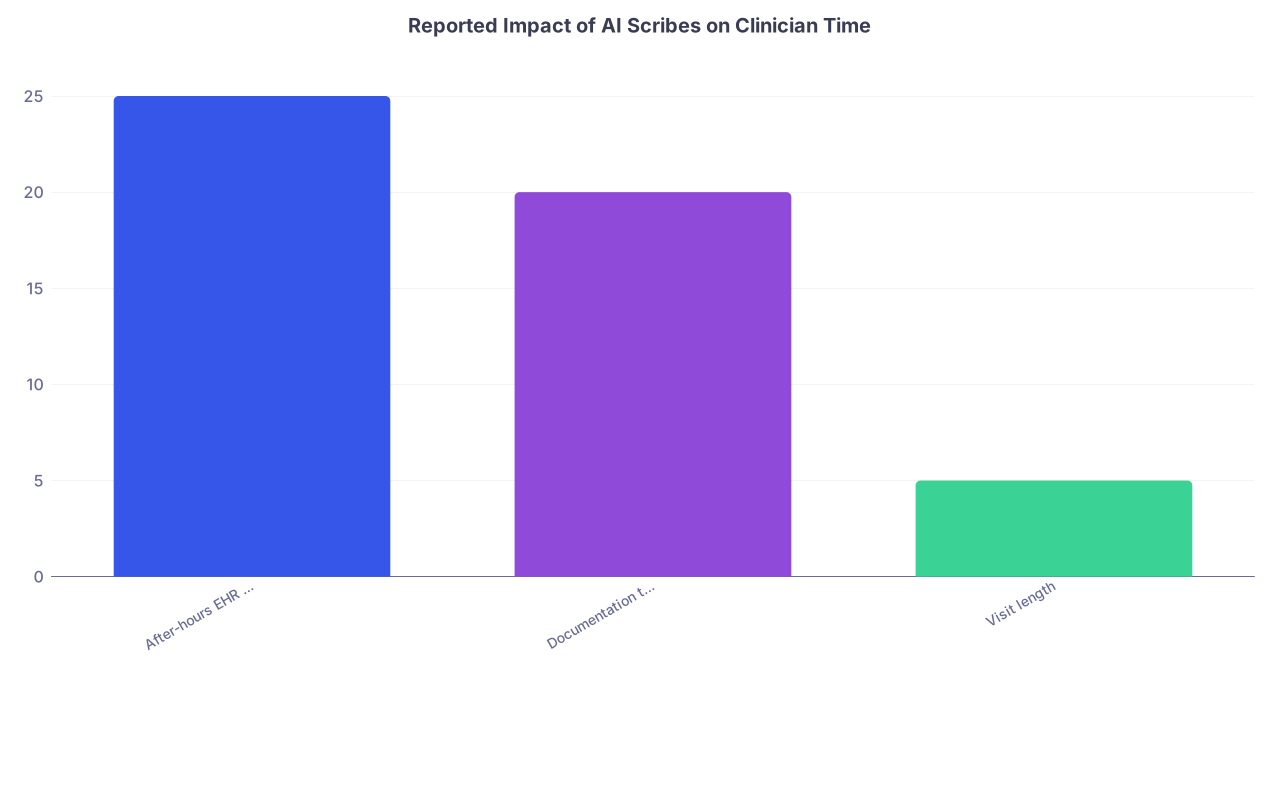
| Category | Value |
|---|---|
| After-hours EHR time | 25 |
| Documentation time per visit | 20 |
| Visit length | 5 |
Those numbers are roughly representative of what pilot studies claim: 20–25% reductions in after‑hours EHR work, smaller but real decreases in documentation time per visit, and minimal effect on visit length.
Here’s the problem: shaving 20% off your note‑writing does not magically fix a schedule that’s already unsafe.
If you’re doing 24 visits a day, running 90 minutes behind, covering an inbox of 200 patient messages, and taking call every 4th night, an AI scribe is a painkiller, not definitive treatment. It may stop the immediate bleeding of clerical overload, but the deeper laceration—unsustainable throughput—remains.
Hidden costs that rarely make it into the brochure
Clinicians who actually use these systems will tell you what papers often gloss over.
First, you have to correct the AI. At least at current performance levels, the draft note is not “done.” You spend time:
- Fixing nuance (the model mis‑states risk discussions, or over‑documents)
- Deleting extraneous fluff to avoid bloated notes
- Watching for hallucinated details that never happened
Second, you are now under constant audio surveillance. Some clinicians adapt; others feel watched and constrained, which is its own kind of cognitive load.
Third, practices often treat “saved” documentation minutes as capacity to cram in more patients. That is the cardinal sin. You give people a tool that frees 30 minutes a day, then quietly increase panel size or double‑book. No wonder some pilots report neutral or even worse burnout scores at 6–12 months despite technical success.
I’ve seen this play out: attending is thrilled for a month (“I finished my notes before 5 pm for the first time in years”), then administration bumps their template from 18 to 22 patients because “the AI is helping, right?” Six months later they’re back to charting at home, just on different parts of the record.
AI helped efficiency. Leadership killed the benefit.
Workload is the real variable, and the data says so
Look at the research that tracks EHR burden and burnout across hundreds or thousands of clinicians. A few large‑scale studies:
- Sinsky et al. (2016, Annals of Internal Medicine): physicians spent nearly two hours on the EHR and desk work for every hour of direct patient care during the day, plus one to two hours of after‑hours “pajama time.” That ratio alone predicted burnout.
- Later EHR log studies in large health systems show higher EHR time per day, especially after hours, is independently associated with emotional exhaustion, even after controlling for specialty and demographic factors.
None of those were AI studies. They were about workload measured through digital exhaust.
Now blend in AI. If AI reduces clicks but the total number of tasks, messages, and visits keeps rising, you’ve essentially just improved your ability to endure a bad situation. You did not correct the dose of work.
| Factor (from burnout studies) | AI Commonly Targets? |
|---|---|
| Visit volume / panel size | Rarely |
| After-hours work | Sometimes |
| Documentation time per visit | Yes |
| Inbox / messaging volume | Emerging tools |
| Sense of control over schedule | No |
| Misaligned incentives / RVU pressure | No |
AI is hitting one, maybe two, of the key drivers. The structural heavyweights—volume, staffing, control—are untouched.
If you see a study where AI reduced documentation time but burnout didn’t budge, that’s why.
Inbox and triage AI: another partial fix with hidden traps
The other hot category is AI‑assisted triage and messaging. Algorithms that route, summarize, or draft replies to patient portal messages. Again, the promise: less inbox chaos, happier clinicians.
Some early work is promising. Large language models can draft safe, empathetic responses for low‑risk, informational questions. Triage algorithms can prioritize urgent messages and auto‑route simple requests (refills, paperwork) away from physicians.
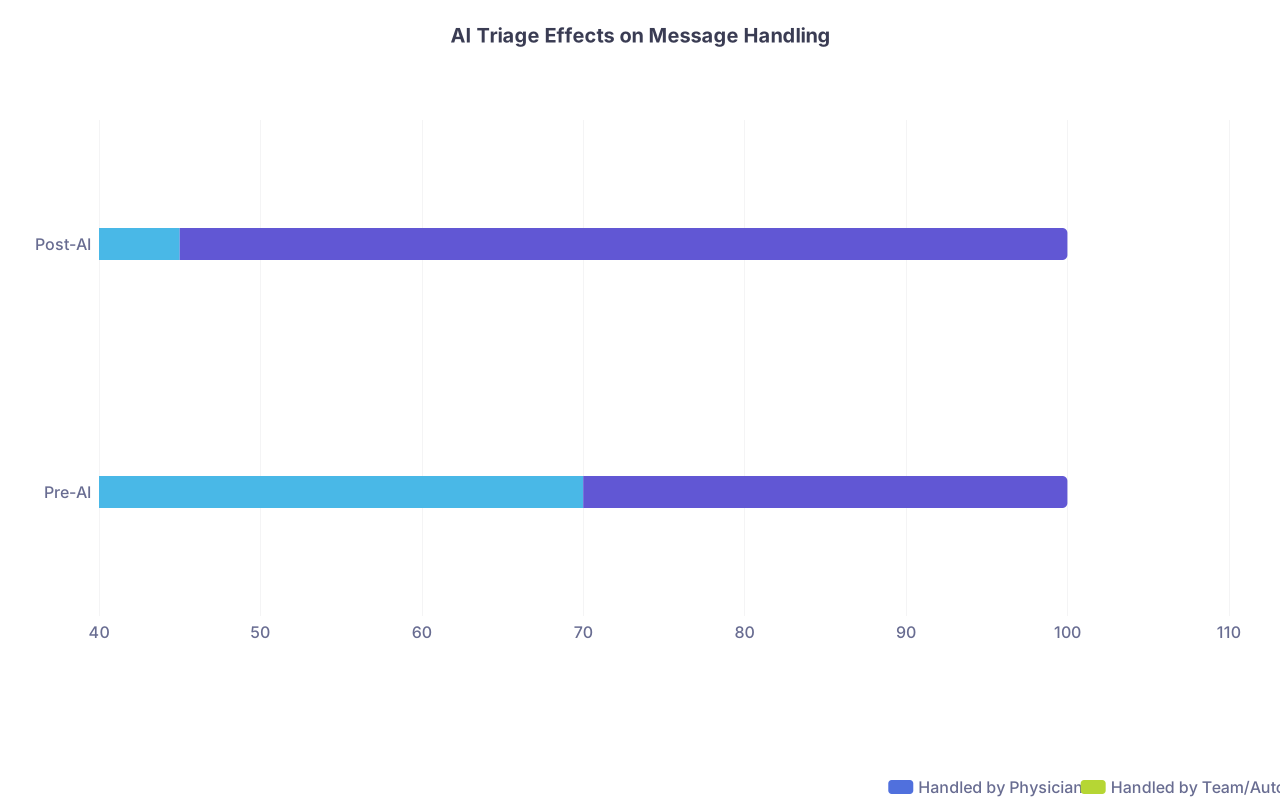
| Category | Handled by Physician | Handled by Team/Auto |
|---|---|---|
| Pre-AI | 70 | 30 |
| Post-AI | 45 | 55 |
Again: directionally good. Less low‑value work for the MD or NP. But there are three problems that do not go away with clever code.
First, message volume is not static. Several systems that expanded portal messaging and quick‑response guarantees saw message volume spike. Make it easier to message and you get more messages. If patient expectations aren’t managed, AI‑driven responsiveness just feeds the beast.
Second, responsibility stays with the clinician. If the model drafts an answer but you are legally on the hook, you must read and approve. That’s not zero work. It’s different work, and sometimes more stressful work, because now you are supervising an unpredictable junior assistant that occasionally makes confident errors.
Third, AI triage does nothing about the upstream cause of messaging overload: patients who cannot get timely in‑person or telehealth access, confusing care plans, fragmented transitions. Those are system design failures. Turning them into sorted inbox tasks doesn’t fix them.
The documentation paradox: better notes, worse day
There’s a quieter issue I see in the better‑designed AI tools: they generate beautifully comprehensive notes. Which sounds great. Until you remember how U.S. medicine works.
More complete notes often mean:
- More data for auditors and payers to scrutinize
- Longer documents that are harder for other clinicians to parse
- A subtle push to “up‑document” risk, which moves you closer to compliance minefields
Some physicians are already anxious about “click compliance” and upcoding investigations. Offloading note drafting to AI doesn’t erase that; in some cases, it amplifies it. I’ve heard actual comments like, “Now I have to check what the AI added that might look like I’m overbilling.”
So AI can paradoxically heighten the sense of surveillance and guilt that accompanies documentation, even if the raw time goes down.

Where AI does help in a meaningful way
I’m not arguing AI is useless. That would be just as lazy as the hype.
Where the data and real‑world reports converge is this: targeted AI, implemented with sane workload policies, can materially improve day‑to‑day experience.
Examples that look promising:
- Ambient documentation in high‑complexity visits, where narrative content is rich and typing is most painful.
- AI‑assisted information retrieval inside bloated EHRs—“show me last three echos and cardiology notes”—cutting cognitive friction.
- Decision support tuned to reduce noise, not add it. Intelligent filtering of alerts, not yet another pop‑up.
When these tools are introduced alongside guardrails like “we will not increase your visit volume or panel size as a result,” clinicians report not just time savings but genuine relief. Less after‑hours work. Less screen‑staring during visits. More feeling like a physician instead of a court reporter.
That’s the combination that matters: technology plus explicit protection of the time it saves.

| Step | Description |
|---|---|
| Step 1 | Deploy AI Tool |
| Step 2 | Less after hours work |
| Step 3 | Lower exhaustion |
| Step 4 | More throughput |
| Step 5 | Burnout unchanged or worse |
| Step 6 | Workload Policy |
Without the “volume protected” branch, you’re just greasing the wheels of a machine that’s already running clinicians into the ground.
The uncomfortable truth: leadership decisions beat algorithms
Most burnout variance is not between individual doctors. It’s between organizations.
Studies repeatedly show that specific clinics or hospitals, even within the same specialty and region, have vastly different burnout rates. The difference is leadership style, staffing, workflow design, and expectations about productivity.
AI does not change any of that by itself. In a supportive environment, it’s a powerful assist. In a toxic environment, it’s a more efficient whip.
I’ve seen two primary care groups adopt the same ambient scribe product:
- Group A capped visits per day, guaranteed two admin blocks per week, and explicitly told clinicians, “time saved is yours.” Burnout scores went down, and retention improved.
- Group B treated it as a “productivity enabler,” bumped slots by 15–20%, and pushed more portal work into “just use the AI to answer quickly.” Chart times looked better on paper. Burnout got worse.
Same AI. Different system. Only one group fixed burnout.

If you’re a clinician being sold AI as the magic answer, your key question to leadership is not “what model are we using?” It’s “what, exactly, will you change about workload and expectations when this goes live?” If the answer is vague, assume the benefit will evaporate.
So what does the evidence‑based path forward look like?
Strip away the sales language and you end up with a fairly simple, slightly inconvenient reality.
Burnout is primarily a function of workload, control, and meaning. AI can influence the first two at the margins, but only if organizations choose to bank the gains instead of spending them on more throughput.
If you want AI to actually move the needle, not just make slides look innovative:
- Use AI to reduce low‑value work, but then freeze or reduce volume. Make a binding commitment not to increase visit counts, panel sizes, or required inbox quotas for at least 12–18 months after implementation.
- Track real burnout metrics, not just satisfaction with the tool. Use validated surveys at baseline and at regular intervals, and be prepared to roll back or modify deployments that correlate with worsening scores.
- Pair AI with non‑technical fixes the literature already supports: better staffing, predictable schedules, protected time, decent leadership training.
That combination has a chance. AI alone does not.

The bottom line
AI can make the workday smoother, but it cannot fix an unreasonable workload. At best, it buys back time that leaders must choose not to resell as “productivity.”
Most of the variance in burnout will still come from staffing ratios, schedules, and culture—not from which AI vendor your system signed a contract with.