
The stereotype that older physicians are anti-tech is lazy, wrong, and increasingly dangerous to repeat.
If anything, the data say something much less convenient: age matters far less than you think. Workflow, incentives, training, and system design drive adoption. Not birth year.
Let’s walk through what surveys and real-world usage actually show—because the “boomer doctor who hates computers” story is mostly a comforting myth younger clinicians tell themselves to feel superior.
The Myth vs. the Numbers
Here’s the cartoon version everyone repeats:
Older doctors hate electronic health records (EHRs), refuse telehealth, and block innovation. Younger doctors are “digital natives,” love apps, and are just waiting to revolutionize healthcare if those dinosaurs would retire.
Now, data.
Multiple surveys over the last decade show:
- Older physicians are slightly slower to adopt some new tech initially.
- But once you control for practice type, specialty, and setting, the age differences shrink dramatically.
- On some measures—like sustained EHR use, patient portal adoption, or comfort with telehealth—older physicians look just as good, and sometimes better, than younger ones.
Let me put some structure on this.
| Measure | Younger Physicians (<45) | Older Physicians (≥55) |
|---|---|---|
| Early adoption of new apps | Higher | Lower |
| EHR use (any use) | Very high | Very high |
| Telehealth visits during COVID | Very high | Very high |
| Long-term EHR satisfaction | Mixed | Mixed |
| Use of patient portals/messages | High | High |
Is this exact? No, because individual surveys vary. But this is the pattern that keeps showing up across AMA, ONC, and specialty society data.
So where does the “older physicians are anti-tech” story actually come from?
Partly from a real signal. Mostly from selection bias and convenient scapegoating.
What EHR Surveys Really Show (Not What Folks Assume)
Let’s talk electronic health records first, because that’s usually Exhibit A in the “old doc vs tech” narrative.
The early 2000s story was simple: solo, older docs in small private practice were less likely to adopt EHRs. That part is largely true. But then the federal incentives hit, health systems consolidated, and by the late 2010s, EHR adoption was near universal across age groups in most surveys of office-based physicians.
What changed? Not the personalities. The environment.
When you look at Office of the National Coordinator (ONC) and AMA data patterns over time, you keep seeing the same thing:
- Practice size and ownership predict EHR adoption far more than age.
Hospital-employed? You’re on an EHR, whether you’re 35 or 65. - Specialty matters more than age. Radiology, emergency medicine, and hospitalist groups went digital early; some cognitive and procedural specialties lagged.
- Within the same system, older and younger physicians are overwhelmingly using the same EHR.
Where you do see age effects is not “uses EHR vs doesn’t” but nuance:
- Younger doctors are a bit more willing to experiment with new features: templates, voice recognition, data dashboards.
- Older doctors are sometimes more consistent in their use of core functionality once trained. They settle on a workflow and hammer it.
I’ve sat through EHR optimization sessions where the “old-school” cardiologist in his 60s was the one who had built the most effective custom macros and dot phrases—and the 30-something internist was still typing free-text novels into every progress note.
Let’s visualize the real gap most surveys hint at.
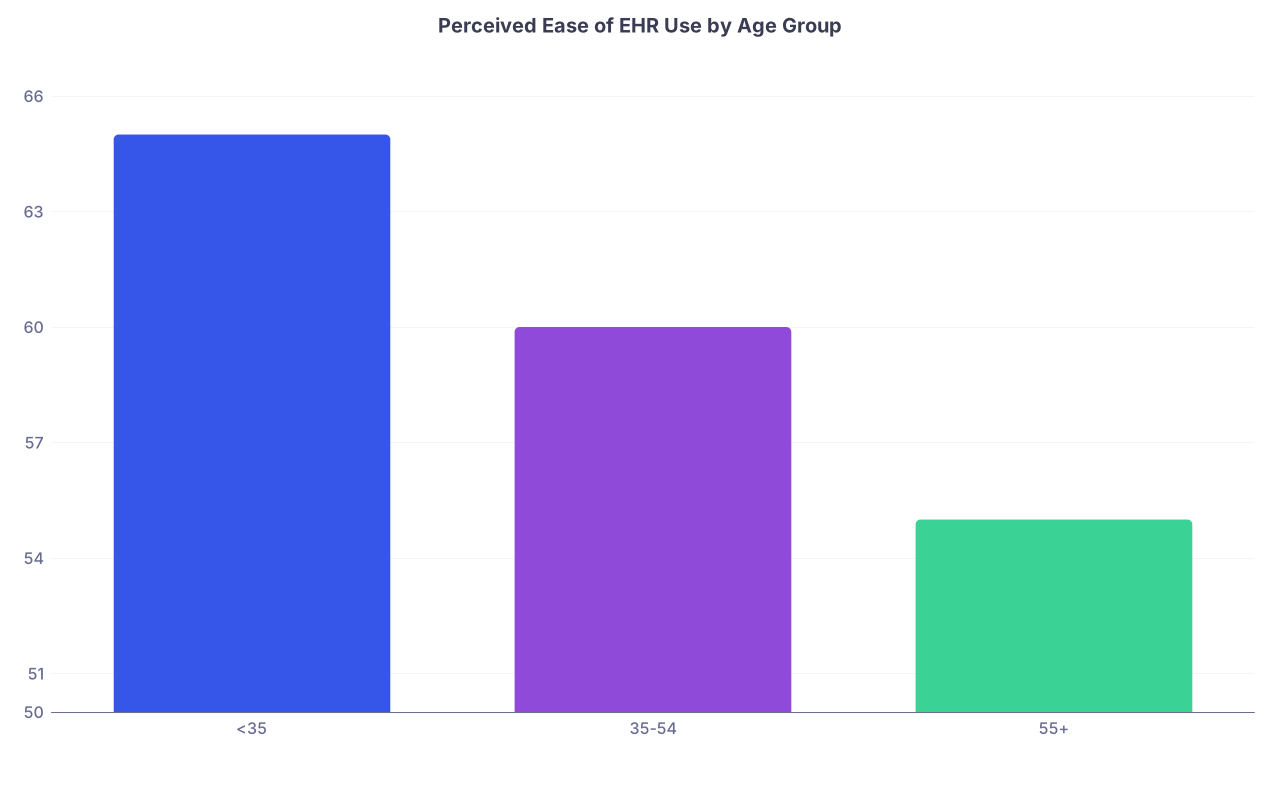
| Category | Value |
|---|---|
| <35 | 65 |
| 35-54 | 60 |
| 55+ | 55 |
Interpret that: yes, older docs often report a bit less ease or comfort. But 55% saying they find their EHR reasonably easy is not “they hate all technology.” It’s “this software is annoying, especially if you didn’t grow up with GUIs—but we’re using it anyway.”
The bigger story in EHR satisfaction is vendor design and regulatory bloat, not age. Everyone is miserable together.
Telehealth: The Myth Really Falls Apart Here
The pandemic exposed a lot of myths. This one included.
You probably heard some version of: “Telehealth exploded because younger doctors embraced it; older ones resisted and tried to pull patients back to the office.”
The actual data? Boringly different.
Surveys from 2020–2022 across AMA, specialty societies, and large systems tend to show:
- Near-universal telehealth use across all age groups during peak COVID.
- Very small differences by age once access to platforms and training was standardized.
- Older physicians often had similar or higher telehealth volumes simply because they had larger established patient panels.
Here’s the pattern that keeps popping up:
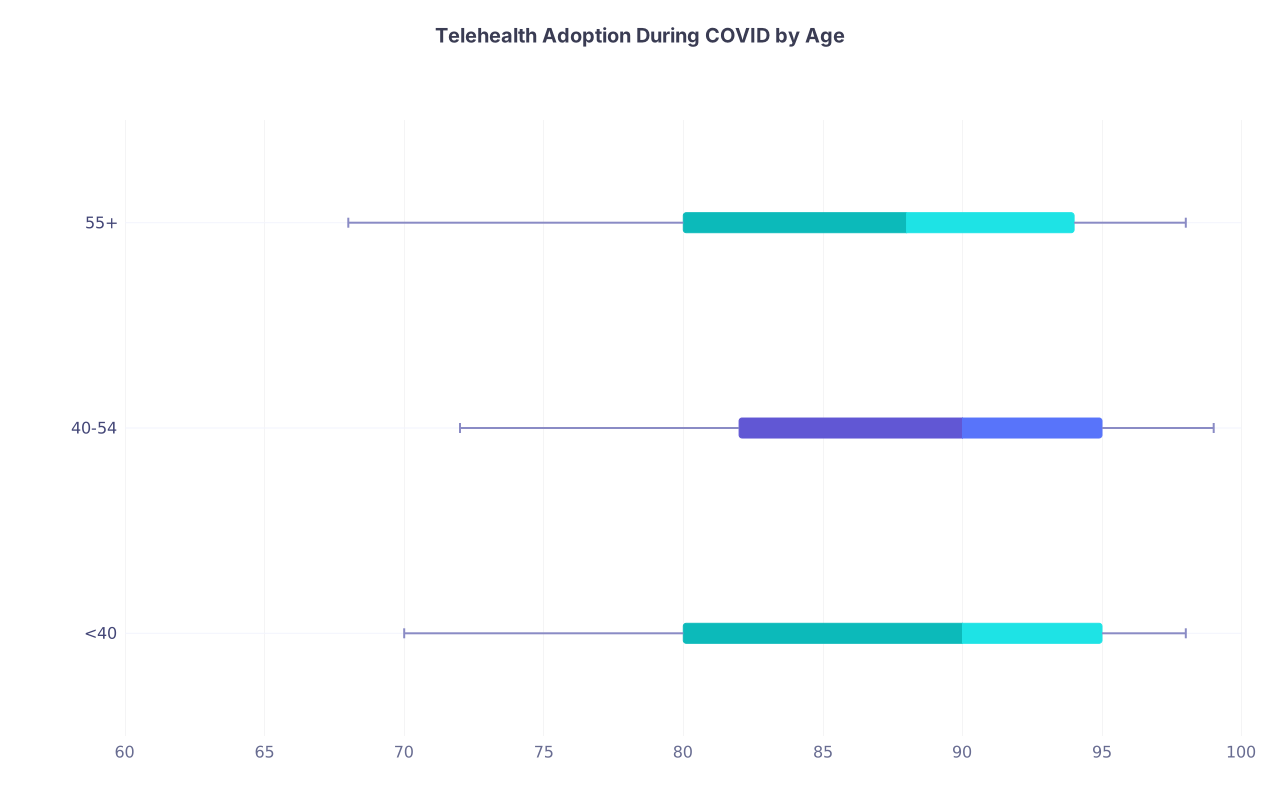
| Category | Min | Q1 | Median | Q3 | Max |
|---|---|---|---|---|---|
| <40 | 70 | 80 | 90 | 95 | 98 |
| 40-54 | 72 | 82 | 90 | 95 | 99 |
| 55+ | 68 | 80 | 88 | 94 | 98 |
Those are rough illustrative ranges, but this is what many health system internal dashboards looked like: everybody jumped in; the distribution overlaps heavily; a minority in every group dragged their feet.
What made the real difference:
- Whether the organization provided frictionless infrastructure (one platform, decent support).
- Clear billing and documentation rules.
- Protected time for training.
I’ve heard this firsthand in hallway conversations:
- The 62-year-old endocrinologist: “Once someone set up the templates for me and I knew I’d be paid, this was great. I see my stable diabetics at home, no commute, fewer no-shows.”
- The 34-year-old surgeon: “I hate telehealth. Waste of time. I can’t examine the patient properly and the video platform keeps freezing.”
Age didn’t predict enthusiasm. Clinical fit and implementation did.
“Digital Native” Is One of the Most Overrated Ideas in Medicine
You hear this constantly: younger physicians are “digital natives” and thus inherently better suited to modern health tech.
That argument ignores reality on multiple fronts.
First, being comfortable with smartphones and social media doesn’t magically translate into loving clunky enterprise software. A 29-year-old who lives on TikTok is just as likely to despise a poorly implemented EHR as a 59-year-old who uses a flip phone.
Second, older physicians have been forced to adopt multiple waves of tech already:
- Paper to basic EMRs
- Fax to secure messaging
- Dictation to voice recognition
- Pagers to secure text apps
Many of them know the pain points better than younger colleagues who entered after the dust settled. I’ve watched senior docs walk into vendor demos and cut straight through the nonsense: “Show me how fast I can refill 20 meds at once. No, not the pretty dashboard—the actual workflow.”
Younger doctors, ironically, sometimes have less leverage and power within organizations to demand tech that works. They’re the ones stuck on the default templates, while some cranky senior partner has a custom build the residents would kill for.
Where Older Physicians Do Push Back (And They’re Usually Right)
Let’s be honest: there are areas where older physicians resist certain technologies more than younger ones. But the nuance matters.
Three common friction points:
Patient-facing algorithms and AI “decision support”
Older physicians are more likely to question opaque risk scores and automated prompts. That’s painted as “anti-tech,” but often it’s “I’ve watched enough hype cycles to know when vendors are overselling.”Wearable data dumps
Many older physicians groan (loudly) about patients bringing in 40 pages of Fitbit heart rate graphs. Younger docs groan too—they just complain about it on Twitter instead of at grand rounds. The issue isn’t age; it’s information overload with no reimbursement.New messaging channels without time or pay
Older physicians are often more willing to say what everyone is thinking: “No, I’m not answering app messages at 10pm for free.” Younger physicians do it silently and burn out faster.
None of this is luddite behavior. It’s boundary-setting in a system that loves to dump unpaid digital work on clinicians.
If you’re designing “the future of healthcare” and you treat this skepticism as an age problem instead of a design and incentives problem, you’re the one not thinking clearly.
What Actually Predicts Tech Adoption in Physicians
Let me cut through the hand-waving and summarize what surveys and real-world implementation experience keep showing.
The strongest predictors of whether a physician embraces new technology are:
- Practice environment – Health system vs solo. Employed vs independent. Integrated IT vs every doc for themselves.
- Perceived impact on control and autonomy – Tools that feel like surveillance or extra admin work get resisted across all ages.
- Training and support – A 60-year-old with a good super-user and real training will outperform a 30-year-old tossed a login and a PDF manual.
- Time and incentives – If there’s no protected time, no RVUs, and no recognition, adoption dies. Again, regardless of age.
Age is a secondary amplifier. If you already feel closer to retirement, you’re less likely to volunteer as beta-tester for a chaotic new telehealth platform. That’s not “anti-tech,” that’s cost-benefit calculation.
On the flip side, I’ve watched older physicians become fierce champions of tools that clearly save time or improve patient care: automated lab follow-up, smart prescribing checks (when not spammy), and structured templates for complex diseases they see every day.
The pattern is simple:
- Tech that reduces friction and respects clinical judgment is embraced.
- Tech that adds clicks and second-guesses physicians under the guise of “innovation” is hated.
Everyone is rational here. It’s just more fashionable to blame “older doctors” than admit your product is bad.
The Age-Blaming Problem: It Hides the Real Work
The “older physicians are anti-tech” myth is more than just inaccurate; it’s operationally harmful.
It does three nasty things:
Lets vendors off the hook
If adoption is low, they can say, “Well, doctors over 55 are resistant.” No. Maybe your interface is garbage and your implementation was top-down and rushed.Splits physicians into fake tribes
Younger vs older, progressive vs dinosaur. In reality, both groups complain about the same things over coffee: alert fatigue, inbox overload, poor integration, and lost face time with patients.Stops leaders from fixing structure
It’s easier to mutter about “older docs not getting it” than to invest in better training, co-design, usability testing, and compensation models that reflect digital work.
If you actually want the future of healthcare to work, you need to do the unsexy, structural stuff—across every age group.
Here’s what that actually looks like in practice:

| Step | Description |
|---|---|
| Step 1 | Identify Clinical Need |
| Step 2 | Co-design With Clinicians |
| Step 3 | Align Incentives and Time |
| Step 4 | Provide Training and Support |
| Step 5 | Measure Real Outcomes |
| Step 6 | Iterate or Kill Tool |
Notice what’s not in there: “Make sure younger doctors push it on older ones.” Because that’s not how sustainable change works.
Where the Future Is Actually Heading
If you look past the noise, the future of healthcare tech is going to be driven by mixed-age teams of clinicians who share one trait: low tolerance for tech that wastes time.
The fantasy of some “gen-Z-only” digital revolution in medicine is just that—a fantasy. Here’s what’s actually emerging inside competent systems:
- Senior physicians setting hard clinical and workflow requirements.
- Mid-career physicians translating that into operational realities.
- Younger physicians stress-testing tools and workflows early, then feeding back issues.
- Health IT and data teams forced to serve all three rather than flattering just the “innovators.”
And in this mix, the 58-year-old who remembers life before EHRs is often the most valuable skeptic in the room. They know exactly what got better and what got worse—and they’re often the first to call out when a “solution” just moves the work from one place to another.
Let’s ground this a bit more visually.
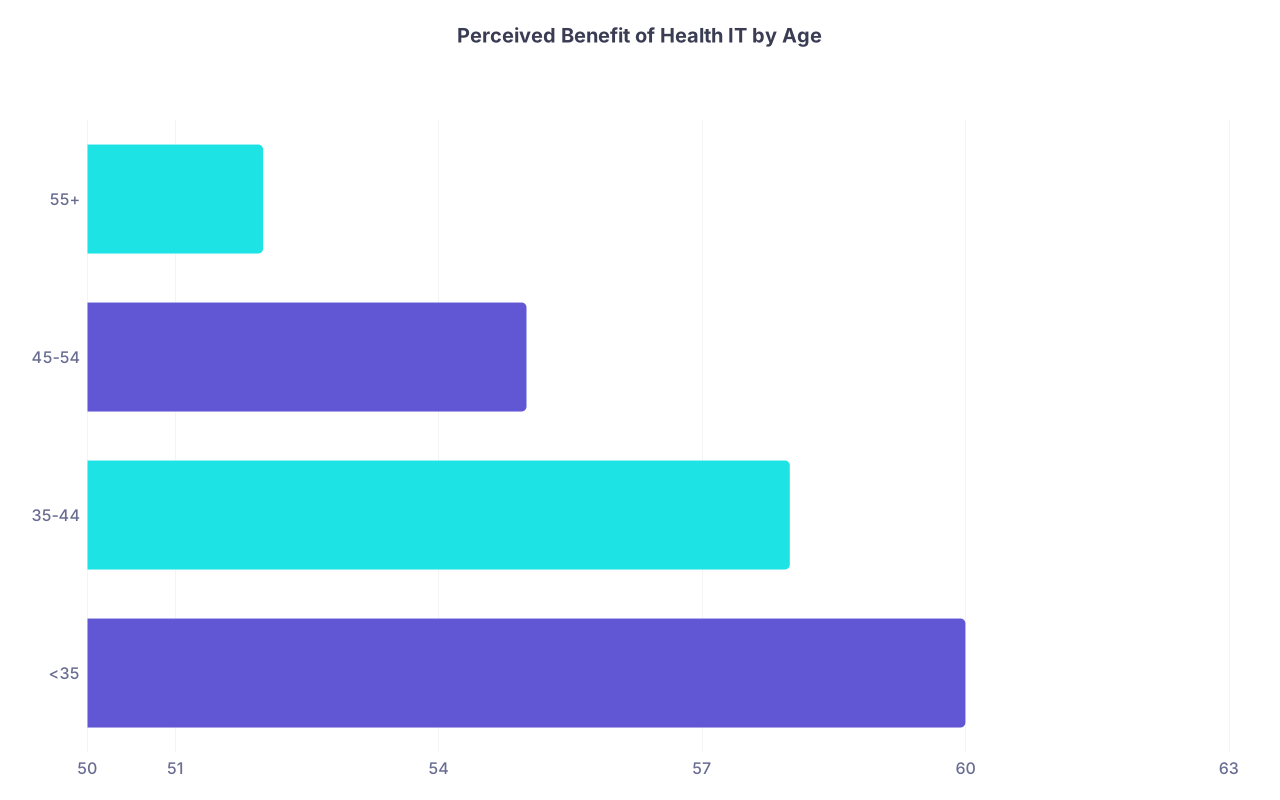
| Category | Value |
|---|---|
| <35 | 60 |
| 35-44 | 58 |
| 45-54 | 55 |
| 55+ | 52 |
You might look at that and say, “See, older doctors see less benefit!” I look at that and say: all of those numbers are mediocre. Which means the problem isn’t that 55+ physicians are reactionary. It’s that current health IT still kind of sucks across the board.
And they’re all telling you that.
How You Should Actually Think About “Older” Physicians and Tech
If you’re a policymaker, a health tech founder, or a resident rolling your eyes at a senior consultant, here’s the framing shift you need.
Stop asking: “Why are older doctors so anti-tech?”
Start asking: “What would make this tool obviously valuable to a clinician with 30 years of scar tissue and no need to impress anyone?”
If you can pass that test, you’ll have zero trouble signing up the 35-year-olds.
And if your tech only impresses people who have never seen a full malpractice lawsuit, a broken EHR migration, or an inbox meltdown after a poorly planned patient messaging rollout—then yes, older physicians will resist you.
They’re not anti-tech. They’re pro-survival.
Key points:
- Surveys consistently show small age differences in tech adoption once you control for practice setting, specialty, and support; the “older physicians are anti-tech” narrative is mostly myth.
- Resistance from older clinicians usually targets badly designed, workflow-worsening tools, not technology itself—and their skepticism often protects everyone from avoidable disasters.
- If your “innovation” cannot convince a clinically busy, near-retirement physician that it’s worth their time, the problem isn’t their age. It is your design, your incentives, or both.