
The future of medicine might make you a highly paid prescription technician for Amazon‑Pfizer‑GoogleCare rather than an actual doctor.
That’s the fear, right?
You’re not just worried about getting into med school or residency. You’re worried that by the time you finally get there, “your” practice won’t really be yours. That pharma, insurers, and big tech will quietly be calling the shots while you click boxes in an EMR and “trust the algorithm.”
You’re scared that:
- Pharma will decide what you prescribe.
- Tech companies will decide how you diagnose.
- Hospital admins and payers will decide how long you see patients.
And you’ll just…sign orders.
Let’s talk about that. Honestly. Because some of your fears are exaggerated, but some of them are dead on. And you’re right to be thinking about this now instead of waking up to it as a jaded PGY‑3 on call at 3 a.m.
What “Control My Practice” Actually Looks Like
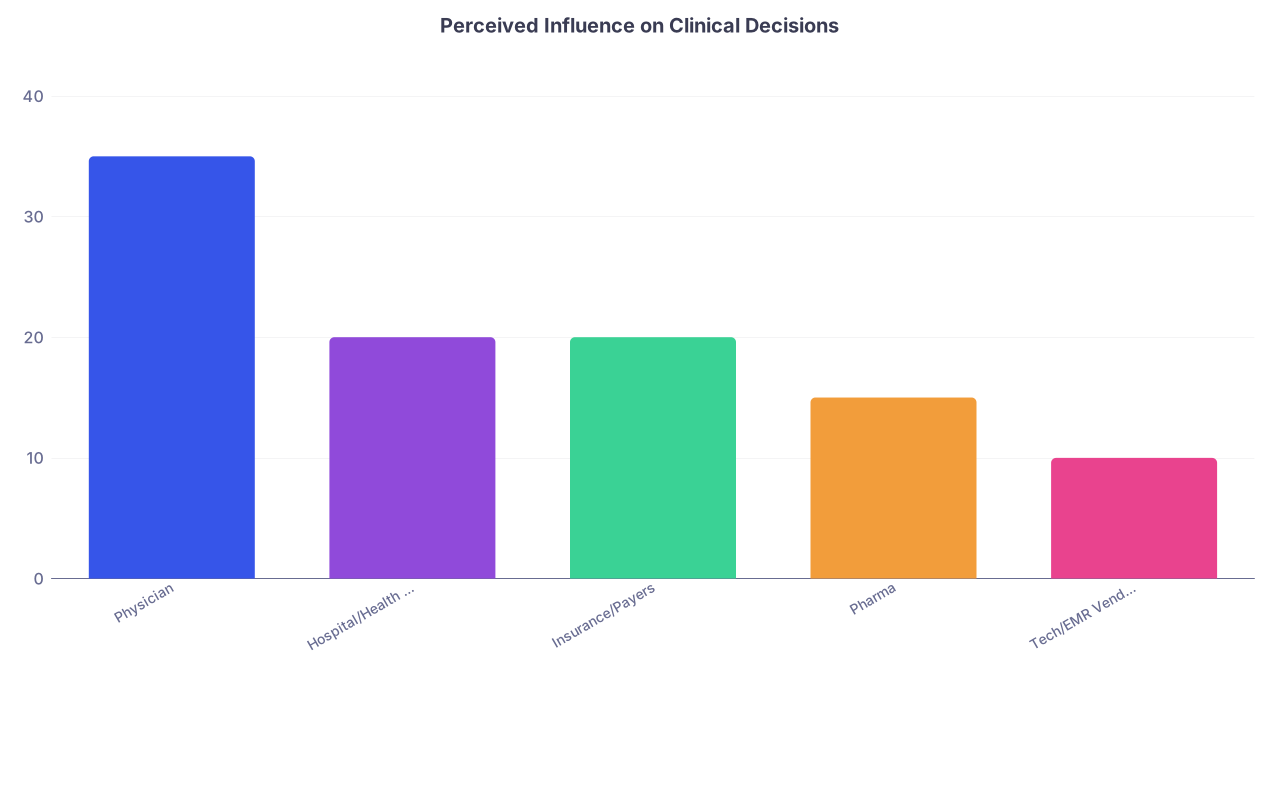
| Category | Value |
|---|---|
| Physician | 35 |
| Hospital/Health System | 20 |
| Insurance/Payers | 20 |
| Pharma | 15 |
| Tech/EMR Vendors | 10 |
“Control my practice” doesn’t mean some pharma rep walks into your clinic and literally takes your prescription pad out of your hand.
Control looks like:
- Formularies that block the med you want and force the cheaper “preferred” drug
- EMR alerts that nudge you toward certain pathways because a payer or committee blessed them
- “Quality metrics” that determine your bonus and quietly reward fast, standardized, guideline-following care
- AI “decision support” that flags your choice as “non-standard” and makes you second‑guess every deviation
And then you look up and realize: you still sign your name, but the decisions are heavily pre‑shaped by systems you didn’t design and companies you never voted for.
Is that happening? Yes. Already.
Is it 100% hopeless? No. But it won’t fix itself while you’re “focusing on Step 2.”
How Pharma Already Shapes What Doctors Do (And How Bad It Can Get)
Pharma has been influencing medicine for decades. This part isn’t new. What is new is how subtle and data‑driven it’s getting.
Old‑school influence was obvious:
- Free lunches
- Sponsored “educational” dinners
- Branded pens, notepads, flash drives
- Paid “advisory boards” where people talked for 30 minutes and earned $3,000
That stuff still exists, but the real power now is baked into:
- Clinical guidelines (written by committees where conflicts of interest can be… generous)
- Prior authorization rules (which drugs are “worth it” to payers)
- Formularies (what’s even realistically accessible to your patient)
I’ve seen attendings groan at a prior auth denial, say “Fine, we’ll use the formulary drug,” and move on because they’re behind already and have 3 notes unfinished.
That’s how pharma + payers win: not through dramatic bribery, but through exhaustion and friction.
Worst‑case scenario you’re picturing:
- Most major guidelines subtly favor expensive, branded options
- Hospital systems cut deals with certain pharma companies for “preferred products”
- You get performance bonuses partially tied to adherence to those internal “pathways”
- Deviating from them creates more admin work, more prior auths, more peer‑to‑peer calls
You end up prescribing what the system wants, not what you would’ve picked in a vacuum.
Reality check: this trajectory is real, but not absolute. There are guardrails—conflict‑of‑interest policies, independent research, generics, PBM scrutiny. You won’t become a literal puppet. But yes, the strings will be there, and you’ll feel them.
The New Player: Tech and AI Trying to Run the Exam Room

If pharma is the old boss, tech is the new boss that wants everything: your data, your workflow, your patients’ loyalty, your attention.
Think:
- Epic/Cerner/Oracle EMRs embedding AI decision support
- Big Tech (Amazon, Google, Apple, Microsoft) building health platforms, telehealth, remote monitoring
- Startups offering AI triage, AI scribes, AI risk prediction, AI radiology reads
The marketing pitch is always the same:
“We’ll reduce your burden and help you practice at the top of your license.”
The fear in your head:
“You’re going to turn me into a warm body that implements what the algorithm spits out.”
And the worst‑case future is honestly not insane:
- AI pre‑writes your note, orders labs, suggests ICD‑10 codes
- AI gives a probability‑based diagnosis with a ranked list of treatments
- Hospital or insurer says: “High‑risk cases must follow AI‑recommended pathways unless strongly justified”
- Outcomes and billing are monitored, and deviating from the AI becomes a liability risk
Now blend that with pharma: AI suggesting treatments that just happen to fit with the formulary deals, the “value‑based care” contracts, or sponsored evidence.
If you’re thinking, “This sounds dystopian and also disturbingly plausible,” yeah. You’re not crazy.
But again—there’s more nuance.
Right now, AI tools are:
- Often clunky
- Biased
- Not fully trusted by clinicians
- Heavily marketed but only partially adopted
I’ve seen residents run the AI suggestion, glance at it, shrug, and proceed with their own plan. Companies are still trying to figure out where they can shove these tools into workflows without open rebellion from clinicians.
So no, you’re not about to be replaced by ChatGPT‑Care.
But you are going to be practicing in a world where “standard of care” increasingly includes tools designed, owned, or influenced by giant non‑physician entities.
Who Actually Has Power Over Your Future Practice?
Let’s be brutally clear: as a med student, resident, or early attending, you’re near the bottom of the power pyramid. That’s part of what’s freaking you out.
Here’s who currently has disproportionate influence on your day‑to‑day:
| Player | How They Influence You |
|---|---|
| Pharma Companies | Drug availability, marketing, trials |
| Tech/EMR Vendors | Workflows, alerts, documentation |
| Insurance/Payers | What gets paid for, what’s blocked |
| Hospital Systems | Protocols, metrics, scheduling |
| Regulators (FDA, CMS) | Rules for AI, drugs, billing |
You’re probably imagining some shadowy pharma‑tech boardroom plotting how to turn you into a compliant button‑pusher. Reality is more boring and more dangerous: everyone is optimizing their own metrics—profit, efficiency, engagement, “value”—and clinical autonomy becomes collateral damage.
Where do physicians still have leverage?
- In professional societies (guidelines, position papers)
- In academic medicine (saying “no” to bad trials or biased designs)
- In policy and regulation (committees, advisory roles)
- In unions and collective bargaining (residents and attendings banding together)
- In how they individually practice (documenting why they deviate, building local micro‑cultures within departments)
None of that feels very comforting when you’re an MS1 staring at Anki cards, but it’s where the real counter‑weight lives.
What You Can Actually Do Now (So You Don’t Wake Up Stuck Later)
I know the instinct: “I’ll worry about this once I’m an attending.” That’s how people end up blindsided and bitter.
You want concrete things. Here you go.
1. Choose training environments that aren’t fully captured
Look for programs where:
- Faculty openly talk about conflicts of interest
- There’s active research in ethics, health policy, or implementation science
- Residents get some exposure to regulatory, informatics, or quality‑improvement work
Those places are usually where the skeptical conversations happen. Where people are allowed to say, “This new AI tool is garbage” without being shut down.
2. Learn how these systems work, not just how to click them
Nobody’s asking you to become a data scientist. But you should understand:
- What a “black box” model is
- Basics of bias in training data
- Who pays for certain “decision support” tools and why
- How formularies and PBMs (pharmacy benefit managers) actually operate
Take the elective in informatics. Or health policy. Or medical ethics. Not because it’ll be on the boards, but because it’s the choke point of your future autonomy.
3. Practice documenting your independent thinking
Tech and pharma can’t fully control what you can justify and defend.
You need to get good at:
- Writing clear, defensible notes: “Chose X over guideline‑preferred Y because…”
- Citing evidence quickly (even if it’s just UpToDate + 1 or 2 primary sources)
- Anticipating pushback from insurers and having a rationale ready
That sounds bureaucratic, but it’s power. If you can defend your choices, you’re harder to steamroll.
4. Stay allergic to financial conflicts—and say it out loud
If you’re already anxious about pharma influence, good. Keep that allergy.
Practical rules:
- Don’t rely on reps as your primary source of drug info
- Be transparent about any paid relationships you ever take on
- Question any guideline where half the panel has deep industry ties
- Be extremely skeptical of “sponsored education” that pushes one product hard
I’ve seen students quietly ask, “What are the conflicts of interest for this speaker?” That tiny question changes the tone of the whole room.
5. Find mentors who are openly cynical but still practicing well
You want the attendings who say stuff like:
- “Yeah, that alert is nonsense, here’s how I think about it instead.”
- “The insurer wants X, but here’s how we fight that when it matters.”
- “We use the guideline unless it contradicts what’s actually best for this patient.”
These are the people who’ve figured out how to operate inside the system without being owned by it. Shadow them. Ask them how they document. How they talk to admins. How they balance risk.
What You’re Actually Right to Be Afraid Of
Let me validate your worst‑case scenario thinking for a second, because some of it is completely fair.
You’re right to be scared that:
- “Evidence‑based” might quietly mean “industry‑filtered evidence”
- AI tools will be adopted because they save money, not because they improve care
- Reimbursement will increasingly tie you to rigid pathways and penalize nuance
- Patient care will slowly be shaped more by dashboards than by the room you’re actually in
You could absolutely end up in a job where:
- 20‑minute visits become 10
- Your EMR is a labyrinth of required clicks
- Any deviation from the algorithm generates an email from Quality
- You spend your evenings fighting with payers instead of reading about medicine
That’s not paranoia. That’s some clinicians’ daily reality already.
But here’s the piece your anxiety tends to erase: systems are messy. They don’t fully work as intended. People resist. Tools fail. Laws change. Whistleblowers exist. Journalists dig. Physicians walk away from toxic setups and take patients with them.
The future is not a single locked‑in dystopia. It’s a constant tug‑of‑war.
You can’t stop the tide of tech, or the existence of pharma. But you can choose:
- Where you train
- Who you learn from
- What you accept as “normal”
- When you’re willing to say, “No, that’s not acceptable care”
And that matters a lot more than you think as a premed or M1.
Quick Reality Snapshot: How Much Will They Control You?
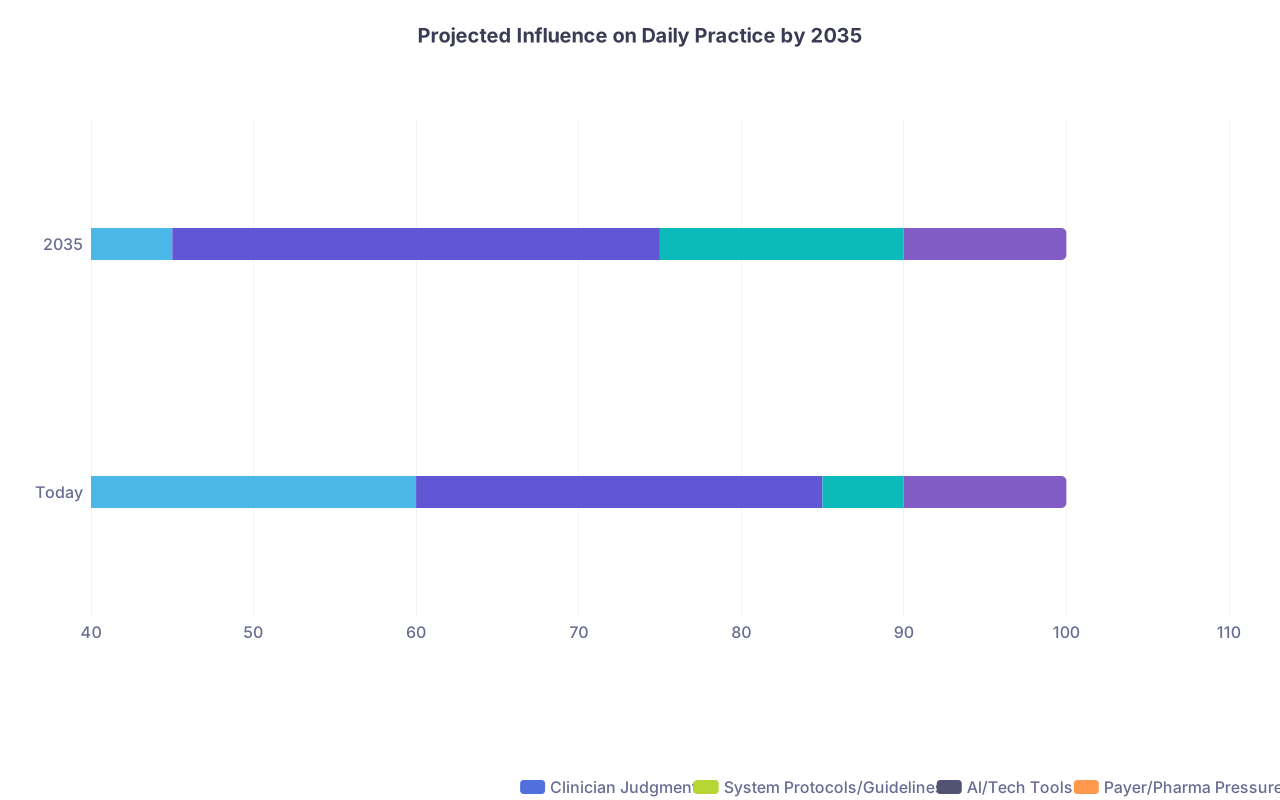
| Category | Clinician Judgment | System Protocols/Guidelines | AI/Tech Tools | Payer/Pharma Pressure |
|---|---|---|---|---|
| Today | 60 | 25 | 5 | 10 |
| 2035 | 45 | 30 | 15 | 10 |
Is that chart real data? No. It’s a rough conceptual guess, but it’s in line with where things are moving:
- Your independent freedom probably shrinks somewhat
- System + AI + payer influence probably grows
- Direct pharma influence might not get bigger, but it’ll get smarter and more embedded
But notice something: clinician judgment doesn’t go to zero. Not even close. It just stops being the only strong force in the room.
Your job is to make sure your judgment stays loud enough to matter.
FAQs – 5 Questions You’re Probably Still Stewing Over
1. Am I selling out by even entering a system this influenced by industry?
No. You’re entering a battlefield, not a sales department. “Selling out” is when you stop asking questions, take the speaking fees, and let convenience replace judgment. Going in with your eyes open and a spine is not selling out. It’s necessary.
2. Should I avoid using AI tools or pharma‑sponsored resources completely?
Probably not. Avoiding them entirely can actually hurt you and your patients. Use them, but suspiciously. Compare their outputs with independent sources. Ask who paid for what. Treat them like smart but biased consultants, not oracles.
3. Will I get punished for going against guidelines or AI suggestions?
You might get extra friction—more documentation, more peer reviews, maybe annoyed admins. But if you make thoughtful, well‑documented decisions with patient welfare first, you’re on solid ground. People get in trouble when they deviate randomly or sloppily, not when they deviate and can explain why.
4. Is private practice safer from pharma‑tech control than working for a big system?
“Safer” in some ways, more vulnerable in others. You may have more day‑to‑day autonomy but still depend on the same payers, formularies, and tools. Also, small practices can get squeezed hard by insurers and tech vendors. There’s no magic escape pod; there are just different trade‑offs.
5. What’s one concrete skill that will protect my autonomy the most?
Learn to write a rock‑solid, concise justification note. Seriously. The ability to clearly defend: “Here’s the diagnosis, here’s the guideline, here’s why I’m following or deviating, here’s the risk/benefit” will save you with insurers, admins, and sometimes even lawyers. It’s not glamorous, but it’s armor.
Open a browser tab right now and search for “medical AI regulation” and “pharma conflicts of interest in guidelines.” Read one article from each that makes you uncomfortable—and then ask yourself: “What kind of physician do I have to become so I’m not steamrolled by this?” Start shaping that person today.