Last week, a fourth‑year med student showed me a tweet of an AI model reading CTs “better than radiologists” and just said: “So… did I pick the wrong profession?”
She laughed when she said it, but you could see it—this sick, hollow feeling that she might be training for a job that won’t exist.
If you’re anything like her (or me), your brain jumps straight to the worst‑case: 10 years from now, some administrator shows up with a slide deck and says, “Good news, the algorithm does your job faster and cheaper.” Badge deactivated. Thanks for your service.
Let’s talk about that. Not with fluffy “AI will never replace human doctors” platitudes. With actual, realistic career scenarios for different specialties—what gets automated, what doesn’t, and how not to accidentally pick a dead‑end role.
The fear under all of this: am I training for an obsolete job?
You’re not actually scared of “algorithms.” You’re scared of:
- Being 300k+ in debt with a skill set nobody needs
- Matching into a specialty that becomes overstaffed as AI eats half the workload
- Waking up mid‑residency and realizing the “cool” parts have been offloaded to software
- Getting stuck doing the boring leftovers while the AI and a few “super‑docs” do the interesting work
And honestly? Some of those fears aren’t crazy.
There will be specialties where:
- The volume of work is heavily automated
- The number of physicians needed drops
- The job market tightens and shifts towards fewer, more specialized humans
So instead of a vague “AI is coming” cloud, let’s get concrete.
Which specialties are actually at risk of “algorithm creep”?
Not the PR version. The realistic one.
Here’s how I think about it: AI eats tasks that are:
- Highly repetitive
- Pattern‑recognition heavy
- Structured, digital, and labeled
- Low in messy human context or deep relationship‑building
So certain fields light up as “vulnerable.” Not doomed. But vulnerable to having large chunks of their work automated.
| Specialty | Automation Risk (Core Tasks) | Likely Future Role Shift |
|---|---|---|
| Radiology | High | Human-AI supervisor, complex cases |
| Pathology | High | QA, complex diagnostics, consults |
| Derm (telederm) | Moderate-High | Procedural/complex focus |
| EM/Urgent Care | Moderate | AI triage, doc as team lead |
| Primary Care | Moderate | Relationship + complexity manager |
Radiology: the poster child for “AI will replace you”
This is the one everyone panics about first.
The nightmare version in your head:
- AI reads all the X‑rays, CTs, MRIs
- One radiologist “oversees” 20 hospitals from home
- Residencies shrink, telerad companies just plug in software
Here’s the more realistic version I’ve seen play out in early deployments:
AI gets very good at:
- Lung nodules
- Intracranial hemorrhage flags
- Fracture detection
- Mammo screening triage
But:
- AI still misses weird patterns, rare conditions, or subtle multi‑system issues
- It throws tons of false positives if you make it too sensitive
- Medicolegal ownership still lands on a human
So what shifts?
Radiologists move from:
- “First pass detector” to
- “Triage, integrator, and final responsibility”
The scary part: if AI handles the easy, high‑volume cases, the total number of radiologists needed per RVU might drop. That’s the part applicants should worry about, not “AI does 100% of reads.”
So what do you do if you love rads?
- Aim for programs with AI integration and informatics, not ones pretending it doesn’t exist
- Build skills in:
- Interventional procedures
- Multidisciplinary conference leadership
- Imaging protocol design / QA
- Informatics or data literacy
Because the residents who just learn “click through studies all day” will get squeezed. The ones who become the system designers / supervisors won’t.
Pathology: quietly even more automatable
Path is less talked about, but from an algorithm’s perspective, it’s delicious:
- Slide images → digital
- Tons of labeled examples
- Strong signal‑to‑noise patterns
- Clear ground truth (eventually)
So yeah, algorithms are already pretty good at:
- Counting cells
- Identifying metastases on certain stains
- Screening Pap smears
- Flagging suspicious areas to review
But. I’ve seen pathologists spend half a tumor board explaining the story behind the slide: borderline features, uncertainty, how it fits with imaging and clinical picture.
That “medicine as messy judgment call” zone is bad for AI and good for humans.
Career reality check:
- You probably won’t see “no pathologists needed”
- You might see:
- Fewer community path jobs
- Centralization to large centers with heavy digital and AI tooling
- More emphasis on molecular, genomics, and complex cases
If path is on your list, just don’t do it assuming it’ll be the same 30 years from now. Lean into:
- Molecular pathology
- Tumor boards and clinical consultation
- Digital pathology and QA roles
Or be okay being the person who uses the AI heavily and is fine with that.
Dermatology: the “my phone can diagnose my mole” fear
You’ve probably seen those apps that let you take a picture of a mole and “check for cancer.” Cue spiral: “So will anyone need derm?”
Current reality:
- Algorithms can be pretty solid at classifying basic benign vs malignant lesions on clean, well‑lit, phone‑quality images
- But:
- Skin tone diversity is a mess in training data
- Real‑world lesions are weird, mixed, partially treated, infected, etc.
- Patients don’t want their face procedure done by a robot (yet)
What’s likely to shift:
Basic triage for “this looks fine vs get this checked” moves to:
- Apps
- Telederm pre‑screens
- PCPs with AI tools
Dermatologists shift more into:
- Complex rashes
- Autoimmune / systemic disease with skin findings
- Procedures (biopsies, excisions, cosmetics)
- High‑risk oncology follow‑up
So the fear might be: “What if I match derm and 10 years later the bread‑and‑butter skin check clinic is run by extenders + AI?”
That’s not insane. If that thought makes your stomach knot, ask derm attendings and residents what percentage of their work is:
- Pure pattern recognition of mundane lesions
vs - Complex disease, procedures, and patient counseling
Because the first category is on the AI chopping block.
“Safer” zones: where algorithms struggle more
No specialty is immune. But some rely so much on:
- Real‑time improvisation
- Physical skill
- Trust and communication under uncertainty
- Negotiating with families/patients
…that full replacement is fantasy for a long time.
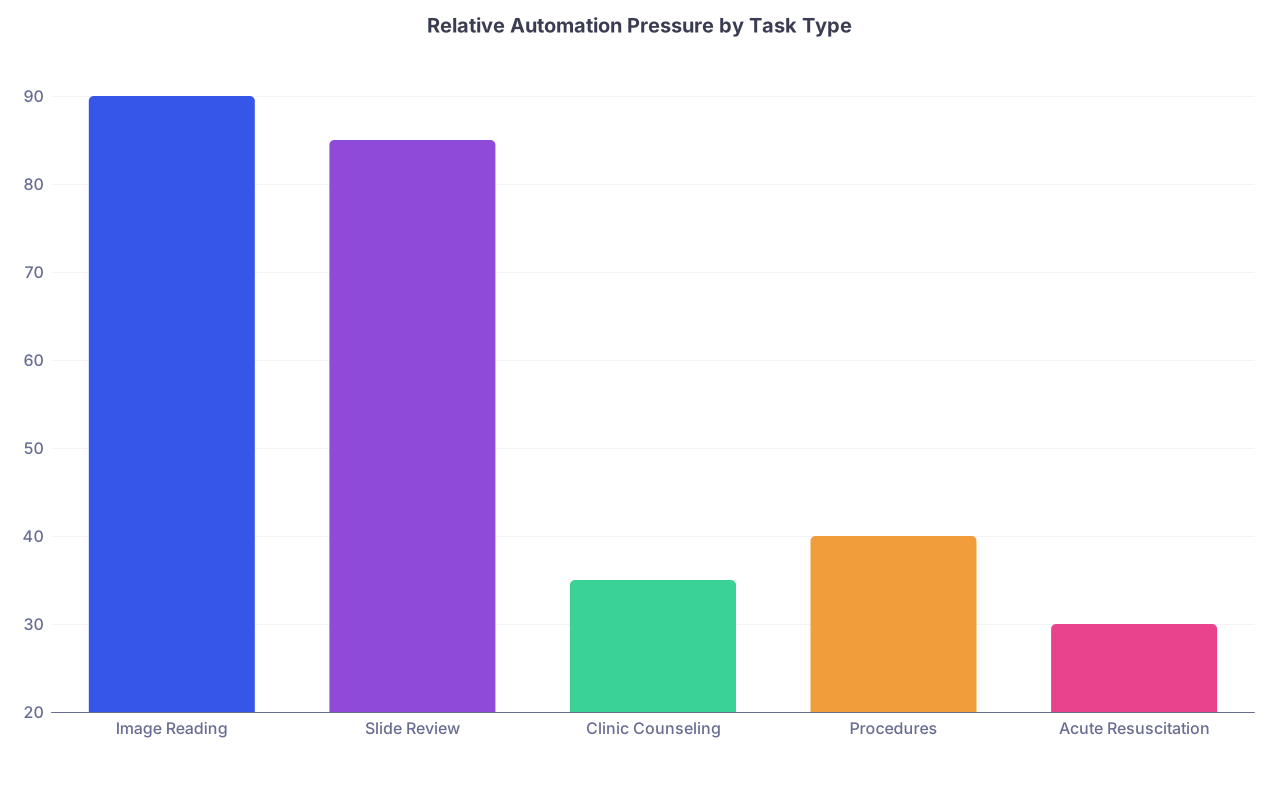
| Category | Value |
|---|---|
| Image Reading | 90 |
| Slide Review | 85 |
| Clinic Counseling | 35 |
| Procedures | 40 |
| Acute Resuscitation | 30 |
Numbers are rough, but the shape is the point.
Emergency Medicine / Critical Care
Will ED triage bots and AI‑assisted decision tools show up? Absolutely.
- AI reads the EKG in 0.3 seconds
- Flags subtle sepsis patterns from vitals + labs
- Suggests diagnoses and antibiotic choices
But in a resuscitation bay with a crashing patient, families crying in the doorway, nurse short-staffed, you’re:
- Making judgment calls with incomplete and conflicting data
- Dealing with social factors, substance use, mental health, violence
- Deciding who gets the last ICU bed
There’s no clean “input → output” mapping there.
What will change:
The parts of EM that are basically urgent care + protocolized workups can be:
- Offloaded to urgent care clinics with heavy AI
- Staffed more by APPs with AI support and fewer docs
- Or routed via virtual triage before hitting the ED
So even here, you might see job pressure on the low‑acuity, high‑volume side.
Primary Care: everyone says “safe,” but it’s… complicated
People love to say: “Primary care is about relationships. AI will never replace that.”
Half true. Half denial.
Reality:
- A shocking chunk of primary care is:
- Refill management
- Simple guideline‑driven care (HTN, DM, lipids)
- Standard screening / forms
- Templated counseling
Algorithms + care teams can and will eat into that.
But the hard part of primary care is:
- The vague, multi‑symptom, 9‑problems‑in‑20‑minutes patient
- Social chaos, trauma, non‑adherence, complex families
- Incorporating specialist notes, imaging, labs, social constraints, and actually getting something done
That’s nowhere near pure automation.
What I’d realistically expect:
- Fewer routine visits done by MDs
- More:
- Complex care clinics
- Team‑based models (MD + NP + care manager + AI tools)
- Focus on patients who can’t be easily “AI‑protocolized”
Primary care survives. But if you go into it assuming you’ll mostly see straightforward “BP check and med refill” forever, you might be blindsided.
Concrete career scenarios: how this might actually look
Let me sketch some plausible futures so you can feel how this plays out in a real week of your life.
Scenario 1: Radiologist, 2036
You’re at a mid‑size academic center.
- Overnight reads? Mostly AI first‑pass.
- You sit at a console where:
- AI groups studies by predicted urgency
- It pre‑labels likely findings
- It auto‑generates draft reports
Your job:
- Verify, correct, and sign off
- Take the weird, low‑confidence cases where the AI keeps hedging
- Run a multidisciplinary tumor board twice a week
- Consult with surgeons who want to “push” indications
There are fewer radiologists than there would’ve been 20 years earlier. You’re busier, but the most boring normal studies never hit your queue—they’re auto‑signed after dual AI + human spot‑check QA.
Good job? Possibly great.
Destroyed field? No.
Shrunken compared to 2024 expectations? Also yes.
Scenario 2: PCP, 2034, community clinic
You walk in and 20 patients are “already seen” by the digital front door:
- Symptom checker + chatbot did history intake
- AI summarized prior notes, labs, and imaging
- It suggests 3 likely diagnoses and guideline‑concordant plans
Half your patients are simple enough that:
- The AI recommends a plan
- Your MA reviews it
- You just co‑sign or tweak with a quick tele touchpoint
Your actual mental energy goes to:
- The undiagnosed weight loss, abdominal pain, and depression case
- The patient with 12 meds, 5 specialists, and no transportation
- The family in crisis who shows up with “headache” as the chief complaint
Your day feels more like “complexity manager + counselor” and less like refill robot. AI ate busywork you hate but also made administrators push panel sizes to insane volumes. Mixed bag.
Scenario 3: EM physician, 2032, urban ED
In triage:
- AI runs on the vitals, chief complaint, EKG, and maybe voice tone
- Flags risk for sepsis, MI, PE, stroke
- Suggests initial orders
Nurses and APPs run “algorithm‑friendly” flows. You’re:
- Handling trauma activations
- Taking the nebulous “I just feel off” cases
- Mediating between social work, psych, family
- Making call after call for admissions in a gridlocked system
The AI helps, but it’s also one more thing people yell at you about: “The computer said I might have cancer, why haven’t you done the scan?” Great.
So how do you choose a specialty without getting wrecked by automation?
You can’t get 100% certainty. But you can stack the deck.
Some patterns I’d look for if I were choosing now:
Pick fields where core identity involves at least two of these:
-
- Surgery, EM procedures, GI, IR, OB, anesthesia, etc.
- Yes, robots will increase, but humans will still be very present.
Deep longitudinal relationships or trust‑sensitive work
- Primary care, palliative, psych, some pediatrics
- Places where “I trust this person” matters.
High‑ambiguity decision‑making under real‑world constraints
- Complex medicine, rheum, ICU, ED
- Where the job is not just “pick the right answer,” but “pick the least bad one given reality.”
And if you do love a higher‑risk field like rads or path:
- Don’t be passive. Be the person who:
- Understands AI tools
- Helps implement and critique them
- Takes on the complex consult, not just high‑volume simple reads
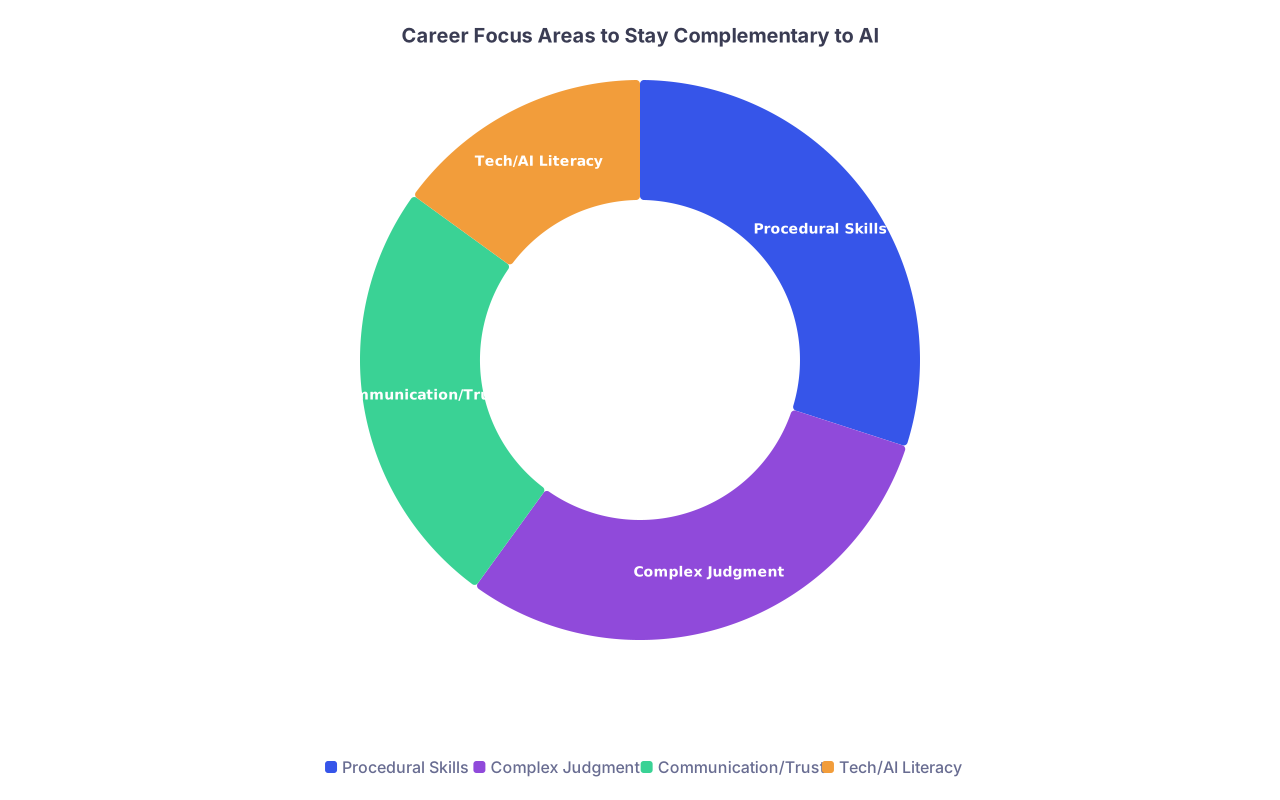
| Category | Value |
|---|---|
| Procedural Skills | 30 |
| Complex Judgment | 30 |
| Communication/Trust | 25 |
| Tech/AI Literacy | 15 |
Your worst‑case scenarios vs what actually happens
Your brain probably does this:
- “What if there are no jobs?”
- “What if they cut salaries in half?”
- “What if my entire specialty disappears?”
Here’s the pattern I’ve seen in other industries that got hit hard by automation (radiology’s not special here):
- Jobs don’t vanish overnight—they shift
- The boring, repetitive tasks get automated
- The human jobs get:
- More complex
- More cognitive
- Often more stressful
- Sometimes better, sometimes worse
Medicine won’t be an exception. It’ll be messy. There’ll be winners and losers. Some subspecialties will overexpand and then contract painfully.
But “no more doctors, all algorithms” is fantasy. There’s too much ambiguity, liability, and politics for that.
The real risk is subtler:
You choose a path where the fun, identity‑defining tasks end up given to AI or to a smaller elite group, and you’re left with the leftover work + charting + supervision.
So when you’re shadowing, ask yourself:
- “Which parts of what this doctor does are structured, repetitive, pattern recognition?”
- “Which parts are messy relationship, physical skill, or deep judgment?”
Assume the first bucket shrinks. Build your career around the second.

| Step | Description |
|---|---|
| Step 1 | Old Physician Role |
| Step 2 | Pattern Recognition Tasks |
| Step 3 | Procedures and Hands On |
| Step 4 | Complex Judgment |
| Step 5 | Relationships and Counseling |
| Step 6 | AI Systems |
| Step 7 | Future Physician Core |

If you’re still spiraling: a more honest kind of reassurance
I’m not going to say “don’t worry, medicine is safe.” You’re not stupid; you can see the direction things are going.
What I will say:
- Being early in your career during a big shift is scary, but it’s also leverage. You’re not locked into 20 years of doing something one way.
- The people who get hammered hardest are usually the ones who:
- Ignore the shift
- Mock it
- Or insist “this is how we’ve always done it”
You don’t have to become a machine‑learning engineer. Just don’t be the person who refuses to learn how the tools work.
Long term, patients will still want:
- Someone to blame
- Someone to trust
- Someone to interpret the machine’s “answer” in the context of their actual life
That “someone” is still a human with a medical degree. Maybe a slightly different kind of doctor than existed in 1995. But still a doctor.
Years from now, you’ll probably remember less about the fear of being replaced by an algorithm and more about the decisions you made because of that fear—what you chose to learn, where you decided to lean in instead of look away.