
Programs already know you’re using AI. The question is whether you’ll look careless, dishonest, or dependent because of how you use it.
That’s the part that keeps me up.
Because on paper, “AI tools to study and draft notes” sounds innocent. Helpful, even. But in my head it quickly turns into: Will they think I cheated? Will they think I can’t think? Will I get labeled as the lazy, shortcut person before I even show up?
Let me cut through the noise and tell you how this actually plays out from an application and training standpoint.
What Programs Really Care About (And What They Don’t)
No PD is sitting there thinking, “How dare this student use modern tools to learn.” That’s not the concern. The concern is: can you function safely as a doctor, think independently, and tell the truth?
If your use of AI doesn’t threaten those three things, most people won’t care. A lot will quietly do the same themselves.
The problem is when AI use leaks into things that do matter to programs:
- Exam integrity
- Originality and honesty in your written work
- Clinical reasoning and judgment
- Professionalism (especially documentation and patient care)
Using AI to structure your notes? Summarize an UpToDate article? Create Anki-style prompts? No sane program director is going to blacklist you for that.
But if they see AI fingerprints in ways that suggest you cut corners where you shouldn’t have? Different story.
Where AI Use Is Basically Fine (If You’re Not Reckless)
Let’s start with the part that should calm your heart rate a bit.
I’ve watched students do all of these without raising a single eyebrow from faculty:
- Using ChatGPT to turn a wall of text into a bullet-point summary for review
- Asking an AI, “Explain nephrotic vs nephritic like I’m a first-year”
- Using AI to help generate practice questions (and then cross-checking them)
- Drafting initial outlines for learning plans, schedules, or concept maps
- Cleaning up grammar in presentations or emails
- Turning scribbled notes into something legible and structured
Most attendings barely understand how these tools actually work, but they absolutely understand this: doctors use reference tools constantly. We Google obscure things on call. We use UpToDate, MDCalc, Lexicomp, institutional order sets. AI is just another layer in that stack.
The future of healthcare basically guarantees AI-assisted workflows. Clinical decision support, automated chart summaries, AI triage, radiology AI… None of this is “cheating.” It’s where the system is headed.
So no, you are not going to be secretly blacklisted because you used AI to understand the Krebs cycle.
What makes people twitchy is when AI steps over into dishonesty, dependency, or obvious fakery.
Where Programs Will Start Judging You
Here’s where your “what if they judge me” anxiety is unfortunately justified.
1. Application Materials That Read Like AI
I’ve seen faculty read a personal statement and say, “This sounds… generic. Almost like it was generated.” That’s it. That one sentence. And suddenly they’re skeptical of everything else from that applicant.
They don’t need proof. They just need doubt.
Common red flags they notice:
- Robotic, polished-but-empty language that doesn’t sound like any human they’ve met
- Overly grand phrases like “ever since I was a child, I have been deeply passionate about the noble pursuit of medicine”
- Reused buzzwords with no specific stories: “resilience,” “grit,” “longstanding passion” but no actual believable detail
- The same tone across every essay, every prompt, every answer, like a single template
If they suspect your statement or secondary essays are AI-written, they’ll question your judgment and honesty. They may not toss your app immediately, but you’ve put yourself in a hole for absolutely no reason.
Using AI as a brainstorming partner? Fine. Using it as a mildly glorified thesaurus to clean wording? Fine. Pasting “write my personal statement” and submitting the output? That’s where you risk being quietly judged as untrustworthy or lazy.
2. AI in Graded or Integrity-Sensitive Work
If your school or an exam says “no AI use,” that’s not a suggestion. That’s their misconduct line in the sand.
Possible landmines:
- AI-generated answers or explanations for take-home exams that explicitly forbid outside help
- Using AI to write graded reflections, professionalism essays, or OSCE write-ups that are supposed to reflect your own thinking
- Submitting AI-generated literature reviews or paragraphs in research papers without disclosure or proper citations
- Plugging actual patient identifiers/details into public models (even “just to rephrase the note”)
If any of that gets discovered, a residency program will judge. Because now it’s not “AI user,” it’s “honesty/professionalism issue.” And those are death flags on an application.
3. AI-Generated Clinical Notes Without Oversight
This is where future-of-medicine and immediate-risk collide.
Right now, some hospitals are piloting AI scribe tools and auto-drafting systems. That’s different from a med student secretly using ChatGPT to spit out an H&P.
You know what freaks attendings out?
- Notes that look too polished and templated but don’t actually match the encounter
- Assessment/plan sections clearly above the student’s level, with errors that reveal they didn’t understand what they wrote
- Copy-paste or AI-paste errors that create safety risks (wrong side, wrong dose, wrong diagnosis)
If your AI use leads to bad or unsafe notes, they’re not going to be impressed that you “leveraged cutting-edge tools.” They’ll see it as a threat to patient care.
Will Programs Know I Used AI to Study?
Short version: probably not, unless you shove it in their face or it distorts your work.
Using AI in private study or to organize your life isn’t something that magically shows up on ERAS.
You don’t submit: “MCAT: 515, GPA: 3.8, ChatGPT: used daily.”
But here’s how it can sneak into your application in a way they notice:
- Your essays don’t sound like you in interviews. They’ll ask about something you “wrote,” and you stare blankly. Or repeat generic lines. That mismatch is loud.
- Your letters mention weak clinical reasoning or lack of independence, and your apps are full of perfect, glossy writing. That contrast can make them wonder who actually did the work.
- You talk obsessively about “AI in medicine” in every answer, but you can’t actually discuss risks, limitations, or specifics beyond buzzword level.
If AI has become a crutch instead of a tool, it shows up as: shallow understanding, poor reasoning under pressure, and weirdly generic written voice.
Programs aren’t hunting for AI users. They’re screening out people they don’t trust to think and act independently when it matters.
How to Use AI Without Looking Like a Walking Red Flag
This is the part I wish someone had spelled out for me instead of just saying “don’t cheat.”
Think of AI like UpToDate with ADHD. Useful. Fast. Wrong more often than it seems. And absolutely your responsibility to double-check.
Use it like this:
- Let it explain and organize, not decide or replace your brain
- Make it simplify complicated topics, then cross-check with real sources (textbook, guidelines, UTD)
- Ask it for outlines, then fill in the details yourself from trusted references
- Have it generate questions, then you verify every answer and reasoning
- Use it to reformat things (tables, summaries) not to invent content
Where you don’t want to be:
- “I studied mostly with ChatGPT, I didn’t really use primary sources.”
- “I let AI write my rough draft and then I just tweaked a few words.”
- “I pasted my H&P into a public model to make my note sound nicer.”
You can absolutely say in an interview, if asked, something like:
“I sometimes used AI tools as a starting point to organize my study notes or simplify complex topics, but I always cross-checked with primary resources and made sure I could explain everything independently without any tool.”
That answer is normal. Reasonable. No one sane is going to ding you for that.
Future of Healthcare Angle: Are We Supposed to Use AI or Not?
Here’s the hypocrisy that makes this all extra confusing.
Hospitals, systems, and journals are all screaming about “AI integration,” “AI-powered workflows,” “AI decision support.” Then the same ecosystem turns around and says, “But don’t you dare use it in a way we don’t like.”
The reality is more nuanced:
- Medicine is absolutely moving toward AI-augmented practice.
- Training environments are still trying to figure out where the guardrails need to be.
- Until those guardrails are clearer, the safe path is: AI for learning/organization, not for primary clinical decision-making or undisclosed ghostwriting.
Some residency programs will like that you’re comfortable with AI, especially in informatics-heavy fields, radiology, EM, or systems-oriented internal medicine.
What they won’t like is someone who can talk about AI but can’t manage a basic differential without help.
If you’re going to mention AI in your apps or interviews, you’d better be able to say something real. For example:
- Specifics of bias in training data and how that might affect risk scores in minority populations
- Limitations of LLMs with hallucinations and non-deterministic output
- Where AI clinical decision support should end and human responsibility begins
- Concrete examples like Epic’s AI note suggestion tools, or FDA-cleared AI radiology tools
If all you’ve got is “AI will transform medicine by making doctors more efficient,” they’ll tune out.
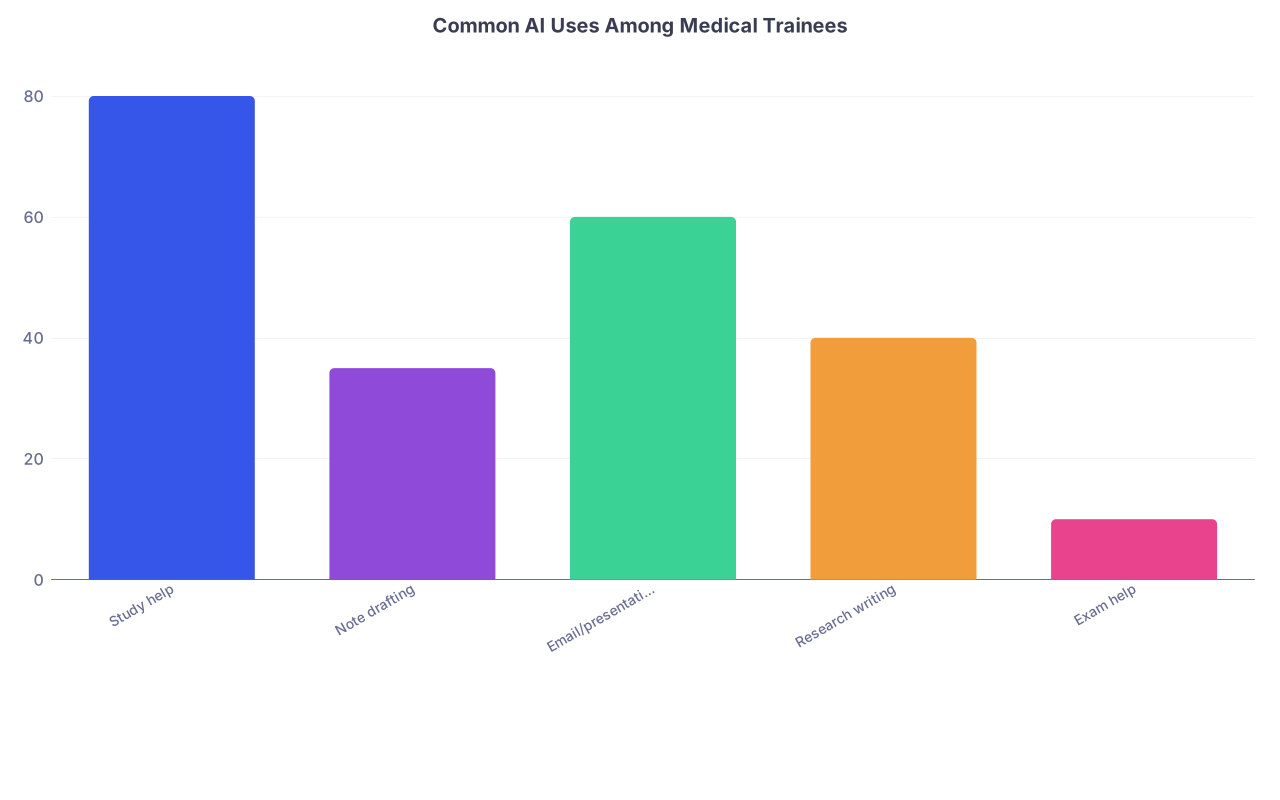
| Category | Value |
|---|---|
| Study help | 80 |
| Note drafting | 35 |
| Email/presentation polish | 60 |
| Research writing | 40 |
| Exam help | 10 |
Will Programs Ask Directly If I Used AI?
Right now, most don’t. Some schools have started adding vague language about AI to professionalism policies, but residency programs generally aren’t asking:
“Did you use AI to study?”
What they are starting to ask (or will soon):
- “How do you see AI affecting your specialty in the next 5–10 years?”
- “Have you used AI tools in your education or clinical work? What concerns do you have about them?”
- “What do you think are the ethical challenges of AI in healthcare?”
You don’t need to confess: “I used ChatGPT for pathophys summaries.” That’s not the point.
You do need to show:
- You’ve thought about this beyond hype and fear
- You understand both benefits and risks
- You see AI as a tool, not a replacement for your brain or your integrity

| Step | Description |
|---|---|
| Step 1 | Use AI |
| Step 2 | Low concern |
| Step 3 | Depends |
| Step 4 | High concern |
| Step 5 | Professionalism risk |
| Step 6 | What for |
Concrete “Do This, Not That” Examples
You’re probably like me and want someone to spell out the line.
Example 1: Studying for Step 1
- Better: “I used an AI tool to explain topics I didn’t get from Boards & Beyond, then I checked each thing in UWorld explanations or First Aid.”
- Worse: “I mostly asked AI questions instead of doing question banks because it was faster.”
Example 2: Writing a personal statement
- Better: “I asked AI to list themes based on my bullet-point experiences, then I wrote every sentence in my own words and voice.”
- Worse: “I pasted my CV into ChatGPT and told it to write a personal statement, then I fixed a few sentences and submitted.”
Example 3: Clinical note drafting
- Better: “I used an institution-approved AI scribe pilot under attending supervision, then personally reviewed and corrected every line before signing.”
- Worse: “I pasted my handwritten note into a public AI so it could ‘make it sound like a real doctor wrote it’ and used that as my submission.”
You can see the pattern. The problem isn’t “AI touched this.” It’s “I outsourced my responsibility and pretended I didn’t.”
| AI Use Case | How Programs Tend to View It |
|---|---|
| Study explanations | Generally acceptable |
| Organizing notes/summaries | Generally acceptable |
| Brainstorming essays | Acceptable with caution |
| Final essay generation | Concerning / dishonest |
| Graded assignment writing | Academic misconduct if prohibited |
| Clinical note generation | High concern without oversight |
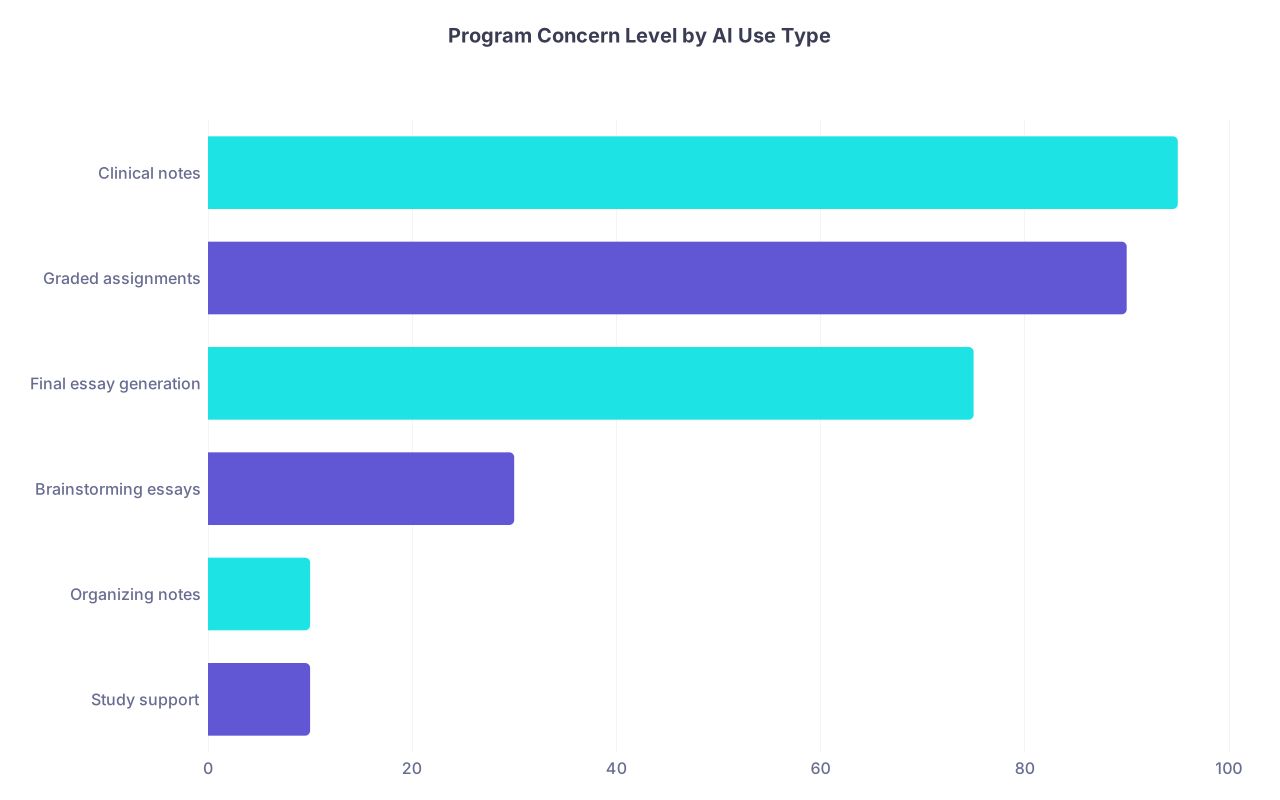
| Category | Value |
|---|---|
| Study support | 10 |
| Organizing notes | 10 |
| Brainstorming essays | 30 |
| Final essay generation | 75 |
| Graded assignments | 90 |
| Clinical notes | 95 |

How Much Should I Admit or Disclose?
This is the part that makes me spiral too. “If I used AI at all, do I have to say it? What if they ask? What if they dig?”
Here’s the clean line I stick to:
- If AI use violated a rule (exam policy, school policy, IRB, authorship guidelines): that’s a misconduct issue, not an “AI” issue. Different category.
- If AI was used like a tutor, editor, or organizer in unregulated contexts: you don’t need to preemptively confess it on everything you submit.
- If you’re explicitly asked “Did you use AI in this?” be honest, but frame it accurately: “Yes, as a tool for X, but I did all of Y and Z myself.”
You don’t need to write: “This personal statement was assorted with help from ChatGPT” at the bottom. That’s not the current norm.
But if a journal or research conference requires AI disclosure, then you follow their rules exactly. That’s non-negotiable.

Okay, So Will They Judge Me?
Here’s the uncomfortable but honest answer.
They will judge you for:
- Dishonesty
- Dependency
- Sloppy or unsafe use of tools
- Work that clearly isn’t yours
They will not sit around trying to sniff out whether you used AI to clean up grammar or outline a study plan.
If your biggest AI sin is “I asked ChatGPT to explain heart failure medications in simpler terms and then checked resources to make sure it was right,” you’re fine. Completely fine.
Your anxiety is wrapped around the wrong fear. The risk isn’t “they’ll discover I used AI.” The risk is “I’ll quietly let AI weaken my thinking and integrity in ways I can’t hide during real-life performance.”
If you keep those two things solid—your thinking and your honesty—AI becomes just another tool you used in a messy, stressful journey to become a physician.
And nobody’s going to reject you for that.
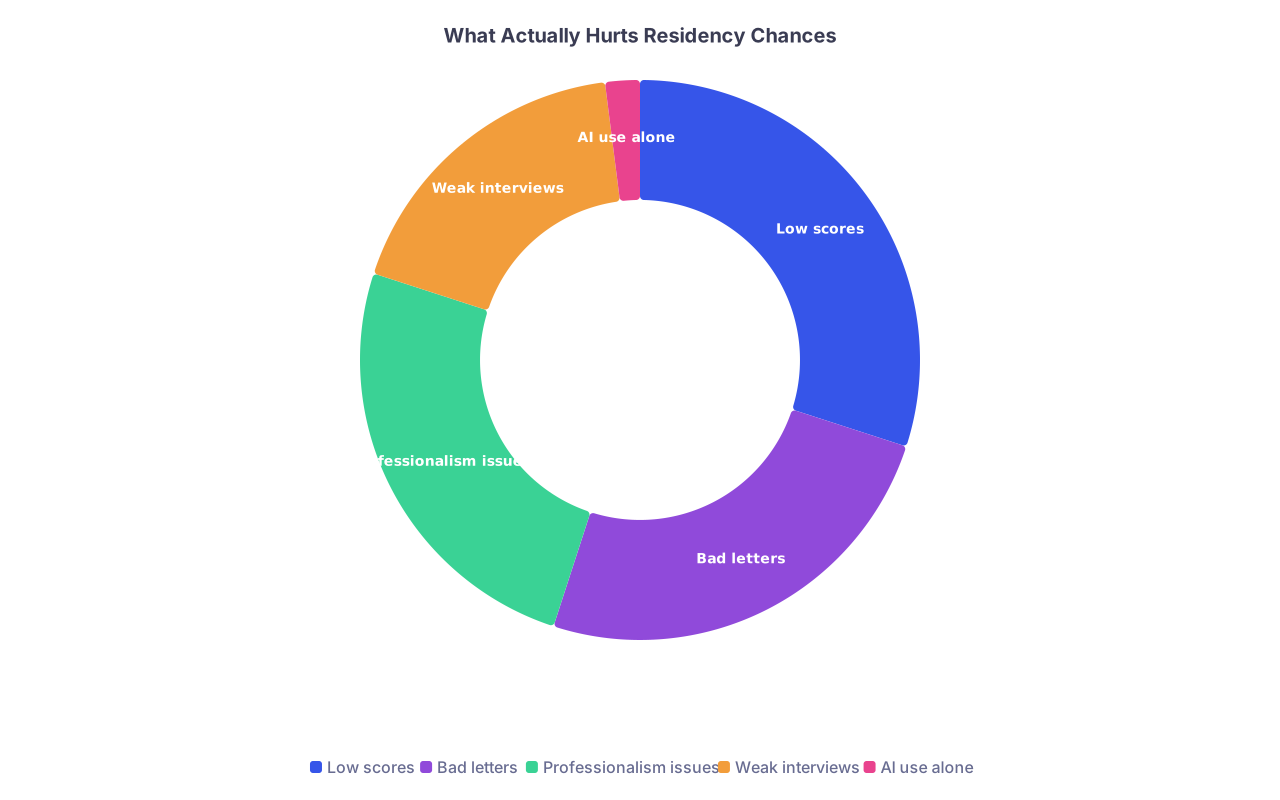
| Category | Value |
|---|---|
| Low scores | 30 |
| Bad letters | 25 |
| Professionalism issues | 25 |
| Weak interviews | 18 |
| AI use alone | 2 |

FAQ (Exactly 6 Questions)
1. Should I avoid mentioning AI use in interviews or essays altogether?
No. You don’t have to hide it like a crime. If it comes up naturally—especially in “future of healthcare” or “technology in medicine” questions—you can absolutely say you’ve experimented with AI tools. Just emphasize that you use them cautiously, cross-check information, and do not outsource your judgment or integrity to them.
2. Will residency programs reject me if they suspect my personal statement was AI-written?
They might not outright reject you only for that, but it will absolutely hurt you. It creates doubt about your honesty and makes your application less memorable and less human. Even if they can’t prove it, many will quietly downgrade your file or be less excited to interview you. It’s just not worth the risk when you can use AI for brainstorming and still write the actual statement yourself.
3. Is it okay to use AI to draft my study notes from lecture slides or textbooks?
Yes, that’s one of the most reasonable uses. Ask AI to summarize, to organize material into digestible chunks, or to turn walls of text into something you can work with. The key is that you still read, think, and verify. If AI makes your notes but you never deeply engage with the content, your exam scores and clinical performance will expose that long before any “AI detection” does.
4. What about using AI for research writing—will that hurt me with programs?
It depends how. Using AI to polish grammar, suggest ways to clarify sentences, or help structure sections is increasingly common, and many mentors quietly do this themselves. But generating entire paragraphs, literature reviews, or analyses that you don’t fully understand—and then putting your name on it—is risky academically and ethically. If a research mentor or journal finds out, that kind of professionalism flag will hurt you more than any generic AI use ever would.
5. Can I use AI to help draft patient notes during clinical rotations?
Not in a casual, unapproved way. If your institution has an official, HIPAA-compliant AI tool and your attending knows you’re using it, that’s one thing. Secretly pasting patient details into public models or letting AI manufacture assessments or plans is a serious professionalism and privacy problem. Programs won’t “judge you for using AI” so much as they’ll question your safety and ethics as a clinician. That’s a big, red stop sign.
6. Do I need to put a disclaimer on my personal statement or application that I used AI tools?
Right now, for residency applications, no. There’s no standard field for that, and you don’t need to preemptively confess that you used AI to check grammar or brainstorm ideas. If a specific venue (journal, conference, school assignment) requires AI disclosure, then you follow their rules explicitly. For everything else, your responsibility is to ensure the ideas, voice, and final work are genuinely yours and reflect your own thinking.
Key takeaways: Programs don’t care that you used AI to study; they care if you sacrificed honesty or independent thinking. Use AI as a helper, not a ghostwriter or decision-maker. And if you guard your integrity, your “AI use” won’t be the thing that decides your future.