The worst timing mistake residents make with digital health and AI fellowships is simple: they either jump too early with no foundation, or wake up interested when it’s already too late to matter.
If you want digital health, informatics, or AI to be a real part of your career—not just a buzzword on your CV—you have to time your moves. Ruthlessly. Year by year, sometimes month by month.
Below is the residency timeline I’d use if you told me: “I’m a resident, I care about AI / digital health, and I don’t want to miss the train.”
Big Picture: How Your Residency Years Map to AI & Digital Health
Let’s anchor the timeline first.
Most people fall into one of three broad categories:
| Profile | Typical Start Point | Priority |
|---|---|---|
| Already technical | MS/CS background, prior startup | Leverage skills fast |
| Curious but novice | No coding, early interest | Build literacy + signal |
| Late convert | Burned out PGY-3+ | Targeted, realistic moves |
Your exact moves vary. But the phases of residency are pretty predictable. So I’m going to walk you through:
- MS4 / Pre-residency: set your trajectory
- PGY-1: exposure and basic literacy
- PGY-2: signal and specialization
- PGY-3 (and beyond): commit to a path (fellowship? industry? hybrid?)
- Application season timing for digital health / AI-focused fellowships
And I’ll call out concrete examples: clinical informatics fellowships, AI-heavy research tracks, innovation/digital health fellowships, pharma/tech hybrid roles.
MS4 / Pre-Residency: Set the Direction, Not the Destination
At this point you should not be “choosing your AI fellowship.” You should be choosing a residency that does not choke off future digital health options.
9–12 Months Before Residency (Early MS4 / ERAS Season)
Your priority now: pick an environment where tech and data are taken seriously.
At this point you should:
Screen programs for real infrastructure, not buzzwords.
Look for:- Established clinical informatics fellowship (ACGME)
- Affiliation with a university that has CS/Engineering or a data science institute
- Active EHR optimization, data science, or AI implementation projects (Epic Cognitive Computing, Cerner tools, etc.)
Read between the marketing lines.
If a program website says “innovation” 15 times but has:- No named digital health faculty
- No data science center or informatics division
- No recent publications in informatics / AI
…that’s fluff. You’ll fight for scraps.
Stack one or two tangible signals in MS4:
- An elective in clinical informatics, digital health, or “healthcare innovation”
- A small project: e.g., quality improvement + basic analytics, pilot telehealth workflow, something that could become a poster
You don’t need to learn Python in MS4. You need to avoid matching into a black hole where your only “tech” exposure is clicking order sets.
PGY-1: Exposure, Literacy, and Buying Yourself Options
Your intern year is not for building a startup. It’s for not drowning. But you can still make smart moves.
At this point you should focus on three things: orientation, literacy, and light experimentation.
Months 1–3 of PGY-1: Listen and Map the Terrain
You’re in survival mode. That’s fine.
At this point you should:
Identify the tech / informatics people.
- Who is the CMIO or Associate CMIO?
- Which attendings sit on the EHR committee?
- Is there a data science or AI lab nearby?
Notice pain points.
Keep a running note (phone is fine) of:- Repetitive, stupid clicks
- Common diagnostic delays
- Handoffs that fail because of bad information flow
These become project ideas later. I’ve seen excellent AI fellowship statements built on “I watched 6 months of terrible discharge workflows and decided to fix it.”
Read selectively, not broadly.
One paper or article a week on:- Clinical AI (diagnostic models, prediction tools)
- Digital health implementation
Place like NEJM AI, JAMIA, or journals publishing Epic or Cerner tool evaluations.
Months 4–6 of PGY-1: Light Skills & Micro-Projects
Now you’ve stabilized clinically. This is where you quietly build leverage.
At this point you should:
Gain structured literacy, not expertise. Pick one of these and do it consistently for 3 months:
- A short online course in:
- Intro to Python for data analysis
- SQL for healthcare data
- Intro to machine learning (even a Coursera-level is fine)
- Or, if you hate code:
Healthcare quality & safety / population health analytics course
You’re building “I can talk to engineers without embarrassing myself” credibility.
- A short online course in:
Volunteer for one small digital health–adjacent project. Examples:
- EHR order set optimization with the hospital IT or QI team
- Pilot for a new telehealth workflow
- Simple data pull with hospital analytics to examine readmissions
Keep it realistic. One project, scoped to something you can actually finish during PGY-1.
Months 7–12 of PGY-1: Decide Your Directional Path
By end of PGY-1 you don’t need an exact fellowship picked. But you do need to choose a general lane:
- Clinical informatics (ACGME, usually 2 years, often EM/IM/Path/Neuro friendly)
- Data / AI research (PhD-ish environment, K awards, labs)
- Industry / startup aligned (digital health innovation, product roles)
- “Clinician who’s very fluent in tech,” no fellowship, but strong projects + network
At this point you should:
Have one 5–10 minute conversation with:
- The CMIO or informatics fellow about what they actually do
- A PI or faculty who runs an AI or data science project
Those two conversations will clarify more than 10 hours of random internet reading.
Roughly decide: Will I apply to a fellowship right after residency?
If yes, your PGY-2 will look very different (see below).
PGY-2: Signal, Specialize, and Build a Real Portfolio
PGY-2 is the inflection point. By now you’re functional clinically. This is where your choices start to lock in—or drift aimlessly.
At this point you should be moving from “interested in AI” to “people associate me with digital health.”
Months 1–3 of PGY-2: Pick a Track and Commit
Your job here is focus, not perfection.
At this point you should:
Choose a primary angle:
- Implementation / informatics
- Algorithm / AI model development
- Operations / workflow design and telehealth
- Policy / ethics and governance of AI
Lock in at least one longitudinal project that matches that angle. Concrete examples:
- Informatics angle: Help design and evaluate a sepsis alert modification with your EHR team.
- AI model angle: Collaborate with a data science lab training models on imaging or EHR data.
- Telehealth angle: Lead evaluation of a new remote monitoring program for heart failure or diabetes.
Clarify fellowships that fit your lane.
For example:- Clinical Informatics: Stanford, UCSF, Vanderbilt, Regenstrief, Oregon, Harvard/BIDMC
- AI-heavy research: Mass General Brigham, NYU, Mayo, Stanford AIMI, etc.
- Digital innovation: programs like Stanford Biodesign, Texas Medical Center Innovation, or local innovation fellowships
You’re not applying yet, but you are reverse-engineering their expectations.
Months 4–6 of PGY-2: Create Visible Output
By mid-PGY-2, people should be able to see your interest, not just hear about it.
At this point you should:
Produce at least one of the following:
- Abstract / poster at informatics or AI-related meetings (AMIA, HIMSS, SIIM, ML4H)
- Internal presentation to your department about your project’s early results
- A small tool or dashboard used on your ward or service
Start assembling mentors in a triangle:
- 1 clinical mentor in your specialty who “gets” digital health
- 1 technical / informatics mentor (CMIO, informatics faculty, data science PI)
- 1 career mentor who understands fellowship and hiring processes
You don’t need all three perfectly aligned. You do need all three to know your name and your goals.
Months 7–12 of PGY-2: Decision Point – Fellowship or Not?
Now comes the hard part. You decide whether you’re going to:
- Apply for a digital health / informatics / AI fellowship right after residency
- Build an industry / hybrid career without formal fellowship
- Defer and revisit later (less ideal if you’re serious)
At this point you should:
Talk to current fellows at the programs you’re eyeing. Ask:
- What backgrounds get accepted?
- How much real AI or product work do you actually do vs. EHR administrivia?
- Where do grads go—industry, academic, CMO/CMIO pipeline?
Roughly map the application window.
Many clinical informatics fellowships start accepting applications:- About 14–18 months before fellowship start
- Structured through ERAS for some, direct for others
That means you’re writing applications during late PGY-2 or very early PGY-3.
Make a call:
If you’re going to apply, you now switch from exploration to execution.
PGY-3 (and Beyond): Execution, Applications, and Career Launch
By PGY-3 you are out of “try everything” mode. You’re either:
- Applying to AI / digital health / clinical informatics fellowships
- Positioning yourself for industry roles
- Or deliberately remaining an AI-fluent clinician without a formal fellowship
PGY-3 Months 1–3: Final Prep Before Applications Hit
At this point you should:
Lock your narrative.
Your story should sound like:
“I saw this clinical problem repeatedly. I worked on these projects. I gained these skills. Now I want this fellowship to scale the impact.”Polish tangible outputs:
- Try to convert at least one poster into a manuscript, even if it’s small
- Finish data collection on any ongoing project
- Update your CV focusing on:
- Roles (e.g., resident liaison to EHR committee)
- Impact (e.g., reduced click burden by X%, increased telehealth uptake)
Ask for letters early. Give your writers:
- 6–8 weeks lead time
- A 1-page summary of your digital health story
- Your updated CV and any abstracts/papers
PGY-3 Months 4–8: Fellowship Application Season
Different programs have slightly different calendars, but the pattern is similar: this is when you pull the trigger.
At this point you should:
Submit applications to:
- Clinical informatics fellowships (often via ERAS, some direct)
- AI / data science research fellowships through departments or institutes
- Innovation-focused fellowships (health tech incubators, design fellowships)
Stay strategically narrow. Don’t apply to everything vaguely “tech.” Apply where the structure matches your goal:
- If you want to lead EHR and system design → classic clinical informatics
- If you want to build models / publish in AI → research fellowships in data science or imaging
- If you want to ship products → innovation / industry-partnered programs
Prepare to talk about real constraints.
Interviewers are tired of “AI will transform everything” monologues. Be the candidate who talks about:- Bias
- Integration with workflows
- Regulatory issues
- Why 90% of pilots never scale
That shows you’ve actually been on the wards with these tools.
PGY-3 Months 9–12: Plan A vs. Plan B
As decisions roll in, you should not be improvising your backup plans.
At this point you should:
If you matched/accepted a fellowship:
- Clarify expectations:
- Protected research / project time
- Tech stack and data access
- Opportunities to work with CS/engineering departments or external tech partners
- Line up a pre-fellowship project you can hit the ground running with.
- Clarify expectations:
If you did not get into a fellowship (or changed your mind): Choose your next-best path deliberately:
- Chief resident year with deeper involvement in QI / EHR / digital initiatives
- Industry role: clinical consultant, medical director, or clinician-in-residence at a startup or big tech health division
- Another academic year as research associate in an AI or informatics lab
Do not just drift into a random attending job and “hope to add AI later” unless the job description explicitly includes that work.
Alternative Path: No Fellowship, Still a Digital Health Career
Not everyone needs or wants a fellowship. Some of the most effective physician leaders in digital health never did one. But they were strategic about timing.
If you skip formal training, your timeline shifts:
Late PGY-2 to PGY-3:
- Build strong project portfolio + 1–2 good publications or pilots
- Start softly networking with industry (conferences, LinkedIn, introductions via your mentors)
Final 6–9 months of residency:
- Target “clinical + product” roles:
- Part-time attending + part-time with a startup, accelerator, or health system innovation center
- Medical director for clinical content, workflow design, or regulatory strategy
- Target “clinical + product” roles:
First 2–3 years out:
- You accumulate “real product experience” (requirements writing, user testing, validation studies)
- These years can substitute for formal fellowship when you later want leadership roles
The key is the same: you decide early enough to aim your PGY-2 and PGY-3 years at this outcome.
Visual: How Attention Shifts Over Time
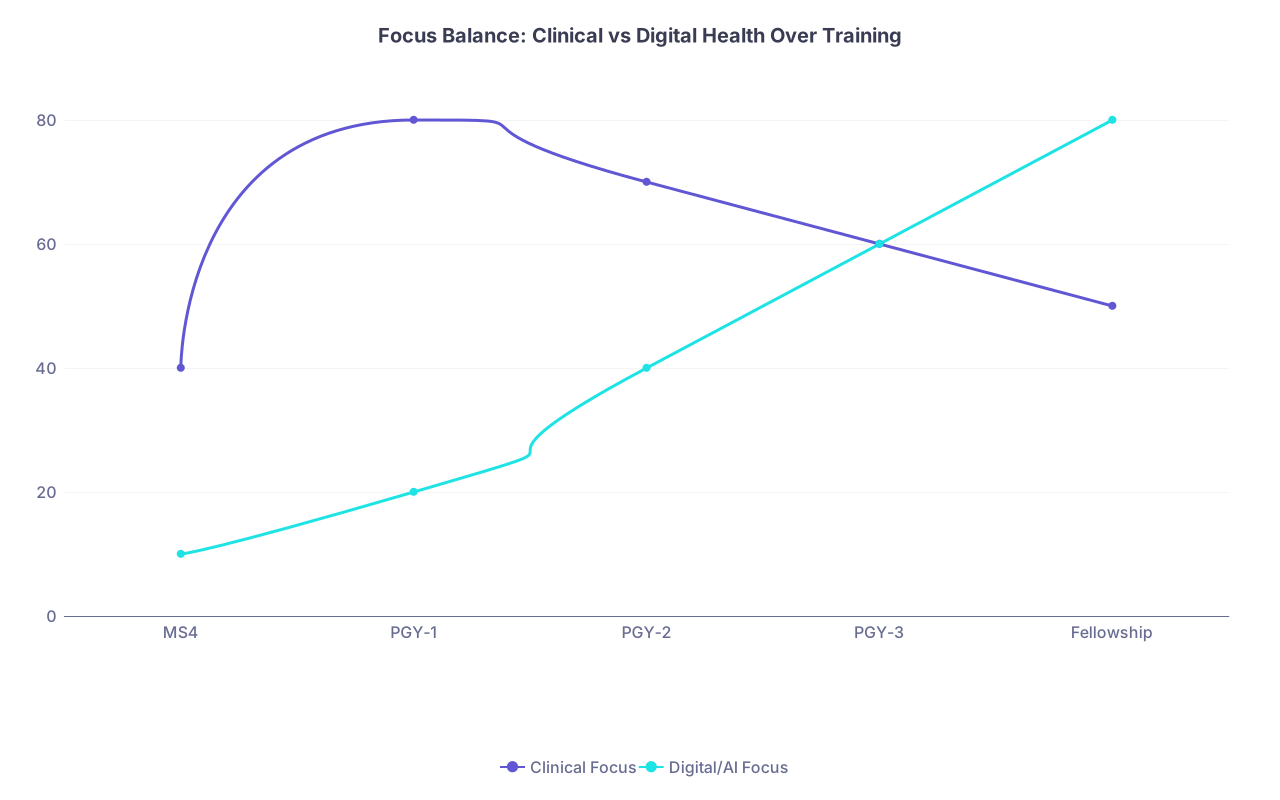
| Category | Clinical Focus | Digital/AI Focus |
|---|---|---|
| MS4 | 40 | 10 |
| PGY-1 | 80 | 20 |
| PGY-2 | 70 | 40 |
| PGY-3 | 60 | 60 |
| Fellowship | 50 | 80 |
You’re not abandoning clinical work; you’re gradually rebalancing what gets your extra energy.
Concrete Micro-Timeline: What to Do, Year by Year
Sometimes it helps to see the whole thing stitched together.
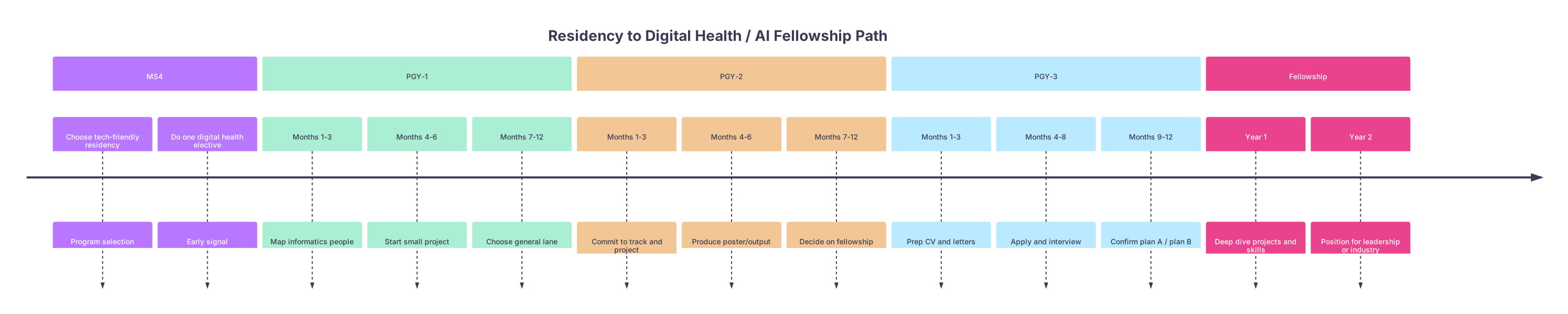
| Period | Event |
|---|---|
| MS4 - Choose tech-friendly residency | Program selection |
| MS4 - Do one digital health elective | Early signal |
| PGY-1 - Months 1-3 | Map informatics people |
| PGY-1 - Months 4-6 | Start small project |
| PGY-1 - Months 7-12 | Choose general lane |
| PGY-2 - Months 1-3 | Commit to track and project |
| PGY-2 - Months 4-6 | Produce poster/output |
| PGY-2 - Months 7-12 | Decide on fellowship |
| PGY-3 - Months 1-3 | Prep CV and letters |
| PGY-3 - Months 4-8 | Apply and interview |
| PGY-3 - Months 9-12 | Confirm plan A / plan B |
| Fellowship - Year 1 | Deep dive projects and skills |
| Fellowship - Year 2 | Position for leadership or industry |
And alongside that, think in terms of weekly time:
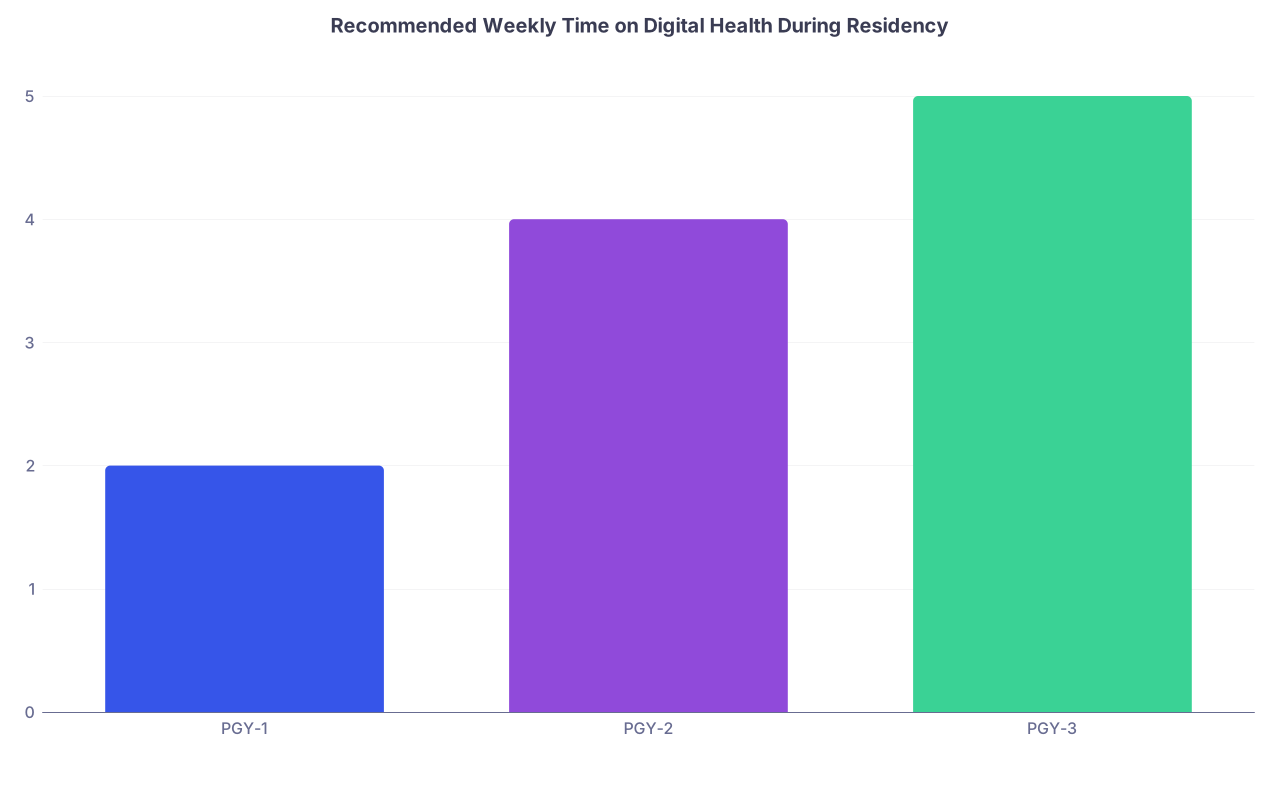
| Category | Value |
|---|---|
| PGY-1 | 2 |
| PGY-2 | 4 |
| PGY-3 | 5 |
That’s average focused hours per week outside your clinical duties. More than that is possible, but for most residents, unrealistic long-term.
Common Timing Mistakes (And When They Happen)
A few patterns I see repeatedly:

PGY-1 doing too much too fast.
Joining three “AI projects,” taking two online courses, plus a QI committee. They burn out and do none of them well. PGY-1 is for one small, scoped project + literacy.PGY-2 not deciding on fellowship early enough.
They decide to apply mid PGY-3 with:- No letters from informatics people
- No clear project completion
- Vague narrative
They look “interested” but not committed. That’s a hard sell.
PGY-3 applying to everything.
They scatter applications to clinical fellowships, informatics, and random innovation roles without a coherent story. Programs can smell that a mile away.Waiting for the “perfect” AI project.
You don’t need to build a deep-learning model on 1M patients. A well-executed sepsis alert refinement or telehealth workflow pilot shows more real-world impact than some half-finished fancy algorithm.
Where AI-Focused Fellowships Fit in the Future of Healthcare
Digital health and AI are not side quests anymore. They’re becoming core infrastructure. But the systems to train people are still catching up.
So here’s the blunt take on timing:
If you want to lead AI/digital efforts (CMIO, health system AI lead, head of clinical AI at a company), then:
- A well-chosen fellowship, timed with strong PGY-2 and PGY-3 preparation, accelerates you significantly.
If you want to be a highly effective clinician collaborator with tech teams:
- You can get away without formal fellowship if you use PGY-2/3 and your first attending years wisely.
Either way, the mistake is pretending you’ll “figure it out later.” Later doesn’t exist. You either build toward this during residency, or you don’t.
Final Takeaways
- By the end of PGY-1, you should have exposure and a direction—not a detailed plan, but a lane.
- By the middle of PGY-2, you should be executing at least one substantial digital health or AI project and identifying specific fellowships or roles.
- By early PGY-3, your decision about pursuing an AI/digital health fellowship should be made, and your time should shift from exploration to disciplined preparation and applications.