
The quiet battle between IT and clinicians over clinical AI isn’t theoretical. It’s happening right now in your hospital’s basement conference rooms and “AI steering committee” meetings where half the key people never show up.
And it’s going to decide whether clinical AI actually helps patients…or becomes another bloated, expensive decision-support toy that everybody ignores while the vendor collects the check.
Let me tell you what really happens.
What’s Actually Being Fought Over (It’s Not Just “AI”)
On paper, everyone agrees: “We should leverage AI to enhance patient care.” That line is in every strategy deck.
Behind closed doors, the fight is about control. Who controls:
- The clinical workflows
- The definition of “good enough” accuracy
- The risk tolerance for false positives and false negatives
- The budget and vendor relationships
- The data access and integration priorities
IT leaders think they’re deploying infrastructure and tools.
Clinicians think they’re defending their license and patient outcomes.
Vendors think they’re selling a “platform.”
Administration thinks they’re buying a differentiator for the annual report and the board slideshow.
Nobody says it like that in meetings. But you see it in the behavior:
- The AI use case is chosen because it fits the CIO’s roadmap, not because it fixes the ward’s biggest pain point.
- The clinical champion is added at the end, asked to “bless” something that’s already 90% decided.
- IT pushes for standardization and scale; clinicians ask for nuance and exceptions.
This is the fault line.
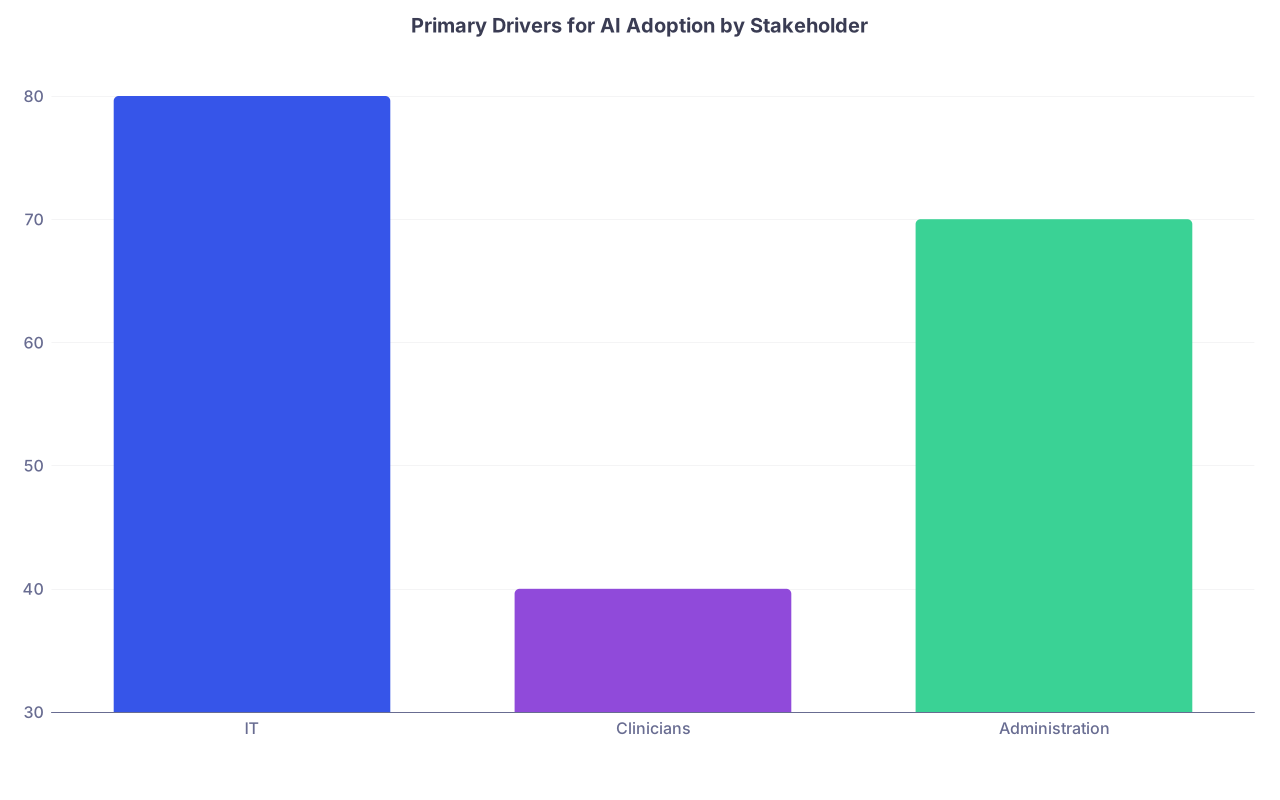
| Category | Value |
|---|---|
| IT | 80 |
| Clinicians | 40 |
| Administration | 70 |
(That’s roughly how the priorities feel: IT driven by technology and architecture, clinicians by patient impact, administration by strategy and optics.)
How AI Actually Gets Chosen: The Backroom Version
Most clinicians imagine that clinical AI systems are adopted like this:
Identify major clinical problem → review evidence → select best tool → pilot → refine → scale.
Nice fantasy.
Here’s the real sequence I’ve seen more times than I can count:
- A vendor with a polished deck gets early access to the CIO or CMO at a conference. They promise “frictionless integration” with the EHR and “FDA-cleared models” that will “predict deterioration 12 hours earlier.”
- Someone in leadership wants to be seen as “innovative.” The phrase “we should be a national leader in AI” gets thrown around. No one wants to be the dinosaur.
- IT is tasked: “Explore this AI platform and get back with an implementation plan.” Note: not “Should we do this?” but “How do we do this?”
- A “clinical champion” is recruited. Usually someone already friendly to administration, not necessarily the most respected clinician on the front line.
- Governance structures appear: “AI Oversight Committee,” “Digital Health Council,” “Innovation Steering Group.” Half the time, major decisions get made in pre-meetings and side conversations anyway.
- By the time the average front-line clinician hears about it, the project has a signed contract, a go-live timeline, and a press release half drafted.
And then everybody pretends the decision is still “in discussion.”
If you’re a clinician reading this and you’ve ever wondered why the AI project seems misaligned with your daily reality on the wards, that’s why. You weren’t at the real decision table.
Why IT Thinks Clinicians Are the Problem
Let me flip the lens for a second. Inside IT and digital teams, the conversation about clinicians can get blunt. You’ll never hear this in public, but you hear it in hallway chats and late-night Slack threads.
It sounds like this:
- “We spent six months getting this Sepsis AI integrated and nobody even opens the dashboard.”
- “Every time we propose a change, the docs say ‘workflow impact’ and stall.”
- “They want 99.9% accuracy from AI, but accept way worse from humans every day.”
- “They keep saying ‘we’re worried about liability’ but won’t sit down to define acceptance criteria.”
From IT’s point of view, clinicians:
- Show up late to design sessions or skip them
- Reject prototypes without offering concrete alternatives
- Demand customization that explodes scope and cost
- Complain loudly but don’t read the training materials
- Argue from anecdotes, not data
There’s some truth in that.
I’ve seen workshops where data science and IT teams brought in a solid risk model, asked for feedback, and half the clinicians left after 20 minutes because pager chaos. The ones who stayed were exhausted and defensive, not engaged.
So IT does what’s rational from their vantage point: they optimize for what they can control.
They make sure:
- The system is stable and scalable
- It’s technically integrated into the EHR
- Security and compliance boxes are checked
- The vendor is under contract and supported
And then they assume clinicians will “adopt” because, well, why wouldn’t you want better prediction?
That’s where the quiet war starts.
Why Clinicians Think IT Is the Problem
Now, the view from the wards.
Clinicians see the AI wave as yet another top-down imposition. They’ve already lived through:
- Badly designed EHR rollouts
- Meaningful Use reporting burdens
- “Optimization” projects that made everything slower
- Alert fatigue from CDS that everyone overrides
So when someone says “We’re rolling out an AI deterioration predictor,” what they hear is:
“More alerts. More clicks. More documentation. More things I can be judged on.”
The private complaints sound like this:
- “They want me to trust a black box, but can’t explain how it works.”
- “If this prediction is wrong and I ignore it, will someone pull my chart in a lawsuit?”
- “They call it ‘assistive,’ but next year they’ll use it as a performance metric.”
- “IT acts like our workflow is just a diagram to redraw, not something constrained by reality and staffing.”
And again, there’s truth in that.
I’ve seen AI sepsis alerts firing based on vital sign artifacts from a blood pressure cuff that was on the floor. The system looked “high sensitivity” on paper. On the night shift, it looked like: “Yet another false positive that I’m supposed to respond to with no extra staff.”
Clinicians know the difference between:
- A prediction that’s technically accurate on population-level validation
- And a prediction that’s actually actionable at 3 a.m. when you have two cross-cover pagers
If the people designing the AI system don’t understand that distinction, the system dies in practice, no matter how beautiful the ROC curve.
Where the Conflict Quietly Explodes: At the Bedside
The real battlefield isn’t the AI committee meeting. It’s a very specific scene.
An intern is on night float. She gets:
- A classic pager message from the nurse: “HR 118, BP 94/58, looks a little off.”
- And simultaneously, a new AI alert in the EHR: “High risk of deterioration in the next 12 hours. Suggested actions: STAT labs, consider transfer to higher level of care.”
Here’s what happens if the quiet war hasn’t been resolved:
She doesn’t trust the AI. Or she’s never been properly shown its performance. Or she thinks this whole system exists more for the CFO’s dashboard than to help her.
So she does what she was going to do anyway. Checks the patient, orders a small workup, documents something generic. Maybe the patient’s fine. Maybe they crash three hours later.
Months later, some quality review pulls the case and looks at the AI log:
- “ALERT FIRED – no escalation documented”
And now people start asking why the clinicians “ignored” the AI. And clinicians start asking why they were told it was “just a tool” if they’re going to be judged for not obeying it like an order.
That’s the quiet battle becoming very loud.
Governance Theater vs Real Clinical Ownership
Almost every health system with AI aspirations sets up some sort of governance. On the outside, it looks mature. Multi-disciplinary committee, charter, meeting minutes.
The reality falls into two categories:
Governance theater
Meetings become rubber stamps. The system or vendor has already been chosen. Clinicians see three slides, ask two questions, and someone says, “We’ll refine this in the pilot.” They never hear about it again until go-live.Real but misaligned governance
Well-meaning committees fixate on things that are easy to talk about:- Bias language in the policy
- Whether to call it “AI” or “decision support”
- The color of the alert icon And they dodge the hard questions:
- In which clinical scenarios does the AI recommendation override usual practice norms?
- What’s the explicit expectation when AI and clinician judgment disagree?
- Who owns the failure when that happens?
Let me translate what smart program directors and CMOs whisper off-record:
If the AI can be ignored with no consequences, it will be.
If the AI cannot be ignored without consequences, you’d better treat it like a clinical protocol, not a “helpful suggestion.”
Most hospitals try to have it both ways. “You’re free to use your judgment… but also we’ll monitor how often you follow the AI.” That ambiguity is poison.
The Vendor Triangle: Who’s Actually Driving?
You’re not just dealing with IT vs clinicians. There’s a third player calling a lot of shots: the vendor.
In internal discussions, vendors position themselves as neutral helpers. They talk “co-creation,” “partnership,” “configurable workflows.”
Behind the scenes, here’s what shapes what you get:
- Their product was originally built for a different context (often US academic centers) and is now being crammed into your mid-sized community hospital.
- Their sales team promised a go-live date that the delivery team knows is insane.
- Their best engineers are focused on the flagship client, not you.
- Their risk team is hyper-conservative, pushing responsibility for every clinical decision back onto your clinicians “per policy.”
So if you’re wondering why:
- You can’t tweak that one threshold that’s obviously too sensitive
- Or you can’t turn off a subset of alerts for one specialty without breaking everything
- Or it takes three months to get an answer on a basic question about model updates
It’s usually because the vendor is balancing ten other clients’ demands and doesn’t want to maintain twenty different versions of their system.
IT knows this. Clinicians often don’t. So clinicians think, “IT refuses to change this.”
In reality, IT has already argued with the vendor, lost, and moved on.
Data Science Caught in the Crossfire
Then there’s the data science team. If your organization is big enough, you’ve probably hired “clinical AI” people internally.
They’re the ones stuck trying to translate:
- “We need higher sensitivity or what’s the point?” from clinicians
- “We need less noise or this will be turned off” from IT and nursing
- “We need a case study with great numbers by Q4” from leadership
- “We need to protect our IP and scale one codebase” from vendors
I’ve watched data scientists roll out strong models that died because nobody ever decided where they sit in the actual workflow. Do they:
- Trigger an EHR alert?
- Populate a list for proactive review by a rapid response nurse?
- Inform a backend prioritization queue?
Those decisions are governance decisions. Risk decisions. Ownership decisions.
When nobody wants to own the risk, the model becomes a “dashboard” that no one opens.
Why This Battle Is About to Get Much Worse
Everything I’ve described is based on today’s systems: risk scores, prediction models, narrow AI.
Now, add generative AI and complex decision-support:
- Systems that draft notes and propose diagnoses
- Tools that summarize the chart and suggest orders
- Algorithms that recommend specific treatment pathways
Here’s the uncomfortable truth: the greater the clinical impact, the more this becomes a power struggle.
Who gets to say:
- “This AI is good enough to recommend a chemo regimen.”
- “This AI can draft discharge instructions mostly unsupervised.”
- “This AI can recommend against an MRI the clinician ordered.”
That’s not an IT question. That’s not just a “quality and safety” question. That’s a culture-of-practice question.
And right now, most organizations are pretending those decisions can be handled with a vendor risk assessment, an IRB consultation, and a one-page policy.
They can’t.
You’re going to see fractures:
- Radiology vs administration over AI read-prioritization becoming pseudo-triage.
- Hospital medicine vs IT over “smart discharge” tools that pressure earlier discharges.
- Emergency medicine vs everyone over AI triage scores being used to second-guess front-door decisions.
These won’t be abstract debates. They’ll show up as:
- Burnout
- Silent non-adoption
- Workarounds
- Or, eventually, open revolt
Two Very Different Futures: Tool or Boss
At the core, this battle is about what role AI will play: tool or boss.
Right now, every health system says, “AI will assist clinicians, not replace them.” Fine. Sounds safe.
But I’ve sat in the closed meetings where CFOs and COOs say things like:
- “If this tool can reduce imaging use by 7%, that’s real money.”
- “Can we use this AI to help standardize ordering across providers?”
- “Are there opportunities to reduce FTEs if the documentation is semi-automated?”
That’s where you see the future fork:
Future A: AI as a quiet, integrated tool.
- Accuracy expectations are realistic.
- It supports judgment, doesn’t police it.
- It’s tuned by the people who actually use it.
Future B: AI as a soft boss.
- It drives metrics tied to your evaluation.
- Deviating from it requires justification.
- It informs staffing and productivity decisions.
Clinicians sense this even when nobody spells it out. That’s why you get reflex resistance. They’re not just resisting an algorithm. They’re resisting the power that may eventually sit behind that algorithm.
The Few Places That Are Getting It Right
There are a handful of systems that have defused this quiet war better than most. The pattern isn’t mysterious. But it requires actual courage from leadership.
They do a few things differently:
Clinical-led, not clinically-decorated.
The real decisions about which AI to deploy, where in the workflow, and with what expectations are led by credible front-line clinicians with real authority. IT supports, not dictates.Honest performance thresholds.
They don’t demand perfection. They define, upfront: “If this tool gets us X% improvement with Y% added noise, we’ll keep it.” And then they stick to that, even when the quality committee gets nervous.Clear rules of engagement.
They answer explicitly:- Is following the AI recommendation the default or optional?
- What documentation is expected when clinicians disagree?
- How will disagreements be reviewed (if at all)?
Shared visibility of the data.
Everyone sees the same dashboards:- Adoption rates
- Alert volumes
- Outcomes tied to use vs non-use
No secret reporting used to quietly rank clinicians against each other without context.
Willingness to kill projects.
This might be the biggest one. They’re willing to say:- “We bought it. We deployed it. It didn’t help. We’re turning it off.” And they do that without blaming IT or clinicians. They treat it as experimentation, not failure.
| Dimension | Governance Theater Hospital | Clinically Led Hospital |
|---|---|---|
| Who picks use cases | CIO + vendor | Front-line clinicians |
| Role of AI alerts | Mandatory but vague | Explicit expectations |
| Handling poor adoption | Blame users | Reassess or retire tool |
| Vendor relationship | Sales-driven | Outcomes-driven |
| Clinician attitude | Cynical, defensive | Cautious but engaged |
The table looks simple. Getting from the left column to the right column is not.
What You Should Be Doing Now (Depending on Who You Are)
Let me be blunt.
If you’re a clinician and you’re ignoring every AI conversation because you’re busy and skeptical, you’re giving away your power. You’ll still live with the consequences. You just won’t shape them.
Pick one:
- Join the AI/clinical decision support committee and actually show up.
- Or become the de facto skeptic who’s also constructive: the person who says, “Show me the data, show me the workflow impact, and here’s how we could make this useful.”
If you’re IT or digital leadership, stop pretending adoption is primarily a training problem. It’s not. It’s a trust and ownership problem.
Before the next pilot, answer—on paper:
- Who owns clinical outcomes associated with this AI?
- Under what conditions will we turn this off?
- How will we handle cases when AI and clinicians disagree?
If you’re administration, be honest about your motives. If you want AI to drive cost savings, say it. Then have the ethical and operational debate in the open, not buried in budget slides.
And if you’re a trainee, pay attention. The systems you’re learning in now will look primitive in ten years, but the power dynamics you’re watching? Those will be the same. You’re getting a preview of your future work environment.
The Battle Won’t Stay Quiet Forever
Right now, the clash between IT and clinicians over clinical AI is mostly passive-aggressive.
- IT deploys tools that get quietly ignored.
- Clinicians grumble in the workroom and click past alerts.
- Administration declares success in glossy annual reports.
That phase won’t last.
As AI systems start affecting:
- Triage decisions
- Resource allocation
- Performance evaluations
- Legal liability
…the stakes will climb. And so will the volume of the conflict.
The organizations that survive that transition with morale and quality intact will be the ones that faced the quiet battle early, named it, and reset how decisions get made.
Clinical AI is not just another tech upgrade. It’s a renegotiation of power in healthcare.
With that in mind, you’re not just “adopting AI.” You’re deciding who gets to practice medicine, who gets to define “standard of care,” and who carries the blame when technology and judgment collide.
The early skirmishes are already underway in your inbox and your committee invites.
With this picture in your head, you’re a step ahead of most of your colleagues. The next step is harder: getting involved where the real decisions are made. Because the systems being built now are the ones you’ll be working under in five years.
And by then, it won’t be a quiet battle anymore. It’ll be the rules of the game.
But that phase—how AI reshapes training, evaluation, and what it means to be “a good clinician”—that’s a story for another day.


| Step | Description |
|---|---|
| Step 1 | AI Alert Fires |
| Step 2 | No action - silent ignore |
| Step 3 | Follow usual judgment |
| Step 4 | Follow AI recommendation |
| Step 5 | Clinician sees alert |
| Step 6 | Trust AI? |
| Step 7 | Outcome |
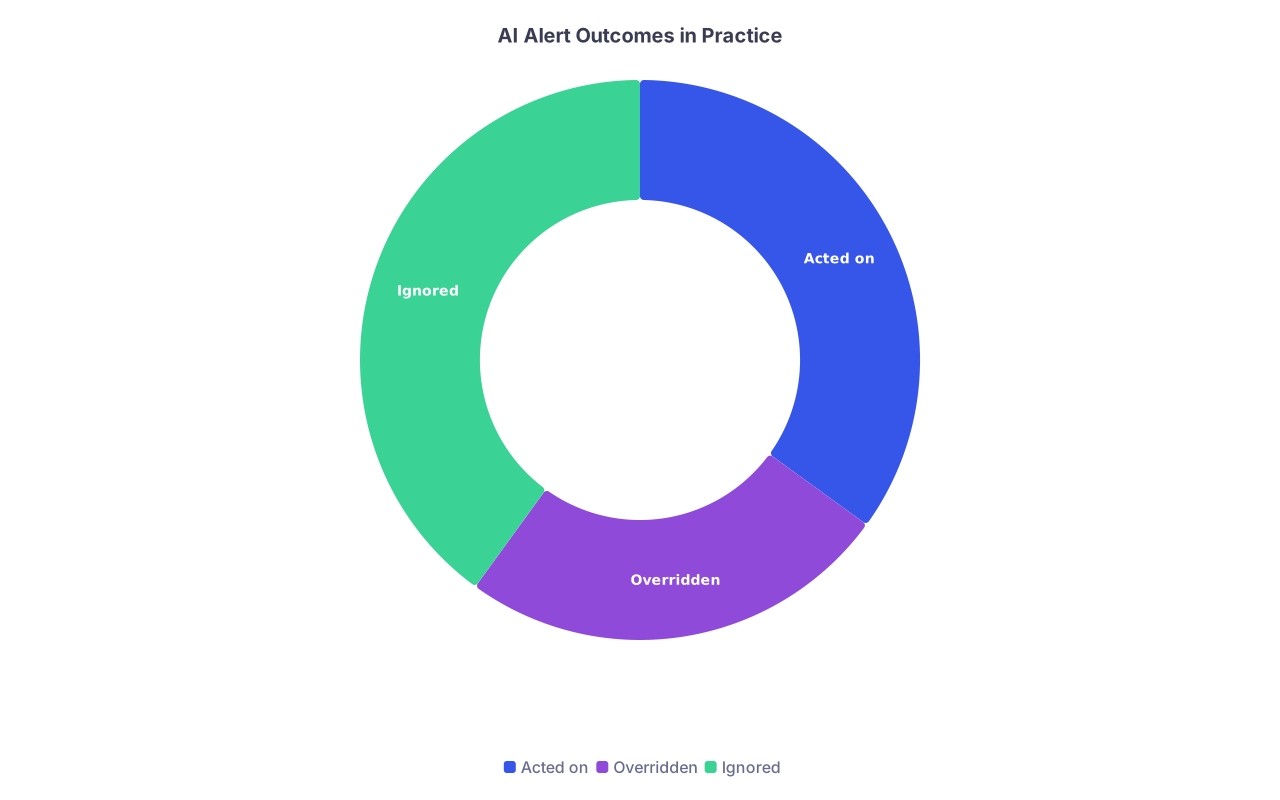
| Category | Value |
|---|---|
| Acted on | 35 |
| Overridden | 25 |
| Ignored | 40 |