
The phrase “AI hospital” is mostly a branding exercise, not a scientific category. Right now, what’s being sold as an “AI hospital” is closer to a hospital with some decent software upgrades than a fundamentally new kind of care.
Let’s strip the marketing paint off and look at what’s actually happening.
What People Think an “AI Hospital” Is vs What Exists
When a hospital CEO says “We’re building the first AI hospital,” people picture three things:
- AI physicians doing diagnoses better than humans
- Fully automated workflows where algorithms run the place
- Dramatic outcome improvements: fewer deaths, fewer errors, lower costs
That vision is decades away. And it assumes problems that, in many cases, aren’t actually the bottleneck.
What we actually have today is:
- Narrow machine-learning tools welded onto very old infrastructures
- Lots of pilots, dashboards, and “AI copilots” in documentation and triage
- Very little hard evidence of system-wide outcome gains from “AI-ification”
There are serious projects, including some entire buildings marketed as “AI hospitals” in China, the Middle East, and a few US integrated systems. But when you look closely, they are not what the press releases imply.
They are conventional hospitals with a heavier-than-average dose of:
- Decision support
- Workflow automation
- Predictive analytics
In other words: better IT. Not a new species of healthcare organization.
Where AI in Hospitals Actually Works (Quietly)
Before I tear down the hype, let me be fair. There are places where AI is doing something useful in hospitals today. They just don’t look like sci‑fi.
Radiology and Imaging: The Poster Child (With Fine Print)
Radiology is everyone’s favorite AI success story. And yes, there’s real substance there.
We have FDA-cleared tools for:
- Detecting pulmonary emboli, intracranial hemorrhage, fractures
- Flagging emergent CT scans so they move up in the queue
- Measuring ejection fraction, LV volumes, and other echo parameters
In multiple studies, AI improves detection of specific findings and can reduce turnaround times. But the nuance: It’s usually acting as a second reader or triage assistant, not replacing the radiologist.
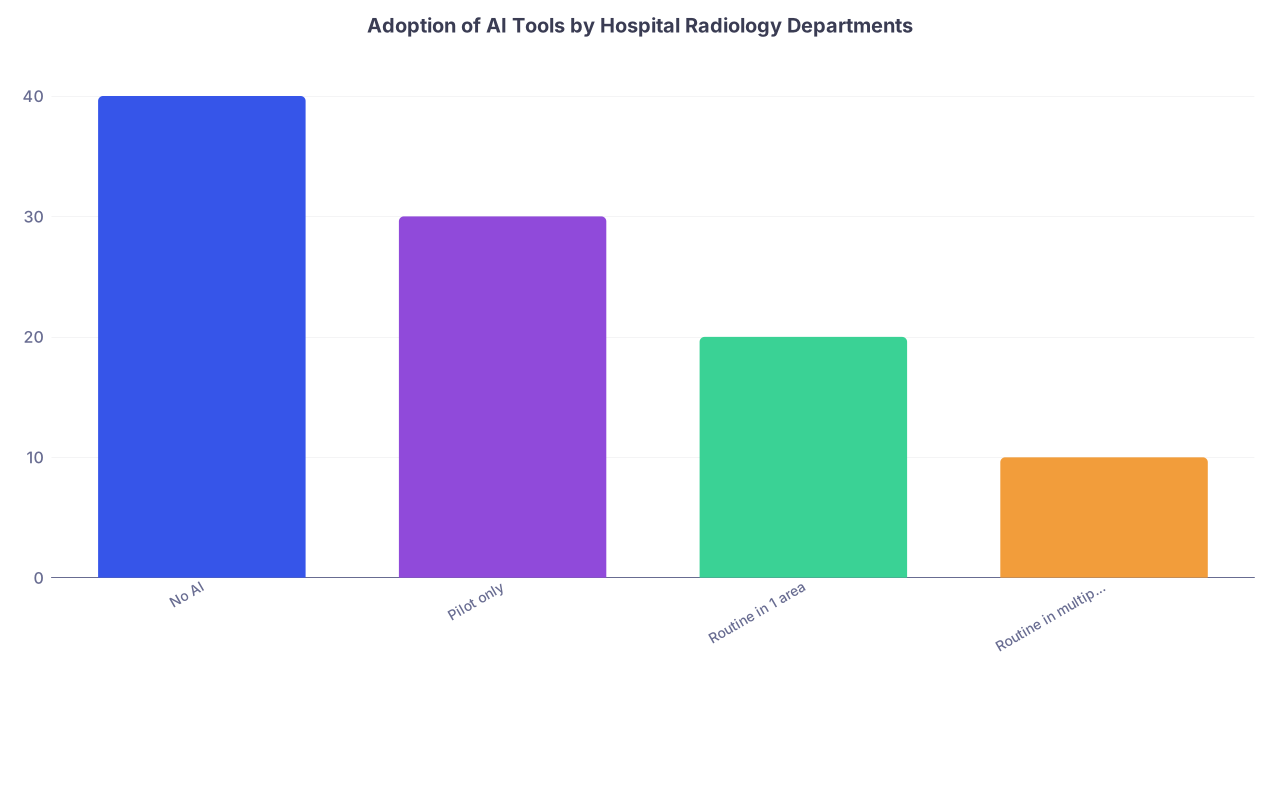
| Category | Value |
|---|---|
| No AI | 40 |
| Pilot only | 30 |
| Routine in 1 area | 20 |
| Routine in multiple areas | 10 |
Those numbers are roughly consistent with survey data from major societies: most radiology departments are dabbling; only a minority have routine deployment across multiple workflows.
What this means: AI in radiology is real, clinically useful in narrow tasks, but nowhere near the full-automation narrative often bundled into “AI hospital” claims.
Operational AI: The Boring Stuff That Actually Saves Money
The least sexy uses of AI are often the most impactful:
- Bed management and patient flow prediction
- OR block scheduling optimization
- Staffing and acuity-based nurse assignment
- Predicting no-shows, readmissions, and ED surges
These tools tend to:
- Save money on staffing and overtime
- Reduce ED boarding time
- Increase OR utilization by a few percentage points
Do they change mortality curves? Not really. But they help a CFO breathe easier.
The catch: Most of this is classical operations research, forecasting, and optimization with a machine-learning flavor. Not general intelligence. Not anything that justifies calling the building an “AI hospital.”
Documentation and Coding: Where Generative AI Is Actually Being Used
The loudest current wave is ambient scribes and coding assistants:
- Tools that listen to patient encounters and draft notes
- Systems that suggest billing codes, problem lists, and orders
- Chat-style “copilots” inside the EHR
These can save clinicians time. And burnout is not a fake problem. But again, the clinical impact is indirect: less time charting, maybe a bit more time with patients, maybe fewer documentation errors.
You’ll hear claims like “we reduced physician documentation time by 40%.” Sometimes that’s real in time-motion studies. Sometimes it’s less impressive in real practice when you factor in corrections and edge cases.
What it’s not: a transformational change in how diagnoses are made or treatments chosen.
The Core Myth: That “AI Hospitals” Solve the Wrong Problem
The marketing pitch assumes this:
“If we just add AI, care will become dramatically better, safer, cheaper.”
Reality: the limiting factor in most hospitals is not a lack of clever algorithms. It’s:
- Perverse payment structures
- Fragmented data systems
- Understaffing and burnout
- Misaligned incentives between hospital, payer, and patient
- Organizational inertia bordering on pathological
So when a hospital slaps “AI” on top of that mess without fixing the fundamentals, you get:
- Slightly faster charting
- Nicer dashboards
- One or two AI tools with marginal metrics improvements
And then a press release about “the future of medicine.”
You want real transformation? That takes boring, unglamorous work: workflow redesign, governance, data infrastructure, culture change. AI can help, but it doesn’t substitute for that.
What “AI Hospital” Claims Usually Hide
If a system is yelling about becoming an “AI hospital,” I start looking for what they’re not saying out loud. Pattern I’ve seen more than once:
- EHR modernization disguised as AI revolution
- Vendor lock-in: “Our AI platform will unify your data” (translation: we’ll own your stack)
- PR distraction from more mundane complaints: long waits, financial trouble, quality issues
Let’s parse some common phrases you’ll see in these announcements.
“End-to-end AI-powered care journey”
Usually means: some automated triage chatbot on the website + a predictive readmission model + AI scribes + a few radiology tools. End-to-end in the loosest possible sense.
“Self-optimizing hospital operations”
In reality: a forecasting algorithm feeds a dashboard; a human still has to interpret and implement change. There is no closed-loop, full-automation system safely orchestrating beds, staffing, and procedures without humans in control.
“AI-driven clinical decision-making”
Regulators are very clear: AI is supportive, not autonomous. If your marketing sounds like the AI is making the primary decision, you’re either overstating or inviting a compliance visit.
| Claim in Brochure | What It Usually Means in Practice |
|---|---|
| AI-powered triage | Symptom checker chatbot with escalation rules |
| AI doctor or AI clinic | Decision support tool plus human clinician |
| Fully automated workflows | Some task automation and routing rules |
| Predictive care | Risk scores embedded in EHR alerts |
| AI hospital of the future | Regular hospital plus 5–10 added software tools |
Once you’ve seen behind the curtain a few times, it’s hard to take the grandiose labels seriously.
The Real Technical Barriers No One Puts in the Brochure
Let me walk through what actually blocks these “AI hospital” visions, because it’s not math. The math is the easy part.
1. The Data Is Still a Dumpster Fire
Hospital data is:
- Fragmented across EHR, lab, PACS, pharmacy, monitors, devices
- Filled with copy-pasted nonsense and templated junk
- Missing labels you actually need (true outcome, symptom onset, functional status)
Most AI vendors either:
- Train on highly curated, unrepresentative data from a few institutions
- Or scrape raw EHR fields and hope scale beats noise (it usually doesn’t)
That’s why models often perform nicely in the development paper and then die when deployed in a different hospital, with different workflows, different patient mix, different documentation habits.
2. Integration Is the Real Boss Fight
It’s easy to demo an AI tool on a laptop. It’s brutal to make it:
- Pull the right data automatically from the production EHR
- Return results in the right spot in the clinician’s workflow
- Handle downtime, versioning, scaling, consent, and logging
- Not break every time the EHR is upgraded
Hospitals are littered with the corpses of AI pilots that never got over this integration hump. People underestimate how conservative and brittle healthcare IT environments are, often for good reasons (you really do not want experimentation on your main clinical system).
3. Regulatory and Liability Constraints
To be blunt: nobody wants to be first in line when the plaintiff attorney asks:
“Why did you let this black-box algorithm decide to discharge my client?”
So hospitals keep AI mostly on a leash:
- Triage, not final diagnosis
- Risk scores, not mandated decisions
- “Recommendations” with override, not autocompleted orders with no human review
This is not cowardice. This is basic risk management in a world where even non-AI clinical decisions generate lawsuits.
Where “AI Hospital” Might Actually Mean Something in 5–15 Years
Now the optimistic part. There is a plausible path where “AI hospital” becomes more than branding, but it won’t look like robots replacing doctors. It will look like:
- A hospital that has re-architected its data layer so all relevant signals are accessible in real time
- AI systems woven into dozens of micro-decisions: who to call in first, what to prioritize, which patients to focus on right now
- Human clinicians still in the loop, but increasingly supported by ambient intelligence that reduces cognitive overload
Think:
- Early-warning systems that are actually trusted and tuned, not ignored like most current alerts
- Real-time risk stratification across the hospital so safety nets catch patients before they crash
- Seamless, multilingual, multimodal communication between patients, nurses, and physicians mediated by AI
We’re not there yet. A few integrated systems (think large academic centers with in-house data science teams and control over their tech stack) are closer than others. But the gap between them and a small community hospital is massive.
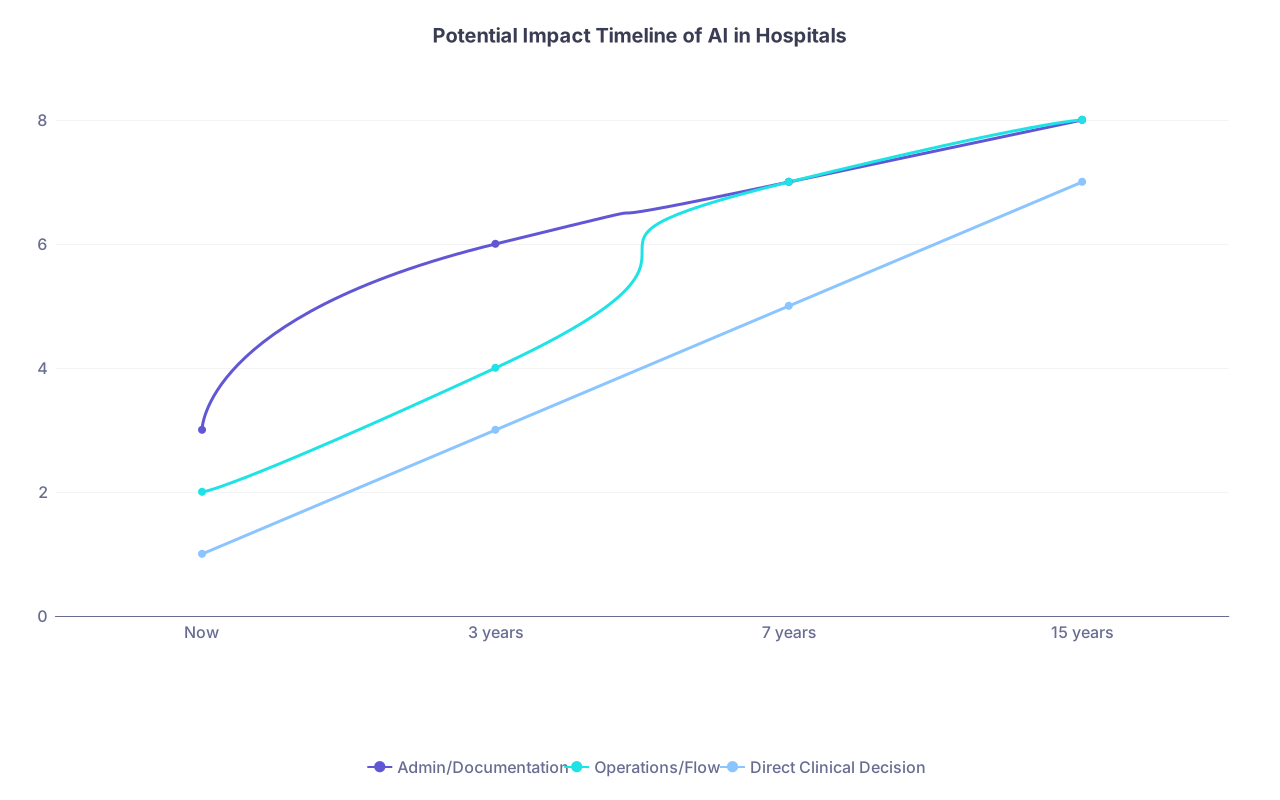
| Category | Admin/Documentation | Operations/Flow | Direct Clinical Decision |
|---|---|---|---|
| Now | 3 | 2 | 1 |
| 3 years | 6 | 4 | 3 |
| 7 years | 7 | 7 | 5 |
| 15 years | 8 | 8 | 7 |
(Scale 1–10: 1 = negligible impact, 10 = transformational. Yes, these are conceptual, but the relative ordering matters.)
Notice what moves first: documentation and operations. Clinical decision-making remains constrained for longer by regulation, evidence requirements, and risk tolerance.
How to Tell If a Hospital’s AI Strategy Is Serious or Just PR
You do not need inside access to smell the difference.
Serious AI hospital behaviors:
- They publish not just “we deployed AI” but hard outcomes: fewer falls, faster sepsis treatment, lower readmissions, with confidence intervals and pre/post data
- They admit where models failed or were retired
- They have a visible governance structure: model review committees, bias audits, kill-switch processes
- They talk about infrastructure: data platforms, integration teams, monitoring
PR-driven AI hospital behaviors:
- Lots of glossy videos, almost no peer-reviewed or even technical detail
- Vague claims: “revolutionizing care,” “transforming outcomes” without numbers
- Heavy emphasis on being “first” or “largest” rather than “most effective”
- Partnering with big-name tech firms where the press release is the real product
If all you can see is a few chatbots, some radiology AI, and ambient scribes, that’s not an “AI hospital.” That’s 2020s baseline technology with better marketing.
The One Hard Question You Should Always Ask
Whenever you hear “AI hospital,” here’s the only question that matters:
“Show me, quantitatively, how care is safer, faster, or cheaper because of AI—and compared to what baseline?”
If the answer is:
- “Our physicians feel supported” → good, but subjective
- “We’ve automated X hours of documentation” → helpful, but indirect
- “Patients love our AI chatbot” → fine, but not core safety/quality
You’re not looking at a new model of healthcare. You’re looking at a tech-upgraded version of the same system.
If, on the other hand, they can show:
- A sustained, validated drop in hospital-acquired complications or mortality tied to specific AI-driven interventions
- Reduced length of stay without worse readmission or adverse events
- Significant cost savings that didn’t come from cutting staff to the bone
Then you can start to use words like “meaningful change” without laughing.
Bottom Line
Three quick points to take away:
- “AI hospital” today is mostly a marketing label for hospitals that have adopted a higher-than-average mix of AI tools—but the core clinical model is unchanged.
- The real wins right now are in documentation and operations, not in AI replacing physicians or making autonomous treatment decisions; the evidence for system-wide outcome transformation is thin.
- If a hospital can’t show specific, quantitative improvements tied to their AI deployments, you’re not looking at the future of medicine—you’re looking at the future of healthcare branding.