You are on hour eleven of a twelve‑hour shift. The ED board is full. Your inbasket is worse. You click into the chart and—mercifully—the AI note is already drafted. HPI, ROS, exam, assessment, plan. All there. Temptation hits: “This looks fine. I’ll just tweak a line or two and sign.”
This is where people get burned.
Not usually that day. Not even that week. The problems show up later—when a patient complains, a lawyer requests records, or a quality review pulls your note and it reads like a bad fanfic of what actually happened.
Let me be blunt: AI documentation tools can be lifesavers for cognitive load and efficiency. They can also quietly wreck the integrity of your charts if you treat them as gospel or harmless “helpers.” I have seen rock‑solid clinicians look incompetent—or worse, careless—because they trusted an AI draft more than their own brain.
You want the upside without stepping on the landmines. That means you need to know exactly how these tools fail, and where clinicians make predictable, repeatable mistakes.
1. Blind Trust: Signing Notes You Did Not Actually Read
The laziest but most common error: assuming “it captured the visit” and skimming at best.
Here is the trap: AI systems trained on thousands of encounters know what a “typical” note looks like for chest pain, abdominal pain, URI, well‑child visit, etc. So when the audio is unclear, the patient is atypical, or you spoke quickly, the model does not say, “I’m uncertain.” It hallucinates a plausible‑sounding normal note.
I have seen:
- “No suicidal ideation” documented in a patient who explicitly described passive SI.
- “Denies chest pain” in a visit where the sole reason for presentation was chest pain.
- Normal neuro exam auto‑inserted in an elderly fall patient who never had a full neuro exam done.
The mistake is thinking of AI notes as a “scribe.” They are not. They are pattern‑generating guess machines with zero liability and no clinical judgment.
How to avoid this:
Stop signing without a deliberate review pattern.
Have a fixed order you always check: chief complaint → HPI → exam → assessment/plan → orders. Same every time. Your brain needs a checklist, not vibes.Use hard stops for critical sections.
Make it a rule for yourself: you never sign a note without manually confirming:- Chief complaint
- Initial vital concerns (pain, mental status, SOB, chest pain, bleeding, pregnancy)
- Assessment and plan, line by line
Delete more than you think you should.
If a section feels off, do not surgically tweak; nuke and rewrite in your own words. Partial edits around a flawed core are how contradictions creep in.
2. Fabricated Details: The “Looks Right” Problem
AI is remarkably good at making things up that sound believable. That is its job. In clinical notes, this looks like:
- Counseling that never occurred (“Discussed tobacco cessation and provided resources”)
- Exams you did not perform (“Fundoscopic exam normal” when you never picked up the ophthalmoscope)
- Social history you never asked about (“Lives with spouse and two children,” “Denies alcohol use”)
- Follow‑up plans that were never discussed (“Patient verbalized understanding and agrees to follow up in 1 week”)
Clinically, this can seem minor. Legally and ethically, it is a landmine. You are documenting care that did not happen.
Plaintiff attorneys love this kind of thing. They will calmly ask, “Doctor, can you explain why your note states you performed a full neurologic exam, but the nurse documentation and patient testimony suggest otherwise?” Now you are either a liar or sloppy. Both are bad.
How to avoid this:
Train your eye to aggressively hunt for “too complete” documentation.
Perfect ROS. Textbook full exam for a low‑acuity visit. Psychosocial details you do not remember asking about. These are red flags.Strip any detail you do not clearly recall doing or saying.
If you find yourself thinking, “Maybe I did mention that,” assume you did not. Remove it. Vague memory is not good enough when your initials sit under the note.Disable or tighten “auto‑expand” templates behind the AI.
Many systems blend AI with your old smart phrases. You get an exam that is 60% old template, 40% AI. If you use a full normal exam template, you must be willing to manually de‑normalize it every time. If you are not, narrow your templates.Short and accurate beats long and fabricated.
Better: “Focused exam as below; full exam not performed” than a fictitious comprehensive exam.
3. Copy‑Paste on Steroids: Propagated Old Errors
Traditional copy‑paste already caused endless “cut‑and‑paste syndrome.” AI note tools can turbocharge this problem by learning from prior notes and echoing old mistakes forward.
Common scenarios:
- An incorrect past medical history item (e.g., “history of PE”) that gets repeated for years because one ED note mis‑clicked.
- Allergy listed incorrectly, never actually verified with the patient, but propagated into every auto‑generated note.
- A mis‑documented social detail like “current smoker” for a patient who quit 10 years ago, repeated because no one corrected it.
If your AI tool uses prior notes as input signals, it can confidently restate wrong data as if it were fresh. And then you sign it, reinforcing the error for the next visit.
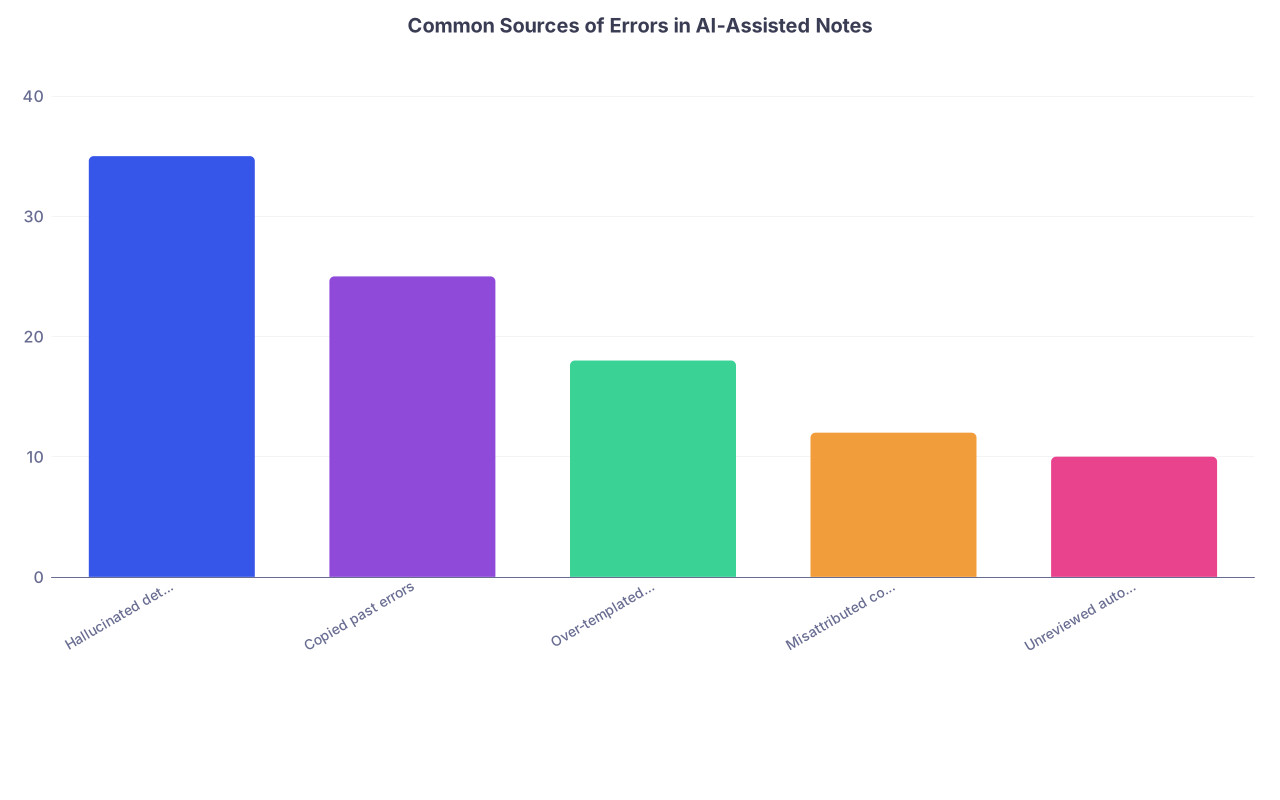
| Category | Value |
|---|---|
| Hallucinated details | 35 |
| Copied past errors | 25 |
| Over‑templated exams | 18 |
| Misattributed counseling | 12 |
| Unreviewed autopopulation | 10 |
How to avoid this:
Actively “rehab” the chart at key touchpoints.
New patient visit, annual visit, major change in care (new cancer diagnosis, surgery, pregnancy): treat these like chances to reset:- Manually verify past medical/surgical history, meds, allergies.
- Delete or correct obviously wrong data instead of letting AI recycle it.
Turn off automatic pulling of prior narrative when you can.
If your system allows, limit AI to the current encounter audio/text rather than “entire chart plus this visit.” Less context means fewer inherited mistakes.Document corrections explicitly.
If you fix a longstanding error: “Previous notes list PE in 2017; after review with patient and chart, no confirmed PE. Problem list updated.” Now there is a paper trail that you recognized and fixed the issue.Be suspicious when the AI note “remembers” details you did not just discuss.
“Lives with daughter” might be true. Or it might be an echo from a 2019 note when they were temporarily staying with family. Ask. Confirm.
4. Over‑Templated, Under‑True Exams and ROS
Another classic problem: AI that “fills in the gaps” to create a polished, complete physical exam or review of systems, even when you did not talk about—or touch—half of those things.
For example:
- ROS: “10‑point ROS negative except as above” when you asked about maybe three systems.
- Exam: Auto‑generated “Normal” for all organ systems because that is what most notes look like.
Regulators and auditors have already caught on to this. It looks like up‑coding and over‑documentation, even if your intent was innocent laziness.
Worse, it can break clinical reasoning. If your exam documents “no focal neuro deficit” on a patient with subtle unilateral weakness you did not check for, you have written your own trap.
How to avoid this:
Ditch the mythical “comprehensive” ROS and exam for routine encounters.
Let focused be focused. “ROS: focused ROS limited to respiratory and cardiovascular as above” is honest. And defensible.Use negative statements only where they matter.
“No neck stiffness, photophobia, or focal deficit” in a headache note. “No chest pain, dyspnea, or exertional symptoms” in a syncope note. Not a laundry list of systems you did not ask about.Edit the exam down to what you actually did.
If the AI gives you a full SOAP template exam, slash it:- Keep general, heart, lungs, targeted areas relevant to the visit.
- Remove things like “normal GU exam” when there was no GU exam.
Create narrow, realistic exam templates if you must use templates.
A limited “ED bedside exam” or “telehealth visual exam” template is far less likely to misrepresent what you did than a full head‑to‑toe.
5. Missing the Patient’s Actual Voice and Concerns
AI notes are trained on patterns. Which means they sand down nuance. They love generic language: “Patient presents for follow up,” “Patient reports intermittent pain,” “Patient verbalizes understanding.” Real people do not talk like that.
When you lean on AI, subtle but important details vanish:
- The offhand comment that triggered your cancer workup.
- The patient’s exact phrasing around suicidal thoughts or trauma.
- The clear refusal of a recommended treatment, which gets watered down to “patient prefers to defer.”
In future disputes, the AI‑smoothed version can make your clinical judgment look arbitrary. Or make it seem like the patient fully agreed when they did not.
How to avoid this:
Preserve key quotes verbatim.
At least in critical moments:- “I feel like life is not worth it, but I would not act on it.”
- “I know I could die if I keep smoking, but I am not ready to quit.”
- “I absolutely do not want surgery, ever.”
Type them yourself. Do not trust the AI paraphrase.
Document the reasoning, not just the result.
AI loves “Plan: x, y, z.” You need one or two human lines:- “CT deferred given normal neuro exam, low risk per Ottawa rule.”
- “Decided against admission; stable vitals, reliable follow up, patient preference.”
Record disagreement clearly.
“Discussed recommendation for admission for observation; patient declined after risks explained, including potential for worsening symptoms or death. Patient elected outpatient management and understands when to seek care urgently.”
AI will not write that for you. You must.
6. Garbage In, Garbage Out: Bad Audio, Worse Notes
Most of these tools rely on recordings. When the audio is a mess—background noise, multiple voices, masks, accents, interruptions—the transcription gets dirty. Then the summarization layer tries to make sense of nonsense.
You end up with:
- Mixed‑up speakers (“Patient advised…” when actually you advised the patient)
- Wrong medication names
- Misheard numbers (15 vs 50, “3 days” vs “3 weeks”)
Once summarized, the errors look smooth. That is the dangerous part: the worst notes are often the most polished.

How to avoid this:
Control the recording environment when possible.
Close the door. Ask others to pause. Place the microphone near you and the patient, not near the hallway.State key data slowly and clearly.
Medication names, doses, durations, numbers. “Metoprolol. Fifty. Five zero. Milligrams. Twice per day.” Yes, it feels silly. No, it is not overkill.Do an extra‑careful review of numbers and meds in the AI note.
Never assume it heard “warfarin” or “apixaban” correctly. Those mistakes can be lethal and will haunt you.Turn off recording during irrelevant chatter.
Small talk with family, casual hallway conversations—these just add noise for the model to misinterpret.
7. Regulatory and Billing Exposure: Looking Like You Are Gaming the System
AI notes can accidentally create documentation that appears tailor‑made for higher billing levels—complete ROS, full exam, complex MDM—with little relation to reality. That is exactly what auditors and payers have been training themselves to detect.
I have seen outpatient notes where:
- Every patient magically has a 14‑point ROS completed.
- Every visit has “complex” MDM language, regardless of actual complexity.
- Each plan contains layered bullet points that read like they were generated for coding, not care.
This screams “upcoding” and “note cloning,” even if the clinician never intended it.
| Red Flag Pattern | Why It Is a Problem |
|---|---|
| Identical phrasing across charts | Suggests cloning, not real care |
| Always complete ROS and exams | Implies over-documentation |
| Complex MDM for simple visits | Looks like intentional upcoding |
| Excessive boilerplate counseling | Hard to believe at real time spent |
How to avoid this:
Document for care, not for codes.
If the AI seems to be padding sections with long generic text that does not reflect what you did, trim it ruthlessly.Vary your documentation naturally.
Your notes should not look like copy‑paste clones. They should reflect the real visit, which always has some variation.Align time statements with reality.
If the AI spits out “spent 45 minutes in face‑to‑face counseling,” stop. Unless you honestly did, remove or correct it. Time fraud is low‑hanging fruit for audits.Work with compliance early.
If your institution deploys AI notes, make sure coding/compliance reviews a series of AI‑assisted notes and gives feedback before everyone locks into bad habits.
8. Over‑Reliance: Letting AI Think Instead of You
There is a subtle cognitive trap here: once the note looks clean and sorted, your brain relaxes. You start doing your thinking during documentation review rather than at the bedside. Dangerous flip.
Examples:
- Accepting the AI’s summary of the patient’s story instead of revisiting the raw information in your mind.
- Letting the AI’s problem list framing constrain your differential (“Well, it listed this as ‘viral URI’ so that fits…”).
- Missing inconsistencies because the note read “smooth,” even when your gut felt something was off.
The note should be a product of your thinking. Not a substitute for it.
How to avoid this:
Form your assessment before looking at the AI draft.
Even 10–15 seconds of pausing: “What is my differential? What is my plan?” Then check whether the AI note matches that, not the other way around.Edit the assessment and plan manually every time.
No pass‑through. Ever. This is core clinical reasoning territory. You want your words there, not a paraphrase.Watch for internal contradictions.
HPI says “sudden onset worst headache of life”; assessment says “tension headache, low concern.” If you find that mismatch, fix the assessment, not the HPI, if the patient’s story was truly alarming.
9. Privacy and Consent Missteps
Another place clinicians get bit: assuming the AI tool is invisible to the patient. It is not.
Patients may be recorded without clearly understanding it. Family members' comments get captured and woven into the note. Highly sensitive topics—abuse, immigration status, sexual history—get transcribed and summarized more explicitly than you would usually chart.
Then the patient requests records. Or an insurer reads every line. Or a family member reads the portal note and is shocked by what you wrote about them.
How to avoid this:
Be explicit about recording.
“We use a secure tool that listens to our conversation to help me write the note. It is part of your medical record. Is that OK?” If they say no, do not use it.Be intentional about wording on sensitive topics.
You still must document. But you can do so clinically and respectfully:- Instead of raw quotes about a partner: “Patient reports feeling unsafe with current partner; safety planning performed.”
Mute or pause during clearly off‑record moments.
Arguments between family, deeply personal side conversations not directly relevant to care—do not let the system harvest all of that by default.Know where the data goes.
If your vendor offloads audio to external servers, you have an obligation to understand the privacy protections. “I did not know” is not a great defense.
10. Workflow Chaos: Letting the Tool Dictate the Encounter
Last mistake: bending your patient encounter around the limitations of the AI system.
You have seen this already: clinicians who change how they speak, where they stand, even how they ask questions, all to “make the AI capture it better.” They talk to the microphone more than to the patient.
That is backwards. The tech is there to serve your clinical interaction, not distort it.

| Step | Description |
|---|---|
| Step 1 | See Patient |
| Step 2 | Do Real Clinical Reasoning |
| Step 3 | Use AI to Draft Note |
| Step 4 | Thorough Human Review |
| Step 5 | Delete or Rewrite Sections |
| Step 6 | Sign Note |
| Step 7 | Accurate and Honest? |
How to avoid this:
Protect the primacy of the bedside interaction.
Maintain eye contact. Ask questions the way you normally would. If the AI cannot handle reality, the vendor needs to improve it—not you to distort yourself.Do not narrate for the microphone.
Saying things like, “Now I am examining your abdomen, soft, non‑tender” just to help the system creates weird encounters and brittle dependence on the tech.Have a fallback plan.
If the tech fails mid‑shift, you should be able to chart without it. If losing the AI feels catastrophic, you are too dependent.Push back on bad implementation.
If leadership is pressuring you to rely heavily on AI notes without adequate training, feedback loops, or time to review, speak up. Silent acceptance now becomes your problem later.
The Future Is Coming—You Just Cannot Sleepwalk Through It
AI‑assisted documentation is not going away. It will get better, faster, more integrated. But the core responsibility will not change: your name is on the note, your license backs it, and your patients live (or suffer) under the decisions it supports.
There are three things you must not forget:
AI notes are drafts, not truth.
Never sign what you did not actually read—and aggressively remove anything you did not truly do, say, or decide.Short, honest, and human beats long, polished, and wrong.
Focused exams, preserved key quotes, and clear reasoning in your own words will protect you far more than auto‑generated fluff.You are still the clinician.
The thinking, the judgment, the consent, the responsibility—all of that is you. Use AI as a tool, not a crutch, and you can have the efficiency without the regrets.