
What happens when your attending stops you mid‑presentation and asks, “What’s the source for that?”… and the real answer is “ChatGPT”?
If you’re using AI to build case presentations, journal clubs, or teaching talks, you’re already in risky territory. Not because AI is “bad.” Because most med students are quietly making the same dangerous mistake:
They’re treating AI output like evidence.
As if a paragraph from an LLM is equivalent to:
- A randomized controlled trial
- A guideline statement
- A reputable review article
It isn’t. And if you do not understand that difference, you’re setting yourself up to look unprofessional at best and unsafe at worst.
Let me walk you through the landmines so you don’t get torched in front of your team (or worse, mislead them about patient care).
The Core Mistake: Confusing “Fluent” With “Factual”
An LLM like ChatGPT is a pattern machine. Not a fact machine. That distinction matters.
You ask:
“What’s the best second‑line treatment for HFpEF in a patient already on ACEi and beta‑blocker?”
AI happily spits out a confident paragraph with:
- Wrong drug classes
- Outdated trial data
- A guideline that doesn’t exist
- A made‑up citation to “JAMA 2021”
But it sounds very plausible. Polished. Organized. Even “evidence‑based” if you’re not looking too closely.
Here’s the trap: because the language is:
- Clear
- Organized
- Free of “ums” and “uhs”
Your brain tags it as reliable. That’s the illusion of fluency. And this is where med students blow it:
They copy AI content into:
- PowerPoints
- Handouts
- Case summaries
…then stand up and present it as if it came from real literature.
So when someone on the team asks:
- “Which trial showed that?”
- “What’s the NNT?”
- “Where in the guideline is that recommendation?”
You can’t answer. Because there is no trial. No NNT. No page in the guideline.
You trusted style as proof of truth.
That’s the mistake we’re killing today.
Where This Blows Up: The Clinical Presentation Trap
Let’s be specific. Here’s where I keep seeing students get burned.
1. “AI as Guideline” in Patient Management Slides
Scenario: You’re on cardiology. You ask AI:
“Summarize current guideline-directed medical therapy for HFrEF.”
You get something that looks clean and “up to date.”
You throw it into your slide deck.
What goes wrong:
- AI mixes ACC/AHA and ESC recommendations
- Uses drug names or doses that changed in recent updates
- Lists therapies that are “considered” as if they’re “Class I”
- Misrepresents level of evidence
Then your cardiology attending says:
“That’s not accurate based on 2022 AHA/ACC/HFSA guidelines. Where did you get this?”
If your real answer is “ChatGPT” and you didn’t cross‑check? You’ve just shown you:
- Don’t understand how guidelines work
- Don’t verify your sources
- Don’t respect evidence hierarchy
That’s a credibility hit you didn’t need to take.
2. Fake or Garbled Citations
AI loves to hallucinate references that look real:
- Real journal name
- Real‑ish year
- Believable authors
But the article doesn’t exist. Or if it does, it’s about something else entirely.
If you paste those citations into your:
- Journal club
- Case talk
- Grand rounds “learning issues”
…you’re committing academic sloppiness at best. Academic dishonesty at worst.
Attendings absolutely catch this. I’ve heard this exchange word‑for‑word:
Resident: “That came from a 2019 NEJM trial.”
Attendings: “Which trial?”
Resident: “…I don’t remember the name.”
Attending later checks. No such trial. You don’t recover from that quickly.
3. Oversimplified Pathophysiology Presented as Fact
AI is decent at intro‑level explanations. But it often:
- Over‑simplifies complex pathways
- Blends old hypotheses with current models
- States contested theories as settled fact
If you throw that into a pathophysiology slide for, say, sepsis or Alzheimer's, you risk:
- Stating outdated mechanisms (“two‑hit model” as if it’s the only model)
- Ignoring key controversies
- Sounding like you learned everything from a blog, not a textbook or review article
That’s how you get the subtle head tilt and eyebrow raise from a basic science faculty member. You may not even realize why your presentation “felt off” to them. This is why.
AI vs Evidence: Not the Same Game
Let’s draw a hard line between these two categories so you stop mixing them.
| Aspect | AI Output | Real Evidence |
|---|---|---|
| Source | Statistical model | Actual studies/guidelines |
| Verifiability | Often not traceable | Specific paper/guideline |
| Stability | Changes with model updates | Fixed and citable |
| Reliability | Variable, can hallucinate | Peer-reviewed (ideally) |
| Appropriate Use | Drafting, brainstorming | Clinical decisions, citations |
The big mistake: acting like the left column is the right column.
AI output is:
- A starting point
- A drafting aid
- A way to structure your thinking
It is not:
- A primary source
- A guideline
- A trial
If you present it as such, you’re wrong. Full stop.
The Ethical Angle: You’re Not Just Risking Embarrassment
Let’s go beyond “I don’t want to look dumb.” You’re in medicine. There’s an ethical floor.
When you present something in a clinical or academic setting, you’re implicitly saying:
“I have done enough work to consider this trustworthy.”
If all you did was:
- Ask an AI
- Skim to see if it “looks right”
- Paste it in
…you have not done that work.
Problems that follow:
Erosion of trust
Once your team knows you use AI uncritically, they start questioning everything you say.Patient safety risk
If someone acts on a nuanced management point you pulled from AI and it’s wrong? Now it’s not just your reputation on the line.Academic integrity issues
Universities and teaching hospitals are starting to treat uncredited AI use like plagiarism. Presenting AI‑generated citations as real is straight‑up falsification.
Don’t kid yourself: “I didn’t know” will not sound good when your PD or clerkship director is involved.
Safe Uses of AI for Med Students (That Won’t Make You Look Reckless)
AI isn’t the villain. Blind trust is.
Here’s how to use AI without stepping on a landmine.
1. Use AI for Structure, Not Substance
What you can responsibly do:
- Ask: “List key sections for a 10‑minute talk on COPD management.”
- Ask: “Generate potential learning objectives for a case about DKA.”
- Ask: “Help me turn these bullet points into a more readable paragraph.”
Then:
- You fill in the content from UpToDate, guidelines, and real papers.
- You treat AI like a writing intern, not a co‑author of your medical content.
2. Use AI as a Question Generator, Not an Answer Sheet
Better prompt:
“Suggest 10 key questions I should answer when presenting on anticoagulation in AFib.”
Then you go answer those questions using:
- CHEST guidelines
- AHA/ACC documents
- Landmark trials like ARISTOTLE, ROCKET‑AF, etc.
AI helps you scope the topic, not own the content.
3. Use AI to Simplify, Then Verify Against Primary Sources
You can ask:
“Explain the difference between Type 1 and Type 2 myocardial infarction for a senior med student.”
Then:
- Compare the explanation to the Fourth Universal Definition of MI
- Cross‑check against a trusted cardiology review
If they align closely, great — you saved some time. If not, the AI output goes in the trash.
Red Flags That You’re Misusing AI in a Presentation
If any of these are true, you’re in the danger zone.
- You can’t name at least one primary source for every key management recommendation on your slide.
- Your reference slide mostly came from AI suggestions you did not individually verify.
- You have not opened a guideline PDF or major review article while preparing.
- You rely on AI for numbers (NNT, sensitivity/specificity, mortality benefit) without checking.
- You feel a bit nervous when you imagine your attending asking, “Where did that come from?”
If you feel that twinge reading this, take it seriously. You’re already too dependent on AI.
A Simple Workflow: How to Keep AI in Its Lane
Here’s a safe, efficient way to integrate AI into your prep without embarrassing yourself.

| Step | Description |
|---|---|
| Step 1 | Pick Topic |
| Step 2 | Ask AI for Outline Only |
| Step 3 | Identify Key Questions |
| Step 4 | Find Real Sources - Guidelines, Trials, Reviews |
| Step 5 | Extract Data, Numbers, Recommendations |
| Step 6 | Draft Slides in Your Own Words |
| Step 7 | Optionally Ask AI to Polish Language |
| Step 8 | Manual Final Check Against Sources |
Notice what’s missing?
“Copy AI content directly into slide” is not a step.
How Faculty Actually Think About AI Right Now
You might be underestimating how your attendings see this.
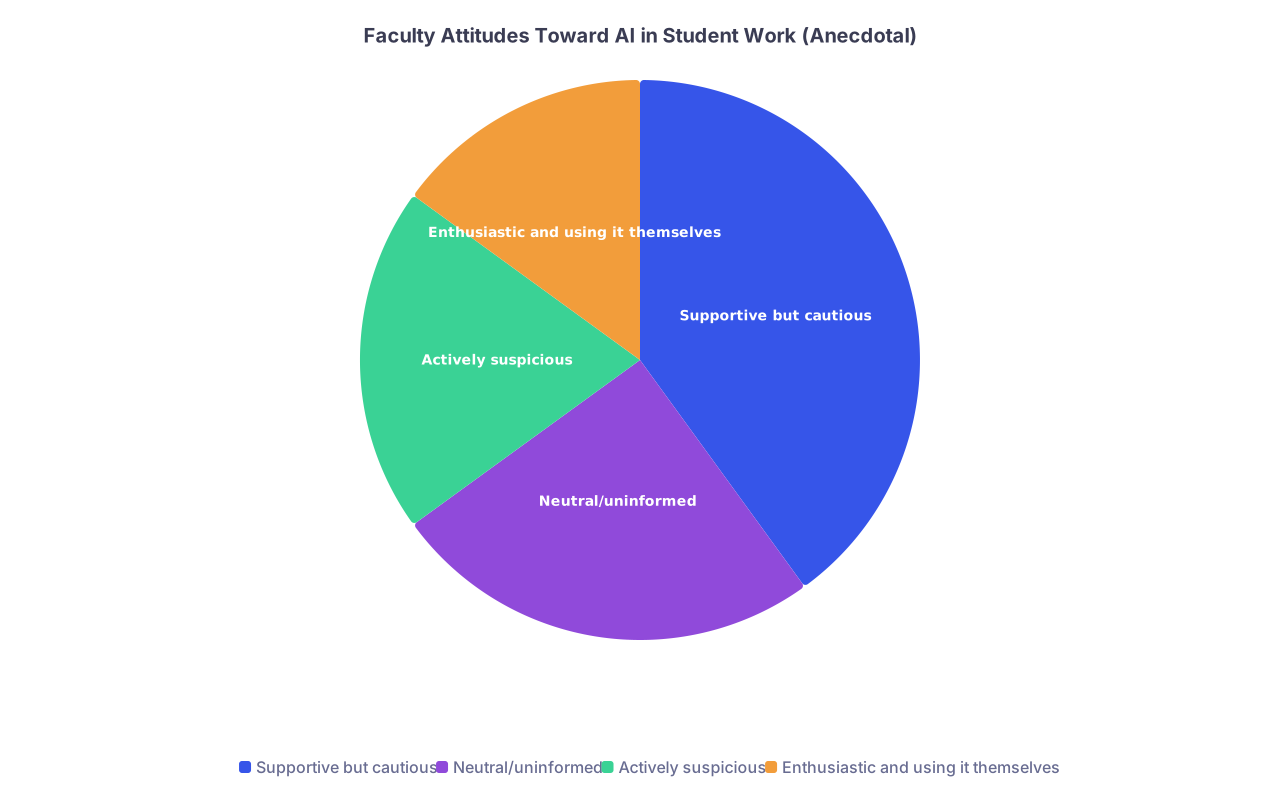
Here’s the rough breakdown I’m seeing in academic hospitals:
| Category | Value |
|---|---|
| Supportive but cautious | 40 |
| Neutral/uninformed | 25 |
| Actively suspicious | 20 |
| Enthusiastic and using it themselves | 15 |
The “actively suspicious” group? They’re the ones most likely to ask detailed questions about your sources. If they catch you using AI as evidence, they’ll remember.
The “supportive but cautious” group? They’re fine with you using AI — if you show:
- Clear primary sources
- Understanding of limitations
- Honesty about what AI did and didn’t do
The group you should not want to impress is the “I don’t care, whatever” category. That’s how standards decay, and you become the sloppy resident everyone complains about later.
How to Talk About AI Use Without Throwing Yourself Under the Bus
If someone asks, “Did you use AI for this presentation?” — don’t panic. There’s a right answer and a wrong one.
Wrong answer:
“Yeah, I used ChatGPT for most of the content and then added some references.”
Translation to faculty: “I outsourced my thinking.”
Better answer:
“I used AI early on to brainstorm an outline and list of subtopics, then I went to [guideline X] and [review Y] for the actual content and data. The recommendations here are directly from those sources.”
That tells them:
- You understand AI is a tool, not a source.
- You know what real evidence looks like.
- You respect academic rigor.
If you did accidentally lean too hard on AI and get called on something, own it:
“You’re right — that point came from an AI‑generated draft and I didn’t verify it thoroughly. I’ll correct that and follow up with the appropriate source.”
Humbling? Yes. But miles better than pretending and getting cornered deeper.
The Future: AI Will Get Better, But This Rule Won’t Change
Models will improve. Citations might become more reliable. Integration with real databases will tighten.
But one thing will not change:
- Evidence comes from studies and guidelines.
- Responsibility comes from humans.
- Judgment comes from you.
AI will never be the one standing in front of a family explaining why a decision was made. Or in a morbidity and mortality conference defending the thought process.
That’s you. Or future you. So start building the right habits now.
Quick Self‑Audit: Are You Using AI Responsibly?
Look at your last or upcoming presentation and ask:
- Can I list the key guidelines and at least 2–3 major studies my talk relies on?
- Could I recreate this presentation without AI if I had to, just using those sources?
- Did I verify every number, recommendation, and “fact‑sounding” claim against something citable?
- If my attending asked, “Show me the PDF or paper for that,” could I pull it up in under a minute?
If the answer is “no” to any of those, you’re skating on AI‑thin ice.
Fix that now, before someone else points it out for you.