
Protecting Against AI Hallucinations: A Checklist for Daily Practice
AI hallucinations are not a quirk. They are a clinical risk that will hurt real patients if you treat AI output like a colleague’s note instead of what it really is: a confident autocomplete with no built‑in sense of truth.
If you plan to use AI in healthcare and you do not have a hallucination protocol, you are already behind.
Let me give you one.
This is a practical, field-ready checklist you can put next to your workstation and actually use. Not a hand‑wavy “remember to be cautious with AI” poster. You will see exactly what to do before, during, and after you use an AI tool so hallucinations get caught early—ideally by you, not by the patient or the morbidity and mortality conference.
1. Start With One Rule: AI Never Bypasses Clinical Judgment
Before you touch any checklist, you need a ground rule that everyone on the team can recite.
Rule #1: No AI output enters the medical record, treatment plan, or patient communication without human clinical review and verification.
If that sounds obvious, good. It is also the first thing people violate when they are rushing through notes at 7:30 pm.
Here is what that rule means in practice:
AI is assistive, not authoritative.
- It may suggest diagnoses, orders, patient education, discharge summaries, or prior authorization letters.
- It does not decide anything alone.
The human reviewer must:
- Have appropriate clinical competence for the specific task.
- Be clearly accountable (you should be able to answer: “Whose decision was this?”).
You treat AI output like:
- A junior trainee’s first draft.
- A medical student’s problem list.
- A consulting service that has not examined the patient.
If you do nothing else from this article, adopt that rule and enforce it. But if you want to actually reduce hallucinations, keep going. We will turn this principle into concrete steps.
2. Know the Three Failure Modes You Are Up Against
You cannot protect against AI hallucinations if you treat them as random weirdness. They are predictable.
Most clinical AI failures fall into three buckets:
Fabricated facts
- The model invents:
- Nonexistent studies or guidelines.
- Incorrect drug doses or interactions.
- Imaginary lab values, imaging findings, or patient history.
- Example I have actually seen:
- “Recent randomized trial from the New England Journal in 2022 showed…” (journal issue does not exist).
- The model invents:
Confident nonsense
- The reasoning chain sounds plausible but is clinically wrong.
- Example:
- Suggesting high-dose NSAIDs in an elderly CKD stage 4 patient because “pain severity outweighs renal risk.”
- Mixing up similar-sounding drugs (e.g., ceftazidime vs. ceftriaxone) with the wrong spectrum.
Context errors
- The AI gives a reasonable answer for the wrong patient, wrong setting, or wrong constraints.
- Example:
- Recommending inpatient workup for a stable outpatient scenario.
- Suggesting imaging that your facility does not have.
- Giving U.S.-centric dosing or guideline recs in a different country.
Your checklist must explicitly target all three. Otherwise you will patch one hole and leave two wide open.
3. The Core Checklist: 10 Steps Before You Trust Any AI Output
Print this. Laminate it. Tape it to the monitor where people are using AI.
AI Hallucination Defense Checklist (Clinical Use)
Run through this sequence any time AI affects care, documentation, or formal communication.
Clarify intent first (before prompting)
- What exactly are you asking the AI to do?
- Select a category:
- Drafting text (notes, letters, patient education).
- Summarizing information (consult notes, long charts).
- Decision support (differential, workup, treatment options).
- Administrative (forms, prior auth, emails).
- If the task is high-risk (medication changes, procedures, triage), you treat the output as suspect by default.
Anchor on real patient data
- Open the EHR. Look at the actual:
- Allergies
- Med list
- Problem list
- Recent labs/imaging
- When you prompt the AI, give only verified facts from the record, not your memory:
- Good: “55-year-old male with CKD stage 4 (eGFR 21), DM2, HTN, on lisinopril, furosemide, metformin…”
- Bad: “Older man with kidney issues and diabetes…”
- Open the EHR. Look at the actual:
Force the model to expose uncertainty
- Use prompts that discourage fake certainty:
- “If you are not sure, say you are not sure.”
- “List what you are less certain about.”
- “Flag anything where evidence is weak or controversial.”
- This does not eliminate hallucinations, but it often makes them easier to spot.
- Use prompts that discourage fake certainty:
Immediate sanity check: Does this pass the 10‑second sniff test?
Ask yourself:- Does anything look grossly wrong? Out of proportion?
- Is the tone or structure clearly off for the document type?
- Are there any obvious contraindications ignored?
If you see even one major red flag, stop. Do not “just edit a bit.” Restart with a tighter, more explicit prompt or skip the AI for that task.
Fact-check any specific numbers or citations
For anything involving:- Drug doses, frequencies, routes
- Lab reference ranges
- Risk scores or calculators
- Mechanical ventilation settings
- Quoted studies or guidelines
Do not trust the AI. Use:
- Your hospital guidelines or drug formulary.
- Trusted databases (UpToDate, Lexicomp, Micromedex, local protocols).
- Official calculators (CHADS‑VASc, Wells, HEART, etc.).
Quick rule:
- If it has a number in it and you would be embarrassed to get it wrong in front of your attending, verify it.
Check for fabricated sources
When the AI cites literature or guidelines:- Copy one or two titles or DOIs into PubMed or Google Scholar.
- If they do not exist or look wrong, assume all the citations are unreliable.
- Replace them with your own verified sources or remove citations entirely.
Cross-validate with your own clinical reasoning
Work backwards:- Independently list:
- Your own top 3 diagnoses.
- Your own initial workup.
- Your own first‑line management.
- Compare with the AI:
- Where do you disagree?
- Did the AI miss a must-not-miss diagnosis (e.g., ectopic, ACS, sepsis)?
- Did it suggest something you had not considered? If yes, verify that idea elsewhere.
- Independently list:
Check for context mismatch
Ask:- Does this recommendation fit:
- Outpatient vs inpatient?
- Pediatric vs adult vs geriatric?
- Resource level of our facility?
- Local regulations and scope of practice?
- If the output feels “U.S.-academic-center oriented” and you work in a low-resource or different regulatory setting, treat it as a template, not an answer.
- Does this recommendation fit:
Edit aggressively; never accept as-is
Especially for:- Clinical notes
- Discharge instructions
- Referral letters
- Patient education messages
You should:
- Remove any line you cannot personally defend on rounds.
- Rewrite any sentence that sounds like generic filler.
- Tailor it to this patient (their language level, their comorbidities, their goals).
Label AI-assisted content internally
Even if you do not annotate in the formal chart, your team should know:
- Where AI was used.
- What parts were human-authored vs edited.
- Who did the final sign‑off.
At minimum, agree locally: “If you used AI heavily for this document, mention it verbally in sign‑out or team chat.”
This is the daily “micro” checklist. But hallucinations also require system‑level defenses.
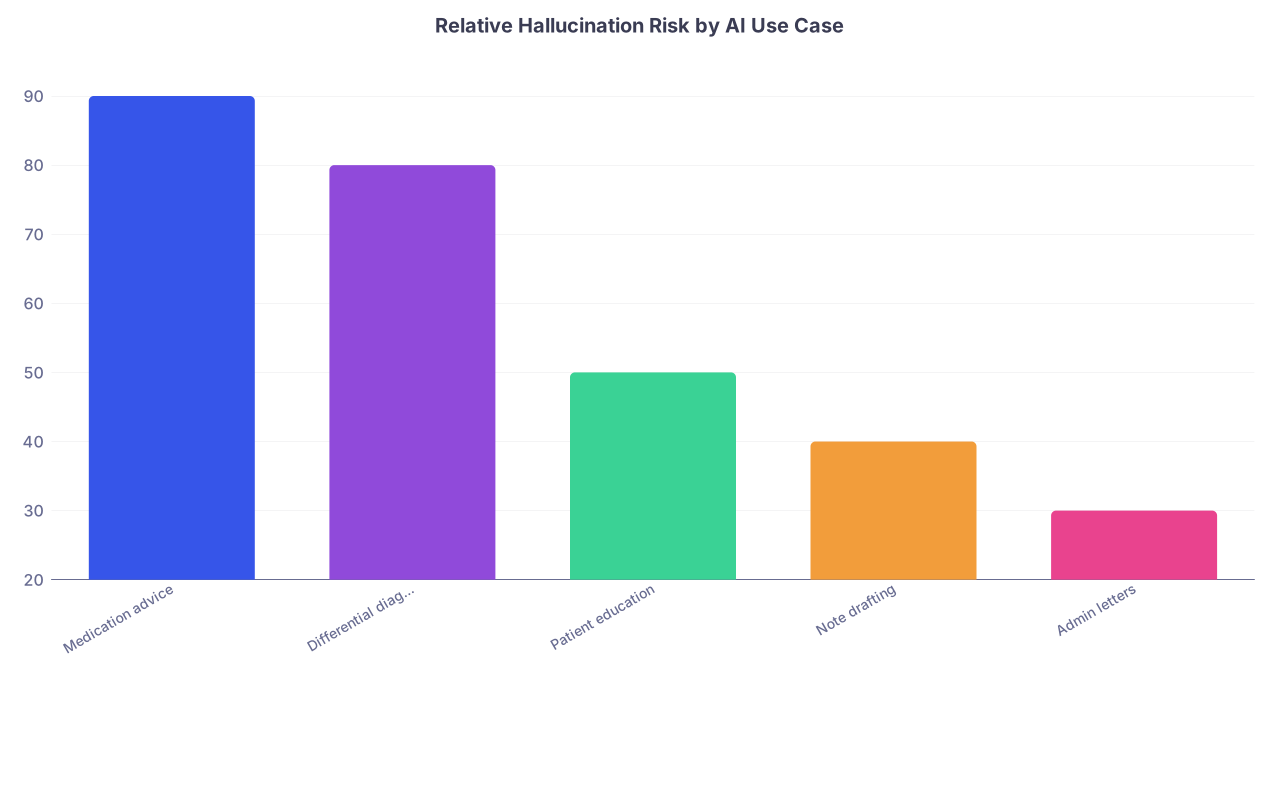
| Category | Value |
|---|---|
| Medication advice | 90 |
| Differential diagnosis | 80 |
| Patient education | 50 |
| Note drafting | 40 |
| Admin letters | 30 |
4. Embed Hallucination Protection into Team Workflow
You cannot rely on individual vigilance forever. People get tired, overworked, and lazy. The system must carry some of the load.
A. Define “AI-appropriate” vs “AI-off-limits” tasks
Create a short list for your department.
Examples:
Green zone (AI allowed with review)
- Drafting:
- Discharge summaries
- Insurance letters
- Referral letters
- Patient education in plain language
- Summarizing:
- Long outside records
- Multi-specialty notes for case review
- Drafting:
Yellow zone (AI allowed only for brainstorming, not direct use)
- Differential diagnosis suggestions
- Ideas for diagnostic workup
- Exploring guideline options in complex comorbidities
- Drafting but not finalizing care plans
Red zone (AI not used or only in highly controlled pilots)
- Medication dose selection for high-risk drugs (chemo, anticoagulants, insulin infusions).
- Triaging emergencies or advising immediate action.
- Final decisions about capacity, involuntary holds, or end-of-life care.
- Any step where a single wrong suggestion is catastrophic.
Write this down. Put it in the department handbook. Teach it to new hires and residents.
| Task Type | Risk Level | AI Use Policy |
|---|---|---|
| Discharge summary draft | Low | Allowed with clinician edit |
| Medication dosing | High | Not allowed / independent check |
| Differential brainstorming | Medium | Allowed, must independently verify |
| Prior authorization letter | Low | Allowed with quick review |
| ED triage decisions | Very High | Not allowed |
B. Use checklists at the right friction level
If your hallucination defense mechanism adds 10 minutes to every note, no one will use it. You need fast checks that align with reality.
Practical approach:
For low-risk text (referral letters, summaries):
- Use a 3-question mini check:
- Does anything sound clinically wrong?
- Are all numbers / dosages / names correct?
- Is this clearly tailored to this patient?
- Use a 3-question mini check:
For medium-risk clinical suggestions:
- Apply the full 10‑step checklist from section 3.
For high-risk decisions:
- Use AI only for background understanding, not for the decision itself.

| Step | Description |
|---|---|
| Step 1 | Consider using AI |
| Step 2 | Use AI with quick 3-question check |
| Step 3 | Use AI with full 10-step checklist |
| Step 4 | Do not use AI for final decision |
| Step 5 | Verify against guidelines and EHR |
| Step 6 | Clinician approves and documents |
| Step 7 | Task risk level |
5. How to Prompt to Reduce (Not Eliminate) Hallucinations
You cannot “prompt-engineer away” hallucinations completely, but you can reduce the rate and make them louder when they do occur.
Here is a short prompting protocol tuned for clinical use.
A. Constrain the domain
Bad prompt:
- “What is the best treatment for this patient?”
Better:
- “Given this adult outpatient with stable vitals and the following conditions and meds, list 3 evidence-based treatment options for their hypertension, focusing only on pharmacologic options that are commonly used in U.S. primary care.”
Why it helps:
- Forces the model into a narrower, more familiar lane. Less room for wild guesses.
B. Ask for reasoning and uncertainty
Prompt pattern:
- “Explain your reasoning step-by-step. Then list 3 aspects you are less certain about or that require human clinical judgment.”
Why it helps:
- You see where the logic goes off the rails.
- You get a shortlist of things to double-check.
C. Force reference to guidelines calmly (but verify yourself)
Prompt:
- “Generate a list of possible diagnoses for this presentation, and loosely align them with general concepts from [ACCP asthma guidelines / ADA diabetes guidelines / KDIGO CKD guidelines]. Do not invent specific citations.”
Then:
- You go look at the real guidelines. Do not trust any made-up citations even if they sound plausible.
D. Make it admit limits
Prompt:
- “If any part of this question is outside typical outpatient adult medicine, or depends on local practice patterns, say that explicitly instead of guessing.”
You will still get guesses. But you increase the chances the model will surface its blind spots (“This may vary by institution…”), which should trigger your skepticism.

6. Build a Local Feedback Loop: Catch, Log, Fix
If you are serious about safety, you need to treat hallucinations like you treat near-miss medication errors.
A. Capture hallucinations when they happen
Set up:
- A simple reporting mechanism:
- A shared spreadsheet.
- A quick form in your intranet.
- Even a structured message type in your team chat (#ai-issues).
When someone spots an AI hallucination, they record:
- Date/time
- Use case (note drafting, education, decision support)
- What the model said
- Why it was wrong or risky
- Whether it reached the patient record or not
- How it was caught
You are not trying to blame the user. You are trying to see patterns.
B. Classify errors by severity and type
At least monthly, someone reviews the log and tags each event:
Severity:
- S0 – harmless (stylistic, minor wording).
- S1 – could mislead but unlikely to cause harm.
- S2 – could contribute to minor harm if not caught.
- S3 – could contribute to major harm or death.
Type:
- Fabricated citation
- Wrong dosage
- Wrong diagnosis suggestion
- Incorrect guideline summary
- Context mismatch (wrong age, setting, resource level)
Look at your S2 and S3 errors. Those define where your current protections are failing.
C. Adjust your checklist and use policies accordingly
Examples:
If you see repeated dose hallucinations:
- Move dosing into the “AI-off-limits” category.
- Add explicit “always verify dosing” to your checklist.
If you see repeated fabricated citations:
- Prohibit AI-generated reference lists.
- Require manual literature search for anything that will be cited externally.
If you see context mismatch (e.g., pediatric vs adult):
- Make patient age and setting mandatory fields in all prompts.
- Add a bolded age/setting check to your quick 3‑question review.
This is how a system actually becomes safer over time.
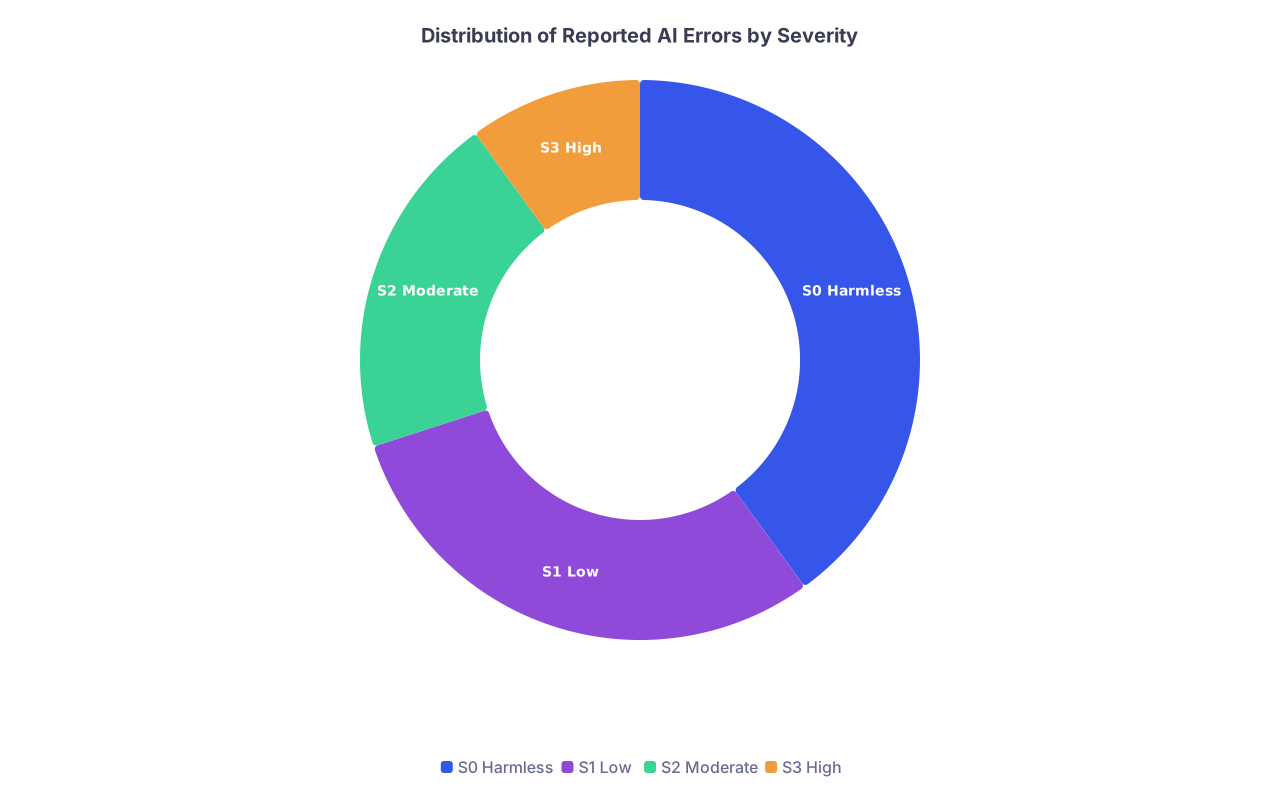
| Category | Value |
|---|---|
| S0 Harmless | 40 |
| S1 Low | 30 |
| S2 Moderate | 20 |
| S3 High | 10 |
7. Train Your People: What to Teach Clinicians and Staff
Most so-called “AI training” in healthcare is glossy vendor demos. Useless.
You need short, blunt training that focuses on failure recognition.
A. Core points every clinician should know
In one 60-minute session (or two 30-minute huddles), cover:
What hallucinations look like
- Concrete examples from your own environment.
- Before/after screenshots: AI output vs corrected version.
Where AI is officially allowed vs forbidden
- Your green / yellow / red zones.
- Real scenarios: “Is this OK or not?” quizzes.
How to use the checklist in under 2 minutes
- Live demo: take a raw AI output, run it through the steps.
- Show how fast it can be once you get used to it.
How to report problems without blame
- Show the reporting mechanism.
- Emphasize: “If you catch something, you protected patients. That is good. Tell us.”
B. Shadowing and audits
Do 1–2 weeks of lightweight audits when starting:
Pick a random sample of AI-assisted documents:
- 5 discharge summaries
- 5 patient education notes
- 5 referral letters
Have a senior clinician:
- Review them for hallucinations and context errors.
- Give direct feedback to the author:
- “This part is solid.”
- “Here is where you over-trusted the AI.”
- “Here is how I would have checked that.”
After that initial period, shift to periodic spot checks.

8. Special Cases: Patient-Facing AI and Chatbots
If your organization runs patient-facing AI (symptom checkers, chatbots, patient portal assistants), hallucinations become much more dangerous because patients may act on advice without a clinician in the loop.
You must add extra layers:
Strict scope limitations
- The bot:
- Can explain logistics (appointments, refills, portal help).
- Can rephrase clinician-authored education in simpler language.
- Cannot:
- Diagnose
- Recommend starting/stopping medications
- Advise on emergencies (“take an extra dose of…”).
- The bot:
Hardwired safety messages
- Every medical answer ends with:
- “This information is general and may not apply to your situation. Do not change any medications or treatments without speaking to your clinician. Call emergency services or go to the ER for urgent concerns such as chest pain, trouble breathing, or severe bleeding.”
- Every medical answer ends with:
Clinician review for high-risk messages
- If a patient asks:
- About suicidal thoughts
- About chest pain, shortness of breath, neurological deficits
- About pregnancy complications
Route those queries directly to a human triage nurse or clinician. The AI can acknowledge, but not answer clinically.
- If a patient asks:
Logging and reviewing conversations
- Periodically audit a sample of chatbot conversations.
- Look specifically for:
- Overconfident medical advice
- Under-triage of serious symptoms
- Fabricated references or “guarantees” of outcomes
When in doubt, bias toward under-use of AI on the patient-facing side.

| Step | Description |
|---|---|
| Step 1 | Patient question |
| Step 2 | AI answers directly |
| Step 3 | Route to human clinician |
| Step 4 | AI provides general info with safety disclaimer |
| Step 5 | Patient encouraged to contact clinician |
| Step 6 | Medical or admin? |
| Step 7 | High risk topic? |
9. Technology Choices That Reduce Hallucinations (A Bit)
You cannot “buy your way out” of hallucinations, but your tooling choices do matter.
When you talk to vendors or your internal IT team, push for:
Models with retrieval-augmented generation (RAG)
- Instead of the model “remembering” everything, it:
- Searches your internal knowledge base or guidelines.
- Generates answers that cite those real documents.
- Your checklist still applies, but you at least know where the content supposedly came from.
- Instead of the model “remembering” everything, it:
Domain-specific fine-tuning from your own content
- The model is trained or adapted on:
- Your templates
- Your order sets
- Your local protocols
- This reduces context mismatch (e.g., suggesting tests you do not offer).
- The model is trained or adapted on:
Built-in reference links for every clinical claim
- Best-case scenario:
- Every major recommendation comes with a link to a specific guideline section or policy document you can open.
- At minimum:
- It should distinguish between “based on your local content” vs “general model knowledge.”
- Best-case scenario:
Configurable guardrails
- Ability to:
- Block certain tasks (e.g., opioid dose recommendations).
- Force disclaimers.
- Restrict language (no “guarantee,” “safe for anyone,” etc.).
- Ability to:
Again: even with all this, hallucinations persist. Your human checklist is still your primary defense.
10. Put This Into Practice Today
You do not need a full enterprise AI strategy to start protecting your patients.
Here is a concrete sequence you can complete this week:
Today (15–20 minutes):
- Copy the 10‑step AI Hallucination Defense Checklist from section 3.
- Turn it into a one-page document.
- Print and place it next to every workstation where AI is used.
Within 48 hours:
- With your immediate team, define:
- 3 “green zone” AI tasks you will allow.
- 3 “red zone” tasks you will not use AI for.
- Write them on a shared board or document.
- With your immediate team, define:
Within 7 days:
- Run one short huddle (20–30 minutes):
- Walk through 2 real AI outputs from your environment.
- Use the checklist live to critique them.
- Identify at least one hallucination or weakness in each.
- Run one short huddle (20–30 minutes):
Within 14 days:
- Create a simple hallucination reporting log (spreadsheet or form).
- Announce to the team:
- “If you catch an AI error, log it. We will review monthly. No blame.”
That is how you start.
Now, do one small but concrete thing:
Open the last AI-generated clinical document you used and run it through the 10-step checklist. Mark everything you would change. Then update your local policy so those changes are not left to chance next time.