The way most clinicians prepare for tumor board is inefficient, inconsistent, and dangerously dependent on who had time to read what last night.
Let’s fix that with AI. Not someday. Now.
If you are still walking into multidisciplinary conferences with a patchwork of EMR printouts, scattered journal PDFs, and “what I remember from NCCN,” you are leaving quality – and time – on the table. AI will not replace your judgment, but it can absolutely replace the chaos.
This is a playbook for how to actually use AI tools to prepare for tumor board and case conferences in a way that is safe, reproducible, and realistic in a busy clinical environment.
1. Ground Rules: What AI Should and Should Not Do For Tumor Board
Before tactics, boundaries. If you get this part wrong, the rest is useless.
What AI is good for
AI is powerful for:
- Structuring and summarizing messy information
- Quickly surfacing guideline-relevant questions
- Highlighting missing data that will matter to the team
- Generating differential plans and options for discussion
- Drafting documentation (case summaries, proposed plans, letters)
What AI is not allowed to do
AI must not:
- Make final treatment decisions
- Override established guidelines or trial data
- Replace your responsibility to verify critical facts in the chart
- Create “new evidence” out of thin air
Use AI as a very fast, very organized junior fellow who never gets tired but still needs supervision.
To keep yourself out of trouble, adopt one hard rule:
No AI-generated suggestion enters the chart or the plan without human verification in the EMR and guidelines.
Everything I describe below assumes you are adhering to that rule.
2. A Simple AI Workflow You Can Use This Week
You do not need an enterprise deployment to get value. You need a repeatable workflow.
Here is a concrete 5-step pattern you can use before every tumor board or case conference.

| Step | Description |
|---|---|
| Step 1 | Identify cases |
| Step 2 | Collect key data from EMR |
| Step 3 | Deidentify or use secure AI tool |
| Step 4 | Generate structured case brief |
| Step 5 | Ask AI to flag gaps and options |
| Step 6 | Verify against EMR and guidelines |
| Step 7 | Create slide and note templates |
Let’s break this into what you actually do on a Tuesday afternoon when you are on service.
Step 1: Identify and group cases
You already have a tumor board list. Improve it slightly:
- Group by:
- Disease site (breast, lung, GI, GU, heme, etc.)
- Clinical stage / setting (new dx, neoadjuvant, adjuvant, metastatic)
- Specific question (resectable? systemic options? palliative RT? trial-eligible?)
AI works best when you give context: “Breast – early-stage – adjuvant decision” is better than “breast cancer.”
Step 2: Pull the right data from the EMR
Most people overcopy or undercopy. You want the minimum set that drives treatment decisions.
For solid tumors, I recommend pulling (or having a template in your AI prompt for):
- Demographics: age, sex, performance status, comorbidities (brief)
- Key dates: diagnosis, imaging, biopsy, surgery, systemic therapy, radiation
- Pathology summary:
- Histology
- Grade
- Biomarkers (ER/PR/HER2, PD-L1, MSI, NGS highlights, etc.)
- Margins, lymphovascular invasion, nodes
- Staging:
- Clinical and pathologic TNM (with date and version)
- Imaging summary:
- Most recent staging scan impressions (with dates)
- Prior treatment:
- Surgeries (what, when, margins, nodes)
- Systemic regimens (drugs, start/end, response/toxicity)
- Radiation (site, dose, fractionation)
- Current issues / tumor board question:
- Recurrent disease?
- Borderline resectable?
- Unclear systemic choice?
- Trial consideration?
Copy only this level of detail into your working document. If using a non-HIPAA-safe AI tool, you must deidentify:
- Replace names with labels (e.g., “Patient A,” “Mr. X”)
- Remove MRNs, DOB (keep age), addresses, phone numbers
- Scrub dates if policy requires (or shift by a uniform offset)
If your institution has an approved, HIPAA-compliant AI tool integrated with the EMR, you can skip some of the manual deidentification – but still follow your local policy.
Step 3: Turn your notes into a structured AI prompt
Now you feed the data to AI in a tightly structured way. Something like:
You are an oncology decision-support assistant helping a multidisciplinary tumor board prepare for discussion.
I will provide a deidentified case.
- Summarize the case in a structured format for tumor board (1–2 concise paragraphs and key bullet points).
- Infer the most likely staging group (using AJCC 8th edition) based on TNM and describe any assumptions.
- List up to 5 key clinical questions the tumor board should clarify.
- Identify missing information that would meaningfully affect decisions.
- Propose 2–3 evidence-based management options for discussion only, with rationale and relevant guideline citations (NCCN, ESMO, ASCO as applicable).
Then I will review and verify against the chart and guidelines.
Do not provide a definitive plan; present options and questions.Here is the case:
[PASTE YOUR DEIDENTIFIED CASE DATA HERE]
That single pattern does most of the heavy lifting.
You then repeat for each case or for similar cases in a batch.
3. What High-Value AI Output Looks Like (And How To Use It)
Let me show you what “good” actually looks like so you can recognize when the AI is phoning it in.
A. Structured case brief
You want something like:
- Patient: 62-year-old woman, ECOG 1, history of HTN and well-controlled DM2
- Diagnosis: Invasive ductal carcinoma of left breast, Grade 2
- Biomarkers: ER 90%, PR 60%, HER2 0 by IHC, Ki-67 18%
- Stage: cT2N1M0 → pT2N1aM0 (AJCC 8th – Stage IIB)
- Treatment to date:
- Lumpectomy with SLNB (2/4 nodes positive, 2 mm extracapsular extension, margins negative but close at 1 mm deep)
- No systemic therapy yet
- Current issue: Adjuvant systemic therapy and RT field/boost decisions
You copy/paste this directly into your slide or tumor board template with minimal editing.
B. AI-identified key clinical questions
Examples of useful questions AI should propose:
- Is regional nodal irradiation indicated given 2 positive nodes and extracapsular extension?
- Does the patient meet criteria for adjuvant chemotherapy based on clinical-pathologic features and available clinical scores (e.g., Oncotype DX, if ordered)?
- Any contraindications to endocrine therapy or specific agents?
- Is there a role for escalation (e.g., CDK4/6 inhibitor) if high risk by appropriate criteria?
You will typically keep 3–4 of these and ignore the rest. The point is not to obey the AI, but to ensure you have not forgotten to raise an important angle.
C. Gap analysis – what is missing?
This is one of AI’s most underrated uses.
Ask:
From the perspective of an oncology tumor board, what key information is missing or unclear in this case that could change management?
You should see items like:
- No mention of genomic assay (e.g., Oncotype DX) in this hormone receptor–positive, HER2-negative, node-positive early breast cancer
- Unclear if the patient has significant cardiac comorbidities that would impact choice of chemotherapy or targeted therapy
- No report of baseline LVEF or prior cardiotoxic exposure
- Not clear whether a breast MRI was performed to rule out multifocal disease
You then decide which items are worth chasing in the chart before the meeting. Over time, you will see patterns and can update your intake template so those gaps rarely occur.
4. Using AI To Align With Guidelines And Trials (Without Blind Trust)
A lot of clinicians are understandably nervous about “AI and guidelines.” The solution is not to avoid AI; it is to control it.
A controlled guideline-check workflow
Use AI like a guidelines index + discussion partner:
You: Propose your preliminary plan based on your reading of the case.
Ask AI:
Here is a deidentified summary of a cancer case and my preliminary management plan.
- Identify which major guidelines and trial data are most relevant (e.g., NCCN, ASCO, ESMO), by name and year.
- Explain how my plan aligns or conflicts with those sources.
- Suggest any major options I might be missing that would usually be considered by a tumor board for a patient like this.
Do not recommend a single “best” option; instead, organize the options that would be reasonable to discuss.
Assume I will verify your references myself.You: Verify citations in UpToDate, NCCN, or your local pathway tool. If the AI “cites” something that does not exist, discard that part and adjust your prompt next time to demand more conservative referencing.

Mini-case: How this looks in reality
- Lung tumor board, 58-year-old male, stage IIIA NSCLC, borderline resectable.
- Your initial thought: concurrent chemoradiation with possible consolidation immunotherapy.
- You feed the AI a summarized case and your initial plan.
Good AI output will:
- Confirm the role of concurrent chemoradiation and consolidation immunotherapy based on PACIFIC or similar trials.
- Ask if invasive mediastinal staging was done and if resection was evaluated by thoracic surgery.
- Flag the importance of PD-L1 status and contraindications to immunotherapy.
- Mention that neoadjuvant chemo-immunotherapy with surgery is a competing paradigm in some stage III subsets, depending on features.
You then double-check the referenced studies and align your tumor board talking points accordingly.
5. Building Reusable AI Templates For Different Disease Sites
If you try to freestyle every time, you will burn out quickly and your output will be inconsistent. The fix: build and save a handful of standard prompts.
Here is what I mean.
| Disease Area | Template Focus | Typical Use |
|---|---|---|
| Breast | Stage, receptor status, genomic assay, nodal status | Adjuvant vs neoadjuvant, escalation/de-escalation |
| Lung | Stage, histology, driver mutations, PD-L1 | Resectability, chemo-IO vs IO alone vs TKIs |
| GI | Local vs metastatic, MSI, RAS/BRAF, resectability | Perioperative vs palliative systemic, RT role |
| GU | Risk groups, PSA, Gleason, volume of disease | Local vs systemic intensification, sequencing |
| Heme | Cytogenetics, molecular markers, risk scores | Induction choice, transplant eligibility, maintenance |
For each disease area, you build:
- A standard structure for the case data you paste in
- A standard set of questions for AI:
- “Summarize case”
- “Propose staging”
- “List key questions”
- “Identify missing info”
- “Outline 2–3 management paths with rationale”
Save these prompts as:
- EMR SmartPhrases (for the case extraction side)
- Text snippets in a secure note-taking app
- Templates in your institution’s AI interface (if available)
You should not be reinventing the prompt every time.
6. AI For Radiology and Pathology Integration
A big chunk of tumor board time is spent reconciling what the radiologist sees, what the pathologist sees, and what the surgeon thinks is possible. AI can help tee this up.
A. Synthesizing imaging reports
You are not feeding full DICOM datasets to a generic AI model (yet). Stick with radiology reports.
Use a prompt such as:
I will paste several radiology report impressions for the same patient over time (CT, PET-CT, MRI).
Summarize the evolution of disease, focusing on:
- Sites of disease at baseline
- Response or progression at each time point
- Any new lesions that might change staging or management
Prepare this as a short longitudinal narrative suitable for tumor board.
Now you have a 5–8 sentence “imaging story” instead of flipping through 6 tabs while everyone waits.
B. Making pathology relevant to decisions
Pathology reports are usually written for other pathologists. AI can translate.
Prompt:
Here is a deidentified pathology report for a cancer case.
Extract and list only the elements directly relevant to staging and systemic therapy decisions, grouped as:
- Histologic type
- Grade or risk group
- Margins and invasion patterns
- Nodal findings
- Biomarkers and molecular findings
Do not restate the microscopic description unless it affects treatment.
This keeps everyone focused on what matters.

7. Using AI To Prepare Your Slides And Documentation
If your tumor board slide creation takes more than a few minutes per case, you are doing it by hand unnecessarily.
Slide skeleton generation
After you have the structured summary from AI, ask:
Using the case summary you just produced, generate a concise bullet-point outline for tumor board slides with sections:
- Patient and diagnosis
- Key pathology and imaging
- Prior therapy
- Current problem / reason for presentation
- Management options and discussion points
Keep this to a maximum of 8 bullets total.
You then:
- Copy those bullets into your slide deck
- Attach real imaging and pathology screenshots yourself
- Edit for accuracy and style in 1–2 minutes
Drafting post-tumor-board notes and letters
After the meeting, documentation is tedious. AI can ease that too, with careful control.
You jot quick meeting notes:
- “Consensus: adjuvant FOLFOX, restage in 3 months, no role for RT now; consider trial X if progression; palliative care referral for symptom support.”
Feed this plus the structured case data to AI:
Here are the key tumor board decisions for a deidentified case. Draft a structured tumor board note that includes:
- Brief case summary (2–3 sentences)
- Attendance (placeholder list)
- Discussion highlights (bulleted)
- Consensus recommendations and rationale
Use neutral, professional language. I will edit before adding to the chart.
You must still review and adapt this to your institution’s note template and legal standards, but you have a 70–80% starting point generated in seconds.
You can also:
- Draft patient letters summarizing tumor board discussion in lay language.
- Produce referring physician updates that are clear and concise.
Again: always verify; never paste blindly into the EMR.
8. Monitoring Quality And Safety: A Simple Check Protocol
If you start using AI for tumor board prep, you need a safety net. It does not have to be complicated.
Here is a minimal quality protocol:
Spot-check 10–20 early cases
- Compare AI-derived stage vs what you and your tumor board decide.
- Track discrepancies and adjust prompts.
Track these three problems
- Wrong staging or incorrect application of a guideline.
- Hallucinated trials or inaccurate citations.
- Omitted key decision factors (e.g., missed important biomarker).
Create “never events” for your AI use
- Never accept AI staging without verifying TNM yourself.
- Never cite an AI-suggested trial or guideline unless you reviewed the original.
- Never enter AI text into the chart without human reading and editing.
Teach your fellows and residents
- Show them what a good AI prompt looks like.
- Let them run the tool, then grill the output during case prep.
- They learn critical appraisal rather than blind trust.
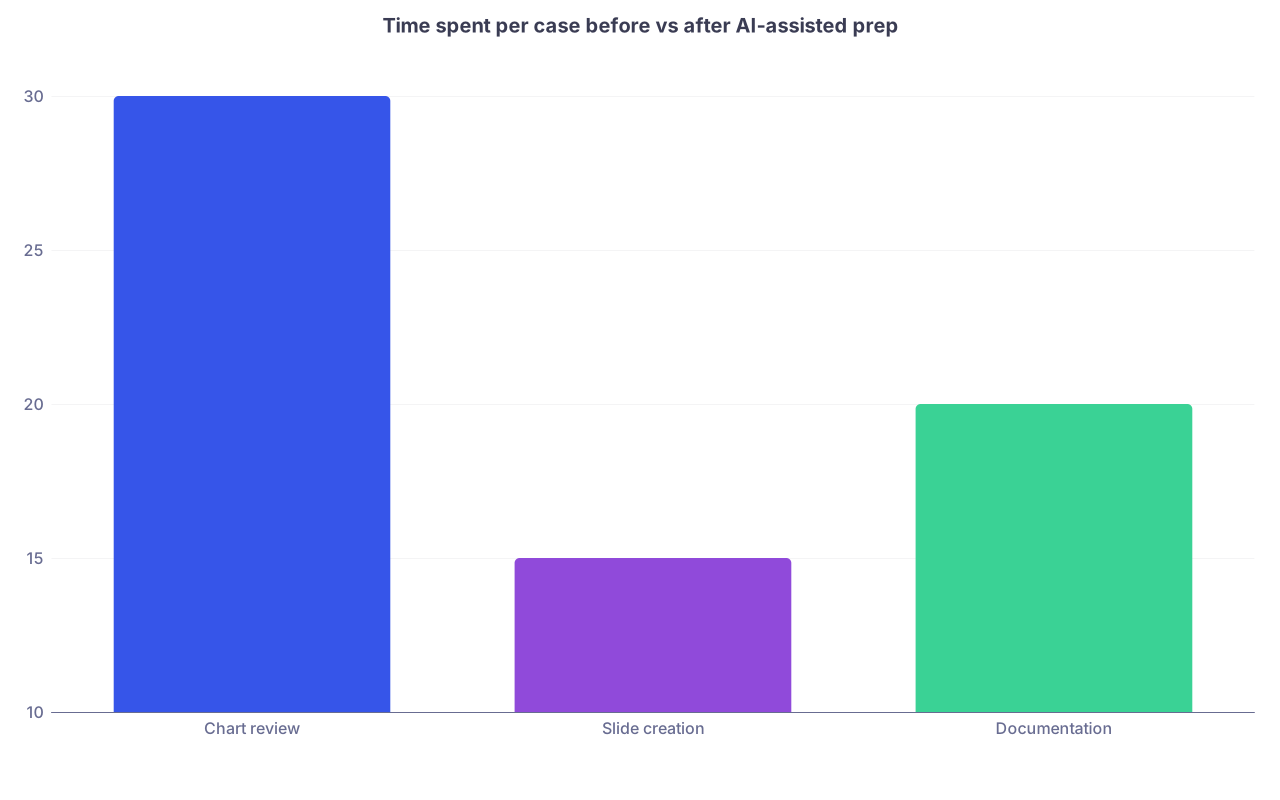
| Category | Value |
|---|---|
| Chart review | 30 |
| Slide creation | 15 |
| Documentation | 20 |
You can realistically cut non-clinical prep time per complex case by 30–50% once your prompts and templates are stable.
9. Preparing For The Near Future: What Is Coming Next
If you want to be ready for the next 3–5 years of AI in tumor boards, plan for three shifts.
1. Direct integration with EMR and PACS
Expect:
- AI tools that auto-ingest chart data and imaging, then generate draft summaries without your copy-paste.
- Case lists that auto-populate with staging, guideline-aligned options, and trial matches before you even open the patient.
Your job becomes: editor and decision-maker, not data wrangler.
2. Real-time AI support during tumor board
Eventually you will have:
- Live AI that listens to the case discussion (speech-to-text), cross-checks guidelines, and surfaces options and references in real time.
- Automatic generation of a meeting summary while you talk.
You want to be the person in the room who already understands how to sanity-check AI output, not the one arguing that “we should go back to paper.”
3. Trial matching at scale
Current trial matching is clunky. AI will:
- Parse inclusion/exclusion criteria from protocols.
- Match them to structured case features.
- Present a shortlist of plausible trials for each case, ranked by fit.
Your prep workflow should already include the fields trial algorithms need: stage, biomarkers, prior therapy, performance status, comorbidities.
10. How To Start Tomorrow: A 7-Day Implementation Plan
If this sounds abstract, here is the blunt plan.
Day 1–2: Build your templates
- Draft 1–2 disease-specific prompt templates for your most common tumor board cases (e.g., breast and lung).
- Define your minimal case data structure for each.
Day 3–4: Pilot on a small number of cases
- Use AI prep on 3–5 upcoming tumor board cases.
- Compare: time spent, clarity of presentation, number of “oh we forgot that” moments.
Day 5: Adjust and set guardrails
- Tweak prompts where AI was inaccurate or verbose.
- Write your personal “never events” for AI use. Stick them in your desk drawer or on your desktop.
Day 6–7: Scale slightly
- Add 1 more disease site template.
- Show one colleague or trainee how you are doing this. Take their feedback.
You are now past theory and into practice.
Key Takeaways
- AI should be your structured, tireless junior fellow for tumor board prep – summarizing, flagging gaps, and organizing options, not deciding care.
- The leverage comes from repeatable templates: structured prompts by disease site, standard case data fields, and clear guardrails for verification.
- If you start using AI now, on your terms, you will walk into future AI-integrated tumor boards as the person who already knows how to control and critique the machine – not the one trying to catch up.