
The worst career move you can make in modern medicine is saying “yes” or “no” to new tech by gut feeling alone.
You are about to be bombarded with AI pilots, workflow apps, “smart” devices, remote monitoring dashboards, and dashboards for your dashboards. Some will truly help patients and your career. Many will waste your time, burn your reputation, or quietly lock you into terrible workflows for years.
I want you to stop guessing and start treating tech decisions like you treat antibiotics: indication, dose, risks, and follow‑up. And I am going to lay out when in your progression from intern to junior attending you should say yes, maybe, or absolutely not.
PGY-1: Survival Mode – Default “No” With Very Narrow “Yes”
At this point you are not a “future of healthcare” leader. You are a liability factory if you get distracted. Your primary job is survival and competence.
Your tech rule for this year:
Say “no” to almost everything, “yes” to what directly lowers your cognitive load on service.
Months 1–3: Do Not Volunteer For Anything
Right now you should:
- Learn your EMR cold.
- Learn order sets, note templates, and how to get data quickly.
- Watch who is actually efficient, not who talks most about “innovation.”
Say yes only to:
Tools that shave clear time off core tasks
- Example: A pre-built dotphrase pack that senior residents use and swear by.
- Example: An EMR shortcut workshop run by informatics—if it is scheduled in protected time.
Mandatory institutional tools
- New CPOE interface? You do it. You do not want to be the person still using legacy views.
Say no (or “not now”) to:
- “We’re piloting this AI sepsis alert—want to help tune it?”
- “We’d love an intern voice in this workflow redesign committee.”
- Any project where you cannot extract exactly what changes for you on nights in the ICU.
At this point you should literally have a script:
“I’m honored you asked. Right now I’m focused on getting solid clinically. Can we revisit this after I finish my first ICU block?”
Use it. Repeatedly.

| Step | Description |
|---|---|
| Step 1 | PGY1 Invite |
| Step 2 | Consider joining |
| Step 3 | Defer |
| Step 4 | Say yes |
| Step 5 | Does it reduce work today |
| Step 6 | Mandatory or protected time |
PGY-1, Months 4–12: Targeted Tech “Shadowing,” Not Ownership
Once you are no longer drowning every call night, you can start observing tech projects without owning them.
At this point you should:
Identify the 2–3 tech initiatives that will touch your daily work the most
Examples:- New AI-assisted imaging triage tool in the ED.
- Smart pumps rollout on your main ward.
- New secure messaging platform replacing pagers.
Ask to sit in one planning or feedback session per project
Your line:“I’m on this service a lot. I’d like to sit in once to understand how this will affect front-line workflow.”
Your default answer to joining the working group is still no. But you:
- Listen for who actually understands workflow versus vendors.
- Note who gets ignored when they bring up safety or usability issues.
- Watch what data they do or do not collect.
Say yes only if all three are true:
- The project directly affects your service in the next 6 months.
- Meetings happen during already scheduled didactics or non-clinical hours.
- There is a defined end (e.g., “three feedback sessions during rollout,” not “join the innovation council”).
If any of those is missing, you politely stay at the edge.
PGY-2: Strategic Exposure – Start Saying “Yes” To Bounded Pilots
Now you know the system. You know which nurses will tell you the truth. You have some slack in your schedule. This is the inflection point where intelligent tech involvement starts to pay off.
Your rule this year:
Say “yes” to small, time-boxed roles on projects that let you learn how tech gets built and evaluated.
Early PGY-2 (Months 1–6): One Pilot Max
Pick one initiative, not five.
Here is how to choose:
| Factor | Good Sign |
|---|---|
| Scope | Limited to 1–2 units or 1 service |
| Time | Clear start/end dates, < 6 months |
| Leadership | Named clinical and IT leads |
| Data | Plan for pre/post or A/B metrics |
| Your Role | Concrete tasks, < 3 hrs/month |
Examples of good “yes” projects in PGY-2:
- Order set optimization pilot on your heme-onc service.
- Your role: collect cases where order sets failed; join 2 redesign meetings; test changes.
- Secure messaging app rollout on night float.
- Your role: log cases where messaging improved or worsened handoffs; present brief summary.
Bad yes:
- Institution-wide “digital transformation” steering committee.
- Vendor-focused “innovation ambassador” role with no defined work product.
At this point you should:
- Block specific hours in your calendar for the project.
- Tell your chief: “I’m committing to X hours/month on this QI/tech pilot; if it creeps beyond that, I’ll need to step back.”
Late PGY-2 (Months 7–12): Learn How to Say “Conditional Yes”
You will now see the pattern:
- Someone pitches you a “transformative” AI tool.
- They have a slide deck and enthusiasm; less often they have outcomes data.
Your answer should become more sophisticated:
Ask 4 questions on the spot:
- “What specific workflow is this replacing?”
- “What metric will you use to call this a success?”
- “Who is responsible when the tool is wrong?”
- “What is the sunset plan if it fails?”
Then decide:
- If they cannot clearly answer 2 or more of those, say no.
- If they can, say: “Conditional yes. I can commit to X hours/month through [end date] focused on [defined tasks].”
This is how you avoid being the unpaid implementation arm for vague visions.
PGY-3 / Senior Resident: Choose Your Tech Identity
Now people treat you like a junior attending, but pay you like a resident. This is when your reputation around tech starts to harden.
Your rule:
Decide whether you are going to be “the tech person” in your niche, or a smart skeptic who only touches critical systems. Both are fine. Waffling is not.
Path A: You Lean Into Tech Leadership
If you actually enjoy this stuff, PGY-3 is when you start taking ownership.
At this point you should:
Own one end-to-end project affecting your home service.
Example:- Implement and evaluate an AI readmission risk score on the medicine wards.
- Lead a project to redesign discharge summary templates with auto-pulled structured data.
Attach your name to outcomes, not just participation.
Not: “Helped with AI pilot.”
Yes: “Led implementation of X, resulting in 15% reduction in Y with unchanged Z.”Learn basic evaluation
You do not need to be a data scientist. But you do need to understand:- Pre/post comparisons.
- Balancing metrics (e.g., reduced LOS without increased readmissions).
- Basic confounders.
At this point you should start saying yes to:
- Being the primary resident liaison for one major initiative in your department.
- Presenting outcomes at departmental M&M or QI conference.
- Joining 1–2 high-yield committees (e.g., Clinical Informatics Committee, not “Innovation Day Planning”).
And no to:
- Every “cool” pilot that is not on your strategic path.
- Any role where your contribution is basically unpaid marketing for a vendor.
Path B: You Stay Clinically Focused but Technically Literate
If you do not want an informatics/innovation career, your strategy changes.
You still need to:
- Protect your time.
- Ensure tech does not make your workflow worse.
- Avoid being labeled “that attending who refuses to use the new system.”
At this point you should:
- Say yes to early adopter roles only for tools that directly improve your bread-and-butter work.
- Say no to leadership roles but yes to structured feedback opportunities.
Your script:
“I won’t lead this, but I’m happy to be a high-volume user and give structured feedback during rollout.”
You gain influence on how tools are shaped without getting trapped in meetings.
Transition to Junior Attending (Year 4–5 Post-Med School): Now Your Yes Actually Matters
This is where the question in the title finally becomes existential. Your “yes” can:
- Lock your team into a flawed documentation system.
- Shape hiring for tech roles.
- Influence whether your group signs a multi-year vendor contract.
Your rule now:
Say “yes” only when you can see: the clinical gain, the data plan, the exit ramp, and the political cost.
Let us break this down by your first 24 months as an attending.
Months 0–6 as Attending: Aggressive Observation, Conservative Commitment
New attendings get targeted as “innovation champions” because:
- You are not yet burned out.
- You still remember passwords.
- You are easier to sway than entrenched senior faculty.
At this point you should:
Map the tech power structure.
Within your first 2–3 months, identify:- The CMIO / CNIO or equivalent.
- The 1–2 attendings who actually drive decisions on EMR, AI, devices.
- The operations manager who controls implementation details.
Audit your current tech stack during your initial rotations.
On each service, ask:- “Which tool makes your life better?”
- “Which tool makes your life worse?”
Ask nurses, pharmacists, residents. You will get unfiltered truth at 3 a.m.
Say yes only to low-risk, high-visibility roles.
Good early-attending “yes”:- “I’ll be the attending lead for resident feedback during the new handoff tool rollout this quarter.”
- “I’ll co-present the results of the AI imaging triage pilot at Grand Rounds.”
Bad early-attending “yes”:
- “Sure, I’ll co-chair the Digital Transformation Task Force” in your first 3 months.
- “Yes, I’ll be a physician champion for this vendor” before you have stable clinical footing.
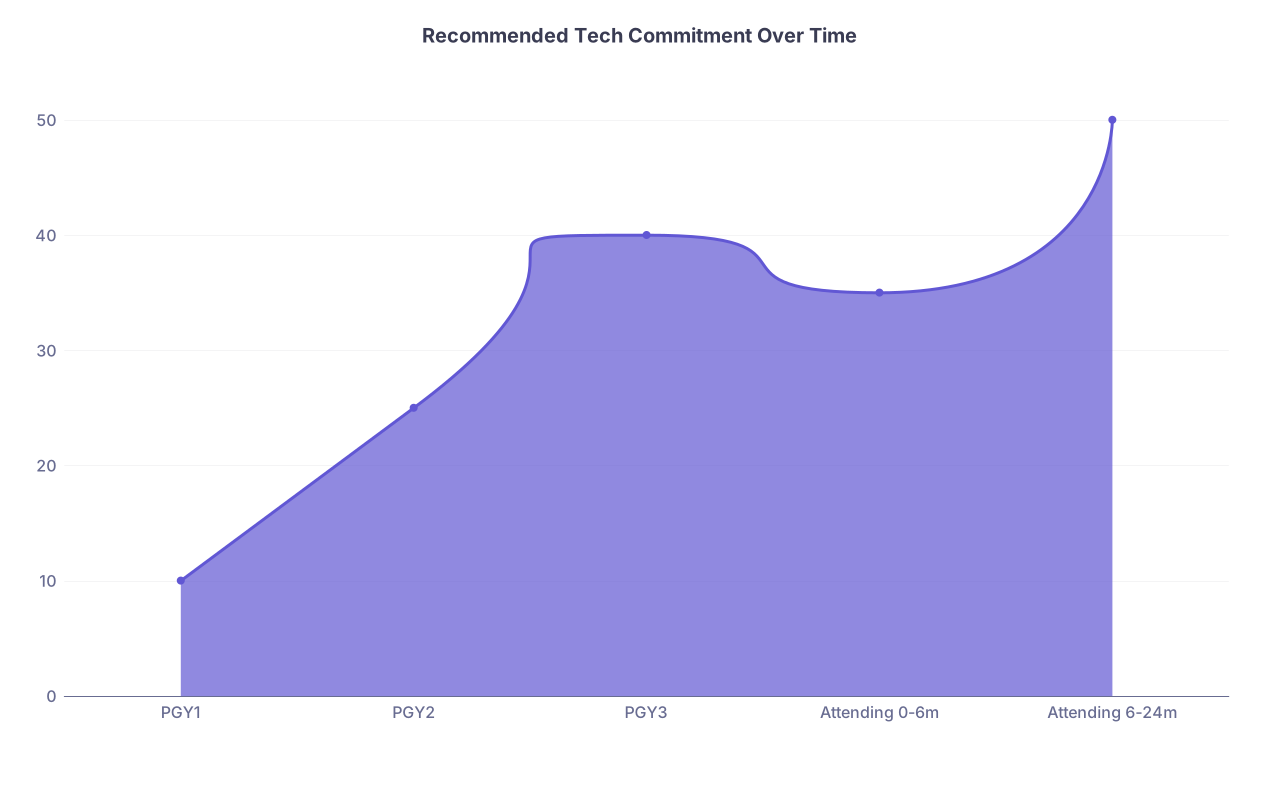
| Category | Value |
|---|---|
| PGY1 | 10 |
| PGY2 | 25 |
| PGY3 | 40 |
| Attending 0-6m | 35 |
| Attending 6-24m | 50 |
(Values here are relative percentage of your “non-clinical energy” to spend on tech. Not your total time.)
Months 6–24 as Attending: Where Strategic “Yes” Builds Your Brand
Now you are established. People trust your clinical judgment. Saying “yes” to the right tech initiative can anchor your role for the next decade.
At this point you should choose one of three archetypes and act accordingly.
Archetype 1: The Clinical Informatics Track
You lean in hard.
You should say yes to:
- Formal roles:
- Associate CMIO for a service line.
- Medical director for clinical decision support (for your department).
- System-level initiatives:
- AI-based risk scores.
- Clinical pathways embedded in EMR.
- Device integration projects (telemetry, smart pumps, remote monitoring).
Your “yes” criteria here:
- Clinical alignment – It must touch your core specialty.
- Data clarity – You must have access to performance dashboards.
- Governance – There is a real safety and oversight structure.
And you should proactively say no to:
- Every “innovation showcase” that does not tie to your core work.
- Projects where you cannot influence specification or evaluation, only cheerlead.
Archetype 2: The Operationalist
You care about throughput, staffing, length of stay.
You should say yes to:
- Bed management and throughput tools.
- Order set and pathway redesign tied to LOS.
- Communication platforms that reduce page burden.
Your filter:
“Will this make it easier for my team to get patients in, treated safely, and out?”
If the answer is vague, say no, especially to:
- Shiny AI tools that predict something nobody owns (e.g., “risk of something” with no playbook).
- Dashboards that add visibility but do not change capacity.
Archetype 3: The Quiet Expert
You want clinical excellence, solid reputation, minimal politics.
You should:
- Say yes to being a trusted tester for tools that directly touch your niche (e.g., new EP lab mapping system, new ICU ventilator interface).
- Say no to leadership titles, yes to documented feedback that you keep for your own records.
Because here is the truth: even as a “quiet” attending, your pattern of tech yes/no will follow you. When promotion time comes, people remember if you improved workflows or consistently fought upgrades with no alternative.
Red Flags: When to Say a Hard No at Any Stage
Regardless of where you are from intern to junior attending, there are absolute no-go signals.
If you see any of these, your answer should be “no” or “not until that is fixed”:
No clear owner
- If no single person can say “I am responsible for outcomes of this tool,” walk away.
-
- If the project exists mainly because “the vendor included it in the contract,” skip.
No metrics
- If success cannot be described in 1–2 measurable outcomes, you are signing up for infinite scope creep.
No exit plan
- Ask: “What has to be true for us to decide to turn this off?”
- If the room goes quiet, do not join.
Unsafe-by-design workflows
- Examples you will actually see:
- Alerts that fire on every patient, every time.
- Systems that allow order entry without clear patient context.
- Tools that hide critical data behind extra clicks “to simplify UI.”
- Examples you will actually see:
These are not your sandbox. These are how careers end up on the front page in the wrong way.
Green Flags: When Saying Yes Is Almost Always Worth It
On the flip side, certain patterns almost always signal a good “yes,” especially as you move toward junior attending.
You should lean in when:
Nursing and pharmacy are already engaged and positive
- If the bedside team is asking for it, not just tolerating it, that is a strong sign.
Project leaders show you pre-existing pain points
- They walk you through a current-state workflow and data. Not just vision slides.
There is a small pilot with real off-ramp
- “We are going to test this on unit X for 3 months, and here are the criteria we will use to expand or stop.”
They explicitly ask for your constraints
- “How many hours could you realistically give this?”
- “Which weeks are bad because of call?”
These are your best bets for meaningful impact per hour invested.
A Simple Timeline Summary: What To Say Yes To, When
| Stage | Default Stance | Good Yes | Clear No |
|---|---|---|---|
| PGY1 (0–6m) | No | EMR efficiency tools | Any leadership role |
| PGY1 (6–12m) | Mostly No | Single feedback session | Multi-month pilots |
| PGY2 | Selective Yes | 1 bounded pilot | Broad committees |
| PGY3 | Strategic Yes/No | Owning 1 key project | Unaligned side projects |
| New Attending (0–6m) | Conservative Yes | Service-level rollout roles | System-wide chair roles |
| Attending (6–24m) | Strategic Yes | Roles matching chosen archetype | Vendor showpieces only |
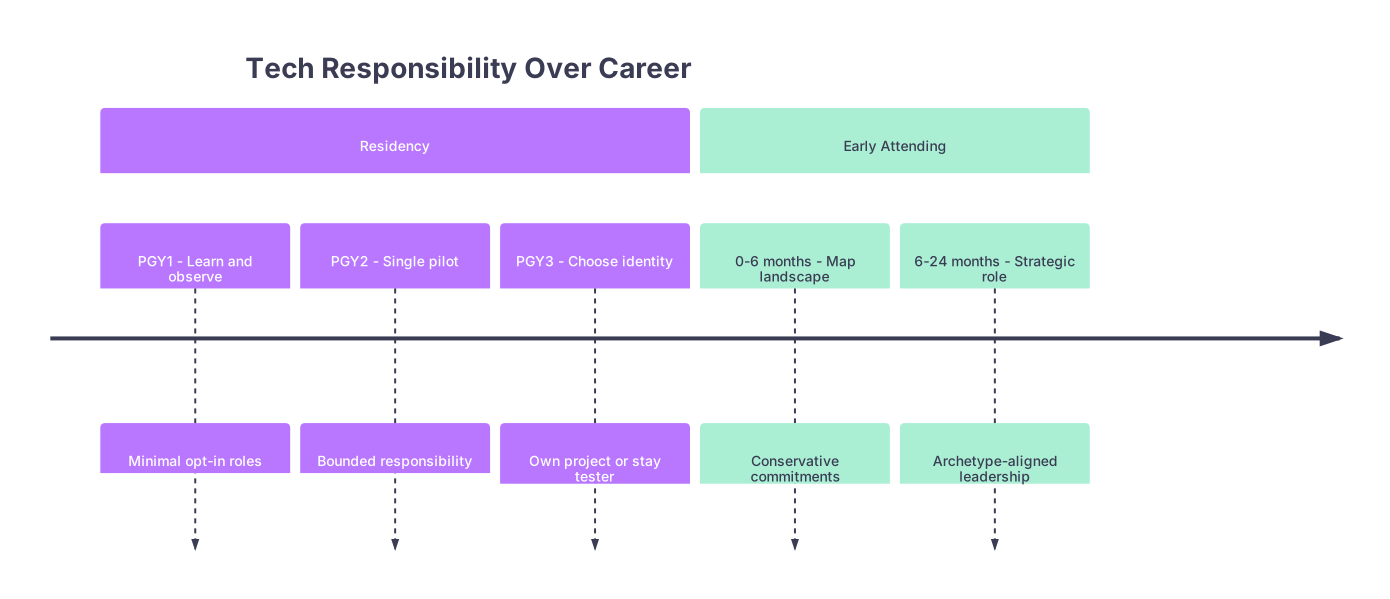
| Period | Event |
|---|---|
| Residency - PGY1 - Learn and observe | Minimal opt-in roles |
| Residency - PGY2 - Single pilot | Bounded responsibility |
| Residency - PGY3 - Choose identity | Own project or stay tester |
| Early Attending - 0-6 months - Map landscape | Conservative commitments |
| Early Attending - 6-24 months - Strategic role | Archetype-aligned leadership |
What You Should Do Today
You do not need a grand plan to start making smarter yes/no decisions.
Today, do one concrete thing:
Make a 3-line list on a notepad or in your phone:
- One tech tool that genuinely helps your work right now.
- One tech tool that obviously makes things worse.
- One upcoming initiative you have heard rumors about.
Next time someone asks you to join or “champion” something, pull out that list and ask yourself:
- Does this move #2 closer to #1?
- Or is this just adding a #4 that I will complain about on night shift?
Then decide. Deliberately. Not by flattery, not by fear of missing out.
Start by revisiting the last tech thing you said yes to. Ask yourself: given this framework, would you say yes again?