
The biggest danger of clinical AI for residents isn’t that it’s wrong. It’s that it’s almost right—and you stop thinking.
If you remember nothing else, remember this: overtrusting clinical AI will not protect you when your attending starts asking, “Walk me through your reasoning.” Blaming the algorithm won’t save you on rounds, in M&M, or in a lawsuit.
Let me walk you through the mistakes I keep seeing and how to avoid becoming the resident who “trusted the AI” and ended up owning a preventable disaster.
1. The Core Problem: You Quietly Hand Off Your Brain
The subtle mistake isn’t “using AI.” That’s fine. It’s using AI as authority instead of input.
Here’s the progression I’ve seen in real wards:
- Intern opens the AI decision support in the EHR.
- AI flags “low risk PE,” “likely viral illness,” or “no acute intracranial process.”
- Resident glances, nods, and mentally downgrades concern.
- On rounds: “We think this is X,” but the reasoning is just… vibes + AI output.
Nobody says, “The algorithm told me this.” They just internalize it and present it as their own reasoning. That’s the trap.
The danger isn’t that the AI is malicious. It’s that:
- It’s trained on population patterns, not this specific weird patient.
- It’s only as good as the input data (garbage in, polished garbage out).
- It doesn’t have to defend its decision to an attending, a family, or a jury. You do.
If you start letting AI outputs replace your own problem representation, you’re not “being efficient.” You’re quietly surrendering the only thing that makes you a physician instead of a human API wrapper: clinical judgment.
2. Common Ways Residents Overtrust AI (And Get Burned)
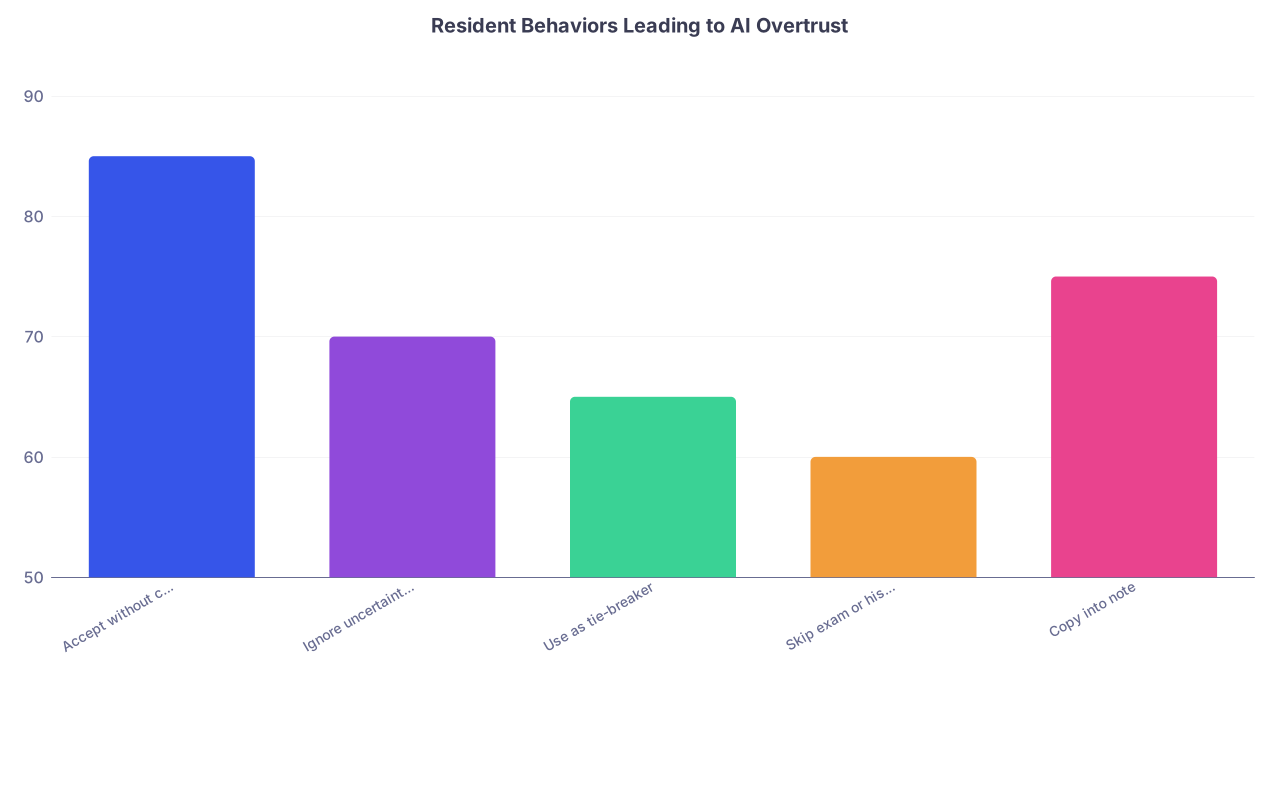
| Category | Value |
|---|---|
| Accept without checking | 85 |
| Ignore uncertainty flags | 70 |
| Use as tie-breaker | 65 |
| Skip exam or history | 60 |
| Copy into note | 75 |
Let’s be specific. These are the repeat-offender mistakes.
Mistake 1: Treating “High Confidence” as “Definitely Right”
Many clinical AI tools show some version of:
- “High confidence: pneumonia”
- “Low risk: discharge safe”
- “Low probability: sepsis”
Residents see “high confidence” and stop questioning.
The problem? That “confidence” is model confidence, not truth. It’s not calibrated to your exact patient, your hospital’s population, or your malpractice risk.
You get burned when:
- The AI is confident on bad or incomplete data (missed vitals, mis-entered med list).
- The presentation is atypical, so the model’s training data barely covers it.
- The rare but deadly diagnoses—the ones that kill your patients and your career—are exactly the ones the model under-calls.
How to avoid this mistake:
- Anytime you see “high confidence,” your reflex question should be: “What would disprove this?”
- Ask yourself: “What serious things could this be instead that the model might miss?”
- Build the habit: treat AI confidence like a med student’s enthusiasm. Useful, but not proof.
Mistake 2: Letting AI Replace Your Differential, Not Inform It
I’ve watched residents do this with AI diagnostic support: they had a half-formed differential, then they see the AI list and just adopt it wholesale.
Suddenly:
- Anything not on the AI’s top 5 drops out of their mind.
- Rare diagnoses disappear.
- They start forcing the story to fit the suggestion.
This is anchoring on steroids.
Safer workflow:
- Generate your own differential first. Even just 3–5 possibilities.
- Then check the AI.
- Ask:
- What did it add that I missed?
- What matters that it didn’t list?
- Does this change my workup, or just my confidence?
If you can’t articulate your own list without looking at the AI, that’s a red flag. You’re drifting into dependency.
Mistake 3: Using AI to Justify What You Already Wanted to Do
The worst overtrust isn’t naive. It’s self-serving.
Classic scenario:
- You’re tired. You want to discharge.
- AI risk tool says: “Low risk” or “Safe for outpatient follow-up.”
- You latch onto it as permission.
I once heard a resident say, half-joking, “Well, the tool says they’re low risk, so we’re covered.” No, you’re not. The risk calculator isn’t coming to court.
You know this pattern from other tools:
- HEART score for chest pain.
- Wells score for PE.
- CURB-65 for pneumonia.
Now imagine those, but powered by a black-box neural network trained on data you’ll never see. Are you really comfortable using that to rubber-stamp your shortcut?
Rule of thumb: If you’re relieved by what the AI says, double-check your motives. You might be looking for an excuse, not a truth.
Mistake 4: Blindly Trusting AI Image Interpretation

This one is already happening with CXR, CT, and MR tools:
- AI flags “no acute intracranial hemorrhage.”
- Or “no pneumothorax.”
- Or “no PE on CT.”
Residents skim the report and feel reassured. They present the scan as negative… but never actually looked closely themselves.
Things that go wrong:
- Small but clinically meaningful findings missed (subsegmental PE in a borderline patient, early ICH).
- AI trained mainly on positive/negative labels, not nuance of “significant for this patient.”
- Residents stop developing visual pattern recognition because the machine always “pre-reads” for them.
And then the radiologist calls later: “There actually is a small SAH” or “You missed that apical pneumothorax.” Everyone looks at the note. Your name is on the decision.
How to blunt this risk:
- Use AI-assisted imaging the way you’d use a junior radiology read: helpful, never definitive.
- Always ask: “What would I do differently if this finding is actually present?” If the answer is “a lot,” you don’t get to outsource it.
- Never present an imaging summary you cannot defend visually or via official radiology report.
3. Why Attendings (Rightly) Don’t Care That “The AI Said So”
Attendings know something you might be trying to forget: in every adverse event review, the question is never “Did the AI mess up?” It’s “Was this clinician’s care reasonable?”
| Role | Legal/Clinical Responsibility | Protected By 'AI Error'? |
|---|---|---|
| Intern | Limited, but scrutinized | No |
| Resident | Substantial, growing | No |
| Attending | Ultimate clinical responsibility | No |
| Hospital | System-level liability | Rarely |
On rounds, when they keep asking you:
- “What’s your differential?”
- “Why did you choose that antibiotic?”
- “Why are you comfortable sending them home?”
They aren’t just “pimping” you. They’re checking whether you can independently justify decisions that AI might have nudged.
Here’s what gets residents in trouble:
Hollow reasoning.
When the attending drills down—“Why not PE? Why not ACS?”—and all you’ve got is “low risk per tool” or some vague justification, they notice. They might not say it out loud, but they’ll start watching you more closely.Chart notes that expose dependency.
I’ve seen notes that basically parrot AI outputs:- “AI prediction suggests low sepsis probability.”
- “Radiology AI flagged no acute findings.” That might feel thorough. It actually screams: “I’m outsourcing my brain.” In peer review or legal review, that looks bad.
Mismatch between AI suggestion and obvious clinical red flags.
The moment the model says “low risk” and the patient is gray, sweaty, and hypotensive, you are in dangerous territory. The attending sees it. If you don’t, they stop trusting your judgment.
Your job is not to obey the algorithm. Your job is to interrogate it.
4. Specific Clinical Scenarios Where Overtrusting AI Is Extra Dangerous
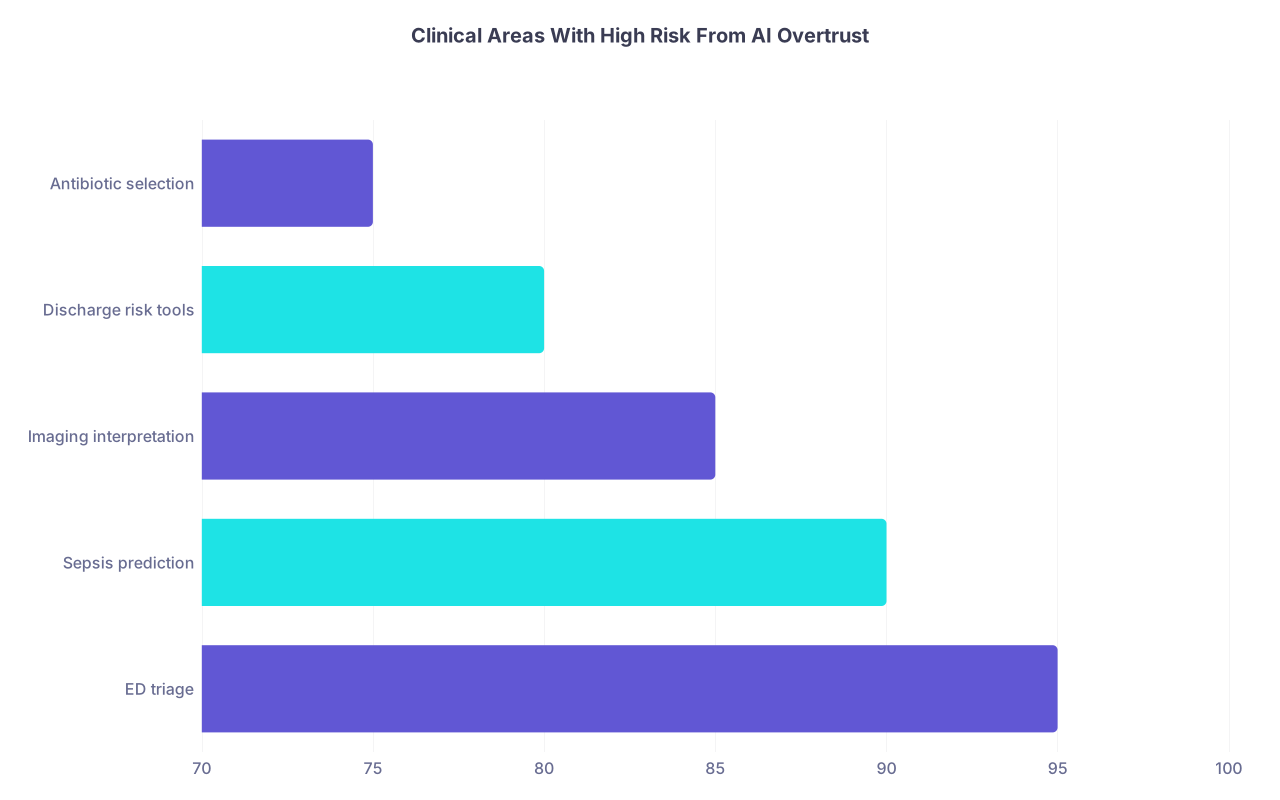
| Category | Value |
|---|---|
| ED triage | 95 |
| Sepsis prediction | 90 |
| Imaging interpretation | 85 |
| Discharge risk tools | 80 |
| Antibiotic selection | 75 |
Here’s where I see residents particularly vulnerable.
Scenario 1: ED Triage Tools
AI tools that predict:
- “Low risk for admission”
- “Low likelihood of ICU transfer”
- “Safe for fast-track”
These are built on massive datasets and look impressive. The trap: they optimize for system throughput, not your personal risk tolerance for missing a crashing patient.
Pattern I’ve seen:
- Overloaded ED.
- AI flags a borderline patient as “low risk.”
- Resident feels less urgency, delays repeat vitals or labs.
- Patient decompensates in the waiting room or on the floor.
On review, the question is: “Why did you think this patient didn’t need closer observation?” Answering “The system triage said they were low risk” is a career-limiting move.
Scenario 2: Sepsis & Deterioration Alerts
Sepsis prediction AI or early warning scores are everywhere. They’re also noisy.
The mistake swings both ways:
- Underreacting because “AI didn’t flag sepsis” → you ignore subtle, early sepsis.
- Overreacting blindly → alert fatigue, knee-jerk broad-spectrum antibiotics, no thinking.
The lethal version is underreacting.
If a patient looks worse and you’re reassured because the alert didn’t fire yet, you’ve inverted the relationship. The AI is supposed to augment you, not downgrade your eyes and ears.
Scenario 3: Discharge Decisions Based on Risk Calculators
This is where residents can quietly get themselves into lawsuits they won’t see coming for years.
You discharge because:
- “30-day readmission risk low”
- “No predicted ICU upgrade”
- “Low mortality risk score”
Those tools are often calibrated on population outcomes and payer priorities, not your personal oath or your patient’s unique risk factors.
The twist: a single disaster case (unexpected death at home, return arrest, missed critical diagnosis) will overshadow 1,000 “efficient discharges.”
If your discharge decision can’t stand up without the AI, it’s too fragile.
5. A Safer Way to Use AI on Rounds (Without Falling Behind)
Here’s how you use clinical AI without letting it quietly use you.

| Step | Description |
|---|---|
| Step 1 | See Patient |
| Step 2 | Form Your Own Assessment |
| Step 3 | Generate Differential |
| Step 4 | Check AI Tool |
| Step 5 | Use As Supporting Evidence |
| Step 6 | Reevaluate Data and Assumptions |
| Step 7 | Escalate to Attending if Concerned |
| Step 8 | Document Your Reasoning Clearly |
| Step 9 | AI Matches Clinical Picture? |
Step 1: Always Think First, Then Look
Non-negotiable rule: you must commit to a preliminary assessment before opening the AI.
Even if it’s rough:
- “Top 3 diagnoses?”
- “Sick vs not sick?”
- “Admit vs discharge?”
Force yourself to articulate it, even if only in your head or in a quick note.
Step 2: When You Check AI, Be Explicit About Its Role
Decide which of these you’re doing:
- Hypothesis generation: “What did I miss?”
- Risk stratification: “How does this change likelihoods?”
- Cross-check: “Does this contradict my impression?”
If you can’t answer “What am I using this AI for right now?” you’re drifting.
Step 3: Treat Disagreement As a Red Flag, Not an Annoyance
If the AI gives you something that really doesn’t fit:
- Don’t just shrug and pick whichever you like better.
- Ask: “Is my data entry wrong?” “Is there missing info?” “Am I anchoring?”
Sometimes the right answer is: “The AI is likely off here because [X].” But you should be able to articulate that out loud to your attending.
Step 4: Present on Rounds As If the AI Didn’t Exist
This is the litmus test.
On rounds, your presentation should stand entirely on:
- History.
- Exam.
- Data.
- Your reasoning.
If you need to reference the AI, it should be as supporting evidence, not the core:
- Good: “Given X, Y, Z, I think this is low-risk chest pain. The risk model also places her in a low-risk group, which is reassuring but doesn’t change my plan.”
- Bad: “The AI says she’s low risk so I think we can discharge.”
If you can’t defend the plan without mentioning the AI, you don’t actually own the decision.
6. Documentation: Don’t Turn Your Note Into a Liability Time Bomb
There’s another quiet mistake: how you document your use of AI.
Residents either:
- Never mention AI at all, or
- Copy-paste AI phrasing directly into notes to look “thorough.”
Both are risky.
Avoid:
- Blindly pasting AI-generated differentials, plans, or risk scores verbatim.
- Letting AI text stand in for your actual thought process.
Do instead:
- Document your reasoning first.
- If you reference AI, write it like any other tool:
- “Using [tool], patient meets criteria for low-risk category; however, due to [specific factor], we are still admitting/observing.”
- “Risk prediction supports outpatient management but doesn’t solely determine it.”
Remember: every copied AI phrase you don’t deeply understand is something a lawyer—or a morbidity conference—can use to show you didn’t think.
7. The Long-Term Cost: You Can Train Your Brain To Be Obsolete
Short-term, overtrusting AI gets you through a heavy call night.
Long-term, it quietly wrecks your training.
If during residency:
- You always check AI for imaging before you form your own read → your pattern recognition never matures.
- You lean on AI for antibiotics and dosing → you never deeply learn ID.
- You outsource subtle risk assessments → your gestalt stays underdeveloped.
Then one day:
- You’re a junior attending in a community hospital with no fancy AI.
- Or the system goes down.
- Or the AI is pulled because of a recall or regulatory change.
Suddenly it’s just you, a sick patient, and your underdeveloped judgment.
Overtrust now is how you become dangerous later.
Use AI. Fine. But use it like scaffolding, not like a prosthetic brain.
FAQ (Exactly 3 Questions)
1. Is it ever okay to say on rounds that I used an AI tool in my decision-making?
Yes—but only if you could defend the same decision without mentioning it. Phrase it as: “I assessed X, Y, Z and concluded [plan]. I also checked [specific AI/risk tool], which was consistent but not determinative.” If your explanation collapses without the AI, you’re overdependent.
2. What if my attending wants me to use the EHR’s AI suggestions to be more efficient?
Use them, but do not let “attending said so” justify lazy thinking. You can comply and protect yourself: think first, compare with AI, and bring up discrepancies. A good attending will respect that. A reckless one won’t be there when your name shows up on a complaint.
3. How do I practice not overtrusting AI while still learning to use it?
Pick a few high-yield situations—chest pain, sepsis, imaging reads. For each case, commit on paper (or in your head) before opening the AI: your differential, your risk category, your plan. Then check the AI and simply mark: agree / disagree / unsure. Review your patterns monthly. If you find you’re just “agreeing” without analysis, you’re not learning—you’re outsourcing.
Key Takeaways:
- AI is a tool, not an excuse. You—not the model—own every clinical decision tied to your name.
- Think first, then check AI. If you can’t defend a plan without citing the algorithm, you don’t understand it well enough to use it.
- Overtrusting AI doesn’t just risk today’s patient; it sabotages your development into a safe, independent physician.