The story you’re being told about AI and “supporting clinical decisions” is sanitized. The truth is that AI decision-support is already shaping your autonomy in training in ways most residents do not recognize until they’ve internalized it.
Let me walk you through what is actually happening behind the EHR pop‑ups and glossy vendor demos. This is the stuff discussed in closed-door faculty meetings, not at grand rounds.
The Quiet Shift: From “Support” to “Soft Control”
Here’s the first uncomfortable fact: most AI in hospitals isn’t built to help you. It’s built to help the system—throughput, billing, readmission penalties, malpractice risk, resource allocation. Your autonomy is collateral damage.
When you hear “AI decision-support,” you probably picture some sleek differential-diagnosis tool, or a sepsis alert that says “Hey, you might be missing this.” That exists. But the more powerful levers are quieter:
- Predictive models telling bed control who’s “discharge ready” before you’ve even seen the patient.
- Algorithms prioritizing consults, imaging, and ED admissions based on risk scores.
- AI documentation tools pushing you toward specific phrases that maximize billing.
You’re told these tools are “optional support.” But watch how the culture changes.
A hospitalist once told me after a leadership meeting: “If the readmission model flags a patient as high-risk and you discharge anyway, you’d better be ready to defend that to the CMO.” That right there is how “support” becomes a leash.
Residents feel this first and hardest because you’re at the bottom of the power chain and the most scrutinized. You’re the one on the front line when an attending says, “Why’d you override the alert?” or “The algorithm flagged them—why didn’t you admit?”
Your autonomy doesn’t vanish overnight. It just gets hemmed in from all sides.
How AI Is Actually Used in Real Hospitals (Not the Conference Version)
Let me spell out the real deployments, because the gap between marketing and reality is huge.
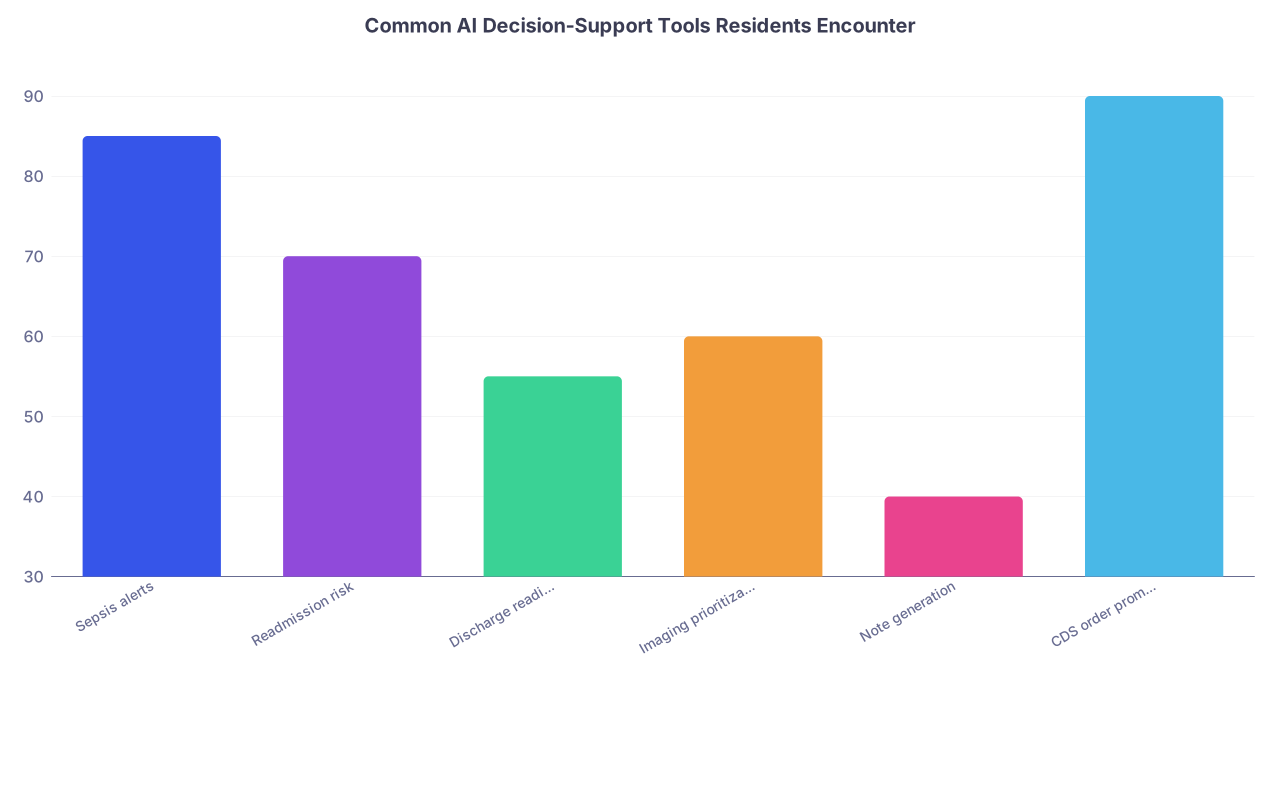
| Category | Value |
|---|---|
| Sepsis alerts | 85 |
| Readmission risk | 70 |
| Discharge readiness | 55 |
| Imaging prioritization | 60 |
| Note generation | 40 |
| CDS order prompts | 90 |
(Some numbers are approximate adoption levels I’ve seen discussed in admin meetings and vendor talks; they’re not random.)
Here’s how they actually show up in your day:
1. Sepsis and Deterioration Alerts
You know those annoying EHR banners: “High risk of sepsis—consider lactate, blood cultures, broad‑spectrum antibiotics”?
Attendings will say things like, “I don’t trust Epic sepsis alerts, they overfire,” but then in M&M, when a case goes sideways, one of the first questions: “Was there an alert? What did the team do?”
So practically:
- If you ignore an alert and the patient does poorly, you’re defending yourself against both the chart and the algorithm.
- If you follow it reflexively, you may overtreat, blow up the antibiogram, and delay your own clinical reasoning.
That’s the autonomy squeeze. The safest move professionally is often to follow the machine even when your gut says otherwise. Over time, that rewires you.
2. Readmission and Discharge Risk Models
These are the tools your leadership loves because CMS penalties hurt. You’ll hear about “high-risk patients” at multidisciplinary rounds based on AI scores.
You’ll see things like:
- Discharge planning notes pre-populated with: “Patient identified as high readmission risk. Consider…”
- Case managers pushing: “The model says they’re low risk; can we discharge today?”
- Leadership dashboards tracking “discharge on predicted day” as a performance metric.
For you that means:
- Pressure to justify keeping a patient whose model score says “low risk.”
- Subtle shaming when your patient readmits and someone notes “they were flagged high risk and we didn’t do X, Y, Z intervention.”
You still can go against the model. But the bar to justify your decision keeps rising. That’s erosion of autonomy.
3. Imaging and Consult Prioritization
Radiology AI is already everywhere: triaging head CTs, chest CT PEs, flagging suspected pneumonias. ED consult prioritization based on severity/risk scores is next.
In practice:
- Your “stat” head CT for a mild headache might get bumped below an AI-flagged “high-risk intracranial pathology” scan.
- Stroke, trauma, neuro teams will often see the AI-prioritized cases first.
Where do you lose autonomy?
- Your ability to push through exceptions. That “soft” clinical sense that this patient really is sick doesn’t algorithmically exist. You can fight the queue, but you will need social capital—and as a resident, you have very little.
4. Clinical Decision Support (CDS) in Orders
This is the most visible and the most normalized. You see things like:
- “Order set recommended for suspected pneumonia.”
- “This imaging is considered low-value per guidelines—are you sure?”
- “Consider VTE prophylaxis for this patient based on risk profile.”
Most residents treat this as mildly annoying background noise.
But when you override enough, you’ll get pulled aside.
I’ve seen pharmacy or quality improvement email a PD and say: “This intern is an extreme outlier in rejecting best-practice alerts for anticoagulation/antibiotics/LVAD management.” That conversation with your PD won’t be pleasant. And it will not feel optional anymore.
The Psychology: How AI Quietly Rewires Your Clinical Brain
The biggest autonomy hit isn’t legal or explicit. It’s cognitive.
If you train for 3–7 years in an environment where algorithms are constantly pre-framing the decision space, your mental habits change. You start with the machine’s framing and then manually adjust instead of starting clean.
Three specific distortions show up over and over:
1. Anchoring to the AI
You open the EHR and see:
- “Sepsis risk: 0.83 – HIGH”
- “Readmission risk: Very High”
- “This pattern on imaging suggests pneumonia with 92% confidence”
Good luck not being anchored.
I’ve seen residents build an entire diagnostic workup around an AI-flagged sepsis case that turned out to be pure volume depletion + beta-blockers. Why? Because once the chart screams “SEPSIS,” every tachycardia and borderline lactate reinforces the story.
A few years of that, and your own clinical gestalt takes a back seat.
2. Premature Closure Encouraged by Tools
If the AI differential suggests “top 3 likely diagnoses,” there’s a strong temptation to stop there. Especially when you’re exhausted and two of them fit the story.
Good attendings will push back: “What else? What’s the one thing you’d hate to miss?” But as workload climbs and AI gets slicker, there’s an increasing institutional tolerance for: “Well, the system flagged pneumonia and we treated pneumonia.”
Your autonomy to think wider exists on paper. In practice, the cognitive load plus AI nudges promote narrower thinking.
3. Defensive Medicine… but With Algorithms
Defensive medicine has always existed. AI just gives it a more sophisticated excuse.
“I ordered the CT because the decision-support recommended imaging in this risk tier.”
“I admitted instead of sending home because the readmission model flagged them high-risk.”
This is what attendings quietly like about AI: it spreads legal risk across the system. The algorithm becomes a co-defendant.
You feel safer following it, even when it’s not clinically ideal. So the space where you would have taken a carefully reasoned, lower-intervention path shrinks.
Where You Actually Gain Power (If You’re Smart)
It’s not all loss. There are areas where AI can increase your autonomy—but only if you treat it as a tool, not a boss.
1. Faster Pattern Recognition = More Time for Real Decisions
Some AI tools genuinely save you time:
- Automated note drafting that pulls vitals, labs, imaging correctly.
- Smart order sets that auto-suggest appropriate doses and monitoring.
- Image triage that gets the obviously bad scan in front of radiology quickly.
If you’re deliberate, you can use that freed time to actually examine patients, think through complex cases, and discuss management with attendings instead of wrestling labyrinthine order screens.
The residents who win here are the ones who audit the AI output instead of rubber-stamping it.
They:
- Skim AI-drafted notes but then manually add their own assessment narrative.
- Use AI-suggested orders as a starting point, then prune or add based on the real human in front of them.
- Cross-check imaging AI with their own read instead of blind trust.
That habit—“AI drafts, I decide”—is what preserves your autonomy while still getting efficiency benefits.
2. Better Access to Evidence at the Point of Care
The newer generation of tools that summarize guidelines or surface relevant trials in the EHR are actually useful when used sparingly.
You’re on night float. You get called for a patient with cirrhosis and new AKI, borderline blood pressure, unclear volume status. The AI tool pulls up key guidelines, suggests hepatorenal syndrome workup, reminds you of albumin dosing. You were tired, your mental library was frayed—that nudge is helpful.
Your attending doesn’t have to spoon‑feed you the basics; you come to them with a coherent plan. That’s actually a boost to your perceived autonomy and competence.
The trick is to treat these tools like you’d treat UpToDate or a trusted senior resident. Helpful. But not infallible. And absolutely not the final word.
3. Data to Back Your Clinical Instincts
This is the part no one tells you: the same system that watches you can sometimes be turned around to defend you.
Examples I’ve seen:
- Resident wants to keep a patient one more day; admin is pushing discharge. Resident points to model output and additional risk factors the model underweights, documents their reasoning carefully. If that patient crashes at home, the record reads very differently.
- Resident pushed for earlier imaging because “something felt off,” AI didn’t flag deterioration yet. When they’re right, that case gets talked about. Attending notices. Sometimes that becomes a letter writer who calls you “clinically excellent.”
You need to learn enough about how these models work to either ride with them or consciously go against them and document why.
What Your Program Leadership Really Cares About
Let me be blunt: your program director is under pressure from two sides—hospital administration and ACGME. AI is now baked into both.
In closed meetings, the conversation often sounds like:
- “Our residents are overriding VTE alerts at twice the institutional average. That’s a liability.”
- “CMS flagged us for outlier opioid prescribing; can we train residents better with AI prompts?”
- “We need to show ACGME we’re teaching high-value care. Can we use CDS override data as a metric?”
That means your interactions with AI tools are not invisible. They’re data.
| AI-Related Metric | Who Sees It |
|---|---|
| Alert override rates | Quality, PDs |
| Order set usage | Service chiefs |
| Documentation completeness | Coding, compliance |
| Discharge vs predicted date | Hospital admin |
| Imaging appropriateness scores | Radiology, quality |
Nobody hands you this table on orientation day. But these metrics show up in slide decks your PD does see.
So if you:
- Ignore best-practice alerts constantly without coherent documentation
- Never use order sets and freestyle every admission note
- Regularly discharge against model predictions with no rational narrative in your notes
You start to look like a “risk.” Not a cowboy hero. A risk.
The residents who thrive learn the game:
- They override when it matters—but write a clear, concise justification.
- They use order sets, then deliberately modify them where they don’t fit.
- They show they understand the system and when to step outside it.
That’s what true autonomy looks like in this era: knowledgeable, transparent deviation. Not mindless rebellion or mindless compliance.
Training Your “AI Era” Clinical Muscles
So what should you actually do, on the wards, to stay sharp and autonomous?
1. Always Form Your Own Impression Before Looking at AI Outputs
This is non-negotiable if you want to stay clinically sharp.
On pre‑rounds:
- See the patient.
- Build your own mental differential and plan.
- Only then look at the AI scores, CDS suggestions, and risk models.
Yes, it takes a little more time. But you’ll feel the difference. Instead of fitting your brain into the AI framing, you’re comparing two frameworks—yours and the machine’s.
That’s where the real learning lives.
2. Use AI as a “Second Opinion,” Not a Primary Author
For notes, orders, and plans:
- Let AI help with structure and grunt work.
- You handle the nuance: comorbidities, psychosocial factors, patient preferences, things not in the structured data.
If your note reads like only the AI could have written it, you’re not thinking enough. If your note sounds like you—with the AI just filling in boilerplate—you’re doing it right.
3. Practice Saying This to Attendings
You need language that signals both respect for tools and independent thinking. Something like:
- “The model flags them as low readmission risk, but here’s why I’m worried anyway…”
- “CDS recommended broad-spectrum coverage, but given their history and current stability, I’d rather start narrower because…”
- “Imaging AI suggests pneumonia, but clinically I’m more convinced this is volume overload—here’s the evidence.”
Good attendings love this. It shows you’re not a slave to the computer, but you’re not recklessly ignoring it either.
Bad attendings might bristle. Note that reaction. It tells you more about their insecurities than your judgment.
The Future You’re Walking Into (and How to Not Get Steamrolled)
AI decision-support is not going away. The financial incentives are too strong, and frankly, the potential to improve care is real in some domains. You’re not going to out-stubborn an entire industry.
What you can do is refuse to let your clinical identity be flattened into “person who clicks what the screen suggests.”
Expect:
- More granular feedback on your patterns of AI use.
- Evaluation language like “uses decision-support appropriately” becoming standard.
- Fellowship and job interviews quietly caring that you’re comfortable with these tools—but not dependent on them.
What will set you apart is your ability to:
- Explain why you went with or against an AI suggestion.
- Show that your reasoning holds up in chart review and M&M.
- Demonstrate that patients under your care benefit from a combination of human judgment and system support.
The residents who treat AI like a partner they respect but do not worship will be the ones attending physicians actually trust.

| Step | Description |
|---|---|
| Step 1 | See Patient |
| Step 2 | Form Clinical Impression |
| Step 3 | Review AI Suggestions |
| Step 4 | Adopt With Minor Edits |
| Step 5 | Override AI |
| Step 6 | Document Rationale |
| Step 7 | Discuss With Attending |
| Step 8 | Implement Plan |
| Step 9 | Align With Clinical Judgment |