
It’s July 15th. You’re two weeks into your first real job as an attending. Your inbox already has three messages about “AI decision support upgrades,” there’s a flyer for a “Hospital AI Governance Committee” in the physician lounge, and your chair just casually said, “We’ll want you involved in the AI work here eventually.”
You’re still figuring out where the ED bathrooms are. And now there’s AI politics?
This is where most new attendings screw it up. They either:
- Ignore all AI stuff as “admin noise” and wake up a year later to a clunky tool dictating their workflow.
- Or they say yes to everything, land on three different committees, and burn their limited free time in meetings that don’t matter.
You need a timeline. When to ignore, when to observe, when to show up, and when to actually lead.
Let’s walk your first year as an attending—quarter by quarter, then month by month—focused only on one thing:
When and how you should engage with your hospital’s AI committees and governance structures so the tech works for you instead of against you.
Q1 (Months 0–3): Get Oriented, Not Overcommitted
For the first three months, your primary job is simple: be competent, reliable, and not on fire. You’re building credibility. That credibility is the only real currency you have when you eventually walk into an AI committee and say, “This design is dangerous” or “This is going to break our workflow.”
At this point, you should not chair anything. You should not “co-lead” any AI initiative. You observe, ask, and lightly participate.
Month 0–1: Quiet Recon
First 4–6 weeks, your AI goal is intel, not impact.
This month, you should:
Find out what AI “actually” exists in your hospital.
Ask 3 people (ideally separately):- Your division chief: “What AI-based tools are we using now—CDS, triage, sepsis alerts, imaging support, anything?”
- A senior colleague you trust: “What AI or algorithmic tools here are actually affecting your day-to-day?”
- A savvy nurse or charge nurse: “Which alerts or tools slow you down or help you?”
You’ll often discover:
- A sepsis prediction model firing constant alerts
- An imaging triage algorithm in radiology
- Some vendor “AI-scribe” pilot in the outpatient clinic
- An “AI risk score” in the EHR that no one understands but everyone clicks past
Identify all AI-related bodies.
You’re looking for anything with names like:- Clinical Decision Support Committee
- Digital Health Committee
- AI Governance Council
- Data & Analytics Steering Group
Ask your chair bluntly: “Who actually controls or approves clinical AI tools here?” There’s usually a surprisingly small group making big decisions.
Skim, do not study, the policy docs.
Ask IT or your CMIO for:- The AI/algorithm governance policy (it might be buried under “Clinical Decision Support governance”)
- Any list of “approved tools” or “high-risk algorithms”
- Any mention of model monitoring or bias review
You’re not writing a thesis. You just want to know:
- Who signs off
- Who can turn it off
- How new tools are introduced
Notice where AI touches your work. Every day.
For one week, keep a running note on your phone:- Which AI/alert/model popped up
- Did it help? Slow you down? Confuse you?
- One concrete example each day
By the end of the week you’ll have real, specific stories. Committees run on stories more than statistics.
At this point, you should not:
- Volunteer to “represent your department” on an AI committee
- Agree to help implement a new tool you do not understand
- Let anyone call you the “AI champion” yet
You’re still building your mental map.
Month 2: Attend, Don’t Lead
By month 2, you’re no longer drowning every shift, and your name is starting to mean something. This is the right time to get in the room—carefully.
This month, you should:
Attend one AI-related meeting as a guest.
Ask your chair or CMIO:“Can I sit in on the next AI governance or CDS committee as an observer? I want to understand how decisions are made here.”
In that meeting, pay attention to:
- Who speaks with actual authority (not just volume)
- Who seems to understand clinical workflows vs. pure tech
- How they evaluate tools (ROC curves and vendor slides, or real-world impact?)
- Whether front-line clinicians are even present
Map the power players.
Usually you’ll see a mix like:- CMIO or CIO (formal authority)
- A couple of senior clinicians who’ve been there 10+ years
- A risk/compliance person
- Sometimes legal
- Occasionally a data scientist or informatics person who actually knows what a model is
Write down names. Because in 6 months, these are the people you’ll need when a tool misfires for your patients.
Introduce yourself—once.
After the meeting, a simple, short line to the chair:“Thanks for letting me sit in. I’m new faculty in [your specialty]. I’m interested in how these tools affect front-line workflow. Happy to give feedback from the trenches when helpful.”
That’s it. No promises. No joining. You’re planting a flag: “I exist; I care; I’m clinically grounded.”
Start a “Broken or Brilliant” AI log.
Make two columns:- “Helped today”
- “Hurt today”
Put in only concrete examples:
- “AI sepsis alert for Mrs. X at 10 am — fired early, helped me order lactate I’d almost skipped”
- “Stroke AI in ED flagged another false positive, radiology backed it off, ED trust decreasing”
This will become gold later.
Month 3: Decide Your Engagement Level
By month 3, you should have a decent sense of both:
- How much AI is really affecting your day, and
- How functional or dysfunctional your hospital’s AI governance is
Now you decide: Are you lightly involved, strategically involved, or deeply involved?
| Level | Time / Month | Your Role | When It Makes Sense |
|---|---|---|---|
| Light | 1–2 hours | Occasional input | Heavy clinical load |
| Strategic | 3–5 hours | Committee member | You care about AI + time |
| Deep | 6–8+ hours | Subgroup/lead | Formal interest in informatics |
At this point, you should:
- Choose one level and stick with it for the next 6 months.
- Tell your chair what you’re willing to do.
Example script:
“I’d like to be strategically involved in our AI decisions, but I’m not ready to chair anything. I can commit to 3–4 hours a month, especially to tools that affect [ICU/ED/clinic]. Can you loop me in only where I add value?”
If your chair is reasonable, they’ll appreciate the clarity.
Q2 (Months 4–6): Start Influencing, Safely
Now you’re past the pure survival phase. This quarter is about getting your fingerprints on decisions without getting swallowed by governance bureaucracy.
Month 4: Join One Thing. Only One.
This is the month you actually attach your name to something.
Depending on your level:
Light involvement:
- Agree to be on a short-term working group or pilot user group for one tool (e.g., AI scribe evaluation).
- No standing committee memberships yet.
Strategic involvement:
- Join one AI or CDS committee as a member.
- Ask for a defined role: “I want to represent inpatient medicine” or “I’ll focus on ED use cases.”
Deep involvement:
- Join the main AI governance body + one focused subgroup (e.g., imaging AI, predictive analytics).
- But still refuse anything that’s “chair” in your first year.
At this point you should refuse:
- Any role that requires >2 recurring meetings per month
- Any responsibility for vendor selection on your own
- Being the only clinician on a tech-heavy committee (that’s a red flag, not a compliment)
Month 5: Bring Data, Not Vibes
You’ve been logging AI “helped/hurt” cases for a few months. Time to weaponize it constructively.
In your committee or working group, you should:
Present 2–3 specific cases.
Example:- “On March 20, the sepsis alert fired 6 times for one patient with stable vitals and already ordered antibiotics. Nursing ignored the 7th alert. The 8th was actually new deterioration, but they were desensitized. That’s not hypothetical; it happened on 7B.”
Concrete stories beat “this feels annoying.”
Push for at least one small change.
Not a grand overhaul. Just:- Turn off or modify one low-value alert
- Adjust how an AI score is displayed
- Add a one-sentence explanation to an AI output: “This score is based on [x,y,z data]. It is not a diagnosis.”
You’re setting a precedent: doctors at the table = better design.
Ask one uncomfortable but necessary question.
Every AI committee needs someone who will actually say:- “Who’s liable if this recommendation is wrong?”
- “How do we know this model works on our patient population, not just the vendor’s trial hospital?”
- “What’s our plan when this model drifts and starts underperforming?”
You don’t need to solve it. You just need to force it into the minutes.
Month 6: Decide If You’re Scaling Up or Holding Steady
Six months in, ask yourself two brutally honest questions:
- Has my involvement actually changed anything yet?
- Has it damaged my bandwidth for clinical growth or personal life?
Based on the answers:
- If you’ve made 0 impact and feel drained → stay light or step back.
- If you’ve nudged real changes and you enjoy it → stay strategic, maybe inch toward deeper.
- If you’re being asked to lead without support → say no, firmly.
This month, you should also schedule a 15-minute check-in with either:
- The AI committee chair, or
- The CMIO
And say:
“I want to be useful without overextending. From your perspective, where do you see the biggest gap between AI design and front-line reality? That’s where I’ll focus.”
This keeps you aligned with the people actually steering the ship.
Q3 (Months 7–9): Shape the Roadmap, Not Just the Edges
By now, you’re past “new attending” status. People know your name. The AI tools that were “new” at the start of the year are either normal or clearly broken.
This quarter, you move from reactive (fixing pain points) to proactive (shaping what gets built/implemented next).
Month 7: Get Into the Selection Pipeline
You don’t want to be the person who hears about a new AI deployment after it’s live. You want upstream visibility.
This month, you should:
Ask explicitly to see AI proposals early.
To the committee chair or CMIO:“Whenever there’s a proposal for a clinical AI tool that will affect [your area], I’d like to review it before final approval. I’ll focus on workflow, safety, and end-user clarity.”
Use a simple mental checklist for new tools:
| Question | If Answer is “No” |
|---|---|
| Does it solve a real, felt problem? | Push back on implementation |
| Is there clear clinical ownership? | Ask “Who owns this?” |
| Is there local performance data? | Request a pilot first |
| Is deactivation criteria defined? | Insist on an exit plan |
Insist on pilots with real clinicians.
Any vendor or internal team proposing “seamless integration” should be forced into a pilot with:- A small, motivated group of clinicians
- Clear success/failure metrics
- A hard stop date if it underperforms
You’re not the enemy of innovation. You’re the firewall against nonsense.
Month 8: Take Point on One Narrow Issue
This is where deeper value happens: owning one slice of the AI ecosystem.
Pick a lane aligned with your daily work, for example:
- ED triage scores
- ICU prediction models
- Imaging triage
- Outpatient risk scores
- AI scribes / documentation tools
This month, you should:
Publicly claim a narrow domain.
“I’m happy to be the point person for how AI scribes actually work for inpatient medicine attendings on our service.”
Or: “Loop me in on any risk-stratification tools for our outpatient heart failure clinic.”Do one ride-along with the tech team.
Ask the analytics or IT person to walk you through:- What inputs the model uses
- What its outputs look like in the EHR
- How often it gets recalibrated (if at all)
- Where they’re stuck understanding the clinical side
This 1-hour conversation will save you 10 hours of future misunderstanding.
Bring your colleagues’ voices in.
Do a quick, informal pulse check among your peers:- 5-minute hallway chat: “What’s your biggest gripe with the sepsis model?”
- One group text: “Quick poll: does anyone actually find the AI scribe helpful on rounds?”
- Short email: “Reply with ‘+’ if you feel the stroke AI adds value, ‘–’ if not.”
Then present that summarized back to the committee. You become the conduit, not just your own opinion.
Month 9: Reassess Your Boundary Line
By month 9, mission creep is a risk. Admins love an eager young attending who “gets” tech. They will ask for more.
At this point, you should:
- List everything AI-related you’re doing each month: meetings, reviews, pilot testing.
- Cap it. If it’s creeping past your chosen level (light/strategic/deep), cut something.
One email to reset expectations:
“I’m currently on [X committee] and [Y working group], and reviewing tools in [domain]. I want to keep doing high-quality work on those, so I’ll need to decline [new ask] this year. Happy to revisit next year once I see how things stabilize.”
This is how you stay useful without becoming a dumping ground.
Q4 (Months 10–12): Consolidate, Then Decide Who You’ll Be in Year 2
The last quarter is about locking in your role for the next few years, before people permanently script you as “the AI person” or “the disengaged one.”
Month 10: Push for One Structural Improvement
By now, you’ve seen the bones of your hospital’s AI governance. It’s time to try to fix one underlying process, not just a single tool.
Examples of structural improvements:
- Requiring a “kill switch” policy for every AI model (who can turn it off, and when)
- Mandating clinician sign-off for any change in how AI outputs are displayed
- Adding a front-line clinician from each major department to the core AI committee
- Requiring documented education for users before rolling out a high-impact tool
Pick one that:
- You care about
- Is achievable in 3–6 months
- Has clear ownership (not you alone)
Push it. Relentlessly but politely.
Month 11: Document Wins and Problems
Before the year ends, you want a clear story of:
- What worked
- What failed
- What you did
This matters for three reasons:
- Promotion materials (yes, this counts as institutional service).
- Protecting patients from repeated mistakes.
- Setting your year 2 AI engagement strategy.
This month, you should:
Write a 1-page “AI Year in Review” for yourself:
- Tools introduced/changed that actually affected your practice
- Two examples where your input altered a decision or design
- Two unresolved risks or concerns
Share a trimmed-down version with:
- Your chair
- The AI committee chair or CMIO
Something like:
“From the perspective of a first-year attending on [service], here’s what changed this year with AI, and here’s where we’re still vulnerable.”
You’d be shocked how few people ever give this 30,000-foot view with boots-on-the-ground context. It’s valuable.
Month 12: Choose Your Year 2 Identity
End of year, time to answer a blunt question:
“Am I going to be a core AI governance person at this institution, or am I going to be a strategically involved clinician who keeps AI honest from the sidelines?”
Both are valid. What’s not valid is drifting into a role you never chose.
At this point, you should:
If you want to go deeper:
- Ask about formal roles: Assistant CMIO for AI, informatics projects, protected time.
- Consider coursework or a certificate in clinical informatics.
- Plan to take board certification in clinical informatics eventually if that fits your trajectory.
If you want to stay strategic/light:
- Renew commitment to one committee or working group only.
- Politely decline chair roles.
- Focus your influence on clear feedback and specific tools.
And then tell people. Explicitly.
“Next year I want to stay involved strategically but not expand my AI portfolio. My primary focus is still clinical and [research/education]. I’m happy to give input; I’m not looking to take on leadership titles in AI at this point.”
You’ll thank yourself later.
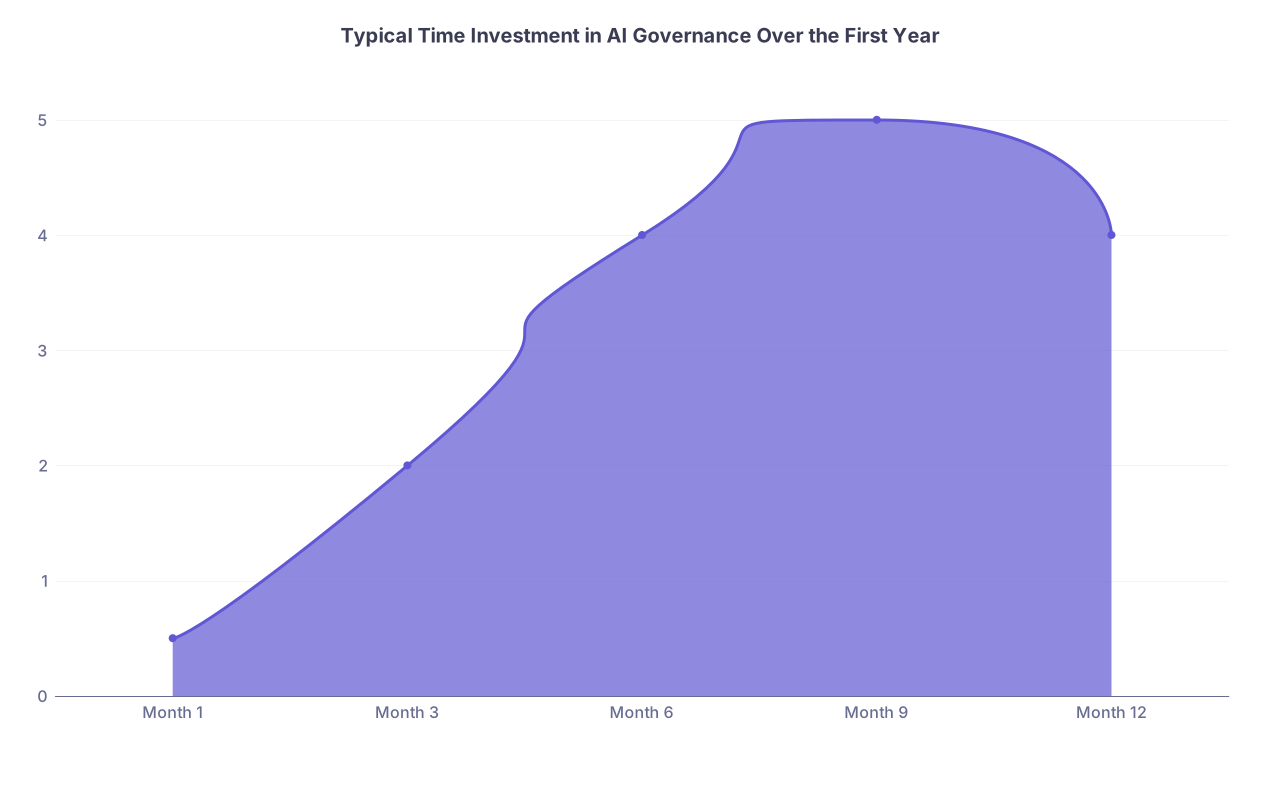
| Category | Value |
|---|---|
| Month 1 | 0.5 |
| Month 3 | 2 |
| Month 6 | 4 |
| Month 9 | 5 |
| Month 12 | 4 |
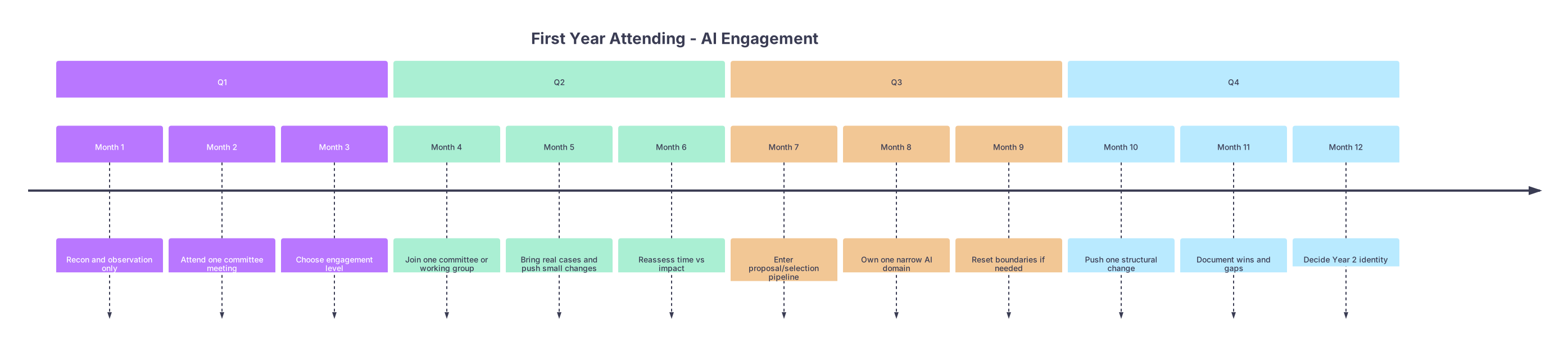
| Period | Event |
|---|---|
| Q1 - Month 1 | Recon and observation only |
| Q1 - Month 2 | Attend one committee meeting |
| Q1 - Month 3 | Choose engagement level |
| Q2 - Month 4 | Join one committee or working group |
| Q2 - Month 5 | Bring real cases and push small changes |
| Q2 - Month 6 | Reassess time vs impact |
| Q3 - Month 7 | Enter proposal/selection pipeline |
| Q3 - Month 8 | Own one narrow AI domain |
| Q3 - Month 9 | Reset boundaries if needed |
| Q4 - Month 10 | Push one structural change |
| Q4 - Month 11 | Document wins and gaps |
| Q4 - Month 12 | Decide Year 2 identity |



Three Things to Remember
- First three months: watch and map, don’t lead. Get oriented, figure out who actually controls AI, log real examples.
- Months 4–9: pick one lane and protect your time. Join one committee or working group, push specific changes, and avoid getting drafted into everything.
- End of year: choose your long-term role on purpose. Either become a serious AI governance voice with protected time, or stay a strategic clinician who shows up when it matters—but don’t drift into a job you never agreed to do.