
AI-heavy personal statements are starting to quietly kill applications.
Not because programs hate AI. Because they hate what your AI obsession usually reveals about you.
If you’re writing about artificial intelligence, machine learning, ChatGPT, or “the future of healthcare” in your personal statement, you are walking through a minefield. You can absolutely do it well. Most people don’t. And the red flags it throws up are very different from what applicants think.
Let me walk you through the specific mistakes that make program directors roll their eyes, close the PDF, and move on.
The Biggest Meta-Red Flag: When AI Becomes the Main Character
The fastest way to lose a program director’s trust is to write a “personal” statement that isn’t actually about you.
Here’s the trap:
- You’re excited about AI in healthcare.
- You’ve done a little (or a lot) of machine learning work.
- You think: “I’ll stand out by talking about the future of medicine.”
So your statement turns into:
- 50–70% about AI
- 20% about generic “transforming healthcare”
- 10% about you, vaguely
Programs read that and think:
- “Is this person applying to medicine…or to a tech incubator?”
- “Will they actually show up for 4 a.m. pages and weekend cross-cover?”
- “Or are they going to be disappointed when residency is mostly people, not Python?”
The core mistake: treating AI as your identity instead of as one tool in your toolkit.
If your statement reads like:
- “AI will revolutionize diagnosis and treatment…”
- “The future of healthcare lies in data-driven solutions…”
- “I am passionate about integrating AI into every aspect of clinical care…”
…but includes almost no:
- Specific patients
- Concrete clinical moments
- Evidence that you actually like caring for humans in real time
That’s a red flag. A big one.
Fix it:
- Anchor the essay in:
- A patient encounter
- A clinical problem
- A broken workflow you personally experienced
- Let AI come in as:
- A supporting actor
- A tool you’ve explored
- One lens you bring, not your entire personality
You’re not being hired as “Chief AI Visionary.” You’re being selected as a doctor-in-training who happens to understand AI.
Red Flag #1: Vague Tech Buzzwords With Zero Substance
Programs are exhausted by fluff. They’ve read the same AI paragraph 200 times this year.
The classics:
- “AI will transform the future of healthcare.”
- “Machine learning will allow earlier diagnoses and personalized treatments.”
- “Big data and predictive analytics will revolutionize patient care.”
This language tells them nothing. It signals familiarity with TED Talks, not with real problems.
What this telegraphs to programs
When they see pure buzzword salad, they infer:
- You probably haven’t actually built or implemented anything.
- You haven’t thought about:
- Bias
- Workflow fit
- Regulation
- Liability
- Data quality
- You want to sound forward-thinking, not be useful.
I’ve watched faculty literally read a paragraph like that, then mutter: “Okay, so they watched a YouTube video.”
How to avoid this
If you mention AI or ML at all, you must show:
- A concrete problem: “Our ED struggled to identify high-risk septic patients early enough…”
- A specific role you played: “I built a gradient-boosted model in Python using 20,000 de-identified ED visits…”
- A real limitation: “The model performed well in development but dropped sharply when tested at a different site, highlighting how brittle models can be when populations differ.”
If you can’t do that, cut the AI paragraph. It’s not helping you.
Red Flag #2: “I Want to Replace Doctors” Energy (Even If You Don’t Say It)
Programs get extremely nervous when your essay sounds like you secretly believe:
“Doctors are inefficient obstacles. AI will fix them.”
You may not intend that message, but certain phrases set off alarms:
- “AI can perform many diagnostic tasks better than physicians…”
- “Soon, much of what doctors do will be automated…”
- “AI will free physicians from mundane patient interaction…”
That last one? Absolute poison. I’ve seen versions of it. It lands terribly.
How this reads to attendings
Remember who’s reading this:
- People who have spent:
- 10–30 years taking call
- Nights in the ICU
- Weekends on wards
- People who feel the system is already devaluing face-to-face care
When you suggest:
- Doctors will be replaced
or - Direct patient care is “mundane”
They don’t think you’re visionary. They think:
- “This person doesn’t understand what good medicine is.”
- “They might cut corners in the name of ‘efficiency.’”
- “They don’t respect the human side of care.”
How to show you “get it”
You can talk about AI without insulting the job you’re applying for.
Better framing:
- “AI cannot replace the physician’s judgment, but it can augment pattern recognition in narrow tasks.”
- “My goal is not to automate decisions, but to support clinicians so they have more time for nuanced conversations.”
- “Working in clinic made me realize that any tool that ignores context, culture, and patient preference will fail—AI is no exception.”
Programs want to see that you understand:
- AI is a tool
- Medicine is a relationship
- You’re not confused about which is which
Red Flag #3: AI Hype With Zero Ethical Awareness
This one is a big, glaring red light.
You’re talking about:
- Early cancer detection
- Predicting suicide risk
- Automated triage
- Risk scores for readmission
But you completely ignore:
- Bias and inequity
- How false positives/negatives hurt real people
- Informed consent
- Data privacy
- Overdiagnosis and anxiety from “early” detection
That reads as naïve at best. Dangerous at worst.
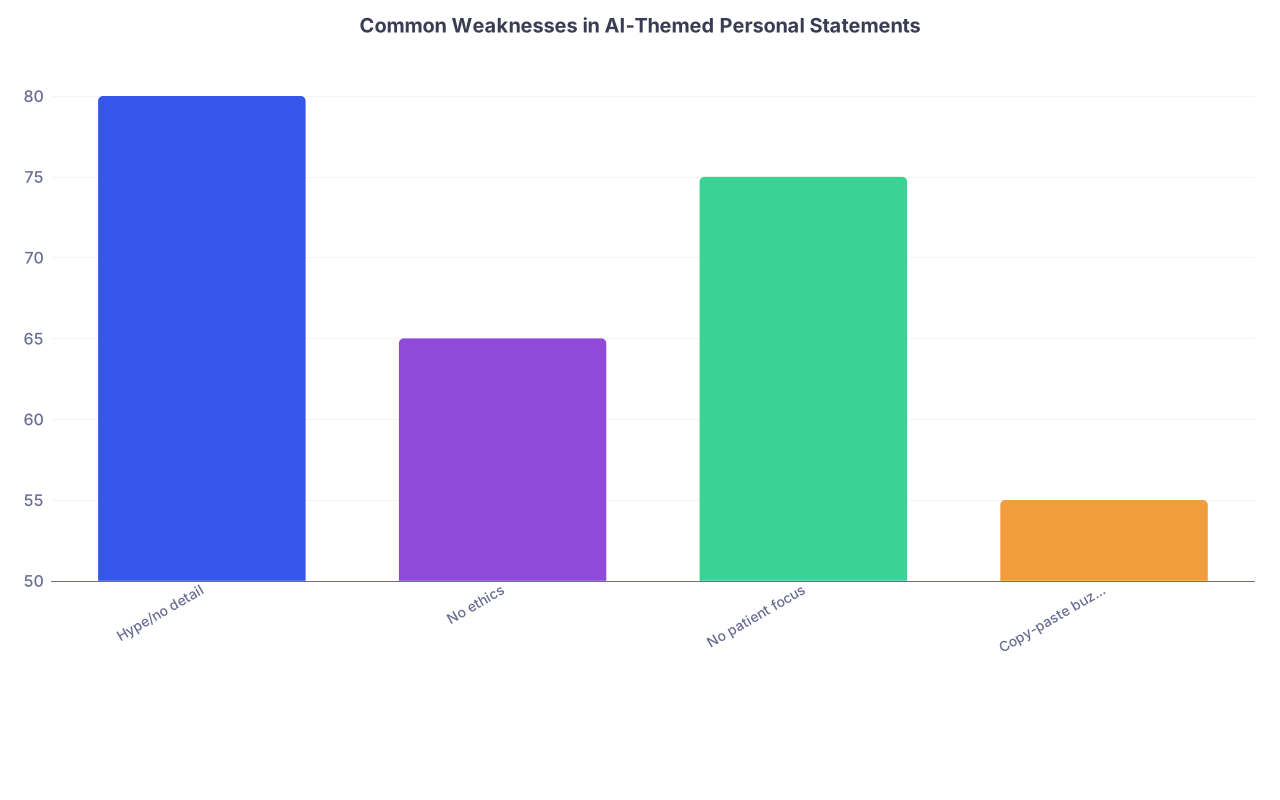
| Category | Value |
|---|---|
| Hype/no detail | 80 |
| No ethics | 65 |
| No patient focus | 75 |
| Copy-paste buzzwords | 55 |
I’ve seen very smart applicants proudly describe:
A model that flags patients at “high risk” of opioid misuse
with zero mention of:Stigma
Misclassification
Racial bias in training data
What happens when the model is wrong
Faculty reaction is predictable: “This person should not be anywhere near vulnerable patients with that mindset.”
How to fix this, concretely
You don’t need a PhD in ethics. You do need basic awareness. For any AI project you mention, ask:
- Who could be harmed if the model is wrong?
- Did the data reflect existing bias?
- How would you monitor real-world performance?
- What guardrails would you want in place?
Then write one or two sharp, specific sentences showing you’ve thought about it:
- “Our initial model under-predicted complications in non-English-speaking patients, forcing us to confront how language and access can distort EHR data.”
- “We chose not to deploy the model clinically because its false negative rate felt unacceptable for a triage tool.”
That tells programs: this person thinks like a clinician, not just a coder.
Red Flag #4: AI as an Excuse to Avoid the Hard Parts of Medicine
Some applicants accidentally reveal their real motive:
They’re not drawn to medicine. They’re trying to escape it by hiding behind AI.
You see it in statements that heavily emphasize:
- “I am most excited about working on tools rather than seeing patients directly.”
- “I hope to build systems so doctors won’t need to be so involved.”
- “My primary interest is in algorithm development; clinical practice will allow me to test models.”
Read that again from a PD’s perspective. You’re applying to a job that:
- Is 90–95% clinical work
for the next 3–7 years.
Not a fellowship in medical AI. Not a product manager role at a health-tech startup.
What they fear
Programs worry you will:
- Burn out fast when residency is not “AI-forward”
- Be disengaged on rounds
- Chase side projects instead of focusing on core skills
- Complain constantly that the hospital isn’t “innovative enough”
I’ve heard these exact comments in rank meetings:
- “I don’t think this person wants to be in the trenches.”
- “Feels like they’re using residency as a credential, not a calling.”
How to show balanced priorities
You can be honest about loving technology, but you must make this undeniable:
- You want to be a physician first
who happens to understand AI.
Stronger phrasing:
- “I see myself as a clinician who can speak both the language of the bedside and the data.”
- “Residency is where I hope to become an excellent internist; any AI work I do will only be valuable if that foundation is solid.”
If a reader finishes your essay unsure whether you actually like patient care—that’s your fault, and it’s fixable.
Red Flag #5: “ChatGPT Wrote This” Vibes
Let’s address the ugly truth: a lot of AI-themed statements sound…like AI wrote them.
Program directors, coordinators, and faculty are already talking about this. Behind closed doors.
Here’s what gives you away:
- Overly generic, glossy phrases:
- “I stand at the intersection of medicine and technology.”
- “My passion lies in leveraging cutting-edge tools to improve outcomes.”
- “From a young age I was fascinated by both biology and computers…”
- Repeated clichés:
- “Ever since I was a child…”
- “In today’s rapidly evolving healthcare landscape…”
- “We are on the brink of a revolution in medicine…”
If your whole essay could be repurposed with search/replace:
- “AI” → “global health”
or - “AI” → “rural medicine”
…it’s not specific enough. And it absolutely sounds like it came out of a model.
The deeper red flag
It’s not just about suspecting you used ChatGPT. Honestly, many faculty assume everyone used something for polishing.
The real red flag is:
- Lack of authentic details
- Lack of voice
- Lack of any sentence that only you could have written
They think:
- “If this is how they tell their own story, how will they present cases?”
- “Do they even know what they really want?”
How to avoid the “AI wrote this” stink
Do this check:
- Highlight every sentence in your AI paragraph.
- Ask: Could a large language model have generated this from a generic prompt?
- If yes, it’s too generic. Add:
- Specific institution names
- Clear numbers
- Real dataset sizes
- Actual outcomes (even if modest)
- Your emotional reaction, not just the technical part
Example of weak vs strong:
- Weak: “We used AI to predict readmissions and improve patient outcomes.”
- Strong: “Our LSTM model, trained on 8 years of de-identified discharge data from [Hospital X], flagged high-risk COPD patients. On review, one of ‘my’ flagged patients had been admitted 5 times in a year; seeing his name in the output forced me to connect code on my screen with the person I had watched struggle to breathe in clinic.”
Only you can write that second one. That’s what programs want.
Red Flag #6: Acting Like AI Solves Structural Problems
Another thing that quietly unnerves programs: tech-savior fantasies.
You position AI as a fix for:
- Broken insurance models
- Staffing shortages
- Poor pay for primary care
- Fragmented mental health care
- Social determinants of health
With lines like:
- “AI can ensure all patients receive equal care regardless of background.”
- “Algorithms will help eliminate disparities by standardizing decision-making.”
- “AI will dramatically reduce physician workload and burnout.”
The people reading this have:
- Fought insurance denials
- Watched patients decline because they couldn’t afford meds
- Seen how “standardized tools” sometimes worsen disparities
So when you imply that more tech = solved injustice, it sounds:
- Naïve
- Privileged
- Detached from actual clinical reality
A more credible approach
You don’t need to fix healthcare in 500 words. You need to show you respect its complexity.
Better framing:
- “AI alone cannot fix structural inequities. In fact, it often amplifies them if we’re not careful.”
- “Working at a safety-net clinic showed me that the biggest determinants of health for many of my patients were housing and food security; any tool that ignores that reality will feel irrelevant at best.”
- “I’m interested in how AI might support—not replace—community-based solutions.”
That tells programs you:
- Have touched real patients
- Understand medicine isn’t a Kaggle competition
- Won’t show up day one announcing you’ll “fix the system” with an app
Red Flag #7: No Evidence You Can Actually Do the AI Work You Describe
This one’s simple, but fatal:
You talk endlessly about AI
but your CV has:- Zero coding experience
- No related publications
- No projects
- No collaborations
Or:
- Your “AI research” is actually:
- Survey studies
- Opinion pieces
- Quality improvement projects with a buzzword-y title
Programs are not stupid. They see the mismatch immediately.
| Applicant Signal | How Programs Interpret It |
|---|---|
| AI in statement, no CV evidence | Hype, not substance |
| 1–2 concrete projects, no pubs | Curious and learning, promising |
| Abstract/poster at real meeting | Legit engagement |
| First-author methods-heavy paper | Serious technical chops |
This doesn’t mean you must be a hardcore coder to mention AI. But if you oversell yourself, programs will notice.
How to stay honest and strong
If your experience is light:
- Own it. Don’t pretend.
- Focus on:
- What you learned
- How it changed your clinical thinking
- What you’d like to explore next, realistically
Example:
- “My exposure to AI has been at the user level, working with a team of data scientists on a readmission tool. While I was not the primary programmer, I learned how model assumptions can fail when they meet the messiness of real-world data and human behavior.”
That’s honest. Programs respect that far more than inflated claims.
Integrating AI Into Your Statement Without Worrying Programs
If you’re serious about AI and medicine, you don’t need to hide it. You just need to avoid the landmines.
Use AI in your statement to:
- Show you understand real clinical problems.
- Demonstrate you can think in systems, tradeoffs, and ethics, not just algorithms.
- Highlight that you want to be a better clinician, not an armchair futurist.
Here’s a simple structure that tends to work:
- Start with a patient or clinical moment (not an app).
- Show how that experience made you see a recurring pattern or systems problem.
- Describe, briefly and concretely, how you explored solutions—some of which might involve AI.
- Admit limitations or failures of the tech approach.
- Close with:
- A reaffirmation of your commitment to clinical excellence.
- A realistic hope for contributing to better tools as one part of your career.
Add details. Remove buzzwords. Keep the humanity.

| Step | Description |
|---|---|
| Step 1 | Clinical Moment |
| Step 2 | Problem You Noticed |
| Step 3 | Your Action or Project |
| Step 4 | Describe Specific AI Use |
| Step 5 | Describe Non AI Approach |
| Step 6 | State Limits and Risks |
| Step 7 | Reaffirm Commitment to Patient Care |
| Step 8 | Did AI Play a Role |

FAQ (Exactly 4 Questions)
1. Is it safe to mention that I used ChatGPT to help draft or edit my personal statement?
Do not say this explicitly in your statement. Programs are already uneasy about authenticity. If you used tools for grammar or structure, the key is that the ideas, stories, and voice are genuinely yours. If the essay sounds like generic AI output, they’ll assume you leaned on it too heavily whether you admit it or not—and that’s the real problem.
2. Can I center my entire personal statement around my AI research?
You can, but you probably shouldn’t. If more than half the statement is about AI and less than half is about your growth as a clinician, your bedside experiences, and why you want to practice medicine, many programs will worry you’re using residency as a stepping stone to a tech career. Integrate AI as one major thread, not the whole fabric.
3. What if my AI project failed or didn’t get published—should I still mention it?
Yes, if you learned something meaningful that relates to how you think as a future physician. Programs are often more impressed by applicants who can explain why a model wasn’t ready for clinical use, or how they discovered hidden bias, than by another “promising results” story. Just be clear, specific, and honest about your role and outcomes.
4. Do programs actually care about AI skills, or will this hurt my chances?
Plenty of programs are interested in applicants who understand AI—but only as long as it’s layered on top of solid clinical motivation. AI won’t rescue a weak personal statement. It can enhance a strong one if you show grounded, ethical, patient-centered thinking. The risk isn’t in mentioning AI; the risk is in letting it overshadow your commitment to being a physician.
Remember:
- AI in your statement should clarify that you’ll be a better doctor, not cast doubt on whether you want to be one.
- Specifics, limits, and ethics beat hype, buzzwords, and grand predictions every single time.