
The fastest way to make physicians distrust your “AI experience” is to fill your application with AI buzzwords you barely understand.
You think it sounds cutting-edge. They think it sounds like LinkedIn cosplay.
I’m going to walk through seven AI buzzwords that are poisoning personal statements, CVs, and interview answers right now—and how to stop making yourself look naive, inflated, or frankly, ridiculous.
If you’re serious about the future of healthcare and AI, learn to talk about it like a clinician, not a pitch deck.
1. “Disruptive” (When You’ve Disrupted Absolutely Nothing)
This might be the most abused word in AI/healthcare right now.
“Disruptive AI solution for triaging patients.”
“Disruptive decision support tool to transform primary care.”
I’ve seen these lines in MS4 personal statements for projects that were… a glorified Excel sheet with a Python script.
Here’s how this goes in a selection committee room:
Attending 1: “Disruptive triage AI—what did they actually do?”
Attending 2: “Scroll down.”
[Sees: single poster, no deployment, no outcomes, no IRB, no users]
Attending 2: “Okay, so, nothing.”
The mistake is simple: you’re using venture-capital language in a clinical world that cares about patient outcomes, not buzz.
Physicians don’t want “disruption.” They want fewer missed MIs, fewer med errors, shorter wait times, and less charting that destroys their evenings. If your work doesn’t touch any of that in a measurable way, it’s not disruptive. It’s exploratory. That’s fine. Just say that.
Red flags you’re overhyping:
- No real users tested it
- No pre/post comparison or outcome data
- No deployment outside a sandbox or simulation
- You “designed the idea,” but engineers or data scientists did all the heavy lifting
What to say instead:
- “Prototype”
- “Exploratory model”
- “Pilot project”
- “Feasibility study”
- “Proof-of-concept”
You’ll sound more credible instantly. And you avoid the eye roll that comes with trying to sell disruption to people who already survived three broken EHR rollouts.
2. “Revolutionizing Healthcare” (In a Summer Project)
If I had a dollar for every sentence that starts with “I am passionate about revolutionizing healthcare with AI…”, I’d have my own startup fund.
You are not revolutionizing healthcare with:
- A Kaggle competition
- A 10-week summer internship
- A single retrospective chart review using XGBoost
That doesn’t mean your work is useless. It just means you need to stop positioning every AI thing you touched as The Future.
Physicians hear “revolutionize” and immediately ask:
- How does this integrate with the EHR?
- Who maintains it?
- What happens when it fails at 2 a.m.?
- Who’s liable if it misguides a resident?
If you have no answers, your “revolution” sounds like a student side quest with no clinical reality.
The real danger: you make it clear you don’t understand what adoption looks like in healthcare. You’re signaling immaturity about systems, regulation, and risk.
Better framing:
- “Improving efficiency”
- “Reducing documentation burden”
- “Supporting early detection”
- “Augmenting decision-making”
Notice the difference: these are specific, bounded goals that fit into how clinicians think. No grandiose revolution needed.
3. “AI-Powered” (When It’s Really Just Rules + Google)
“AI-powered” is the duct tape label people slap on anything with an algorithm.
I’ve seen “AI-powered” used for:
- A simple rules engine that sends alerts when vitals cross a threshold
- A web scraper that pulls guidelines and formats them
- A chat interface that uses a static FAQ database
If your “AI-powered” project could be explained as “if X then Y” logic, every physician who’s used an EHR alert system will see right through you.
The mistake: you’re using “AI-powered” as a magic spell, not a technical description.
You’re not fooling the people who:
- Have heard 15 vendors claim “AI-powered charting”
- Know that most CDS tools are glorified rule engines
- Are already skeptical of anything that adds more buttons or alerts
If you really used AI/ML, you should be able to mention:
- The type of model (logistic regression, random forest, CNN, transformer, etc.)
- The input data (structured? imaging? text? wearable data?)
- Performance metrics (AUC, sensitivity/specificity, etc.)
If you can’t say any of that, drop “AI-powered” and describe what it actually does.
What to do instead:
- Say “automated triage rules” instead of “AI-powered triage”
- Say “natural language processing model” instead of “AI that reads notes”
- Say “machine learning risk prediction model” if it truly is one
Stop hiding behind vague labels. Be concrete. Clinicians trust specifics; they tune out hype.
4. “ChatGPT-Like” or “LLM-Based” With Zero Guardrails
Everyone wants to say they “built a ChatGPT-like tool for clinicians.”
Most of them… absolutely did not.
The lazy version:
- You slapped a front-end UI onto an API call to a large language model
- No prompt engineering beyond “You are a helpful medical assistant”
- No safety constraints
- No alignment with actual guidelines
- No evaluation other than “it seemed pretty good”
Then you write: “We developed a ChatGPT-like AI assistant for clinical decision-making.”
This makes physicians nervous for two reasons:
- Hallucinations. They’ve already seen LLMs produce convincing nonsense.
- Liability. The idea that a med student is casually building tools that “assist in decision-making” with no governance is terrifying.
And yes, they know most of the “LLM for medicine” prototypes right now are half-baked.
If you used an LLM, talk about:
- Guardrails: “We constrained outputs to summarize existing guidelines rather than generate novel treatment plans.”
- Scope: “Educational use only, not deployed clinically.”
- Evaluation: “We compared LLM answers to UpToDate or board-review questions and tracked error rates.”
Here’s what you should not do:
- Claim it “helps doctors make decisions” when no doctor has touched it
- Call it “safe” without any formal testing or QA
- Pretend wiring up an API equates to deep AI expertise
Better language:
- “Prototype interface using a large language model to summarize literature”
- “Educational assistant that reformats guideline content for learners”
- “Experimental tool—tested only in simulated cases, not clinical practice”
Own the limits. Physicians respect that more than chest-thumping.
5. “Predictive Analytics” With No Outcome, No Impact
“Predictive analytics” sounds sophisticated. Often it just means: “We made a model that predicts something… and then stopped.”
I’ve seen applications brag about:
- Predicting length of stay
- Predicting readmission
- Predicting sepsis risk
Then, when asked: “And what did you do with that prediction?”
Silence.
The mistake: you’re acting like prediction itself is the endpoint. Clinicians know prediction is just step one. If it doesn’t change decisions or outcomes, it’s academic theater.
Common sins:
- No baseline comparison to current practice
- No thought about alert fatigue, thresholds, or workflow
- No evaluation of false positives/negatives in terms of real harms
- No focus on who, exactly, would use it and when
You trigger eye rolls when you say things like:
- “Our model achieved an AUC of 0.86,” full stop
- “This could really help doctors” with no specifics
- “This will reduce readmissions” without a single implementation plan
If you’re going to talk predictive analytics:
- Mention performance AND what that performance means (“At 80% sensitivity we had 25% PPV, which may be too low for a real sepsis alert without better risk stratification.”)
- Mention workflow (“We envisioned this feeding into an existing nursing early warning score rather than a new alert.”)
- Admit it’s not deployed (“This stayed at the retrospective, research-only stage.”)
That level of honesty signals maturity and understanding of real clinical systems.
6. “Ethical AI” With No Concrete Trade-Offs
“Ethical AI” has become a shield word. People use it to sound morally serious without doing any serious work.
On applications, I see lines like:
- “I’m passionate about building ethical AI tools for healthcare.”
- “Our project focused on developing fair and responsible AI.”
Then you ask:
- Did you check model performance by race, gender, language, insurance status?
- Did you look at who gets more false negatives (or false positives)?
- Did you adjust the model or at least describe the bias?
Often: no. But they still wrote “ethical AI” because they had one slide on “bias” in their presentation.
Physicians are not impressed by slogans. They’re worried about:
- A model that under-diagnoses sepsis in non-English speakers
- A risk tool that deprioritizes low-income patients
- A triage algorithm that hides behind “the computer says so”
If you’re going to say “ethical AI,” you’d better show:
- What metrics you used for fairness (e.g., equal opportunity, calibration across subgroups)
- What disparities you actually found
- What trade-offs you made (“We accepted slightly lower overall accuracy to reduce disparity in sensitivity between groups.”)
At minimum, state where you fell short:
- “We didn’t have enough sample size to rigorously evaluate subgroup performance, which is a major limitation.”
- “We didn’t have access to race/ethnicity data, so we couldn’t examine that axis of bias.”
That honesty beats pretending you solved AI ethics in a hackathon.
7. “Autonomous” and “Decision-Making” (Liability Traps)
Nothing makes physicians’ eyebrows shoot up faster than students casually throwing around:
- “Autonomous diagnostic tool”
- “AI that makes treatment decisions”
- “Automated decision-making engine for clinical care”
Physicians live in a world where:
- They get sued, not the algorithm
- Regulation is tightening (FDA, EU AI Act, etc.)
- They’re already skeptical of black-box tools
When you call anything “autonomous” in medicine, you set off a chain reaction of questions:
- Who oversees it?
- Can clinicians override it?
- What happens when it’s wrong?
- Is this approved, validated, or just a concept?
Most student projects aren’t autonomous at all. They’re decision support. Or, more honestly, “a tool we hope someone will someday test in the real world.”
And “decision-making” is another landmine. Unless your tool literally orders the CT scan or writes the prescription, it’s not making decisions. It’s suggesting, ranking, flagging, summarizing.
Use language like:
- “Decision support”
- “Prioritization”
- “Risk stratification”
- “Triage aid”
Not:
- “Autonomous diagnosis”
- “AI that decides treatment”
- “Fully automated care decisions”
There are a few true edge cases (e.g., FDA-approved autonomous diabetic retinopathy screening), but unless you were on one of those teams, don’t pretend you built Skynet for sepsis.
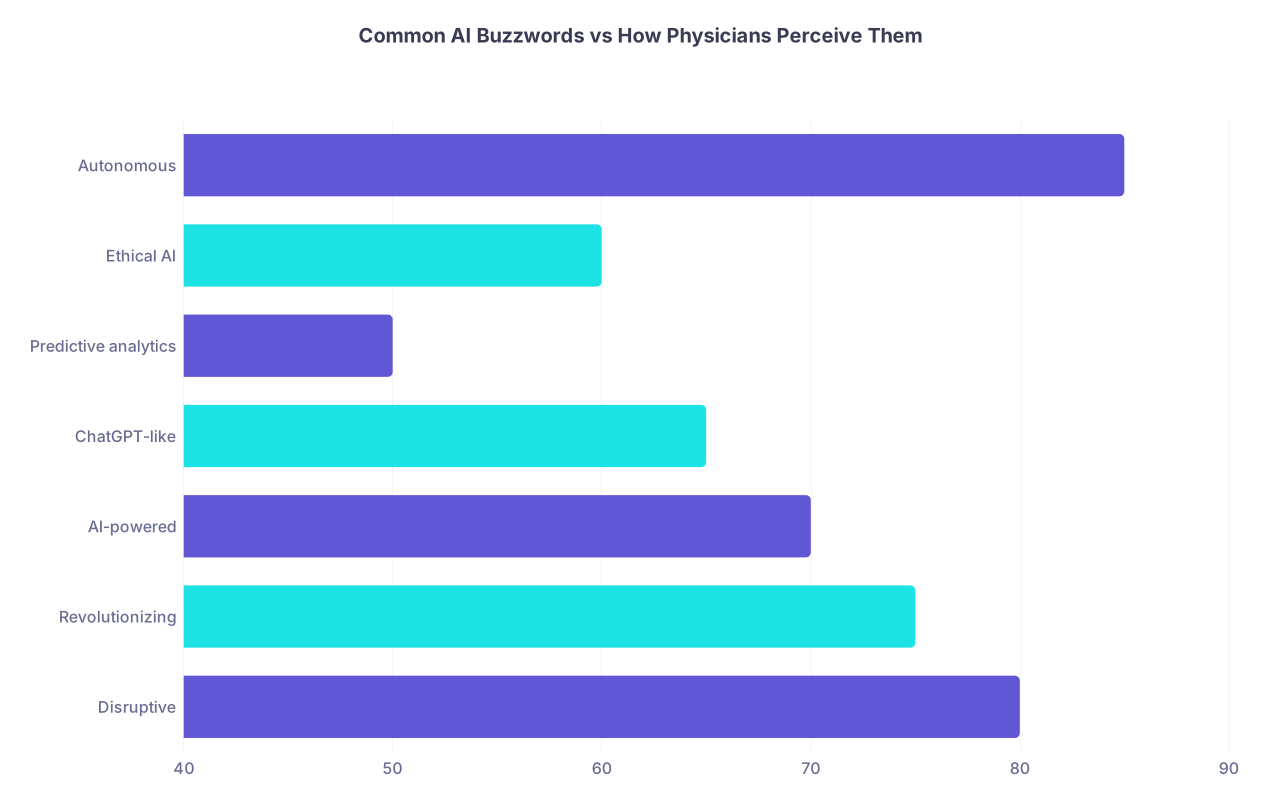
| Category | Value |
|---|---|
| Disruptive | 80 |
| Revolutionizing | 75 |
| AI-powered | 70 |
| ChatGPT-like | 65 |
| Predictive analytics | 50 |
| Ethical AI | 60 |
| Autonomous | 85 |
(Values represent approximate “eye-roll intensity” on a 0–100 scale from typical attending reactions.)
The Quiet Ways You Signal You Don’t Understand AI in Healthcare
Even beyond the explicit buzzwords, there are subtler mistakes that set off alarms for physicians reading about your “AI experience.”
You never mention data quality
If you talk about your model and never mention:
- Missing data
- Label quality
- Noisy documentation
- Garbage in, garbage out
You’re signaling textbook-level understanding, not real-world.
You ignore integration and workflow
A line like: “Doctors can just use this during clinic” is code for “I’ve never watched a real clinic day.”
Someone who understands the environment will say things like:
- “We designed this to run in the background and only surface high-risk cases.”
- “We limited notifications to once per encounter to reduce alert fatigue.”
- “We prototyped an EHR-integrated version that surfaces within the existing patient chart.”
You never say what didn’t work
Every credible AI project has:
- Dead ends
- Models that underperformed
- Failure modes that worried you
- Use cases you explicitly decided against
If your description is 100% glowing success, it reads like marketing, not medicine.
| Buzzword | Better Phrasing |
|---|---|
| Disruptive | Prototype / Pilot / Proof-of-concept |
| Revolutionizing | Improving / Streamlining / Supporting |
| AI-powered | Rules engine / ML model / NLP system |
| ChatGPT-like | LLM-based summarization / Q&A prototype |
| Predictive | Risk stratification model (retrospective) |
| Ethical AI | Fairness analysis of model performance |
| Autonomous | Decision support / Triage aid |

| Step | Description |
|---|---|
| Step 1 | AI Project Experience |
| Step 2 | Describe as prototype or research only |
| Step 3 | Explain deployment and oversight |
| Step 4 | Be specific about model and data |
| Step 5 | Describe methods and trade offs |
| Step 6 | Acknowledge as limitation |
| Step 7 | Use cautious, concrete language |
| Step 8 | Did it impact real patients? |
| Step 9 | Any fairness or bias checks? |
How to Talk About AI in a Way Physicians Actually Respect
If you want to stand out—in a good way—stop parroting buzzwords and start sounding like someone who understands both medicine and technology.
Here’s how you do that.
Be precise
Don’t say “AI app.” Say “gradient-boosted model predicting 30-day readmission using demographics, comorbidities, and prior utilization data.” Short, clear, specific.Be honest about stage
- “Retrospective only, no clinical deployment.”
- “Simulation-tested but not used in live care.”
- “Implemented in one clinic as a limited pilot with attending oversight.”
Acknowledge limitations
- “We lacked external validation in a different health system.”
- “We didn’t evaluate performance in non-English speakers, which is a major gap.”
- “We didn’t integrate with the EHR; this remained a standalone prototype.”
Connect to real clinical pain points
Physicians perk up when you show you understand:- Documentation overload
- Missed follow-ups
- Delays in diagnostics
- Burnout from pointless alerts
If your AI work tries—honestly—to chip away at any of these, say so plainly.
Drop the hero narrative
You are not “leading the AI revolution.” You’re doing early-career work in a messy, evolving space. That’s perfectly respectable. Frame yourself as someone curious, careful, and clinically grounded, not as the savior of healthcare.

The Bottom Line: Buzzwords vs. Credibility
Three things to walk away with:
- Overhyped AI language makes experienced physicians roll their eyes and doubt your judgment, not admire your ambition.
- Specific, honest, technically grounded descriptions of what you actually built or studied will always beat “disruptive AI revolutionizing healthcare.”
- If you respect the complexity of clinical work—workflow, safety, bias, regulation—and your language reflects that, your AI interest becomes an asset instead of a red flag.