Last month, a surgery PD pulled me aside after sign-out and said, “If one more intern tells me about a new app we ‘have to’ use, I’m going to throw their iPad out the window.”
Two days later, an IM PD at a different hospital proudly showed me a PGY‑2’s self-built dashboard that cut their average discharge time by almost an hour. Same type of resident. Completely different reaction.
You’re walking into a profession that’s being rebuilt in real time—EHRs, AI tools, remote monitoring, automation. And your comfort with tech can make you a PD’s favorite…or their biggest headache.
Let’s talk about why.
The Quiet Divide: Two Types of Program Directors
There’s a split nobody advertises on recruitment day. On paper, every program says they “embrace innovation” and “value technological literacy.” Behind closed doors? The conversations are very different.
Roughly speaking, you’ve got two camps.
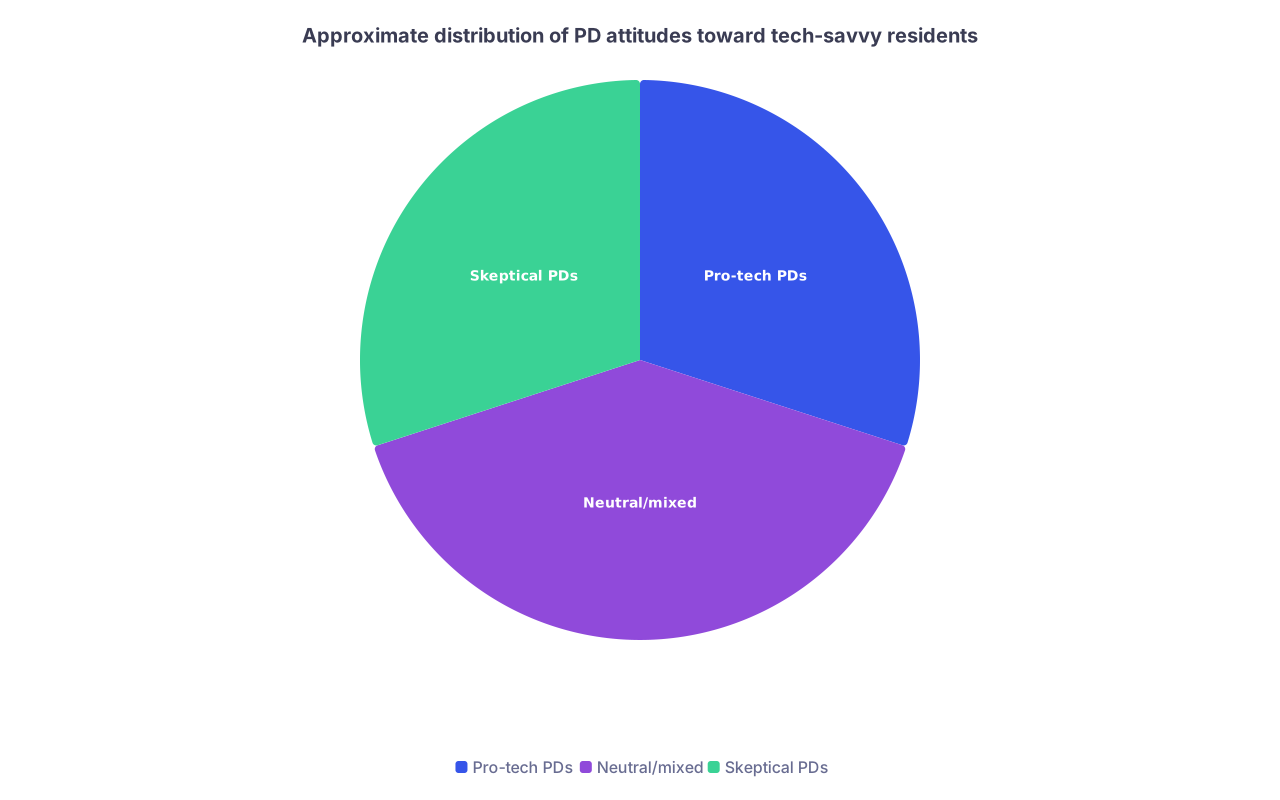
| Category | Value |
|---|---|
| Pro-tech PDs | 30 |
| Neutral/mixed | 40 |
| Skeptical PDs | 30 |
Camp 1: The Builders
These are the PDs who:
- Sit on the hospital’s “digital transformation” committee
- Actually know what an API is
- Brag about “our residents built this tool…”
They see tech‑savvy residents as multipliers. Cheap, motivated, semi-exploitable multipliers, frankly. They know IT moves at glacial speed and consultants cost a fortune. A resident who can tame Epic’s reporting system, clean up a bloated handoff template, or script a small automation? That’s gold.
I’ve seen these PDs nudge rank lists up for candidates who:
- Talk intelligently about data, QI, or informatics
- Have done projects involving EHR optimization, dashboards, or simple tools
- Show they can translate tech into real workflow improvements
They’ll never say, “We ranked her higher because she can code.” But you hear the side comments in the ranking meeting:
“She built a note template that cut note time by 30% for her whole team.”
“This guy basically fixed our M&M tracking process at his med school with a simple script.”
That matters.
Camp 2: The Defenders
At the other end, you’ve got PDs who see tech as an invading army. They’ve watched EHR rollouts double their documentation time, seen third‑party “solutions” make everything worse, and are tired of chasing down “workarounds” that break compliance.
They are not anti-technology in theory. They’re anti-chaos.
To them, tech‑savvy residents are a risk vector:
- More likely to introduce non-approved tools
- More likely to push changes that bypass governance
- More likely to challenge “this is how we do it” with “but we could automate this”
One PD I know in a solid midwestern IM program said this verbatim in a closed meeting:
“I don’t need another intern telling me what FHIR is. I need someone who can get 12 discharges out before noon.”
That’s the axis they care about: throughput and reliability, not innovation.
What “Tech-Savvy” Looks Like From the PD Side
You think “tech-savvy” means you’re good with tools. PDs don’t see it that cleanly. They look for patterns in behavior.

The Tech-Savvy Resident PDs Love
Here’s the archetype PDs in Camp 1 fight to keep:
- Knows the primary job is patient care and documentation. Everything else is layered on top.
- Learns the EHR deeply: smart phrases, order sets, filters, custom views. Not just complaining.
- Brings problems and solutions: “Our handoff errors increased 20% last month. I built a structured template and tested it on nights for two weeks—here’s the data.”
- Respects governance. Asks IT or compliance before connecting third‑party tools.
- Can speak both languages: understands a bit of data structure but can also talk to non-tech attendings without jargon.
A PD once told me about a PGY‑2 who quietly became indispensable:
“He didn’t brag. He’d sit with the new interns, show them three keyboard shortcuts, two smart phrases, and one way to pull labs faster. Suddenly their notes were closing earlier. That’s the tech‑savvy I want.”
That resident later got funneled into a chief year, then a cushy hybrid clinical‑informatics role.
The Tech-Savvy Resident PDs Fear
Now the flip side. This is where your “skill” gets you quietly written off.
- Constantly pitching new apps instead of mastering the existing system
- Using non-approved cloud tools or personal devices for PHI because “it’s more efficient”
- Treating hospital IT staff like idiots
- Disappearing into “projects” while co-residents cover the basic work
- Publicly trashing the EHR or leadership on social media
Every PD has a story. Here’s one.
A PGY‑1 on nights started using a personal note‑taking app synced to his own cloud account. He argued it made cross‑cover more efficient. It also left fragments of PHI in a non-compliant environment. Risk management got involved. The PD had to clean it up.
That resident became “the guy we have to keep an eye on with tech.” His reputation never fully recovered.
From that PD’s mouth to me over coffee:
“I do not have the time or energy to deal with clever cowboys.”
Why Some PDs Light Up When They See Tech Skills
Now, let me tell you what’s actually changing under the surface.
Hospitals are under obscene pressure: value-based care, quality metrics, readmission penalties, staffing shortages. Data and tech are the only way they survive this without burning everyone out even further.
The PDs who understand this see tech‑skilled residents as force multipliers in three explicit ways.
1. They Can Hit the Metrics That Protect the Program
Residency programs live and die on a handful of things:
- Board pass rates
- ACGME milestones
- Clinical productivity
- Quality and safety metrics
- Resident satisfaction and burnout scores
Tech‑savvy residents can quietly boost all of those.
I’ve seen residents:
- Build a simple dashboard using existing Epic reporting that helped track pending labs and imaging, cutting LOS for a subset of patients
- Standardize a discharge summary smart phrase that improved documentation completeness, which in turn improved coding and reimbursement
- Create a simple, approved script to auto-generate skeleton notes for repetitive consults, saving hours per week
None of this shows up in the glossy brochure. But when PDs talk amongst themselves, they mention names:
“She built the sepsis alert workflow that actually worked for our unit.”
“He rewired our M&M data collection so we finally have reliable trends.”
That’s career-defining.
2. They Make Teaching and Admin Easier
Academic programs drown in manual admin. Evaluations, case logs, conference attendance, scheduling, procedure tracking. It’s a mess.
I watched one anesthesia resident set up a tiny web form (approved, behind the firewall) that fed directly into a spreadsheet for airway cases. Before that, everyone was emailing random case logs.
PD’s comment later:
“He saved my coordinator 10 hours a month. Do you think I wrote that in his letter? Of course I did.”
This is where you quietly become “the go-to resident” for the PD and coordinator. And once you’re in that inner circle, you get opportunities others never even hear about—committee spots, pilot projects, introductions to system-level leaders.
3. They Future-Proof the Program
Programs are judged not just by what they are, but what they’re becoming. When a PD can say to the GME committee:
- “We have an informatics pathway that residents actually use.”
- “Our residents presented a tech-enabled QI project at a national meeting.”
- “We co-authored a paper on AI decision support implementation.”
…that program looks forward‑thinking, competitive, fundable. Tech‑savvy residents are the engine behind that story most of the time.
Why Other PDs Flinch When You Lead With Tech
Let’s talk about why the other camp reacts badly to the exact same resident.
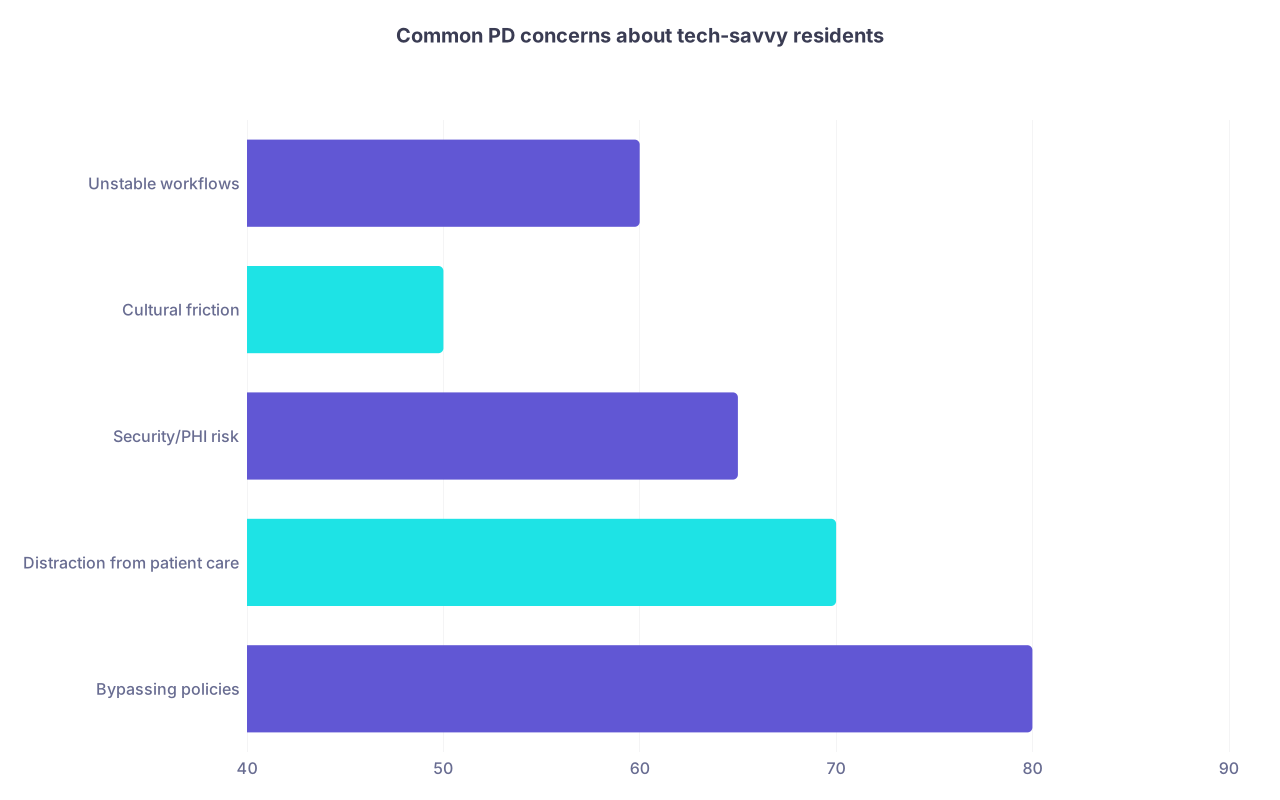
| Category | Value |
|---|---|
| Bypassing policies | 80 |
| Distraction from patient care | 70 |
| Security/PHI risk | 65 |
| Cultural friction | 50 |
| Unstable workflows | 60 |
1. They Remember the Last Disaster
Almost every skeptical PD has a scar:
- A resident used a third‑party messaging app for clinical communication → HIPAA incident
- Someone “optimized” an order set without understanding downstream billing → chaos
- A resident built a homegrown handoff tool that broke when IT updated something → near-miss on a critical patient
Once a PD has lived through one of those, their risk tolerance drops to zero. When you say “I built a tool that…”, they hear “potential sentinel event in six months.”
2. They Associate Tech With Complaints, Not Solutions
Some residents hide behind “tech awareness” to avoid the boring parts of the job. Instead of learning how to efficiently pre-round, they rant about EHR usability. Instead of reading about disease management, they deep dive into med‑Twitter arguments about AI.
Older‑school PDs see that and roll their eyes.
One internal monologue I’ve heard, almost word for word:
“If he spent half as much time learning how to write a clean note as he does talking about large language models, he’d be our top resident.”
Fair or not, that perception sticks.
3. They Don’t Trust Residents as System Designers
There’s a hierarchy here nobody says out loud. Attendings think in terms of service lines, medico-legal liability, hospital finances. Residents live much closer to the ground.
So when a resident says, “We should completely change the way we admit chest pain patients, and I built a form to do it,” a certain type of PD thinks:
- You don’t see the whole chessboard
- You haven’t been sued yet
- You’re underestimating how many stakeholders need to sign off
They’d rather have “boring but reliable” than “brilliant but destabilizing.”
How to Be the Tech-Savvy Resident PDs Actually Want
This is the part nobody teaches you in med school. There’s a way to play this so that both camps of PDs end up liking you, or at least not fearing you.

| Step | Description |
|---|---|
| Step 1 | Intern with tech skills |
| Step 2 | Master basic clinical work |
| Step 3 | Focus on reliability |
| Step 4 | Small workflow fixes |
| Step 5 | Get PD or chief buy-in |
| Step 6 | Run small pilots |
| Step 7 | Collect data and feedback |
| Step 8 | Scale with IT support |
| Step 9 | Trusted by co-residents? |
Rule 1: Earn “Clinically Solid” Before “Technically Brilliant”
If you’re not above-average clinically and reliable on the wards, your tech skills will be seen as a distraction at best, a liability at worst.
That means:
- Notes done on time
- Patients actually know your name
- Nurses trust you to respond
- Your sign-outs are clean
Once you have that reputation—“She’s good, I don’t worry when she’s on call”—then your tech suggestions get heard very differently.
One PD told me flatly:
“If you’re not in the top half of the class clinically, I don’t care what app you built.”
Rule 2: Start Microscopically Small
Don’t walk in as a PGY‑1 trying to redesign the entire inpatient workflow. That screams naive.
Start with:
- A better smart phrase for admission H&Ps
- A small tweak to the sign-out template after discussion with the team
- A one-click way to pull common labs into your note
Then share it quietly with your co-residents. If they love it and it clearly improves things without side effects, then bring it to chiefs or PDs.
The playbook looks like this:
- Identify one pain point everyone complains about.
- Build a low-risk, reversible improvement inside the existing system.
- Pilot it with a small, friendly group.
- Collect before-and-after data if you can (time saved, errors reduced).
- Present it as, “Here’s what we tried, here’s what worked, here’s what didn’t. Want to scale it?”
That’s how you become the resident whose ideas actually get adopted rather than shut down.
Rule 3: Respect the Governance, Even If It’s Slow
Never, and I mean never, move clinical data outside approved channels because “IT is too slow” or “this is just temporary.”
You don’t see the number of complaints, investigations, and audits your PD deals with in a given year. They are constantly one incident away from GME, risk management, or the Dean breathing down their neck.
So your line is simple:
- No PHI in personal tools
- No shadow databases on your laptop
- No backdoor integrations without explicit clearance
You want to build something meaningful? Get yourself onto a QI committee, an informatics workgroup, or a small pilot project that already has IT and compliance on board.
Where This Is All Headed: Tech-Savvy Residents as the New Default
Let me give you the uncomfortable truth: in 10–15 years, the “tech‑savvy” label will disappear. It’ll just be called “being a competent physician.”
| Residency Start Year | Baseline Tech Expectation | Advanced/Bonus Skill |
|---|---|---|
| 2010–2015 | Basic EHR use | Custom templates, macros |
| 2020 | Efficient EHR + data awareness | Simple dashboards, QI tools |
| 2025 | EHR power user + comfort with AI tools | Leading digital QI or informatics projects |
| 2030+ | Seamless integration of clinical + digital workflows | Program-level innovation and system redesign |
Hospitals are already:
- Embedding AI triage and decision support
- Moving more monitoring to remote, digital platforms
- Expecting clinicians to use data transparently with patients
- Experimenting with ambient scribe tech and voice-driven charting
PDs know this. The pro-tech ones are trying to get ahead of it. The skeptical ones are just trying to survive the transition without destroying their residents and staff.
If you position yourself correctly—solid clinically, disciplined with tech, quietly effective—you become exactly what both sides need: a bridge.
The resident who can:
- Take care of patients safely
- Work efficiently inside the messy EHR reality
- See where technology actually helps instead of just sounding cool
- Translate between frontline pain points and system-level solutions
Those are the people who end up with the opportunities that don’t show up on any official posting: early leadership roles, hybrid clinical‑informatics jobs, sponsored fellowships, funded QI projects.
And yes, those are the residents PDs quietly fight to keep and happily recommend.