It’s late January. You’re on a busy Sub-I, hiding in a call room between pages, scrolling through your own ERAS draft like it’s someone else’s chart. Under “Research Experience” you’ve got that shiny line: “Deep learning model for sepsis prediction using EHR data – submitted to [journal].”
Your classmates keep saying, “PDs love AI now.” Twitter is full of residents flexing about LLMs and radiology. You’re wondering: is this actually helping me, or do program directors roll their eyes the second they see “machine learning” on a med student’s CV?
Let me tell you what really happens in those rooms when your “AI research” shows up on the screen.
The First Reaction: Curiosity… with a Raised Eyebrow
There’s been a shift the last 3–4 years. Before 2019, “AI” on a med student CV was rare and usually real—some legit data science or informatics work. Now, it’s everywhere. And PDs know it.
In multiple rank meetings, I’ve watched this exact sequence:
- Coordinator opens the app.
- PD scrolls to research.
- Sees: “Machine learning model to predict readmission”
- Pauses. Literally leans in. Then:
“Okay, is this real or another buzzword project?”
That’s the baseline now. AI on a CV triggers two things simultaneously:
- Mild interest. Because they know this is the direction medicine is heading.
- Mild skepticism. Because they’ve seen a lot of very thin, very inflated “AI research.”
If you think “AI” automatically boosts you, you’re already behind. It’s a filter, not an automatic plus. If it looks substantive, it can help. If it looks like fluff, it actually hurts.
How PDs Sort AI Research in Their Heads
Most PDs don’t sit there formally scoring your work with some rubric. They pattern-match. Quickly. I’ve watched it happen across IM, neurology, EM, rads, even primary care–heavy programs.
In their heads, your AI project falls into one of a few buckets.
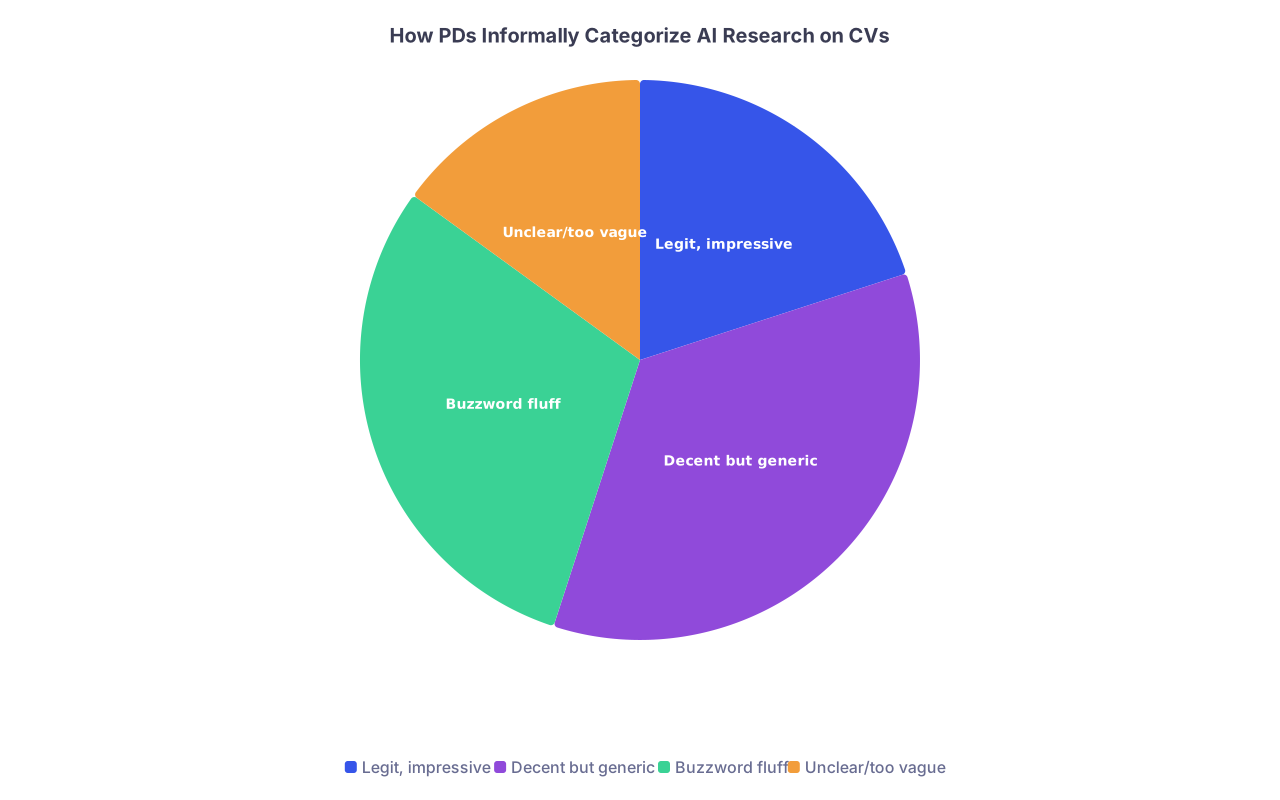
| Category | Value |
|---|---|
| Legit, impressive | 20 |
| Decent but generic | 35 |
| Buzzword fluff | 30 |
| Unclear/too vague | 15 |
Bucket 1: Legit, impressive
This is the minority. But when they see it, they notice.
Typical markers:
- Clear clinical question. Not “we did AI,” but “we predicted x to improve y.”
- Concrete methods that sound like you actually wrote or ran code (or at least did serious data work).
- Tangible output: accepted paper, preprint with your name in a meaningful position, GitHub, conference poster at a real venue (RSNA, NeurIPS workshop, AMIA, etc.).
When PDs see this, the reaction is something like: “Okay, this person can actually handle complex data and projects. That’s probably a resident who can adapt to where medicine is going.”
You do not need to be first author in Nature Medicine. But the project needs to feel real, anchored, finished or close to it.
Bucket 2: Decent but generic
This is most AI research on med student applications.
Something like:
“Retrospective EHR study using logistic regression and random forest to predict ICU mortality. Poster at local research day. Third author.”
To a PD, this says:
- You got exposure.
- You can work in a research team.
- You’re not an expert, but you’ve seen these tools.
They won’t rank you higher purely for this. But it rounds out the “this person can think with data” narrative. It’s a soft positive if the rest of your app is consistent (other research, QI, decent Step 2, etc.).
Bucket 3: Buzzword fluff
This is where a lot of people get burned.
Signals that trigger an internal eye roll:
- Vague one-liners: “Worked on AI to improve healthcare outcomes.” That’s it. No what, no how, no where.
- No output whatsoever, but big framing: “Pioneering AI tools for precision medicine.” As an MS3 who joined a project two months ago.
- Titles that scream marketing: “Revolutionizing emergency triage using next-generation deep learning.” And then the description reveals you mainly helped with chart review.
PD reaction: “Overinflated. Either this person doesn’t understand what they did, or they’re overselling.”
You’ve now signaled something you really do not want tagged to your name: overhype and lack of substance.
Bucket 4: Unclear / too vague to judge
Sometimes the PD can’t even tell what you did. Example: “AI-based tool to analyze imaging.” No model type, no modality, no disease, no your role.
They won’t assume it’s good. They’ll just move on. It becomes noise.
The Hidden Question: “Can I talk to you about this for five minutes?”
Here’s the piece no one tells you: PDs care less about the topic than about your ability to discuss it like an adult who actually worked on it.
On Zoom or in-person interviews, if you list AI research, expect at least one of these:
- “So tell me about the AI project on your CV.”
- “What exactly was your role?”
- “How do you see tools like that changing this specialty?”
- “What did you actually learn from that work?”
You don’t need to start reciting derivations of backprop. But you must be able to do three things calmly, clearly, without bluffing:
- Explain the clinical problem. In plain language. Why it matters.
- Describe the basic model and data: classification? prediction? imaging? EHR? number of patients? retrospective vs prospective.
- State your role: coding, data cleaning, labeling, chart review, literature review, writing, prototyping.
And then answer 1–2 follow-ups that show you actually understand limitations: bias, generalizability, false positives, poor documentation, label quality, how this would fit into workflow.
When an applicant can do that with ease, PDs think: “Okay, that line on the CV is real.”
When they can’t—when they say things like “I mostly helped out” and crumble beyond that—PDs flag it. I’ve literally heard, post-interview: “She sold that AI thing pretty hard on paper, but had no clue what was going on. That worries me.”
You’d be better off downplaying the project than over-selling and then face-planting in the discussion.
The Specialty Matters More Than You Think
Different fields are at different levels of AI saturation. And PDs’ expectations track that.
| Specialty | General Attitude Toward AI Research | Impact if Legit | Risk if Fluffy |
|---|---|---|---|
| Radiology | Very interested | High | High |
| Pathology | Very interested | High | High |
| IM / Cards / Pulm | Moderately interested | Moderate | Moderate |
| Neurology / EM | Growing interest | Moderate | Moderate |
| Surgery | Mixed, depends on program | Low–Moderate | Low–Moderate |
| Psych / FM / Peds | Variable, more skeptical of hype | Situational | Low |
Radiology PDs:
They’ve been hit with AI marketing for a decade. They’ve seen all the “X-ray algorithm beats radiologist” headlines. A rads PD is far more likely to dig into your AI work.
If you apply to rads and say you did “deep learning on chest imaging,” expect them to ask about:
- What architecture (at least CNN vs something else).
- What labels.
- How you dealt with label noise or class imbalance.
- How it compares to existing tools.
If you can answer at a reasonable level for a med student, that’s a big plus. If you can’t—they will absolutely downgrade you. In competitive rads programs, I’ve watched “impressive-sounding AI” turn into a liability during discussion because the applicant clearly didn’t grasp the project.
IM PDs:
They’re more focused on: “Does this person look like they can swim in quality improvement, EHR systems, population health?” If your AI project clearly touches those—sepsis prediction, LOS modeling, readmission, risk scores—they see you as aligned with system-level thinking.
Surgery:
Most surgery PDs care more about classical outcomes research, clinical productivity, and mentorship fit. AI is a bonus at best. If you try to brand yourself as “AI guy” but your actual surgical foundation is thin, they won’t be impressed.
Psych / FM / Peds:
Here it’s all about whether your pitch connects to real issues: access, screening, triage, longitudinal care, equity. They’ve heard of AI, sure, but if you show up talking like a Silicon Valley pitch deck, you’ll get tuned out fast.
The Red Flags PDs Whisper to Each Other
Here’s what PDs and faculty say behind closed doors when AI research goes wrong on an application:
“Another buzzword CV.”
This usually means someone clearly applied the word “AI” to very standard statistics or shallow work because they thought it’d sell.
“Did everything except see patients.”
If your entire story is “AI, AI, AI,” but your clinical evaluations are average and you have no meaningful service, letters talk about you being a bit detached from bedside care—PDs start to wonder if you’re using residency as a stepping-stone to tech and will bail.
“Thinks they’re going to fix healthcare with an app.”
The moment you come off as arrogant about current practice or casually dismiss clinicians as “just going to be replaced,” you’re done. I’ve watched an applicant completely torpedo an otherwise solid interview by half-joking that radiologists will be obsolete in 10 years. The radiology PD did not find it cute.
“Way oversold their role.”
This one is big. When your CV implies you built the model, but it comes out in the interview that you helped with data labeling only, PDs extrapolate that style to everything on your application. You lose credibility far beyond the AI project.
What Makes PDs Actually Impressed
Let’s talk about what moves the needle in your favor, because it’s not just “AI” as a topic. It’s how anchored, mature, and clinically connected your work is.
1. Clear clinical grounding
PDs are clinicians first. If your AI work answers a question they actually care about on service, they perk up.
Examples that land well:
- Predicting unexpected ICU transfers and showing how false alarms would affect nursing workflow.
- Using NLP on notes to flag diagnostic uncertainty and show potential to reduce missed follow-ups.
- Radiology projects that quantify how an algorithm changes reading time or prioritization, not just AUC.
I heard a PD in IM say about one applicant: “His model wasn’t fancy, but he really thought through how to embed it in the admission workflow. That’s the kind of thinking I want in residents.”
2. Honest description of your role
If you did chart review and labeling, say that. If you helped with hyperparameter tuning and building training pipelines, say that. If you just joined late and helped with manuscript editing, be honest.
PDs are not expecting full-stack ML engineers. They care more about integrity and insight over bravado.
I’ve seen applicants impress a room simply by saying: “I joined this project after the model was trained, so my role was focused on validating its performance on a new cohort and analyzing subgroups. The biggest thing I learned was how different performance looked when we stratified by race and language.”
That’s mature. That shows they actually engaged.
3. Awareness of limitations and ethics
AI in healthcare is a minefield—bias, equity, generalizability, liability. PDs know enough to be wary.
If you casually say:
“Our model outperformed clinicians and will probably replace some tasks,”
vs
“We improved performance on this dataset, but we saw big performance drops in certain subgroups and it made me question how we’d safely deploy this without worsening disparities.”
Guess which one reads like a future attending vs a naive tech-bro transplant.

| Step | Description |
|---|---|
| Step 1 | See AI research on CV |
| Step 2 | Ignore or slight negative |
| Step 3 | Trust in applicant drops |
| Step 4 | Neutral curiosity |
| Step 5 | Positive signal |
| Step 6 | Downgrade, credibility issue |
| Step 7 | Boost, viewed as future leader |
| Step 8 | Clear and specific? |
| Step 9 | Role believable? |
| Step 10 | Clinically grounded? |
| Step 11 | Interview discussion strong? |
4. Some tangible outcome
PDs are jaded about “projects in progress.” Everyone has them. They want closure.
Anything that looks finished helps:
- Published paper, even in a mid-tier or niche journal.
- Preprint with a link they can theoretically check.
- Abstract accepted to a recognizable venue.
- Poster or podium at a named conference (not just “institutional research day,” although that’s fine as a baseline).
It’s not just academic snobbery. Residents need to finish charts, finish consults, finish QI cycles. Completed research hints you can close loops.
AI vs Traditional Research: What PDs Actually Prefer
Some of you worry: “Should I pivot all my research to AI? Is it better than wet lab or clinical trials?”
Here’s the blunt truth:
Most PDs care far more about your trajectory and follow-through than the exact topic. AI can be a nice narrative thread if:
- It’s consistent (multiple related projects, maybe some coursework, some QI tied in).
- It doesn’t crowd out evidence that you can function as a normal clinician.
But no one is ranking you higher because you did “AI” instead of “non-AI.”
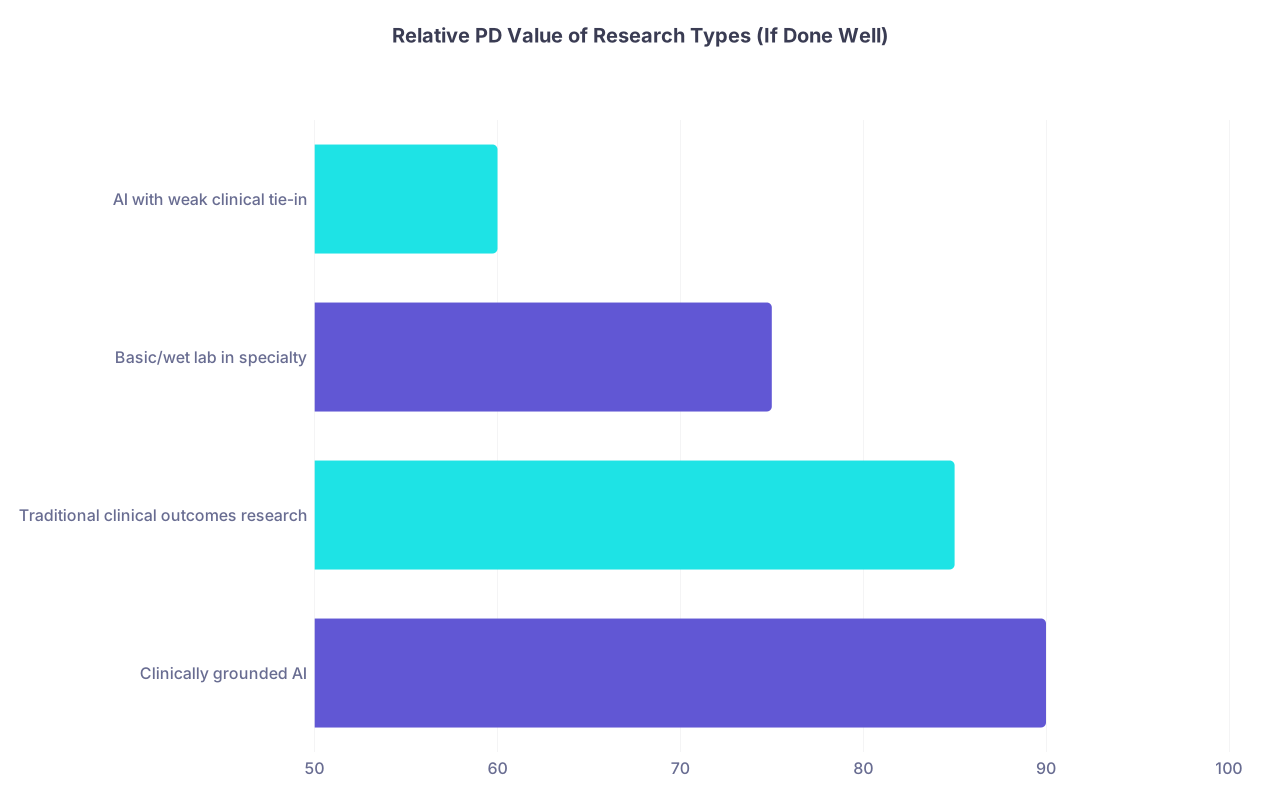
| Category | Value |
|---|---|
| Clinically grounded AI | 90 |
| Traditional clinical outcomes research | 85 |
| Basic/wet lab in specialty | 75 |
| AI with weak clinical tie-in | 60 |
A PD I know in cards put it well: “I don’t care if it’s AI, echo metrics, or mice with induced MI. I care if they stuck with something long enough to understand it and produce something. Hype comes and goes.”
So no, you do not “need” AI research to match into the future of healthcare. And if your AI project is shallow and you’re ignoring good, solid clinical research opportunities you could actually see through, you’re making a mistake.
How AI Research Can Backfire Long-Term
One more quiet concern PDs have—and they rarely say this out loud to applicants:
“Is this person actually going to practice, or are they here until the first tech job offer?”
If you present yourself as:
- Very tech-obsessed,
- Vague about your clinical interests,
- Constantly talking exit paths to industry,
some PDs will hesitate. They don’t want to train someone who’s mentally halfway out the door.
There’s nothing wrong with being interested in industry or informatics. But the way you frame it matters.
If you say:
“I’m excited about combining clinical practice with building better decision-support tools,”
that’s one thing.
If you keep talking about “scaling impact beyond patients” and “moving fast to build products,” in a room full of people who’ve spent 20 years grinding through call, you’re going to come off as out of touch.
The irony: the more grounded you sound in actual patient care, the more PDs will trust you with freedom to explore AI seriously.
How to Position AI Research So PDs Actually Respect It
I’ll leave you with how to present your AI work so it lands in the right bucket.
When you write that CV line and when you talk in interviews:
- Lead with the clinical problem, not the model. “We wanted to identify patients at risk of X…” before “We used a random forest…”
- State your role in one honest sentence. No inflation. “I wrote code to preprocess data and trained baseline models,” or “I primarily did chart review and contributed to the manuscript.”
- Include one limitation or nuance you actually thought about. “One big concern we had was that documentation bias would skew performance in non-English speakers.”
- Connect it to residency-level work. “It made me appreciate how subtle the trade-off is between sensitivity and alarm fatigue for nurses.”
If you can do that, most PDs—across specialties—will put you in the “substantive, thoughtful, future-oriented” bucket. And that does help.
Key points:
- AI on your CV is not an automatic plus; PDs now treat it with built-in skepticism and look hard for substance, honesty, and clinical grounding.
- You will be judged more on how you talk about the project—your role, your grasp of limitations, your connection to real patient care—than on whether you used the hottest model.
- Solid, finished, clinically meaningful work (AI or not) beats flashy, vague, overhyped “AI research” every single time.