
You’re PGY-5. It’s 8:30 p.m. You just finished signing out on a service that never ends, your inbox has three emails from med-tech companies “wanting your input,” and your division chief casually mentioned a “50/50 industry-academic collaborator” position that might be opening in a year or two.
You can feel it: staying 100% in traditional academia is not the full story for your career. But jump too early into industry and you risk burning the academic bridge. Wait too long and you’re the overtrained, overcredentialed fellow with no real-world experience beyond the IRB portal.
This is the moment where timing actually matters.
Here’s your timeline: from late residency through fellowship and the first 5 years after, month-by-month and year-by-year, what you should be doing if you want a serious industry–academic hybrid career rather than a random consulting side gig.
Global Timeline Overview: Where You’re Heading
Let me give you the spine of the timeline first, then we’ll zoom in.
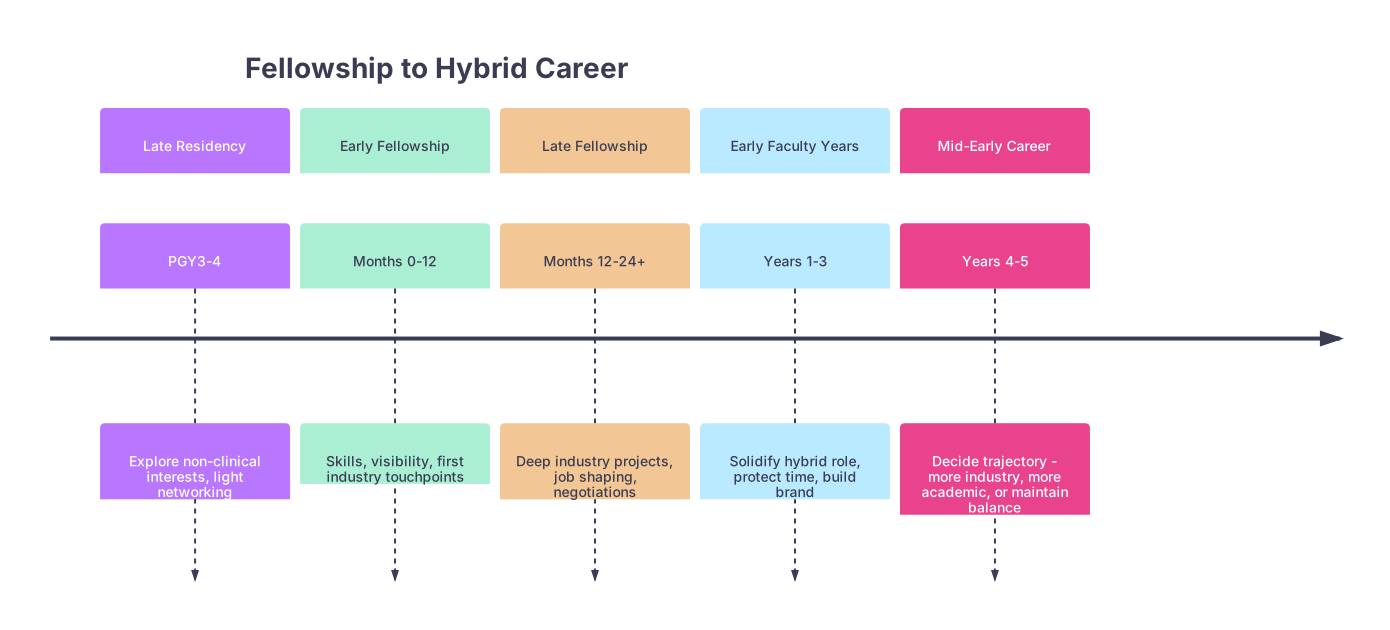
| Period | Event |
|---|---|
| Late Residency - PGY3-4 | Explore non-clinical interests, light networking |
| Early Fellowship - Months 0-12 | Skills, visibility, first industry touchpoints |
| Late Fellowship - Months 12-24+ | Deep industry projects, job shaping, negotiations |
| Early Faculty Years - Years 1-3 | Solidify hybrid role, protect time, build brand |
| Mid-Early Career - Years 4-5 | Decide trajectory - more industry, more academic, or maintain balance |
That’s the arc. Now we walk it.
Phase 1: Late Residency (PGY-3 to PGY-4) – Quiet Positioning
At this point you should not be “trying to jump to industry.” You’d be ignored. Or used. Instead, you’re setting foundations and optionality.
PGY-3: Curiosity + Signals
At this point you should:
Identify which industry–academic lane actually fits you Stop saying “industry” like it’s one thing. It’s not.
Common hybrid tracks:
- Pharma/biotech clinical development (onc, rheum, ID, neuro)
- Medical devices / digital health (cardiology, radiology, surgery-heavy fields)
- Health tech / AI / data science (radiology, path, EM, hospital medicine, critical care)
- Health services / outcomes work with payers or policy orgs (IM, peds, psych, geri)
If you don’t know yet, pick 1–2 likely lanes based on:
- Which journals/abstracts you actually read
- What problems in clinic really piss you off (workflow, access, toxicity, cost)
- Which attendings’ careers you actually envy
Start visible, low-risk activities
At this point your moves should be small but deliberate:
- Join a clinical trials, quality improvement, or informatics committee.
- Ask to help on a registry, device trial, or EHR project.
- Attend at least one industry-sponsored dinner and pay attention to who’s at the table (medical affairs, MSLs, trialists).
Clean up your online footprint
- LinkedIn: create or fix it.
- Add:
- Current level and specialty
- 2–3 specific interests (e.g., “immune checkpoint inhibitor toxicity,” “AI chest imaging,” “perioperative outcomes”).
- Don’t brand yourself as “consultant” yet. It looks ridiculous as a PGY-3.
PGY-4: Early Outreach, No Commitment
By late residency, at this point you should:
Have at least one mentor who touches industry
Not the hardcore NIH-only basic scientist. Someone who:- Runs pharma-funded studies, or
- Has advisory boards, or
- Co-founded a startup.
Attend one major meeting with an industry lens
Example:- Onc: ASCO, hematology: ASH
- Cards: ACC, AHA
- Radiology: RSNA
- Pulm/CC: ATS, SCCM
At that meeting, do three things:
- Visit 3–5 relevant company booths.
- Introduce yourself as “incoming fellow at X with interest in Y.”
- Ask to be added to lists for investigator meetings and advisory boards down the line.
This is quiet groundwork. No big moves yet.
Phase 2: Early Fellowship (Months 0–12) – Skills Before Titles
Fellowship is the best and most forgiving window to build credibility before you ask for money, titles, and protected time.

Months 0–3: Declare Your Direction (Internally)
At this point you should:
Tell the right people what you’re aiming for
Be explicit with:
- Fellowship program director
- Division chief or vice chief for research
- One industry-connected attending
Script-level clear:
- “Long-term I’m interested in a hybrid role where I split time between an academic appointment and substantive work with industry or startups, especially around [X]. What projects or people should I attach myself to now to make that realistic in 3–5 years?”
Pick 1–2 skill tracks that industry actually cares about
Do not over-diversify. Two tracks is enough:
- Clinical trials track
- Phase II/III, protocol work, sub-I PI roles
- Data / informatics track
- EHR phenotyping, R/Python, machine learning collaborations
- Regulatory / quality track
- IRB, FDA submissions, QI with hard outcomes
- Device / digital health usability track
- Workflow design, pilot studies, implementation
Get on one project that will clearly become a publishable product.
- Clinical trials track
Formal training moves
If possible:
- Register for a clinical research methods course or certificate.
- Join any industry-sponsored trial at your site as a sub-investigator.
- Get your CITI/Good Clinical Practice up to date and documented.
Months 4–6: Light Industry Touch
Now you start touching actual companies—but as a trainee, not a hired gun.
At this point you should:
Be involved with at least one industry-linked project
Examples:- Pharma-funded clinical trial (you help with patient screening, data cleaning, maybe sub-analyses).
- Device trial where you help refine workflows or imaging protocols.
- Digital health pilot implementing an AI model or remote monitoring tool.
Introduce yourself to the company-side counterparts Not just the rep.
- Medical science liaison (MSL)
- Clinical scientist
- Medical director
Ask:
- “What kind of clinician collaborators are most helpful to you?”
- “At what career stage do you typically start working more formally with physicians?”
This is reconnaissance. You’re collecting timing intel.
Months 7–12: First Real Outputs
By the end of year 1 of fellowship, at this point you should have:
One of these in motion:
- A first- or second-author abstract involving industry data or products.
- A protocol or sub-study proposal tied to an existing trial.
- A serious role in a tech pilot (e.g., designing clinician-facing parts, identifying safety flags).
One or two early speaking or advisory experiences, even if unpaid:
- Company-sponsored “expert panel” webinar where you’re the trainee voice.
- Internal hospital innovation committee presenting vendor comparisons.
You’re still “in training,” but you’re now visible as someone who understands and can speak to industry problems.
Phase 3: Late Fellowship (Months 12–24+) – The Pivot Window
This is where timing gets critical. Most people blow it here—either they stay vague and miss opportunities, or they jump to full industry and can’t get back to a serious academic role.
Months 12–18: Decide Your First Post-Fellowship Structure
At this point you should decide between three realistic launch options:
| Path | Industry Time | Academic Time | Risk to Future Options |
|---|---|---|---|
| Classic Academic + Side | 5-15% consulting | 85-95% faculty | Low |
| Split or Affiliated Role | 20-50% industry | 50-80% faculty | Moderate |
| Industry Primary + Adjunct | 80-100% industry | 0-20% adjunct | Higher for pure academia |
My blunt opinion for most new fellows:
If you’re serious about an industry–academic career and you have any research or teaching interest at all, start with “Classic Academic + Side” or “Split/Affiliated.” Jumping straight to 100% industry before you’ve built any academic capital is usually a one-way door.
So in months 12–18, at this point you should:
Clarify your non-negotiables
- How much outpatient/clinical do you actually want?
- Do you want to keep serious research going?
- Do you want teaching/trainee involvement?
- How much do you care about title progression (assistant → associate → full)?
Start explicit conversations with your home institution
- “I’d like to structure a role where I can spend 0.2–0.4 FTE with industry partners or trials while staying on faculty. Is that something this division supports?”
You’re testing the flexibility of your environment before you sign anything.
Months 18–24: Concrete Job Shaping and Negotiation
This is your prime window to lock in a hybrid-compatible job while you still have “fellow” on your name tag and people are oddly more accommodating.
At this point you should:
Have 3–5 employers or structures on your radar Mix of:
- Your current institution (or similar academics) offering:
- Core faculty role with protected research time that can involve industry trials.
- Possibly a formal “innovation,” “AI,” or “digital health” faculty position.
- 1–2 companies with:
- Clinical research scientist or medical director roles that explicitly allow academic collaborations or adjunct faculty positions.
- 1–2 health systems with strong industry partnerships.
- Your current institution (or similar academics) offering:
Aggressively use meetings and conferences The 6–9 months before you graduate, your priorities at conferences should shift:
- Set up pre-scheduled meetings with:
- Company medical directors.
- Your prior industry collaborators.
- Faculty at programs known for hybrid roles (e.g., big cancer centers, quaternary hospitals with innovation hubs).
- Set up pre-scheduled meetings with:
Negotiate structure, not just salary
For academic-centered roles, at this point you should ask for:
Protected time explicitly usable for externally funded industry collaboration
Not “admin time.”
Example: 0.3 FTE research/innovation time, with written freedom to apply for industry funding, run trials, or co-lead pilots.Explicit conflict-of-interest and outside work policies in writing:
- How many hours/month of outside activity allowed?
- Do they allow paid advisory boards, speaking, or consulting?
- Do you need permission per engagement?
For industry-centered roles, at this point you should ask for:
Formal academic affiliation options:
- Adjunct appointment.
- Courtesy faculty role.
- Ability to teach or precept if desired.
Flexibility to:
- Publish.
- Present at academic conferences.
- Contribute to guidelines or consensus papers.
This is where people who “just took the best paying offer” get boxed into non-publishable, non-visible work. Don’t do that unless your goal is purely corporate career ladder, not hybrid.
Phase 4: Early Faculty Years (Years 1–3) – Converting Access into Authority
You have your job. Now the timing question changes: when do you scale industry involvement up? When do you say no?
Year 1: Establish Credibility on Both Sides
At this point you should:
On the academic side:
- Get at least 1–2 industry-linked manuscripts moving toward submission (trials, registries, device/digital pilots).
- Present once at a recognizable national meeting as something other than “Fellow Poster #2135.”
On the industry side:
- Take a small number of high-quality engagements:
- 2–3 advisory boards or consulting events that genuinely involve your expertise.
- Participation in protocol design reviews or early product feedback.
If you’re doing 10+ small, scattered activities in your first year, you’re undervaluing your time and diluting your brand.
- Take a small number of high-quality engagements:
Clean conflict-of-interest management
- Log everything.
- Be transparent with your department leadership.
- Do not be the person whose name appears on every drug maker’s consulting slide without any clear academic reason.
Year 2: Choose a Flagship Industry–Academic Project
By year 2, at this point you should have one marquee project that defines your hybrid value:
Examples:
- You’re the site PI for a high-profile, multicenter trial with active protocol input.
- You co-lead a clinical validation study for an AI tool across multiple hospitals, with a plan for first- or senior-author publication.
- You run a quality or outcomes program built around a payer or device partnership that produces real metrics and publishable data.
This becomes your calling card. When someone asks, “So what exactly do you do between industry and academia?” you have a clean, coherent answer.
Year 3: Decide Whether to Scale Up Industry Time
At this point you should reassess the balance:
If you:
- Love the problem-solving and speed on the industry side.
- Are frustrated with academic politics and promotion checkboxes.
- Already have an adjunct or courtesy appointment to keep one foot in academia.
Then you can reasonably consider:
- Moving to a 50–80% industry role with a formal academic adjunct position.
If you:
- Still enjoy teaching, mentoring, and academic identity.
- Have a functioning setup with consulting, trials, and innovation work.
- Are on track for promotion.
Then you probably stay mostly academic with well-structured industry projects—and maybe negotiate a bit more protected time in exchange for bringing in funded work.
The mistake here is drifting. You either commit to being visible and serious in one or two major industry-academic domains, or you end up being background noise in both.
Phase 5: Mid–Early Career (Years 4–5) – Locking in Your Trajectory
By year 4–5, your timing questions are more strategic than logistical.
At this point you should:
Choose your identity hierarchy
You can’t be “everything.” Pick one answer you’re comfortable with when someone introduces you:
- “Academic [subspecialty] with a major focus on [X] industry partnerships.”
- “Industry clinical leader who maintains active teaching and research collaborations.”
- “Hybrid physician working at the intersection of [X] and [Y].”
That choice subtly shapes future invitations, boards, committees, and promotions.
Trim low-yield relationships
Drop:
- Companies that don’t respect your time.
- Projects that never move from “brainstorm” to “contract and timeline.”
- Academic committees that give you zero leverage with industry partners.
Keep and deepen:
- The 1–2 companies where you’re almost part of the internal team.
- The 1–2 academic units (centers, labs, institutes) that actually help you do work.
Decide if you’re stepping toward leadership
If you want industry–academic leadership roles by year 8–10 (division chief of innovation, VP medical affairs, etc.), years 4–5 are where you:
- Start leading multi-site collaborations.
- Sit on guideline panels or major advisory boards.
- Show that you’re not just a “content expert” but can handle strategy and teams.
When Not to Transition (Yet)
Quick, blunt list. If these are true, it’s too early to heavily transition to industry-focused roles:
- You have no completed projects with an industry partner, just “conversations.”
- You’ve never been responsible for a trial, registry, or product workstream that had deadlines and deliverables.
- You don’t know your hospital’s:
- Outside work policy
- COI policy
- Process for reviewing industry contracts
- Your only relationship with industry is via drug dinners and speaker bureaus. That’s not a hybrid career. That’s marketing.
Get one serious, structured project into your portfolio first. Then move.
Two or Three Things to Remember
- The optimal timing for industry–academic transition isn’t a date, it’s a sequence: skills → visibility → responsibility → structure → scale.
- Fellowship is your highest leverage window to build credibility and set expectations, while the first 3 faculty years are where you either convert that into a real hybrid role—or lose the chance.
- If you can’t point to one flagship industry–academic project that defines your value, you’re not ready to scale up your industry time. Build that first; the titles and offers come after.