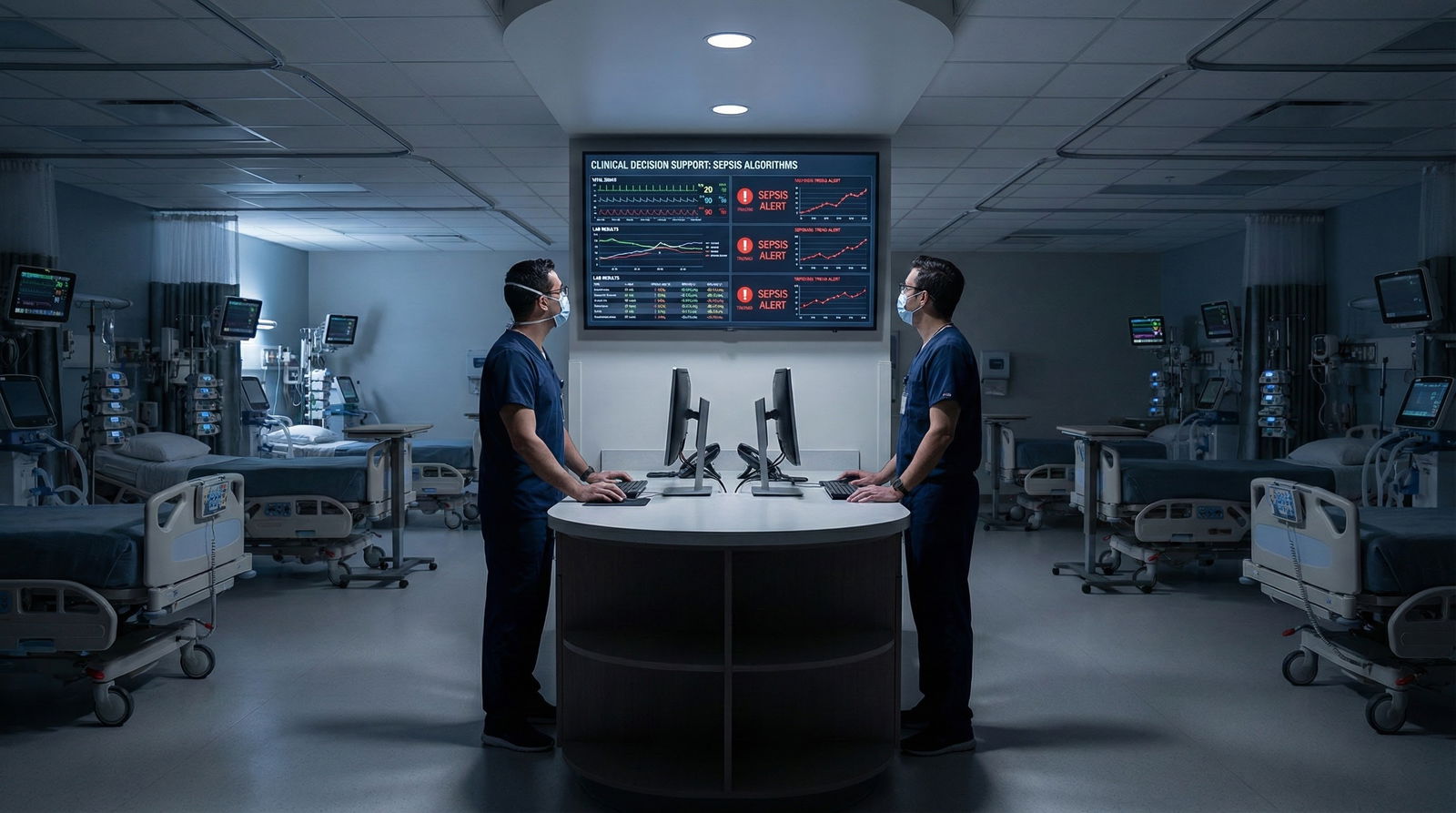
You are in a crowded ED at 7:30 p.m. Three ambulances just rolled in, the waiting room is already a problem, and your charge nurse leans over: “Bed 12 just flagged as possible sepsis on the computer. Again.”
The patient in 12 has pneumonia, is tachycardic to 104, temp 38.3, BP 102/68, lactate 1.9. The EHR banner is screaming SEPSIS ALERT in bright red, timers ticking down. Your phone buzzes: “Sepsis bundle overdue.” You are already doing the right things. But the system does not care.
This is where decision-support algorithms in sepsis actually live: in that tension between signal and noise, between protocol and judgment, between what the algorithm is allowed to do and what you, as the clinician, know is happening in front of you.
Let me walk through this systematically: what these algorithms are really looking at, how they set thresholds and triggers, what they get catastrophically wrong, and where the future is headed if we stop treating them like magic and start treating them like tools.
1. What “Sepsis Decision-Support” Actually Means
Forget the buzzwords for a second. Most “AI in sepsis” at the bedside is one of three things:
- Rule-based logic glued into the EHR
- Early warning score systems that calculate a risk number
- Machine learning models running in the background and surfacing “risk of sepsis” alerts
They are all trying to do one job: detect sepsis early enough that you have time to do something before the patient crumps.
The classic pipeline looks like this:
- Continuous data feed: vitals, labs, nursing flowsheets, medication administration, orders
- Some algorithmic engine: rules, scores, or ML model
- A decision layer: “When this output crosses X, trigger Y alert / order set / workflow”
- Human interface: pop-ups, banners, pager alerts, texts, dashboards, or “nudge” in order entry
The real differences are not just mathematical sophistication. They are:
- What data streams you trust
- Where you set thresholds
- Who gets bothered, how often, and with what consequence
Most clinicians meet these systems as annoying banners, protocol prompts, or that dreaded push alert: “High risk of sepsis. Evaluate now.” Underneath is a lot of messy design work—medical, technical, and political.
2. The Old Guard: Rule-Based Sepsis Alerts and Their Thresholds
The first wave of decision-support in sepsis was basically codified criteria: SIRS, severe sepsis, septic shock, then sepsis-3 (SOFA / qSOFA). Hospitals wrapped these into alerting logic.
Typical Rule-Based Trigger Logic
A stripped-down example you have probably seen:
- Step 1: Infection suspected (e.g., IV antibiotics ordered, or blood cultures ordered, or pneumonia / UTI diagnosis code)
- Step 2: Abnormal vitals or labs:
- Temp > 38.3 or < 36
- HR > 90–100
- RR > 20–22
- WBC > 12 or < 4 or >10% bands
- Optional: Organ dysfunction:
- SBP < 90 or MAP < 65
- Lactate ≥ 2
- Creatinine rising, platelets dropping, bilirubin rising
The algorithm fires an alert when some combination is met: “suspected infection + ≥2 SIRS criteria” or “infection + organ dysfunction.”
The threshold decisions are baked into:
- How many abnormal findings you require (e.g., ≥2 SIRS vs any 1)
- How wide or narrow you set the bounds (HR > 90 vs HR > 100)
- Whether you demand organ dysfunction or only systemic response
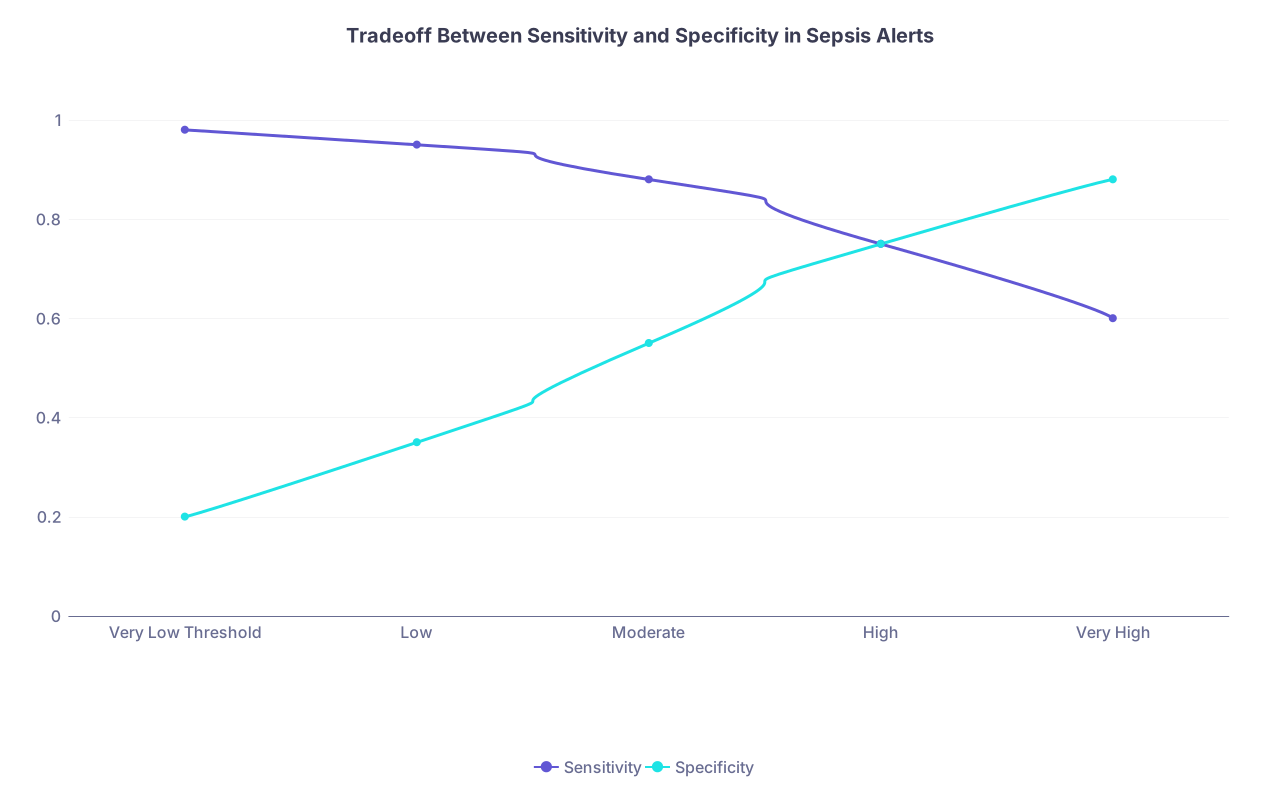
Most early systems leaned toward sensitivity: better to over-fire and catch everything than miss true sepsis. You know how that ended: alert fatigue.
| Category | Sensitivity | Specificity |
|---|---|---|
| Very Low Threshold | 0.98 | 0.2 |
| Low | 0.95 | 0.35 |
| Moderate | 0.88 | 0.55 |
| High | 0.75 | 0.75 |
| Very High | 0.6 | 0.88 |
You cannot have it both ways. Lower thresholds give you big sensitivity and miserable specificity. Raising thresholds to cut noise makes sensitivity tank. Most hospitals landed in the noisy middle.
And those thresholds are not neutral. They push behavior:
- Every borderline hypotensive pneumonia gets “sepsis bundle” workflow
- Moderate post-op fever trips infections flags
- Chronic tachycardia in anemia or AFib lights up the board
On paper, it is “just decision-support.” In reality, it steers practice.
3. Early Warning Scores: NEWS, MEWS, qSOFA and Friends
The next step was aggregating vitals into a risk score, not just yes/no logic.
NEWS, MEWS, and qSOFA are pretty standard:
- NEWS: RR, O2 sat, supplemental O2, SBP, HR, temperature, mental status
- MEWS: HR, SBP, RR, temp, consciousness
- qSOFA: RR ≥ 22, altered mentation, SBP ≤ 100 (≥2 suggests poor outcomes in sepsis)
These were not originally built as “AI.” They were hand-crafted scoring tools. But EHR vendors wrapped them into continuous monitoring:
- Calculate score whenever vitals updated
- If score ≥ threshold → alert nurse, charge nurse, rapid response, or physician
- Secondary trigger: “Consider sepsis” or auto-open sepsis order sets if infection suspected
Hospitals then had to pick thresholds and actions:
| Score Type | Trigger Threshold | Common Action |
|---|---|---|
| NEWS | ≥ 5 | Escalate to senior nurse / MD review |
| NEWS | ≥ 7 | Rapid response / ICU eval |
| MEWS | ≥ 4 | Notify covering provider |
| qSOFA | ≥ 2 | Consider sepsis, lactate, cultures, early antibiotics |
Here is where people get sloppy:
- They treat qSOFA as a screening tool rather than a risk-of-bad-outcomes marker
- They assume a NEWS of 5 means “this is sepsis” instead of “this patient is deteriorating”
- They flatten context: a young trauma patient with pain and tachycardia vs a frail septic elderly patient can have the same score and wildly different trajectories
The core problem: these scores are blunt instruments. Good at flagging “sick.” Not good at saying “sepsis versus something else.” When hospital policy wires them into sepsis bundle compliance, you get routine over-treatment and endless chart gymnastics.
4. Machine Learning Sepsis Models: What They Actually Predict
Now the fun part. Machine learning models started being deployed under banners like “predict sepsis 4–24 hours before onset.” Sounds impressive. You need to look very carefully at three things:
- How they define “onset of sepsis” in their training data
- What the model is actually predicting
- How it is integrated into care and what action the alert demands
Most models use retrospective EHR data: vitals, labs, demographics, some text-derived features (diagnosis codes, orders). They require a label: who “had sepsis,” and when did “onset” occur?
Common label strategies:
- Sepsis defined by ICD codes + organ dysfunction criteria
- Onset defined as first time criteria met or sepsis order set fired
- Sometimes: clinician-documented sepsis time (rare, messy)
Already you see the circularity: if your model is trained to predict “the time the EHR thinks sepsis started,” it will excel at predicting documentation patterns and order behaviors, not pure biological sepsis.
The model then learns subtle trends:
- Rising respiratory rate over hours
- Drifting downward BP or MAP even within “normal” range
- Slight creatinine bump, trend in WBC, platelets, lactate
- Frequency and timing of nursing assessments and vitals (surrogate for perceived sickness)
When deployed, it outputs something like:
- Continuous risk score 0–1 or 0–100
- Rolling prediction of “likelihood of sepsis in next 4–12 hours”
- Categorical risk bucket: low / medium / high
Then comes the key decisions: thresholds and triggers.
5. Thresholds and Triggers in ML-Based Sepsis Alerts
Here is where people either do this carefully or make a complete mess.
An ML model gives you a numeric risk score. But your system has to decide:
- At what score do we trigger an alert?
- Who sees it?
- How often can we re-alert?
- What exactly do we want the clinician to do?
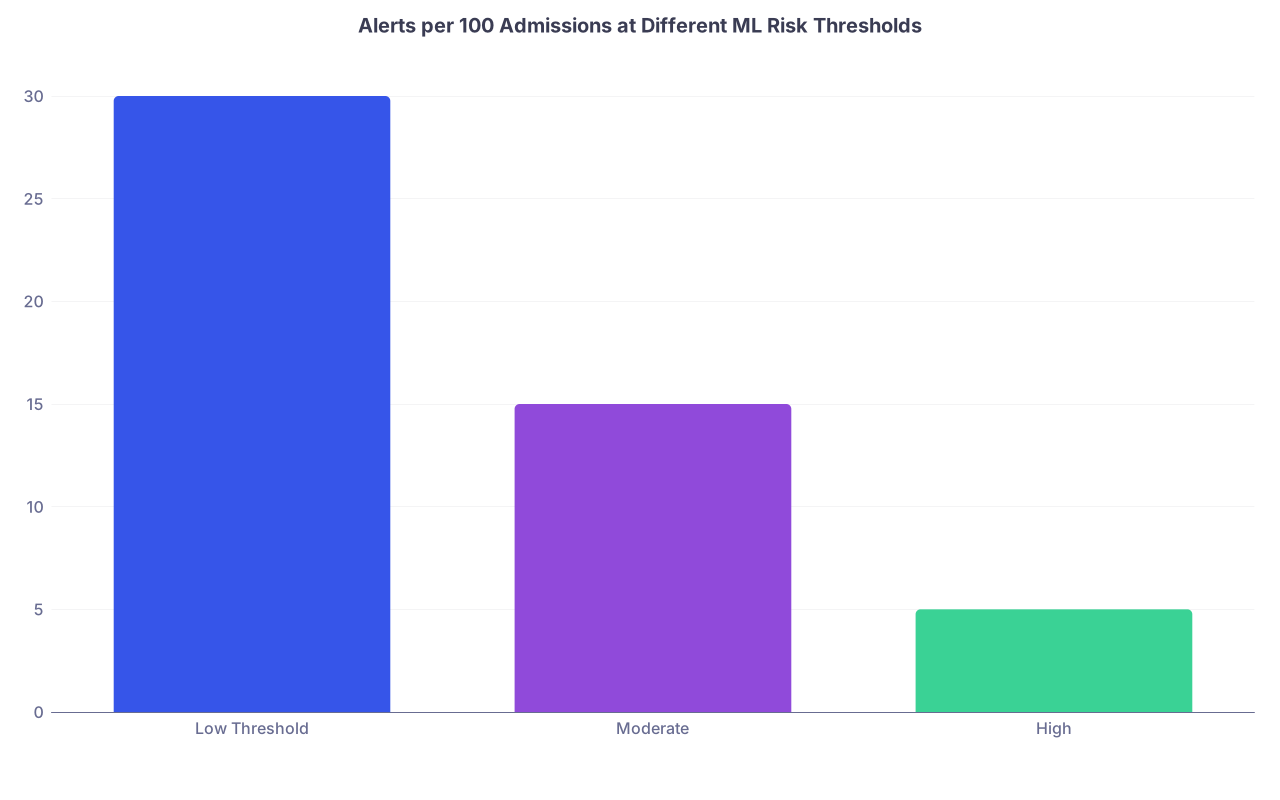
You can adjust thresholds to trade sensitivity for specificity. But you must anchor it to real metrics: how many alerts per 100 admissions, what proportion are truly sepsis, and how early relative to current practice.
| Category | Value |
|---|---|
| Low Threshold | 30 |
| Moderate | 15 |
| High | 5 |
A few scenarios I have seen:
- Low threshold (maximize sensitivity): ~30 alerts per 100 admissions, maybe 20–25% are true sepsis. Everyone quickly stops caring.
- Moderate threshold: ~15 alerts per 100 admissions, maybe 40–50% true sepsis, some earlier than usual. This is where systems can sometimes live.
- Very high threshold: ~5 alerts per 100 admissions, very high precision, but almost no earlier detection than clinical teams already achieve.
The other design choice: triggering events.
- First crossing of threshold only vs repeated alerts if risk remains high
- “Silent” score on a dashboard vs explicit interruptive alerts
- Coupling with mandatory sepsis bundle order sets vs lightweight “review suggested”
This is where leadership has to decide: is this tool advisory, or is it essentially enforcing protocolized care via the back door?
6. Common Pitfalls: Where These Systems Go Wrong
Now to the ugly parts. I will be blunt.
Pitfall 1: Garbage Labels, Garbage Model
If your training label for “sepsis” is just ICD codes or when the sepsis order set fired, you are training the model to reproduce human documentation habits, not to detect sepsis earlier.
You get:
- Models that “predict” sepsis when clinicians are already suspicious
- Minimal lead time gain over usual care
- False confidence in “AI” because AUROC looks good on paper
High AUROC in retrospective data with weak labels is a party trick, not clinical value.
Pitfall 2: Ignoring Treatment Effects
Real-world deployment changes physician behavior, which changes the data. This is treatment–target feedback.
Example:
- Model flags a patient early
- Team responds aggressively: fluids, antibiotics, escalation of care
- Patient stabilizes, never meets sepsis-3 definition
- On paper, model gave a “false positive”; in reality it helped prevent progression
Now try to retrain the model on post-implementation data. The label “had sepsis” gets suppressed for exactly the cases where the model worked. If you are not careful, the retrained model will learn to be less aggressive in those early, rescuable states.
This is one reason post-deployment re-training without causal thinking is dangerous.
Pitfall 3: Alert Fatigue and EHR Weaponization
You already know this one. I have seen institutions with six separate sepsis alerts:
- Rule-based SIRS “screen positive”
- NEWS above threshold
- EHR vendor ML sepsis risk
- Pharmacy antibiotic timing alert
- Lactate overdue alert
- Quality “bundle time zero” timer
They each fire to different people, at slightly different times, sometimes for the same patient. Nurses click through, physicians mentally tune them out, and legitimate early warnings get buried in noise.
Worse: sepsis alerts tied to quality metrics become policing tools. Huddles about “sepsis performance” devolve into “why did you not click the order set at time X.” Algorithms morph into compliance surveillance instead of clinical support.
Pitfall 4: Over-generalization Across Populations
Most sepsis models are trained on:
- Single academic centers
- Predominantly one demographic profile
- Certain practice patterns (ordering frequency, nursing documentation style)
Then they get exported to a very different setting: community hospitals, different patient mix, weaker documentation culture.
What happens?
- Vital sign frequency is lower → missing early trends
- Labs are drawn later / less often → model risk estimates degrade
- Baseline prevalence of sepsis differs → calibration off, PPV drops
Sepsis incidence in a tertiary academic ICU is not the same problem as sepsis in a lower-resource ED. You cannot just flip a switch and expect the same performance.
Pitfall 5: Lack of Interpretability at the Point of Care
Most clinicians will ignore an alert that cannot answer “why.”
If the system says: “Sepsis risk 0.83,” and that is it, you will get resistance. When you have to decide whether to start broad-spectrum antibiotics on a frail patient with borderline vitals, you want to know: what is driving the risk? HR trend? RR? Lactate creeping up? New hypotension?
Good deployments give you a ranked factor list or trend view: “Key drivers: RR trend, SBP drop, WBC rise, temp pattern.” Even if the underlying model is a black box, the interface can surface useful, human-readable signals.
Systems that skip this step and just dump scores into the chart are half-built.
7. How These Algorithms Should Be Used (And How They Should Not)
Let me be concrete.
Proper Use
- As early warning nudges to re-examine patients who may be slipping through the cracks
- As triage aids: prioritize which borderline patients deserve a more urgent bedside assessment
- As guardrails: prompt lactate measurement, culture ordering, or review of antibiotic timing in clearly high-risk patients
- As surveillance tools at a unit or hospital level to monitor sepsis burden and identify patterns of delay
Misuse
- As substitutes for clinical assessment (“Model says low risk, so it is not sepsis”)
- As weapons for compliance enforcement without nuanced context
- As gadfly alerts that interrupt workflow without a clear action or prioritized urgency
- As marketing-driven add-ons with no local calibration, validation, or governance
If your implementation does not include a clear, written answer to: “What exactly do I want the clinician to do when this fires?” then you are not doing decision-support; you are doing decision-harassment.
8. Designing Better Thresholds and Triggers: Practical Principles
If you are on a committee deciding how to deploy or tune one of these systems, here is how I would approach it.
1. Define Your Gold Standard Up Front
- Decide what “true sepsis” means locally. Use sepsis-3 plus clinical adjudication if you can.
- Distinguish “sepsis” from “deterioration without sepsis” (e.g., hemorrhage, cardiogenic shock). Your labels should respect that.
2. Start With Silent Monitoring
- Run the model in the background for weeks or months
- Measure:
- How many alerts would have fired per 100 patients
- How often those patients truly had sepsis
- How much earlier than usual care the model “detected” them
You want hard numbers before exposing clinicians to any of it.
3. Choose Operational, Not Just Statistical, Thresholds
Stop chasing AUROC. Choose thresholds based on:
- Acceptable alerts per clinician per shift
- Minimum acceptable PPV for sepsis (otherwise they stop believing it)
- The real operational capacity: can your team actually respond meaningfully to 20 alerts a day?
If you set a threshold that drives work beyond the team’s bandwidth, your implementation has already failed.
4. Tier Your Alerts
Not every alert needs to be a flashing red pop-up.
You can:
- Show low-risk elevations on monitoring dashboards only
- Send medium-risk alerts to charge nurses or rapid response teams
- Reserve high-risk, highly specific alerts for interruptive MD notifications paired with specific action prompts
Blend rule-based logic and ML when appropriate. For example:
- Soft ML risk bump + high NEWS + suspected infection → strong sepsis alert
- ML bump alone without infection signal → “watch closer,” not “bundle now”
5. Build Feedback Loops With Clinicians
Give them a way to tell the system: “Not sepsis,” “already addressed,” or “alert helpful.” Review this feedback regularly.
If you see frequent “not sepsis” tags in a particular population (e.g., post-op tachycardia), adjust thresholds or add exclusion logic.
If you never review feedback, your model will slowly rot in practice.
9. Equity, Bias, and Silent Failure Modes
This part gets ignored until the damage is obvious.
Sepsis risk is not evenly distributed across populations. Neither is:
- Access to timely vitals and labs
- Likelihood of presenting late
- Documentation quality
If your training data under-represents certain groups, the model may systematically under-call or over-call sepsis in them.
Examples of quiet failures:
- Nursing documentation frequency lower on night shifts or in under-resourced units → model “sees” less deterioration
- Language barriers delaying symptom reporting → model flags later
- Different baseline creatinine or WBC distributions across demographic groups mishandled by simplistic thresholds
You handle this by:
- Stratifying performance metrics by race, sex, age, language preference, insurance status
- Checking calibration and PPV across those groups, not just overall AUROC
- Adjusting data pipelines and thresholds where you see consistent under-detection
If your sepsis algorithm “works” on average but persistently fires later or less accurately in marginalized populations, that is not a minor bug. That is structural harm baked into code.
10. The Next Generation: Where This Is Heading
The future of sepsis decision-support is not “bigger models and more alerts.” If that is your vendor’s sales pitch, be skeptical.
Three directions that actually matter:
A. Continuous, High-Frequency Physiologic Data Integration
Right now, most models are limited by sparse, manual entry: vitals every 4 hours, labs every 6–24 hours. Wearables, continuous monitoring, and smarter bedside devices can feed minute-level data:
- HR variability
- Continuous blood pressure / MAP trends
- Continuous temperature, oxygen saturation, respiratory pattern
Patterns like “increasing variability then abrupt drop,” “progressive tachypnea before obvious tachycardia,” or “subtle perfusion changes” may give earlier and more specific signals than current vitals. But only if you have pipelines and models that can actually handle that granularity.
B. Causal and Treatment-Aware Models
The current generation mostly predicts “sepsis label in EHR” without modeling the effect of interventions.
Future systems need to:
- Predict both risk and potential benefit of specific actions
- Distinguish between “high risk but already appropriately treated” and “high risk and under-treated”
- Incorporate knowledge of recent orders, fluid boluses, and antibiotic choices
That pushes us toward causal inference and reinforcement learning frameworks. Not simple supervised classification on retrospective data.
C. Sepsis Pathway Orchestration, Not Just Alerts
The best systems will not only say “high risk of sepsis.” They will orchestrate care pathways:
- Smart order sets that pre-populate with likely sources, cultures, antibiotics, weight-based fluids, but are easy to adjust
- Auto-notification of charge nurse / RT / phlebotomy when time-critical labs are due
- Real-time bundle progress tracking that distinguishes justified deviations from true misses
And crucially: the system will know when to shut up. If the bedside team has already documented a sepsis plan and is executing it, the algorithm does not need to keep shouting.

| Step | Description |
|---|---|
| Step 1 | Incoming Patient |
| Step 2 | Continuous Data Feed |
| Step 3 | Risk Model |
| Step 4 | Routine Monitoring |
| Step 5 | Team Nudge |
| Step 6 | Sepsis Pathway |
| Step 7 | Bedside Reassessment |
| Step 8 | Smart Order Set |
| Step 9 | Track Bundle Progress |
| Step 10 | Adjust Alerts Based on Response |
That is where “future of healthcare” is actually interesting: orchestration, timing, and workflow-level intelligence, not just a new neural net.
11. How You, As a Clinician, Should Interact With These Systems
Let me be specific about what you should do tomorrow when your hospital rolls out “New AI Sepsis Alert 2.0.”
Ask for the basic performance numbers:
- How many alerts per 100 admissions?
- What proportion are true sepsis?
- How much earlier than current practice does it detect sepsis on average?
Ask who validated it locally and how:
- Was there silent run-in?
- Did they stratify performance across different units and populations?
Clarify expectations:
- What action is expected when it fires?
- Does it create a medicolegal exposure if you disagree with it and document why?
Use it as an extra set of eyes, not as gospel:
- When it flags a patient you thought was fine, re-check them. Walk by. Review the vitals and labs trends.
- When it stays silent on someone you are worried about, do not let that reassure you. You are not an input into the model; you are the safety net around it.
Give feedback:
- Document when alerts are clearly wrong.
- Push leadership for retuning or redesign when patterns of nonsense emerge.
You are not obligated to worship the model. You are obligated to practice good medicine and to refuse tools that obviously degrade it.
Key Takeaways
- Sepsis decision-support lives or dies on thresholds and triggers. Get those wrong, and even a good model becomes useless noise.
- Most current systems either over-alert with crude rules or under-perform with poorly labeled machine learning. Without local validation and thoughtful deployment, you are just automating bad habits.
- The future is not more alerts. It is smarter, treatment-aware, workflow-integrated systems that act as orchestration layers around sepsis care—augmenting, not replacing, your judgment.