The hype around “AI in cardiology” is vague. Digital twins are not. They are the concrete, engineering-grade version of precision cardiology.
You want future-of-medicine territory that is actually credible? Patient-specific hemodynamic digital twins are it.
Let me break this down specifically.
What a “Digital Twin” in Cardiology Really Is
People throw “digital twin” around like it is just a nice 3D rendering. That is wrong.
A real cardiac digital twin is three things welded together:
- A geometry twin – the actual anatomy of this patient
- A physics twin – equations governing blood flow and tissue mechanics
- A physiology twin – parameters calibrated to match that patient’s real measurements
If you only have pretty 3D anatomy, that is a model.
If you include CFD or FEA but no patient calibration, that is a generic simulation.
The “twin” part comes from calibration to an individual’s data and the ability to predict changes over time or under different conditions.
Core components
Think in layers:
Imaging backbone
- CT angiography for coronaries and aorta
- Cardiac MRI for ventricular volumes, function, fibrosis
- 3D echo / TEE for valves and chamber morphology
- Sometimes intravascular imaging (IVUS/OCT) for lesion-level detail
Mathematical models
- 0D (lumped-parameter): Windkessel-type models of the circulation; great for global hemodynamics and speed
- 1D: Wave propagation models along vessels (aorta, large arteries); excellent for pulse wave and pressure reflection analysis
- 3D CFD (Navier–Stokes): High-resolution simulation of flow patterns, shear stress, vortices in complex regions (bifurcations, aneurysms, LVOT obstruction)
- Structural mechanics (FEA): Vessel wall stress, valve leaflet mechanics, ventricular wall strain
Physiologic calibration
- Invasive: pressure tracings, pullback curves, FFR/iFR, LVEDP
- Noninvasive: BP, heart rate, stroke volume, echo-derived gradients, CMR flows (4D flow MRI), cardiopulmonary exercise testing
- Lab + clinical: hemoglobin, viscosity, arrhythmia burden, device parameters
The goal: given a set of real patient data at baseline, the twin can reproduce:
- Pressure waveforms
- Flow distributions in major beds
- Ventricular volumes and ejection fraction
- Valve gradients and regurgitant volumes
- Wall stresses and strain patterns
If the model cannot reproduce those within a defined error margin, it is not ready for decision support. It is just visual candy.
Modeling Patient-Specific Hemodynamics: The Actual Pipeline
Let’s walk through what happens for a single patient, end-to-end, in a realistic future workflow.
1. Data acquisition – what you actually need
For a proper hemodynamic twin in cardiology, you typically want:
Imaging
- ECG-gated cardiac CT or CMR
- At least one modality with good temporal resolution (echo or cine MRI)
- For complex flow: 4D flow MRI is gold, but not mandatory yet for all use cases
Hemodynamics
- Noninvasive BP (baseline, maybe orthostatic)
- Echo-derived cardiac output (or CMR)
- If available: cath lab pressures (aortic, LV, PA, PCWP)
- For valve disease: Doppler velocities, continuity equation measurements
Clinical context
- Rhythm (sinus vs AF), HR variability
- Ventricular function class (HFpEF vs HFrEF)
- Medications (beta-blockers, vasodilators, inotropes)
- Structural devices (valves, stents, LVAD, TAVI, pacing leads)
You are not going to have ideal data on everyone. That is why the models must encode physiology, not just interpolate missing values.
2. Geometry reconstruction – getting the anatomy right
Next step: segmentation and mesh generation.
- Segment: LV, RV, atria, valves, aorta, major arteries (coronaries or large vessels depending on application)
- Clean up artifacts: motion blur, stent blooming, prosthetic valves
- Generate computational mesh:
- Finer elements where flow is complex (around stenoses, bifurcations, valves)
- Coarser mesh in straight, laminar segments to keep compute time reasonable
In practice, clinicians cannot spend hours hand-segmenting. Semi-automated or deep learning-based tools help, but they must be constrained with anatomy knowledge. I have seen models fail because of one mis-segmented bicuspid cusp.
3. Physics setup – choosing the right model level
You do not use the same level of detail for everything. That is a rookie mistake.
Entire circulation or whole-heart performance
- 0D/1D models are sufficient and far more computationally efficient
- Use these for things like “What happens to CO and LVEDP if SVR drops 20%?”
Regional coronary or aortic pathologies
- Combine 0D/1D global circulation with local 3D CFD where needed
- Example: 3D CFD for left main + proximal LAD, coupled to 0D downstream beds
Valve mechanics / LV remodeling
- Add structural mechanics for leaflets or myocardium (FEA)
- This is heavier compute, but necessary for device sizing, stress analysis, or predicting remodeling
Boundary conditions matter more than most non-engineers realize. You need:
- Inlet conditions: LV outflow, RV output, or proximal aortic flow
- Outlet conditions: Windkessel parameters for systemic and pulmonary beds
- Wall conditions: rigid vs compliant; with or without motion; viscoelastic properties
Garbage boundary conditions → impressive graphics with completely wrong numbers.
4. Calibration – turning a model into a twin
Calibration is the crucial step. It is what makes the system patient-specific.
You adjust parameters so that the simulation reproduces the patient’s measured data:
- Peripheral resistances and compliances → match measured BP and stroke volume
- LV contractility, stiffness → match pressure-volume loops (if available) or proxy from echo/CMR
- Heart rate and conduction timing → match ECG / echo timing
- For valve disease: adjust effective orifice area and regurgitant orifice area to match Doppler gradients and regurgitant volumes
This typically uses optimization algorithms:
- Define an objective function (e.g., squared error between simulated and measured: systolic/diastolic BP, CO, valve gradient, LVEDV, etc.)
- Adjust parameters iteratively until error is minimized within a pre-specified threshold
Once calibration is done, you test prediction on variables not used for fitting. For example:
- Calibrate using BP + CO + LV volumes
- Check whether it correctly predicts PA pressure or valve gradient that were measured independently
If the model passes these checks, you have something clinically usable.
Concrete Clinical Use Cases: Where Digital Twins Actually Help
Enough theory. Let’s walk through specific cardiology problems where digital twins of hemodynamics are not sci-fi, but logical next steps.
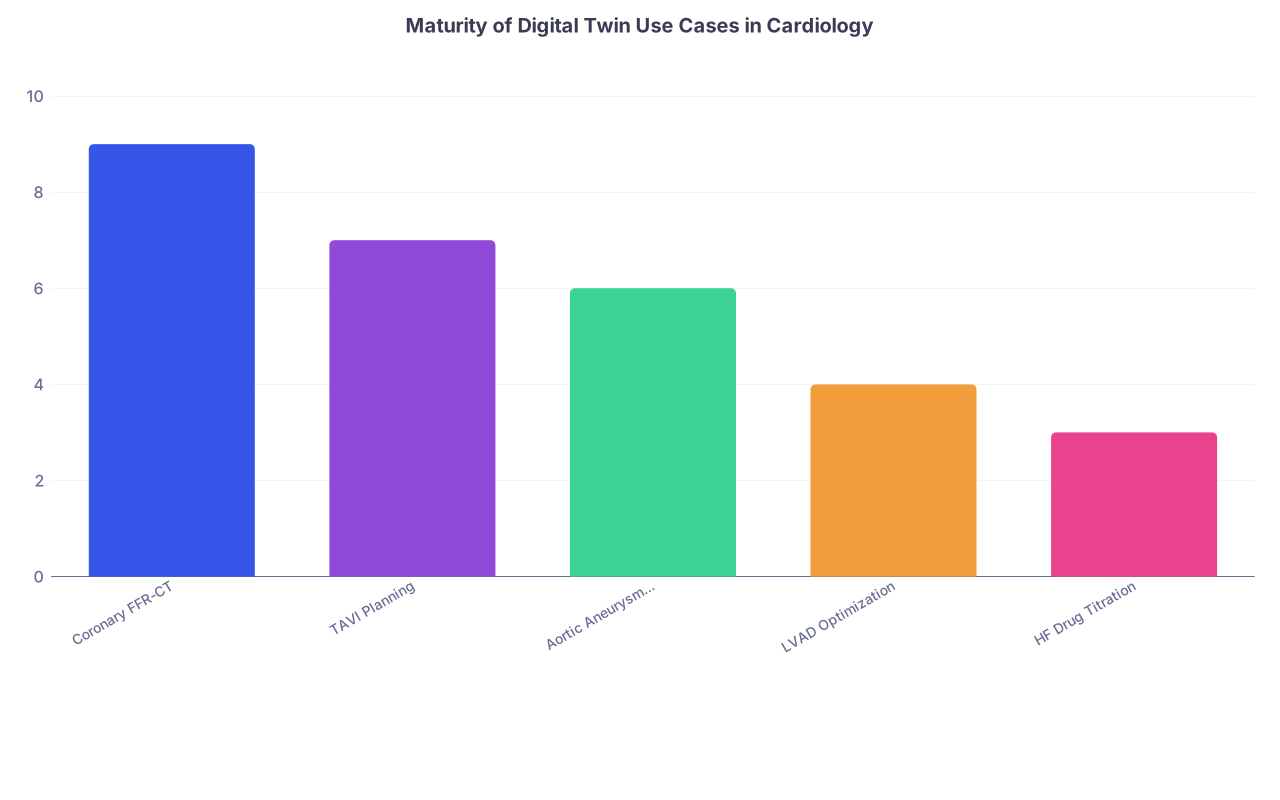
| Category | Value |
|---|---|
| Coronary FFR-CT | 9 |
| TAVI Planning | 7 |
| Aortic Aneurysm Stress | 6 |
| LVAD Optimization | 4 |
| HF Drug Titration | 3 |
(Scale 1–10: 10 = clinically deployed at scale, 1 = pure research.)
Coronary artery disease: virtual FFR and beyond
FFR-CT is already the “gateway drug” for cardiology digital twins.
- Input: coronary CTA
- Process: reconstruct coronary tree, assign microvascular resistances, simulate hyperemic flow, compute pressure drop → virtual FFR
- Output: lesion-level functional significance without a wire
This is a digital twin lite: mostly coronary-centric, limited systemic coupling, but still patient-specific hemodynamics. The next step:
- Extend beyond single-vessel lesions to:
- Multi-vessel disease interaction
- Impact of LV function and microvascular dysfunction
- Predicting hemodynamic changes under different HR/BP scenarios
You can also simulate alternative PCI strategies before touching the patient:
- Stent here vs there
- Different stent lengths and diameters
- Impact of removing serial lesions in different sequences
Not “should we do PCI at all” – that is still a clinical decision – but “if we do, what configuration gives best pressure recovery and minimizes restenosis risk by shear patterns?”
Valve disease and structural heart interventions
TAVI, MitraClip, transcatheter tricuspid repair, LVOT obstruction surgery – these are prime targets.
Pre-TAVI twin:
- 3D aortic root + LVOT geometry from CT
- Aortic valve morphology (bicuspid/tricuspid, calcification pattern)
- LV size and function
- Systemic circulation parameters
Simulation questions:
- What valve size optimizes anchoring without excessive annular stress or coronary obstruction risk?
- How will mean gradient and regurgitation change?
- What will happen to LV afterload and stroke volume post-implant?
For MitraClip-type interventions:
- Model leaflet grasp, regurgitant orifice reduction, LV diastolic filling, LA pressure changes
- Predict whether reducing MR will cause unmasking of LV dysfunction or pulmonary pressure dynamics
There are already pilot studies where 3D structural models plus hemodynamics improved procedural planning and reduced complications. The twin extends that by forecasting whole-circulation consequences.
Aortic aneurysms and dissections
This is where surgeons and cardiologists already appreciate wall stress.
A twin here uses:
- 3D aortic geometry
- Patient-specific BP, flow waveforms
- Vessel wall material properties (estimated from imaging, demographics, maybe genomics in the future)
You get:
- Peak wall stress distribution
- Oscillatory shear index (associated with endothelial dysfunction and progression)
- Predictions under exercise vs rest, or with BP control vs uncontrolled
Translate that into something clinically actionable:
- Risk stratification beyond “max diameter > 5.5 cm”
- Personalized thresholds for surgery in Marfan / Loeys-Dietz / bicuspid disease
- Planning extent of grafting or stent-graft coverage to avoid spinal cord ischemia by simulating flow to spinal collaterals (using 0D/1D + regional 3D).
Heart Failure and Device Therapy: The Next Big Frontier
Coronary and valve twins are the low-hanging fruit. Heart failure is harder. But more interesting.
Whole-heart, whole-circulation HF twins
Imagine a calibrated 0D/1D twin including:
- LV and RV elastance curves (systolic and diastolic)
- Pericardial constraint
- Pulmonary and systemic vascular beds
- Autonomic tone parameters
Feed it:
- Baseline BP, HR, echo-derived SV and EF
- Estimated filling pressures (echo + clinical)
- Mitral/tricuspid regurgitation severity
- Renal function (to approximate volume status dynamics)
Then ask:
- What happens to CO, filling pressures, and renal perfusion if I:
- Increase ACE inhibitor
- Add SGLT2i
- Increase diuretic vs add vasodilator
- Pace biventricularly with specific AV/VV delays
You are not replacing clinical trials. You are tailoring within trial-proven therapies to this physiology.
A skeptic will say: “We already titrate meds based on symptoms and labs.” True. And we undertreat a huge fraction of HF patients because we fly blind on hemodynamic reserves. A twin that reveals “this patient has room to increase afterload reduction without crashing BP” is not trivial.
LVAD and mechanical support
For LVADs, the current practice is still largely trial-and-error speed adjustments plus echo:
- Too low speed – poor unloading, persistent MR, high LVEDP
- Too high – suction events, RV failure, septal shift
A coupled LV–RV–circulation–LVAD digital twin can:
- Predict RV response to different LVAD speeds
- Estimate risk of suction under variable preload (e.g., dehydration, bleeding)
- Evaluate potential benefit of biventricular support versus LVAD alone
I have seen mechanical circulatory support decisions made with incomplete RV assessments that later crashed. A real-time twin in the ICU that updates with arterial line, Swan-Ganz data, and device parameters could prevent those episodes.
How AI Fits In (Without Ruining the Physics)
People tend to polarize: “pure physics” vs “pure AI.” The serious work uses both.
Where AI helps
Segmentation and mesh generation from imaging
- Deep learning for rapid, robust chamber and vessel segmentation
- Automated centerline extraction, lumen/wall separation, plaque characterization
Parameter estimation
- Using prior datasets to generate good initial guesses for resistances, compliances, elastances
- Learning mappings from easy-to-measure variables (age, BP, echo) to harder ones (myocardial stiffness parameters)
Surrogate models
- Train neural networks to approximate outputs of expensive CFD/FEA, allowing near-real-time interaction at the bedside
- Example: once you have simulated thousands of virtual TAVI scenarios, you can predict gradients and regurgitation for new geometries in milliseconds
The golden rule: AI augments, does not replace, the mechanistic core.
You can let AI approximate the solution of the equations. You do not let AI invent new hemodynamics that break conservation of mass or energy. That is how you get pretty nonsense.
Implementation Realities: Why This Is Not Everywhere Yet
If this is so great, why is it not standard of care?
Because the pipeline is heavy, messy, and regulated. Let’s be blunt about the obstacles.
| Barrier | Primary Domain |
|---|---|
| Data quality and consistency | Clinical / Imaging |
| Compute time and infrastructure | Technical |
| Regulatory validation pathways | Regulatory |
| Workflow integration into clinics | Operational |
| Clinician understanding and trust | Educational |
Data and standardization
You cannot build robust twins if:
- Echo reports omit key measurements or use inconsistent methods
- CT/CMR protocols vary wildly between sites
- Hemodynamic data from cath is incomplete or not stored in usable formats
Future: standardized imaging + hemodynamic protocols explicitly designed with digital twins in mind. Think “digital twin-ready” CT: contrast timing, gating, coverage set to support segmentation and flow estimation.
Compute and usability
Full 3D FSI (fluid–structure interaction) simulations for an entire cardiac cycle, with coupled systemic circulation, can take hours on a big server cluster if not optimized.
Solutions emerging:
- Hybrid 0D/1D with localized 3D only where truly necessary
- GPU acceleration and cloud-based platforms
- Surrogate models for interactive planning
Clinicians will not wait overnight to size a valve in a TAVI case list. You either deliver results in minutes or you are irrelevant.
Regulatory and validation
Regulators have a healthy skepticism. They want:
- Prospective, multi-center validation that model-based decisions improve outcomes or reduce harm
- Clear documentation of model limits: in what anatomy, physiology, or data conditions does it break?
- Version control – if the model changes (software update, new physics), you need traceability
The FFR-CT story is instructive: years of validation, clear populations where it works, defined misclassification rates, and specified use cases (e.g., stable chest pain, good quality CTA).
Every new digital twin application will walk a similar path.
Education and trust
Put a beautifully colored wall shear stress map in front of a busy interventionalist who has never heard of Navier–Stokes, and you will get a shrug or mild suspicion.
Digital twins must:
- Present outputs in clinically familiar metrics: gradients, pressures, flows, EFs, valve areas, risk probabilities
- Show uncertainty ranges. Not one magic number.
- Be interpretable – show how changing a parameter leads to specific downstream changes
The test is simple: can a cardiologist use it to make one better decision in a typical clinic or cath lab day without needing a PhD in computational fluid dynamics?
Where This Is Going in the Next 5–15 Years
Let’s be concrete about realistic evolution, not sci-fi.
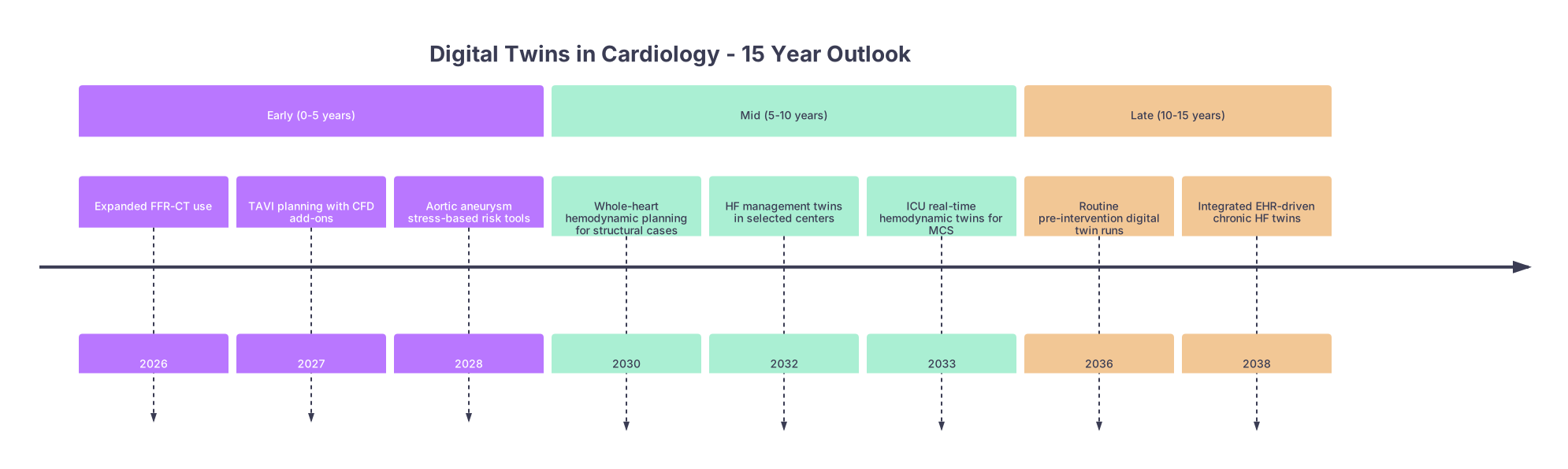
| Period | Event |
|---|---|
| Early (0-5 years) - Expanded FFR-CT use | 2026 |
| Early (0-5 years) - TAVI planning with CFD add-ons | 2027 |
| Early (0-5 years) - Aortic aneurysm stress-based risk tools | 2028 |
| Mid (5-10 years) - Whole-heart hemodynamic planning for structural cases | 2030 |
| Mid (5-10 years) - HF management twins in selected centers | 2032 |
| Mid (5-10 years) - ICU real-time hemodynamic twins for MCS | 2033 |
| Late (10-15 years) - Routine pre-intervention digital twin runs | 2036 |
| Late (10-15 years) - Integrated EHR-driven chronic HF twins | 2038 |
Near-term (0–5 years)
- FFR-CT becomes widespread, especially in systems that want to reduce unnecessary invasive angiography
- Structural heart programs adopt more 3D modeling and modest hemodynamic simulations for TAVI, MitraClip, LAAC
- Aortic centers start using wall stress tools in research and select clinical cases
Twins are still mostly “specialist tools” in high-volume centers.
Medium-term (5–10 years)
- Combined whole-heart + circulation twins for:
- Complex structural interventions where LV, RV, pulmonary circulation, and valves all interact
- Selected HF patients (advanced clinics) to guide device implantation and drug titration
- Real-time or near-real-time hemodynamic twins in ICUs managing LVAD, ECMO, and multi-organ failure
At this point, digital twins start to feel less like research and more like advanced imaging – not used for every patient, but standard for the tricky ones.
Long-term (10–15 years)
- Many patients with chronic cardiovascular disease have a persistent digital twin:
- Updated when they get new imaging, major med changes, or decompensations
- Used to test scenarios: “What if we add ARNI? What if BP control worsens? What if they regain 10 kg?”
- Pre-intervention planning across cardiology:
- Most non-emergent PCIs, ablations, valve interventions run through some flavor of twin prior to the procedure
- Integration with wearables and home monitoring:
- Twins get streaming inputs on HR, BP, activity; can flag hemodynamic deterioration before symptoms explode
Is every piece of this guaranteed? No. But the direction – more physics-based, patient-specific modeling integrated into decisions – is not going away.
FAQs
1. How is a digital twin different from regular computational fluid dynamics (CFD) on a heart or vessel?
CFD alone gives you a fluid simulation in a geometry. A digital twin adds:
- Patient-specific calibration to real hemodynamic measurements
- Coupling to the whole circulation and heart, not just the local region
- Longitudinal use – the same model updated over time for that person
Think of CFD as a tool. The twin is a continuously updated, clinically anchored representation of a patient using that tool plus others.
2. Do digital twins replace invasive tests like cardiac catheterization?
No, not in the foreseeable future. They reduce some invasive tests, especially:
- Diagnostic angiography in stable chest pain
- Some FFR measurements for borderline lesions
But for acute coronary syndromes, complex structural cases, and advanced HF, cath data are often inputs that make the twin more accurate. The relationship is complementary, not competitive.
3. Are these models safe to trust for life-or-death decisions?
“Safe” depends on:
- Rigorous validation in the exact population and use case
- Clear labeling of what the model can and cannot do
- Use as decision support, not autonomous decision-making
You should treat a digital twin result like you treat a new imaging finding: it can strongly influence you, but you do not throw away clinical judgment and everything else you know.
4. What skills does a cardiologist actually need to work with digital twins?
You do not need to derive Navier–Stokes on a whiteboard. You do need:
- A solid grasp of hemodynamics: preload, afterload, compliance, elastance, wave reflections
- Comfort interpreting model outputs (pressures, flows, stresses) and understanding their uncertainty
- Enough modeling literacy to spot nonsense – results that contradict fundamental physiology
The best setups pair cardiologists with engineers or computational scientists. But over time, the expectation will be that a cardiologist can at least “speak the language” of digital twins, the same way interventionalists learned to speak the language of FFR, IVUS, and OCT.
Key points:
- A cardiac digital twin is not a pretty 3D model; it is a patient-calibrated, physics-based system that reproduces and predicts individual hemodynamics.
- The strongest near-term impact is in coronary, structural, and aortic disease planning, with heart failure and mechanical support as the next frontier.
- The barrier is no longer pure science; it is industrializing the pipeline – data, compute, validation, and workflow – so this becomes a routine clinical tool rather than a research toy.