Using AI to Predict ICU Deterioration: Alert Fatigue and Calibration
AI deterioration prediction in the ICU is not failing because the math is wrong. It is failing because the alerts do not behave like clinicians expect a serious warning to behave.
You can have an AUC of 0.93 and still have nurses clicking “acknowledge” reflexively, physicians ignoring pop‑ups, and real deteriorations slipping through because the system cried wolf too often or at the wrong time.
Let me break this down specifically.
What “ICU Deterioration Prediction” Actually Means
ICU deterioration is a lazy phrase that hides several very different clinical targets. If you lump them together, your model’s “performance” will look fine on paper and be useless at the bedside.
Most systems are trying to predict some combination of:
- Need for vasopressors or significant escalation in dose
- Need for new or emergent mechanical ventilation
- Cardiac arrest or rapid response activation
- Unplanned ICU transfer (for ward models)
- Composite “hemodynamic instability” or “respiratory failure” endpoints
In the ICU context, the signal‑to‑noise ratio is already terrible. Patients are critically ill, so “abnormal” is normal. That means a naive early warning style approach—like repurposed ward EWS scores—tends to generate a flood of “high risk” flags that are either obvious to staff or not actionable.
The serious systems in use or under evaluation typically:
- Take in multi‑modal data: vitals, labs, arterial waveforms, ventilator data, meds, nursing flowsheets, sometimes notes.
- Recalculate risk frequently: every 5–15 minutes, or even continuously.
- Output a risk score or tier: 0–1 probability, and/or green / yellow / red buckets.
- Target an event horizon: often 1–12 hours before the bad thing.
Now the key point: predicting deterioration is not the hard part. Predicting it in a way that triggers the right human response, at the right time, without drowning them in garbage—that is where most projects bleed out.
Why Alert Fatigue Is the Central Problem, Not an Annoyance
Alert fatigue is not just “too many beeps.” It is a set of entrenched behavioral adaptations clinicians have developed to survive badly designed systems.
On a real ICU floor, alert fatigue looks like this:
- A nurse glances at yet another “high risk of instability in next 6 hours” and thinks: “He is already intubated, maxed on norepinephrine. What exactly do you want me to do?” Click. Dismissed.
- A resident gets a call at 3 am: “The AI score for bed 7 jumped.” She walks in, sees the patient already on continuous monitoring, arterial line, close to the edge. No new management change emerges. Mentally tags system as “noise.”
- Day shift attendings stop looking at the risk dashboard entirely because by the time they make rounds, the system has flagged half the unit as “high risk” and the output does not map cleanly to actual decisions.
Once clinicians classify your system as “ambient noise,” you are done. You will not get that credibility back with a single ROC curve.
The root drivers of alert fatigue in AI deterioration systems:
Base rate problem
Deterioration events, defined according to some strict composite, are relatively rare even in the ICU. If you want high sensitivity, you will necessarily flag a lot of non‑events, especially if you use static thresholds.Actionability mismatch
Many alerts do not correspond to a specific, reasonable clinical action. If the best anyone can come up with is “monitor closely,” you are going to lose engagement. Clinicians are already monitoring closely.Context‑blind triggers
The model does not know goals of care, code status, planned extubations, or that the patient is in the middle of a known high‑risk intervention. It fires anyway, sounding “urgent” for situations that are fully expected.Temporal clutter
Frequent refresh with overlapping prediction windows means the same patient may trigger near‑identical high‑risk alerts dozens of times over a night. That is not “precision,” that is desensitization.Lack of trustable calibration
A “0.8 risk” that feels the same as “probably nothing” to staff because historically 80% predictions did not correlate with events they cared about. That destroys the signal.
You cannot UX‑your‑way out of this with color codes alone. The math and calibration need to be tailored to human behavior and ICU workflow, not just to statistical accuracy.
Calibration: The Most Abused and Understood Concept in ICU AI
Most people fixate on discrimination (AUC, C‑statistic) and treat calibration as an afterthought. That is backwards for decision support.
What calibration actually is
Calibration asks: when the model says “30% risk,” is the event actually happening about 30% of the time in that group?
- Perfectly calibrated: predicted probabilities match observed frequencies within risk strata.
- Miscalibrated: the model systematically over‑ or underestimates true risk, often in specific subgroups (age, diagnosis, location, etc).
In an ICU deterioration model, poor calibration is not an academic issue. It directly translates into bad behavior:
- If high scores often do not lead to bad events, staff learn to ignore them.
- If low scores are falsely reassuring, staff will rely on them inappropriately.
- If certain patient types (e.g., ARDS vs sepsis vs post‑op) are miscalibrated in different directions, the model becomes unpredictable.
Why calibration is especially fragile in ICU models
ICUs are volatile environments. Key reasons calibration suffers:
- Case mix shifts: A new ECMO program, more liver transplants, or COVID‑like surges can completely alter baseline risk.
- Therapeutic drift: New vasopressor protocols, conservative ventilation practices, early mobilization—these shift outcomes without changing raw physiologic inputs much.
- Documentation and device changes: New monitors, new EHR or flowsheet templates, slight changes in how “shock” or “pressors” are recorded can poison features.
- Cross‑site transport: Models trained at a quaternary center deployed at a community hospital have different baseline risk and treatment capabilities.
A model that was beautifully calibrated on the internal test set at Hospital A in 2019 is usually miscalibrated at Hospital B in 2024. Sometimes catastrophically.
Calibration curves, not just Hosmer–Lemeshow
The minimum serious approach:
- Plot calibration curves across deciles or more granular bins of predicted risk.
- Stratify by relevant subgroups: medical vs surgical ICU, sepsis vs cardiac, age bands, invasive vs non‑invasive support.
- Use calibration intercept and slope metrics; investigate especially high‑risk deciles—for alerting, that tail is what drives behavior.
A flat but nicely diagonal curve averaged over 10,000 patients can hide the fact that your post‑op cardiac surgical cohort is massively over‑predicted while your ARDS cohort is under‑predicted.
From Probability to Alert: Thresholding, Workload, and PPV
The question that will kill or succeed your system is not “Is AUC > 0.85?” It is “At what operating point do we make noise, and what workload does that create?”
You are effectively choosing a risk threshold: above this, we notify someone.
Two crucial quantities:
- Positive Predictive Value (PPV): proportion of alerts that correspond to real events.
- Alert rate per clinician per shift: how many times a human’s attention is interrupted.
Let us make this concrete.
Imagine an ICU with:
- 30 beds
- Average length of stay of 4 days
- Composite deterioration event rate of 10% per patient‑day in a typical high‑acuity MICU (varies, but use something in that ballpark)
- You run the model every hour and alert on risk > 20%
If your model:
- Has high sensitivity (say 0.85) at this threshold
- But relatively poor PPV (say 0.2) in this setting
You might end up with:
- 100 alerts per day, of which 20 correspond to real deterioration within the horizon, and 80 do not lead to any concrete change in management.
Spread across 5 nurses and 2 residents, 100 alerts per day is a disaster. They will mute it or mentally tune out.
To staff, what matters is not “sensitivity 0.85 at 0.2 PPV.” What matters is:
- “I got 8 alerts this shift. 7 of them did not change what I did. One was arguably useful.”
That is how your PPV and thresholding decisions feel at the bedside.
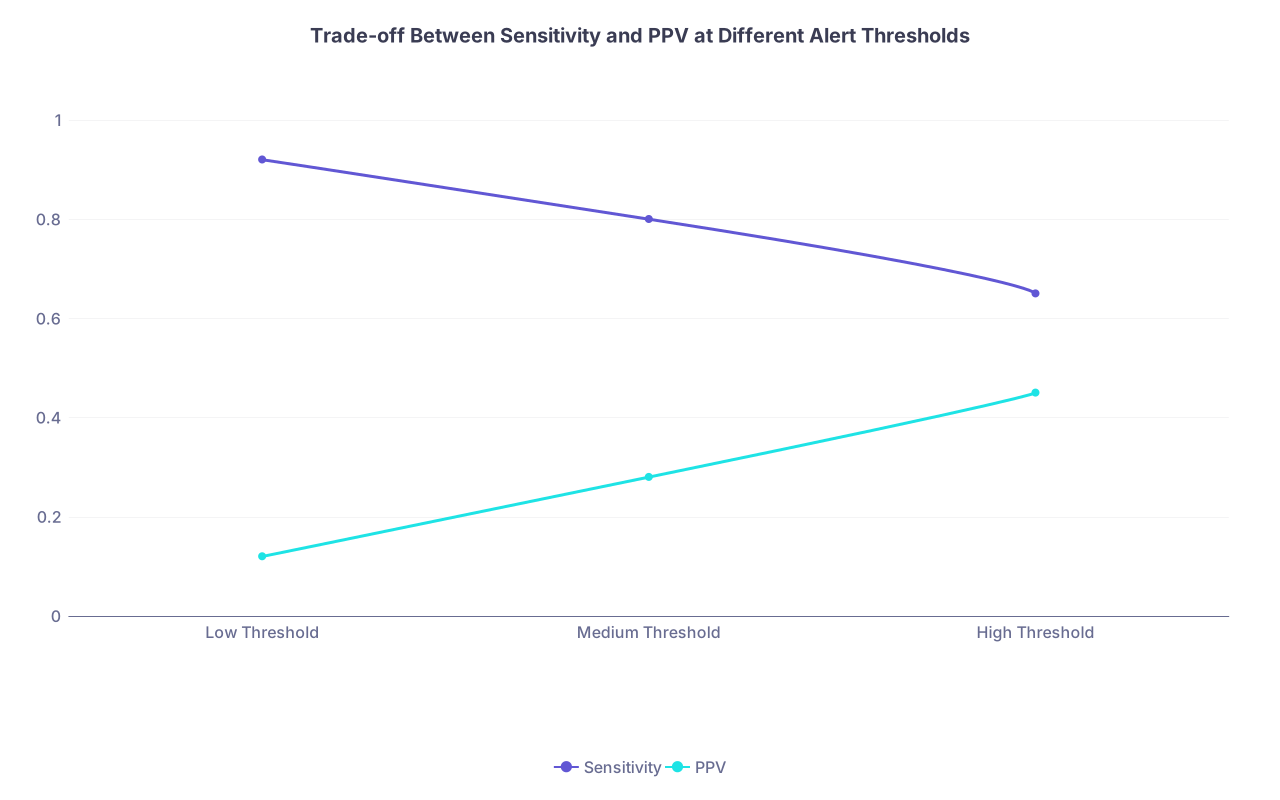
| Category | Sensitivity | PPV |
|---|---|---|
| Low Threshold | 0.92 | 0.12 |
| Medium Threshold | 0.8 | 0.28 |
| High Threshold | 0.65 | 0.45 |
You will not get a perfect trade‑off. But you must select an operating point explicitly based on:
- How many alerts per bed per day is acceptable?
- For which event are we optimizing? Cardiac arrest? Pressor start? Resp failure?
- What staff group will respond, and what is their realistic capacity?
If you do not have these discussions up front, your system will default to “maximize sensitivity” and die of alert fatigue.
Practical Calibration Strategies That Actually Help With Alert Fatigue
You have two intertwined problems:
- The numeric predictions must correspond to real probabilities in your population.
- The mapping from those probabilities to alerts must align with human capacity and priorities.
Here is what I have seen work in real ICU deployments.
1. Aggressive local recalibration
Do not ship an external model into your ICU and just “monitor performance.”
You recalibrate on local data, ideally:
- Use Platt scaling or isotonic regression on your own historical ICU cohort.
- Retrain or at least re‑fit the output layer using a recent time window (last 12–24 months).
- Re‑evaluate calibration every 3–6 months and adjust.
Yes, that means maintaining a data pipeline and a basic MLOps process. If you are not prepared to do that, you are not prepared to run a high‑stakes AI system.
2. Separate “prediction” from “alarm policy”
Stop baking the alert threshold into the model itself. Treat them as separate entities:
- Model outputs a continuous risk score 0–1.
- A separate “alarm policy layer” decides when and to whom to alert.
That policy layer can incorporate:
- Thresholds that differ by ICU type (surgical vs medical), time of day, or staffing level.
- Constraints like “no more than X alerts per bed per shift unless risk exceeds Y%.”
- Suppression rules: do not alert for patients with comfort‑focused orders, do not re‑alert within 60 minutes for the same tier unless risk increases by a large margin.
You are essentially tuning a queuing system, not just a classifier.
3. Calibrate around tiers, not just raw probabilities
Clinicians do not want to interpret continuous probabilities while running a code. They want intelligible risk tiers that mean something.
For example:
- Green: risk < 5%
- Yellow: 5–15%
- Orange: 15–30%
- Red: > 30%
But here is the key: those cut points must be calibrated to your local base rates and to what “red” means behaviorally.
If “red” alerts happen 20 times a day and half are false positives, nobody will distinguish them from “orange.” If “red” occurs once every 3 days and is almost always associated with a patient who genuinely worsens, people will respond.
So you might:
- Fix the expected number of red alerts per 24 hours (e.g., 2–4 per 30‑bed unit) and tune the threshold to hit that volume, then check PPV and sensitivity.
- Do similar tuning for orange and yellow tiers, but route them differently (dashboards rather than push alerts, for instance).
Designing Alerts That Clinicians Will Not Immediately Ignore
Even with perfect calibration and thresholds, you can still lose the human side. ICU clinicians are constantly triaging auditory, visual, and cognitive input.
Some concrete design decisions that matter.
Who gets what, and how
Not all alerts should page everyone.
Reasonable routing scheme:
- Red (very high risk): direct interruptive alert to bedside nurse and covering resident, maybe pop‑up on central monitor.
- Orange (moderate risk): appear in a ranked list on a team dashboard, reviewed on rounds, possibly generate a soft notification.
- Yellow (mildly elevated): no interruptive alert. Just color‑coding and trend visualization for interested users.

| Step | Description |
|---|---|
| Step 1 | Model Risk Score |
| Step 2 | Interruptive alert |
| Step 3 | Dashboard priority list |
| Step 4 | Background display |
| Step 5 | Bedside nurse |
| Step 6 | Resident or NP |
| Step 7 | Charge nurse review |
| Step 8 | Discuss on rounds |
| Step 9 | Risk Tier |
If you broadcast everything to everyone, you are guaranteeing alert fatigue.
Provide context, not just a score
A black box “Risk: 0.31” is useless in a 12‑hour shift.
Better: “Risk 31% (baseline 8%). Drivers: rising lactate, escalating norepinephrine, tachypnea trend up, urine output down.”
Even better if you explicitly show trajectory: “Risk doubled in last 2 hours.”
The point is not interpretability for its own sake. The point is helping the clinician decide:
- Is this aligned with what I already know?
- Is there something here I underestimated or missed?
- Do I need to re‑prioritize this patient today?
Tie alerts to suggested actions (carefully)
You do not tell clinicians what to do, but you nudge them toward concrete steps.
For example, a red alert could be accompanied by:
- “Checklist: confirm MAP goal, review vasopressor dosing, repeat lactate if not done in last 4h, review ventilator settings, re‑assess volume status.”
If 70% of red alerts end up with “no change” in the chart, that is still useful if the team consciously decided that no change was appropriate. The real danger is when alerts vanish into muscle memory without any deliberate reassessment.
The Real‑World Deployment Mess: Data Quality, Drift, and Governance
Let us talk about why many ICU AI projects that look shiny in publications quietly disappear after a year.
Data is noisier than the paper suggests
Your model might rely on:
- Arterial line waveform‑derived features. But the line is overdamped half the time, zeroed late, or transduced from the wrong level.
- Nursing flowsheet entries with wide variability in timing and semantics.
- “Start of vasopressor” defined in 3 different ways between ICUs.
When this noise hits your inputs, both discrimination and calibration degrade, and the system starts producing erratic alerts. Clinicians notice quickly.
You need:
- Pre‑deployment validation on raw production data, not the clean research warehouse.
- Continuous upstream monitoring of data feed completeness and stability.
Concept drift is relentless
Maybe the ICU adopts earlier vasopressor initiation with lower MAP thresholds. That will completely change the meaning of “start of vasopressor” as an outcome marker.
Or the unit starts a new protocol for sepsis bundles, reducing deterioration rates among certain subgroups without obvious changes in vital signs patterns.
Your model, frozen in time, keeps predicting high risks that no longer materialize. PPV collapses. Alert fatigue skyrockets.
The only real defense is governance:
- Scheduled performance and calibration review: quarterly at minimum.
- Drift detection hooks: track baseline event rates, input distributions, and risk score distributions over time.
- A defined process to pause, retrain, or recalibrate models when drift is detected.
Human governance: who owns this thing?
Every ICU AI system should have a named clinical owner and a named technical owner.
- Clinical owner: intensivist or ICU director responsible for answerable questions like “Why are we getting 50 red alerts per day?” and “Should we change thresholds?”
- Technical owner: data scientist / informatics lead responsible for monitoring performance, recalibration, and integration reliability.
Without this, the system becomes “IT’s thing” that clinicians do not trust, or “research’s thing” that ops does not feel obligated to support.
Measuring Success: Beyond AUC and Pretty Dashboards
Here is where many groups stop: they publish model performance metrics and maybe show time‑to‑event curves. That is not enough.
You need explicit pre‑ and post‑deployment metrics on at least three levels:
| Metric Type | Example Measure |
|---|---|
| Model performance | AUC, calibration slope/intercept |
| Alert performance | Alerts per bed per day, PPV, recall |
| Clinical workflow | Time to escalation, RRT calls, LOS |
Model performance
- AUC / AUROC
- Calibration plots
- Brier score
Alert performance
- Alerts per bed per day, by tier
- PPV and sensitivity at the alert thresholds actually used
- Distribution of clinician responses (how often did alerts lead to orders, notes, or documented reassessment?)
Clinical outcomes / process measures
- Time from physiologic deterioration to intervention (pressor start, intubation)
- Rapid response / code blue rates
- ICU length of stay, mortality (careful: many confounders)
- Staff‑reported alert burden and perceived usefulness (properly surveyed, not just anecdotes)
If after six months:
- Your alerts per bed per day are high
- PPV is poor
- Staff satisfaction is low
- And there is no measurable improvement in time‑to‑intervention
Then it does not matter how “advanced” the model is. You have a failed deployment.
The Future: Where ICU Deterioration AI Needs to Go
Right now, most deployed or near‑deployed ICU deterioration systems are still embarrassingly primitive compared to what they could be. A few directions that actually matter.
Integrated treatment‑aware models
Risk prediction should not ignore the treatment trajectory. Starting norepinephrine at 0.02 and titrating up tells you something different than holding steady at 0.1 for 12 hours.
Next‑generation models will:
- Condition risk on likely future treatment paths (counterfactual modeling).
- Distinguish “deterioration despite therapy” from “stable high risk that is being actively managed.”
- Maybe even suggest what change in therapy would most reduce predicted risk (while still keeping human clinicians decisively in charge).
Patient‑specific baselines, not population averages
The sick chronic COPD patient living at a PaCO₂ of 70 with chronic hypercapnia should not be treated like a normocapnic ARDS patient.
Temporal and personalized modeling:
- Use each patient’s own baseline as the reference (e.g., their first 6–12 hours in ICU)
- Focus on deviation from that baseline rather than absolute values
- Potentially reduce false positives for chronically abnormal but stable states
Multi‑modal and unstructured data integration
Most current models over‑rely on structured vitals and labs. But clinicians use:
- Notes, impressions, consult recommendations
- Imaging trends, not just reports
- Procedural context
As NLP and representation learning mature in healthcare, you will see deterioration predictors:
- Incorporate text from notes to understand that “planned extubation” is occurring, and avoid raising panic when vitals transiently worsen.
- Recognize that a patient is peri‑procedural, not “spontaneously crashing.”
That is essential to reducing nonsensical alerts.
Human–AI collaboration tools, not just warning lights
The best future systems will:
- Allow clinicians to simulate “what if?” scenarios (e.g., “If we wean norepi by 0.02, what happens to predicted risk?”).
- Provide transparency at the level of “which patterns in the last 3 hours drove risk up?” rather than inscrutable feature attributions.
- Adapt to user feedback—if clinicians repeatedly mark certain alerts as “not helpful,” the system can reconsider thresholds or contexts.
Without this bi‑directional loop, you have static automation, not an evolving clinical partner.
Three Things to Remember
- Predicting ICU deterioration is easy; predicting it in a way that clinicians trust and act on without burning out from alerts is the real challenge.
- Calibration and alert policy—how predicted risk is turned into specific, routed, and rate‑limited alerts—are more important to bedside impact than squeezing another 0.02 out of the AUC.
- Successful ICU AI demands continuous local recalibration, explicit governance, and hard metrics on alert quality and workflow impact, not just pretty ROC curves.