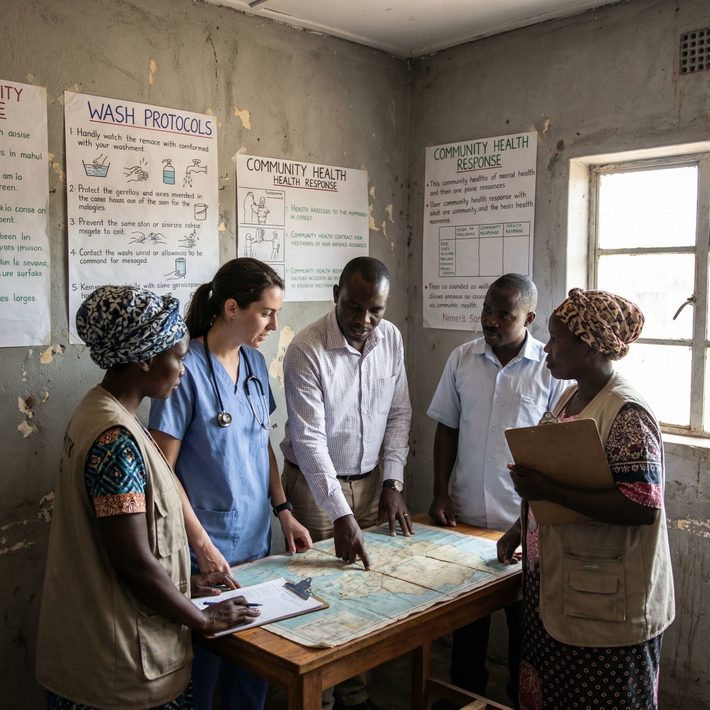
You're staring at your ERAS application. Three research projects, solid boards, a letter from a well-known attending. And there, sitting in your experiences list like a questionable third date, your two-week medical mission trip to Guatemala. You're wondering: does this help me, or does it make me look like I couldn't decide what I cared about?
I've watched this exact scenario play out in advising sessions dozens of times. Students who spent a summer in a resource-limited clinic, came back transformed, and now face the awkward question of how, or whether, to feature that experience when their residency goal is something entirely different. They worry that global health looks like a distraction. They're often right to worry. But they're wrong to think the solution is burying it.
Let's walk through how to handle this depending on where you're actually applying.
The Reality Check: Why Global Health Isn't a Silver Bullet
There's a myth in premed and medical student circles that global health experiences automatically make you a more compelling applicant. Call it the Global Health Halo. You go somewhere difficult, you work hard, you see things most classmates didn't, and you assume program directors will weight that heavily.
They won't. Or more precisely, they won't weight it the way you think.
I've sat on enough application review committees to tell you what actually moves the needle. Research with meaningful output, publications, posters, conference presentations, moves it. Leadership roles with demonstrable impact move it. Consistent clinical experience in your target specialty moves it. A two-week trip abroad? It registers. But it registers the same way a hobby registers: interesting, humanizing, not decisive.
The real problem isn't that global health lacks value. It's that many applicants use it as filler. When you don't have a compelling research narrative, you lean on the mission trip. When you haven't done much specialty-specific volunteering, you highlight the clinic you ran in Honduras. And program directors can smell this dynamic immediately. They see an application that's trying to be interesting rather than an application that knows what it is.
That's the unfocused applicant. Not someone with diverse experiences, but someone whose experiences don't cohere into a story.
Your job isn't to hide your global health work. You did it, it mattered, and pretending otherwise would be both dishonest and strategically foolish. Your job is to contextualize these experiences so they support, rather than compete with, your primary career narrative. A surgical applicant who spent time in a Kenyan district hospital shouldn't bury that experience. She should frame it as evidence of adaptability, resourcefulness, and comfort with clinical decision-making under constraint. That's a surgical asset. The trip becomes a data point in a surgical story.
The distinction sounds subtle. In practice, it changes everything about how reviewers perceive you.
Scenario 1: You're Applying for a Competitive Specialty (e.g., Derm, Ortho, Plastics)
Let's be blunt about the hierarchy of needs here.
For ultra-competitive specialties, program directors are looking for evidence you can do the work and evidence you'll succeed in their environment. That means USMLE scores first. Then research output, specifically research relevant to their field. Then letters from people they know and trust. Then clinical grades, particularly in related rotations. Somewhere well below all of that, they'll notice your volunteer experiences, global or domestic.
This doesn't mean your global health experience is worthless. It means you need to be strategic about where and how it appears.
Deprioritize it on your CV. If space is tight, and for competitive specialty applicants, it always is, move your mission trip to the Volunteer Experiences section rather than giving it prime real estate in your most significant experiences. One entry, briefly described, with the dates and location. Don't pad it. Don't make it sound more dramatic than it was.
Keep it out of your Personal Statement unless it directly informs your specialty choice. This is the mistake I see most often. The applicant writes 200 words about their transformative experience in rural Ecuador and then tries to pivot to why they love dermatology. The pivot never lands. It reads as: "I went abroad, it was meaningful, and then I decided I wanted to do something completely unrelated." That's not a narrative. That's a non sequitur.
The rare exception: if your global health experience genuinely shaped your interest in the specialty. A student who worked in a burn unit in Uganda and is now pursuing plastics reconstruction, that connection works. A student who did a general medical mission and is applying to dermatology because they "want to help people", that doesn't.
If you must discuss it, frame it around transferable soft skills. "Cultural competence" is fine but generic. Better: talk about adapting clinical reasoning to resource-limited settings. Working through an interpreter. Managing patient expectations when you can't offer the standard workup. These skills matter when you're treating diverse domestic populations, and competitive specialties increasingly care about that. Frame it as adaptability under pressure. That's a skill that translates to any specialty.
Don't manufacture a connection that isn't there. Better to feature your global health experience as one line on your CV and spend your personal statement on what actually drives your specialty interest. A coherent story beats a dramatic one every time.
Scenario 2: You're Applying for Primary Care (FM, IM, Peds)
Good news: this is where your global health experience actually helps you.
Primary care residencies, family medicine especially, value exactly the things global health work tends to develop: community engagement, comfort with social determinants of health, patient advocacy, and the ability to care for diverse populations with varied needs. When you're applying to FM, a mission trip isn't a distraction. It's evidence you understand what primary care actually involves.
But even here, the framing matters enormously.

Stop framing it as "saving people." This is the savior narrative, and experienced primary care reviewers hate it. They've seen too many personal statements that read like a travel diary crossed with a hero's journey. "The people of [country] had so little, but they taught me so much", if I had a dollar for every version of that sentence I've read, I'd retire.
Instead, reframe your experience as learning from systemic challenges. What did you observe about healthcare delivery inefficiencies? What did you learn about how clinics function when resources are scarce? What did you discover about triage decision-making when you can't order the test you'd order at home? These are professional insights, not emotional reactions. They make you sound like a future colleague, not a tourist with a stethoscope.
Connect the logistics abroad to challenges at home. Here's what works: "Working in a clinic where we had to ration medications taught me to think carefully about what patients actually need versus what's available. I want to bring that kind of resource-conscious thinking to caring for underserved communities in [city]." That's a bridge. It turns your trip into a professional insight that predicts how you'll practice domestically.
Primary care programs in underserved areas will love this. They're training you to work in environments that, while not identical to rural Guatemala, share challenges: limited time, limited resources, complex social needs. Show them you already understand that work, even if the context was different.
In your Personal Statement, spend real estate on this connection. Unlike the competitive specialty applicant, you can and should integrate global health into your narrative here, but still, do it through professional lessons rather than emotional transformations. Talk about what you learned about systems. Talk about what you observed about continuity of care. Talk about the patient who couldn't follow up because of distance, and how that mirrors problems in your future community.
That's the version that makes you look thoughtful. The version that makes you look like someone who'll still be doing this work in ten years.
Structuring Your Narrative: The 'Bridge' Method
Most applicants fail at featuring global health not because they lack the experience, but because they describe it badly. Let's fix that.
Kill the vacation language immediately. Words to eliminate from your application: "adventure," "discovery," "eye-opening," "unforgettable," "life-changing," "memorable." Every one of these screams that you were a tourist who happened to do some medicine. You're not writing a blog post. You're writing a professional document.
Also kill the sightseeing references. Don't mention the scenery, the food, the cultural excursions, the "beautiful people." None of it belongs. If you find yourself writing "the lush mountains of [country] formed the backdrop to my clinical experience," delete the sentence and ask yourself what you actually did clinically.
Use the Bridge Framework. The goal is to create a logical link between what you did abroad and what you'll do in residency. The bridge has two anchors: the activity itself, and the skill or insight it developed. The second anchor must connect to your target specialty.
Example for Surgery: Don't write about "witnessing surgical disparities." Write about maintaining sterile technique in an operating room where the power went out mid-procedure. That demonstrates attention to detail, adaptability, and the ability to function in less-than-ideal conditions. Surgeons respect that. They know complications happen. They want residents who don't fall apart when the plan changes.
Example for Psychiatry: Don't write about "seeing mental health stigma abroad." Write about navigating conversations about depression with patients whose families saw psychiatric symptoms as spiritual affliction. You had to find language that respected their beliefs while still advocating for treatment. That's cultural humility with direct clinical application, and it's exactly what you'll need working with diverse patient panels in any US psychiatry program.
Example for Emergency Medicine: Describe the triage decisions you made when three patients needed attention and you had one blood pressure cuff. That's EM every day. The setting was different, but the cognitive demand was identical.
Example for Pediatrics: Talk about explaining a difficult diagnosis to parents through an interpreter, without the safety net of a child life specialist or follow-up appointment. That's communicating under pressure. It's relevant everywhere.
Notice what these examples have in common: they focus on what you did and what you learned, not what you felt. Feelings go in your journal. Competencies go in your application.
Also notice that none of these examples require your global health work to be the centerpiece of your application. They're integrated. They support a larger story about who you are as a clinician. That integration is what separates the focused applicant from the unfocused one.
The Bottom Line
Your global health experience isn't a liability, but it's not an asset by default either. It becomes an asset when you contextualize it properly for your target specialty, or when you have the discipline to keep it in the background if it doesn't fit.
Competitive specialties: minimize it, deprioritize it, and never force it into your Personal Statement unless the connection is genuine.
Primary care: leverage it, but reframe it from emotional transformation to professional insight. Show what you learned about systems, not what you felt about sunsets.
Every specialty: use the Bridge Method. Connect what you did to what you'll do. Focus on competencies, not feelings. Kill the vacation language.
And remember, program directors read thousands of applications. They can tell the difference between someone who went abroad to grow and someone who went abroad to check a box. Your job is to make sure your application makes clear which one you were.