
Introduction: Why Tools Matter for Leadership in Medical Teams
Leadership in Healthcare is no longer limited to attendings and department chairs. Residents, fellows, and even senior medical students routinely find themselves coordinating Medical Teams, leading rounds, managing crises, and driving quality-improvement projects. In this environment, having the right Communication Tools, Project Management platforms, and clinical systems is just as important as clinical knowledge.
The demands of modern healthcare—rapid patient turnover, complex co-morbidities, regulatory requirements, and evolving Telemedicine models—mean that even excellent clinicians can struggle if they lack systems to support their leadership. Thoughtful use of digital tools can:
- Streamline communication and reduce errors
- Improve handoffs and continuity of care
- Enhance interprofessional collaboration
- Support data-driven decision-making
- Reduce burnout by organizing work more efficiently
This expanded guide reviews top tools you can use to enhance your effectiveness as a leader in medical teams—especially relevant for residents and early-career physicians. We’ll move beyond simple product descriptions and focus on how to use each category of tool strategically in real clinical and academic settings.
Foundations of Effective Leadership in Healthcare
Before diving into specific tools, it’s important to understand what they are supporting. No app can compensate for poor leadership fundamentals—but the right tools can amplify strong leadership.
Core Leadership Traits in Medical Teams
Effective healthcare leaders, at any level, tend to demonstrate:
Empathy and psychological safety
Understanding the pressures your team faces—night float fatigue, double-coverage in the ED, competing academic deadlines—helps you create an environment where people feel safe speaking up about concerns and errors.Clear, structured communication
Using closed-loop communication, SBAR, and standardized handoff formats. Tools help, but the underlying communication discipline comes first.Adaptability and resilience
Adjusting to changing census, system outages, new institutional protocols, and unexpected crises (e.g., mass casualty events, code situations).Integrity and accountability
Owning decisions, being transparent about limitations, and following through on commitments to patients and colleagues.Vision and situational awareness
Seeing beyond the next admission: anticipating staffing constraints, discharge barriers, and long-term process improvements.
The tools discussed below are most powerful when anchored in these traits—think of them as force multipliers rather than substitutes for leadership.
Digital Communication Platforms: The Backbone of Team Coordination
In busy clinical environments, fragmented communication is a common root cause of errors. Modern communication platforms can centralize information flow, reduce interruptions, and facilitate real-time collaboration—especially across shifts and sites.
Slack: Structured Channels for Clinical and Academic Teams
While HIPAA and institutional policies may limit direct use of Slack for identifiable patient data, it is extremely effective for non-PHI coordination in academic medical centers:
How residents commonly use Slack:
- Residency-wide channels for announcements (rotations, schedule changes, wellness events)
- Rotation-specific channels (e.g., MICU residents + fellows + pharmacists)
- QI or research project workspaces for file sharing and discussion
- “On-call” channels for debriefing challenging cases and supporting peers
Leadership tips for using Slack effectively:
- Pin key protocols and checklists in channel headers
- Create standardized channel naming conventions (e.g.,
#inpt-micu,#research-qipsurgery) - Use threads for specific cases/topics to avoid clutter
- Set expectations: what belongs in Slack vs. EHR messaging vs. pages
Microsoft Teams: Integrated Collaboration Within Health Systems
Many hospitals standardize on Microsoft Teams because of its integration with Outlook, SharePoint, and Office 365—often making it the default Communication Tool outside the EHR.
Use cases for clinical leaders:
- Organizing interdisciplinary case conferences and morbidity & mortality (M&M) reviews via video calls
- Sharing PowerPoint teaching slides and OneDrive files with rotating interns
- Hosting virtual sign-out or pre-round huddles when teams are split across sites
- Running remote QI meetings when schedules make in-person gatherings difficult
Leadership advantages:
- Persistent chat and file history maintains institutional memory
- Channels for each committee or workgroup help prevent “lost” email threads
- Screen sharing allows for real-time review of guidelines, dashboards, and project plans
In both Slack and Teams, leaders must model professional communication standards, especially with trainees—no PHI in non-approved spaces, respectful tone, and avoid message overload.

Project Management Tools: Bringing Order to Complex Clinical Work
Leadership in Healthcare is not only about shift-based clinical care; residents and fellows are often responsible for multi-step projects: quality improvement initiatives, research protocols, curriculum design, and system changes. Project Management tools formalize these efforts so they don’t stall or live only in someone’s inbox.
Trello: Visual Task Boards for Clinical and QI Workflows
Trello uses Kanban-style boards with lists and cards—ideal for visualizing progress.
Practical uses in residency and hospital leadership:
- Quality Improvement Projects
- Lists: “Ideas,” “Planning,” “In Progress,” “Testing,” “Implemented,” “Monitoring”
- Cards: each PDSA cycle, data-collection phase, or intervention sub-task
- Discharge Planning Workflows (de-identified or aggregate)
- Cards for process steps: patient education materials, follow-up scheduling, medication reconciliation
- Curriculum Design
- Cards for lectures, simulations, assessments with due dates and assigned faculty/residents
- Quality Improvement Projects
Leadership tips with Trello:
- Assign owners and due dates to every task—“ownerless” cards rarely move
- Use labels to distinguish clinical, administrative, and academic tasks
- Review boards in short, regular check-ins rather than long, infrequent meetings
Asana: Robust Project Management for Larger Initiatives
Asana offers more structure—subtasks, timelines, dependencies—well-suited for multi-site projects or program-level initiatives.
Common use cases:
- Residency Program Improvements
- Tracking milestones: new rotation design, onboarding resources, wellness program rollout
- Hospital-wide Clinical Pathways
- From stakeholder meetings and protocol drafting to EMR order set builds and training
- Research Project Management
- IRB submission steps, data collection phases, analysis timelines, manuscript preparation
- Residency Program Improvements
Leadership strategies in Asana:
- Create templates for recurring projects (e.g., annual QI cycles, orientation)
- Use dashboards to track progress and identify bottlenecks early
- Integrate with email or Slack so tasks don’t get siloed
For residents, demonstrating proficient use of these Project Management tools signals to attendings and administrators that you can lead change efforts systematically, which is valuable for fellowship and job applications.
Clinical Information Systems: Leading Through Electronic Health Records
Electronic Health Record (EHR) systems are not just documentation tools—they’re powerful platforms for team coordination, data visibility, and process standardization, making them central to Leadership in Healthcare.
Epic Systems: Leveraging Features Beyond Notes and Orders
Epic is widely used across academic and community hospitals. Effective leaders don’t just “use” Epic; they optimize it for team and system performance.
High-yield leadership features in Epic:
- InBasket and secure messaging:
- Create clear norms around response times and appropriate message use
- Utilize team pools (e.g., “Inpatient Medicine Team A”) for shared responsibilities
- SmartPhrases and SmartTexts:
- Develop standardized templates for common notes, discharge instructions, and patient education
- Share useful phrases across residents to reduce variation and save time
- Patient Lists and shared lists:
- Use team lists for rounds to ensure everyone views the same patient panel and flags
- Reporting and dashboards (if enabled for your role):
- Track length of stay, readmissions, sepsis bundle compliance, etc., for QI work
- InBasket and secure messaging:
Leadership opportunities with Epic:
- Join or create an “Epic champions” group for your residency
- Advocate for order set improvements when you see recurring system issues
- Lead micro-teaching around efficiency tools during rotations
Cerner and Other EHRs: Similar Principles, Different Interfaces
Cerner, Meditech, and other EHRs share similar capabilities, though workflows differ.
- Leadership strategies regardless of EHR platform:
- Identify “super users” among staff and leverage their knowledge
- Create quick-reference guides or short recorded demos for interns
- Incorporate EHR optimization into QI projects (e.g., simplified order sets to reduce errors)
By mastering and shaping EHR workflows, you move from being a passive user to a system-level leader, directly influencing patient safety and team efficiency.
Data Analytics Tools: Driving Data-Informed Medical Leadership
Effective Medical Teams increasingly rely on data, not just anecdotes, to guide changes in care processes. Leaders who can interpret, visualize, and communicate data have a distinct advantage.
Tableau: Visualizing Outcomes and Operational Metrics
Tableau enables you to turn raw hospital data into interactive dashboards that leadership and frontline staff can understand at a glance.
Sample use cases in residency and hospital leadership:
- Monitoring readmission rates for your resident service
- Visualizing time-to-antibiotics in sepsis or door-to-needle times for stroke
- Tracking QI metrics: catheter days, fall rates, CLABSI, or VTE prophylaxis compliance
- Analyzing clinic no-show patterns to design better reminder systems
Leadership best practices with Tableau:
- Start with questions: “What decision will this dashboard inform?”
- Use simple, intuitive visuals (avoid cluttered charts)
- Share dashboards in standing meetings (e.g., service huddles, QI rounds)
- Link visualized data to specific action plans
AI-Driven Analytics (e.g., IBM Watson Health)
Platforms like IBM Watson Health and other AI analytic tools can help synthesize large bodies of clinical data, literature, and outcomes.
Potential leadership applications:
- Identifying high-risk patient subsets for targeted interventions
- Comparing institutional outcomes to benchmarks or national guidelines
- Supporting discussions with hospital administration for resource allocation based on data
Practical constraints for trainees:
- You may not directly configure these tools, but you can:
- Learn to interpret their outputs
- Ask critical questions about biases and limitations
- Advocate for pilot projects where AI-driven insights can improve care
- You may not directly configure these tools, but you can:
Being comfortable with data analytics positions you as a clinician who can bridge the gap between frontline care and institutional decision-making.
Collaboration Suites and Digital Whiteboards: Enabling Interdisciplinary Work
Healthcare is inherently team-based. Tools that support shared thinking, brainstorming, and document creation are critical for leading complex projects and educational efforts.
Miro: Visual Collaboration for Process Mapping and Education
Miro functions as a digital whiteboard, excellent for remote or hybrid teams.
Use cases for medical leaders:
- Process mapping a patient journey (e.g., ED arrival to inpatient discharge) with nurses, case managers, and physicians
- Designing clinical pathways or algorithm flowcharts in collaboration with multiple specialties
- Planning simulation scenarios or educational curricula with faculty and chiefs
- Conducting virtual retrospectives after a difficult rotation or code event
Leadership tips:
- Use templates (SWOT analysis, fishbone diagrams) for QI and root cause analysis
- Invite input from all disciplines—Miro allows multiple contributors at once
- Save boards as institutional artifacts for future reference
Google Workspace: Real-Time Document Collaboration
Google Docs, Sheets, and Slides (or their Microsoft 365 equivalents) are core tools for:
Docs: Creating shared protocols, clinical guidelines, manuscript drafts, orientation manuals
Sheets: Tracking data collection for QI, scheduling, or call schedules
Slides: Co-developing teaching decks with co-residents or faculty
Leadership practices:
- Use clear naming conventions and shared drives (e.g., “IM Residency > QI Projects > 2025 Sepsis Initiative”)
- Control access appropriately—who can view vs. edit
- Use comments and suggestion mode to facilitate asynchronous collaboration
These tools are especially valuable when coordinating interdepartmental initiatives, where participants have different schedules and limited overlapping availability.
Feedback, Performance, and Culture Tools: Building Stronger Teams
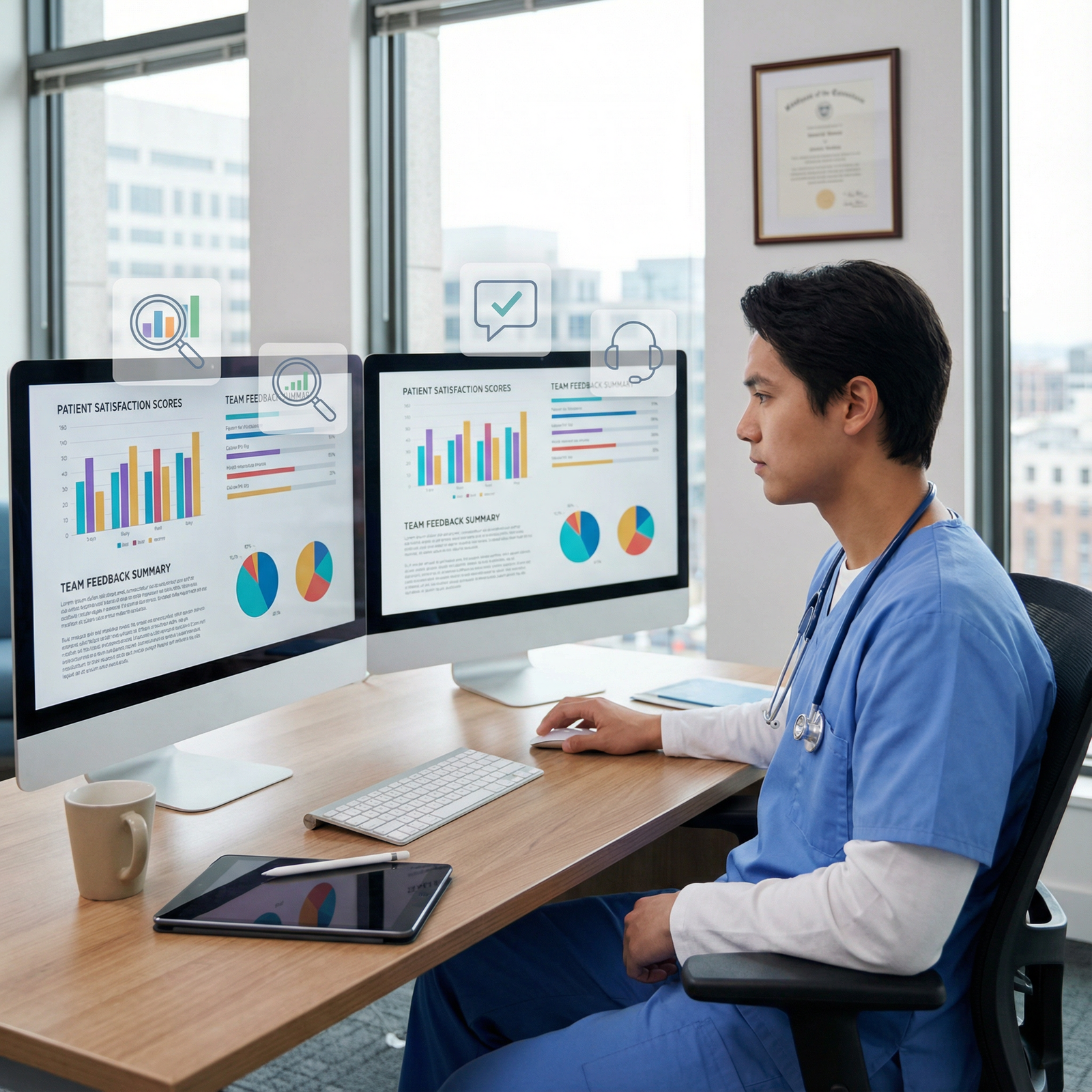
Leadership in Healthcare also involves nurturing your team’s growth and creating a psychologically safe environment. Feedback and performance tools underpin that culture.
Qualtrics and Survey Tools: Listening to Patients and Teams
Qualtrics is a sophisticated survey and experience management platform, but similar principles apply to simpler tools like Google Forms or REDCap surveys.
How medical leaders can use these tools:
- Anonymous resident or nursing feedback on new workflows or rotations
- Pre- and post-intervention surveys for QI projects
- Collecting patient-reported outcomes or satisfaction (with institutional approval)
- Rapid-cycle polls (e.g., which teaching formats residents find most valuable)
Leadership actions:
- Share results transparently (within reason) and outline specific actions taken
- Repeat surveys at set intervals to monitor change over time
- Avoid survey fatigue by keeping instruments focused and concise
Lattice and Performance Platforms: Structured Growth and Coaching
While tools like Lattice are more common in corporate environments, healthcare institutions increasingly use them or similar platforms to manage performance and development.
Potential uses in academic medicine:
- Setting and reviewing individualized learning plans for residents
- Tracking competency-based milestones and EPA (Entrustable Professional Activity) progress
- Facilitating 360-degree feedback from nurses, peers, and allied health professionals
Leadership mindset:
- Use performance data to support—not punish—trainees
- Pair feedback with concrete development plans and resources
- Recognize and celebrate improvement, not just highlight gaps
Intentional use of feedback tools fosters continuous improvement, which is central to high-functioning Medical Teams.
Training, Development, and Telemedicine: Leading in a Hybrid Clinical World
Remaining clinically current and adaptable to new care models is a core leadership responsibility.
Medical Education Platforms: Medscape, HealthStream, and Beyond
Continuous learning platforms support both your own development and that of your team.
Medscape:
- Point-of-care review of conditions and treatments
- CME activities relevant to your specialty
- Summaries of new guidelines you can disseminate during teaching rounds
HealthStream (and similar systems):
- Mandatory institutional training (e.g., infection control, sepsis bundles, compliance)
- Specialty-specific modules that residents can assign or recommend to juniors
- Tracking completion for credentialing or rotation requirements
Leadership opportunities:
- Curate recommended modules for specific rotations (e.g., ICU rotation prep list)
- Integrate online resources into structured teaching (e.g., pre-reading for conferences)
- Use completion data to identify educational gaps
Telemedicine Platforms: Leading Virtual and Hybrid Care
Telemedicine is now entrenched in healthcare delivery, from ambulatory clinics to inpatient consults and follow-up.
Teladoc Health and Enterprise Telemedicine Solutions
Eked-out clinic schedules, distant rural patients, and surge situations demand flexible care models.
- Leadership roles with Telemedicine:
- Designing workflows for virtual visits: pre-visit screening, documentation, billing
- Ensuring equity in digital access (language support, technology assistance)
- Supporting residents in developing best practices for virtual physical exams and rapport-building
- Monitoring metrics like no-show rates, visit duration, and patient satisfaction
Doxy.me and Lightweight Telehealth Tools
Platforms like Doxy.me offer straightforward, browser-based, HIPAA-compliant video visits.
Practical use cases:
- Quick follow-up visits that don’t require in-person assessment
- Transition-of-care check-ins post-discharge
- Remote family meetings when key decision-makers cannot be physically present
- Virtual team huddles when cross-institutional collaboration is needed
Leadership considerations in Telemedicine:
- Train team members on privacy, consent, and documentation standards
- Develop contingency plans for technical failures
- Standardize how urgent findings are escalated from virtual visits
These Telemedicine tools expand your ability to lead patient care across settings, coordinate Medical Teams that are not co-located, and maintain continuity in crises (e.g., pandemics, severe weather).
Frequently Asked Questions: Leadership Tools for Residents and Medical Teams
1. I’m a busy resident. Which leadership tools should I start with first?
Start with the tools that directly impact your daily workflow and are already approved by your institution:
- Your EHR (Epic, Cerner): learn advanced features—SmartPhrases, shared lists, efficient documentation.
- Your hospital’s main communication platform (Teams, secure messaging in EHR): clarify norms and use structured messaging.
- A simple project board (Trello or Asana) for your QI or research projects.
Mastering these three areas quickly boosts your effectiveness as a leader without overwhelming you with extra platforms.
2. How can I make sure these tools don’t add to burnout or screen fatigue?
Tools should reduce friction, not increase it. To avoid burnout:
- Consolidate: use a small number of platforms consistently instead of many overlapping apps.
- Set boundaries: turn off non-essential notifications outside of call hours.
- Standardize: agree as a team on where specific types of communication belong (e.g., urgent = page, non-urgent = EHR message).
- Automate: use templates, macros, and recurring tasks to reduce repetitive work.
If a tool seems to be adding more work than it saves, re-evaluate how you’re using it.
3. Are there privacy or compliance issues with using tools like Slack or Google Docs in healthcare?
Yes—this is critical. You must follow institutional policies and regulations:
- Never include identifiable patient information (PHI) in non-approved tools.
- Use only HIPAA-compliant, institutionally sanctioned platforms for clinical content.
- For external tools (Slack, Trello, Google Docs), restrict usage to:
- De-identified data
- Process maps and protocols
- Educational and administrative content
- When in doubt, check with your compliance office or program leadership before adoption.
4. How can I demonstrate leadership experience with these tools on residency or fellowship applications?
Be specific and outcome-oriented:
- Describe a project, not just a tool:
- “Led a QI project using Asana to coordinate a multidisciplinary team, reducing average discharge time by 1.5 hours over six months.”
- Highlight your role:
- “Configured Epic smart order sets and championed their adoption among interns.”
- Emphasize measurable impact:
- Improvements in patient outcomes, process metrics, or team satisfaction.
Program directors are increasingly looking for applicants who can drive system improvements—not just provide excellent individual patient care.
5. What’s the most important leadership skill to pair with these tools?
The most important complementary skill is clear, structured communication. Regardless of the platform:
- Use concise subject lines or message headers.
- Clarify who is responsible for each task and by when.
- Confirm understanding using closed-loop communication, especially for clinical decisions.
- Invite feedback and questions to ensure psychological safety.
When strong communication practices meet the right tools, you build Medical Teams that are safer, more efficient, and far more resilient.
Explore more ways to enhance your leadership skills in healthcare through our related resources:
Leadership Development in Medicine
Effective Team Communication in Healthcare
Data-Driven Decision Making in Medical Leadership
Transformational Leadership in Healthcare