

Introduction: Why Medical Leadership as Chief Resident Matters
Medical leadership is no longer optional in modern healthcare—it is central to safe patient care, effective Healthcare Education, and resilient clinical teams. Among the many leadership roles in academic medicine, the Chief Resident position is often a physician’s first formal step into Medical Leadership and Clinical Management.
The Chief Resident is much more than “the senior resident.” This role serves as:
- A liaison between residents and attending physicians
- A key architect of the residency’s learning climate
- A front-line leader in patient care and systems improvement
- A visible role model for professionalism, teamwork, and resilience
For residents aspiring to leadership in medicine—whether in academic practice, hospital administration, quality and safety, or medical education—understanding the responsibilities and opportunities of the Chief Resident year is essential. This expanded guide explores the scope of the role, the skills required to succeed, and the real-world impact Chief Residents can make on Patient Care and the future of healthcare systems.
The Core Role of the Chief Resident in Medical Leadership
At its heart, the Chief Resident position lies at the intersection of three major domains: administrative duties, educational leadership, and clinical leadership. Strong performance in one area is not enough; the most effective Chiefs integrate all three to support patients, residents, and the broader program.
1. Administrative Duties: The Operational Backbone of Residency
Administrative responsibilities consume a significant portion of a Chief Resident’s time. Done well, they create the foundation for safe staffing, resident well-being, and high-quality Patient Care.
Scheduling and Coverage Management
One of the most visible tasks is schedule creation and maintenance:
Rotation and call schedules:
Designing monthly or block schedules to ensure adequate coverage across inpatient services, outpatient clinics, night float, and electives.Duty hours and regulatory compliance:
Ensuring adherence to ACGME work hour rules (e.g., 80-hour work week limits, required time off between shifts), while still meeting service and educational needs.Real-time problem-solving:
Covering unexpected gaps due to illness, emergencies, or personal crises—often requiring rapid reshuffling and negotiation while protecting fairness and resident wellness.
Actionable tip: Future Chief Residents should seek early exposure to scheduling (e.g., as a senior resident assistant scheduler) to understand the complexity before taking on full responsibility.
Conflict Resolution and Professional Climate
Chief Residents frequently serve as first-line mediators:
Resident–resident conflicts:
Interpersonal tensions, communication breakdowns, or perceived inequities in workload.Resident–faculty or resident–staff issues:
Concerns about feedback style, supervision level, or perceived mistreatment.Process for addressing concerns:
Listening to all parties, maintaining neutrality, documenting issues when appropriate, and escalating to the Program Director or GME office when needed.
Effective conflict resolution requires emotional intelligence and the ability to preserve relationships while addressing problems. Skilled Chiefs help create a psychologically safe environment where residents feel comfortable raising concerns.
Policy Development and Program Governance
Chief Residents are often invited to participate in program and departmental leadership discussions:
Residency handbook and policy revision:
Updating expectations for professionalism, leave policies, evaluation processes, and remediation pathways.Onboarding and orientation processes:
Helping define what new interns must know and do in their first weeks—both clinically and culturally (e.g., how the team communicates, escalation protocols).Committee participation:
Serving on program evaluation, clinical operations, or patient safety committees, bringing the resident perspective into institutional decision-making.
This involvement offers early exposure to the governance and regulatory side of Clinical Management, a critical skill set for those interested in future leadership roles.
Quality Improvement and Systems-Based Practice
Chief Residents commonly lead or co-lead quality improvement (QI) initiatives:
Identifying system problems:
Recurrent delays in discharge, frequent communication failures, or pattern of near-misses.Designing interventions:
Developing checklists, standard order sets, new communication protocols, or educational efforts.Data tracking and outcome measurement:
Collaborating with QI teams to collect and analyze metrics (e.g., readmission rates, sepsis bundle compliance, time-to-antibiotics).
Participation in QI projects not only improves Patient Care but also builds a strong leadership and scholarship portfolio for Chief Residents considering academic careers.
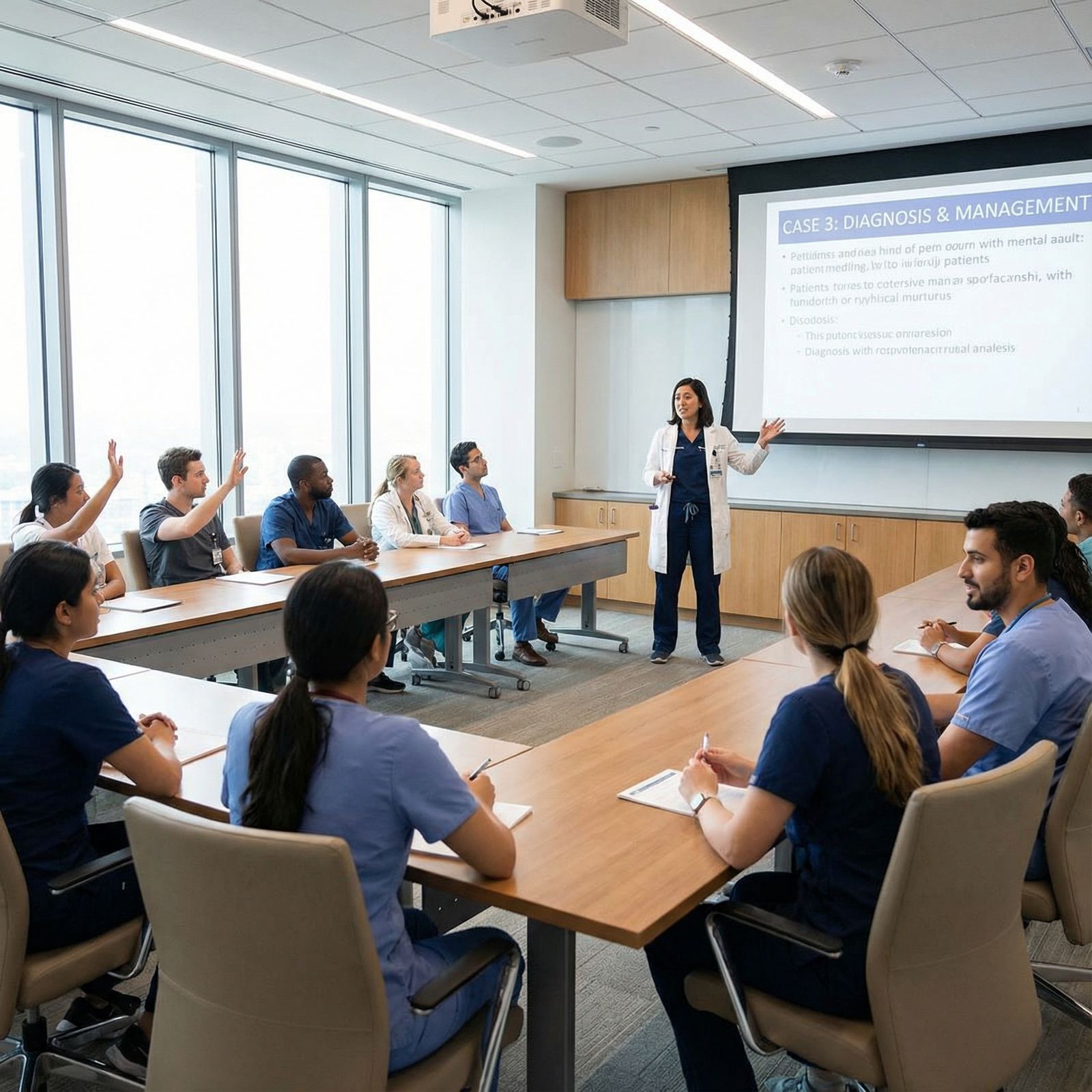
Educational Leadership: Shaping Healthcare Education and Training
Beyond operations, Chief Residents are central figures in Healthcare Education. They influence how residents learn, how feedback flows, and how the curriculum evolves.
2. Educational Responsibilities: Teacher, Coach, and Advocate
Teaching, Mentoring, and Role Modeling
Chief Residents are expected to be highly effective near-peer educators:
Teaching formats:
- Morning report and noon conference
- Bedside teaching on rounds
- Simulation sessions (codes, procedure practice, difficult conversations)
- Case-based discussions and board review sessions
Mentoring and coaching:
Providing longitudinal support to junior residents and interns—helping them develop clinical judgment, navigate remediation when needed, and plan for exams and career choices.Role modeling:
Demonstrating how to communicate with nurses, consulting services, and families; how to disclose errors; and how to manage stress and burnout in high-acuity settings.
Actionable tip: Aspiring Chief Residents can build credibility by investing early in teaching skills—seeking formal teaching electives, feedback from faculty on teaching style, and involvement in student education.
Orientation and Transition Support
The way a program onboards new learners can define their entire training experience. Chief Residents often design and execute:
Intern orientation:
- Hospital systems and logistics (EMR, paging, order entry, call rooms)
- Safety protocols and escalation chains
- Common clinical scenarios they will face in the first month
Senior resident transitions:
Helping PGY-2s or PGY-3s transition to supervisory roles, including how to give feedback, run a medical ward, and lead family meetings.Mid-year refreshers or boot camps:
Re-educating returning residents on high-acuity care before ICU rotations or new subspecialty rotations.
These efforts improve both Patient Care and resident confidence, particularly during vulnerable transition periods.
Curriculum Design, Evaluation, and Continuous Improvement
Chief Residents frequently collaborate with program leadership to ensure the curriculum remains relevant and effective:
Gathering resident feedback:
Using surveys, focus groups, or informal check-ins to learn what is and isn’t working in conferences, rotations, and didactics.Curricular innovation:
Adding new content areas such as ultrasound, health equity, telemedicine, or leadership training based on resident needs and evolving healthcare trends.Aligning with competencies:
Mapping educational activities to ACGME competencies and milestones, ensuring residents are meeting expected levels in medical knowledge, systems-based practice, and interpersonal skills.
Facilitating Feedback and Evaluation
Chief Residents often sit at the nexus of the feedback ecosystem:
Collecting evaluations:
Encouraging completion of evaluations of faculty, rotations, and peers—ensuring data needed for program improvement is captured.Delivering feedback:
- One-on-one performance discussions with residents
- Debriefing after challenging codes or cases
- Providing specific, behavior-based, and actionable feedback rather than vague criticism
Supporting remediation:
Working with the Program Director to support residents who are struggling academically, clinically, or professionally, while maintaining confidentiality and compassion.
Developing a reputation for fair, honest, and constructive feedback is a hallmark of an effective Chief Resident and a core component of Medical Leadership.
Clinical Leadership: Guiding Teams and Safeguarding Patient Care
Chief Residents maintain an active presence on the front lines of clinical work. Their clinical leadership is crucial in complex, high-stakes environments.
3. Clinical Responsibilities in Day-to-Day Care
Clinical Supervision and Team Coordination
Chief Residents, depending on specialty and program structure, may:
Supervise inpatient teams:
Overseeing multiple teams or services, ensuring patients receive timely assessments, appropriate diagnostic workups, and evidence-based care.Model clinical reasoning:
Making their thought process explicit—why one test is ordered over another, risk-benefit calculations, or how to narrow differentials.Support interprofessional collaboration:
Partnering with nursing, pharmacy, social work, and case management to create cohesive care plans.
In this Clinical Management role, the Chief Resident sets expectations for teamwork, communication style, and respect across disciplines.
Decision-Making and Advocacy in Complex Cases
Chief Residents frequently serve as:
The “resident voice” in multidisciplinary meetings:
Representing the experiences and constraints of frontline providers during case conferences, morbidity and mortality rounds, and hospital committees.Escalation leaders:
Knowing when to involve attendings, subspecialty consultants, risk management, or ethics consults in difficult or high-risk clinical situations.Patient and family communication support:
Coaching junior residents through breaking bad news, goals-of-care conversations, and conflict with families, while stepping in directly when needed.
These experiences sharpen both medical judgment and leadership under pressure.
Crisis Management and High-Acuity Events
Emergencies are inevitable in residency settings. Chief Residents play a key role in:
Rapid response and code leadership:
Running codes or supervising code teams, ensuring ACLS protocols are followed while delegating tasks efficiently.Mass casualty or surge events:
Helping coordinate resident deployment, triage decisions, and communication chains during unexpected surges (e.g., pandemics, disasters).Debriefing after crises:
Leading hot debriefs immediately after a resuscitation or critical event to identify system issues, address emotional impact, and reinforce learning points.
Effective crisis leadership is a defining element of Medical Leadership and profoundly affects both Patient Care and team resilience.
Fostering Team Culture, Wellness, and Professionalism
Chief Residents are culture-setters:
Modeling professionalism:
Punctuality, respectful communication, appropriate documentation, honesty about errors, and commitment to follow-through.Promoting wellness and burnout prevention:
Identifying overburdened residents, coordinating coverage for medical or mental health needs, and advocating for realistic workload expectations.Encouraging inclusivity and psychological safety:
Addressing microaggressions, supporting diverse residents and staff, and fostering an environment where questions and concerns are welcomed.
This aspect of Clinical Management is as critical as any scheduling or curriculum work; it shapes whether a program is perceived as supportive or toxic.
Essential Skills for Success as a Chief Resident
Thriving in the Chief Resident role requires a broad skill set that blends clinical excellence with leadership competencies.
4. Core Competencies of Effective Chief Residents
Advanced Communication Skills
Strong communication underpins nearly every Chief Resident responsibility:
Clear, concise clinical communication:
Handoffs, consult requests, and updates to attendings must be accurate and efficient.Difficult conversations:
Delivering critical feedback, addressing professionalism concerns, or conveying policy changes that may be unpopular.Upward and downward communication:
Translating resident concerns to leadership, and leadership directives to residents—in a way each group can understand and accept.
Chief Residents who invest in communication training (e.g., workshops, simulation, feedback from mentors) are better equipped for both current and future Medical Leadership roles.
Emotional Intelligence, Empathy, and Interpersonal Skills
Empathy is not a “nice-to-have”—it is essential:
Understanding context:
Recognizing when a resident’s performance issues may be related to stress, illness, family events, or burnout.Building trust:
Maintaining confidentiality when appropriate, following through on commitments, and being consistently fair.Navigating hierarchy:
Respecting attending authority while still advocating for resident needs and patient-centered changes.
These skills are crucial not only for Residency Life and Challenges but for later leadership in any healthcare setting.
Leadership, Management, and Delegation
Chief Residents must learn to lead peers—one of the most challenging forms of leadership:
Setting expectations:
Clarifying team norms, goals for rotations, and standards for professionalism.Delegating tasks:
Assigning responsibilities based on ability and workload, rather than trying to do everything personally.Managing up and across:
Negotiating with attendings, nursing leadership, and administrators for resources, support, or change.
Leadership training programs, mentorship from prior Chief Residents, and deliberate reflection can help build these capabilities.
Critical Thinking, Problem Solving, and Systems Thinking
Beyond bedside decision-making, Chiefs must think at the systems level:
Diagnosing system problems:
Distinguishing between individual errors and system failures (e.g., confusing order sets, inadequate staffing).Balancing competing priorities:
Patient safety, resident education, service needs, and institutional constraints rarely align perfectly; Chiefs must make nuanced tradeoffs.Innovation mindset:
Seeing challenges as opportunities to design better workflows, educational approaches, or communication pathways.
This broader perspective is central to long-term Medical Leadership and quality improvement careers.
Time Management, Organization, and Adaptability
Juggling clinical work, teaching, meetings, and administrative responsibilities requires:
Structured time-blocking:
Setting aside dedicated time for email, scheduling, QI work, and academic projects.Boundary setting:
Communicating availability and learning to say no when requests threaten to overwhelm capacity.Flexibility:
Adapting quickly to new institutional policies, EMR upgrades, changing staffing models, or crises such as pandemics.
Chief Residents who establish sustainable routines and seek support avoid burnout and model healthy professionalism.

Real-World Impact: How Chief Residents Shape the Future of Medicine
The Chief Resident year is often transformative. It provides experience and visibility that can open doors to broader Medical Leadership roles.
5. Case Examples: From Chief Resident to Physician Leader
Case 1: Building a Mentorship Culture
Dr. Jane Doe, an Internal Medicine Chief Resident, recognized that interns in her program felt isolated and overwhelmed. She:
- Conducted a needs assessment via anonymous survey
- Partnered with faculty to create a structured mentorship program pairing interns with senior residents and attendings
- Developed a brief mentor training workshop focusing on active listening and career guidance
- Tracked outcomes such as intern satisfaction, retention, and perceived support
Within one year, the program saw improved morale and lower attrition. Dr. Doe later became an Associate Program Director, expanding mentorship efforts across multiple departments.
Case 2: Improving Sepsis Care Through Clinical Management
Dr. John Smith, a Chief Resident in a large academic hospital, noticed variability in sepsis recognition and management. Leveraging his leadership position, he:
- Collaborated with the hospital’s QI department to analyze baseline sepsis outcomes
- Organized interdisciplinary team meetings with emergency medicine, ICU, nursing, and pharmacy
- Helped implement a standardized sepsis bundle in the EMR, with automatic alerts and order sets
- Led targeted education for residents and nurses, including simulation of septic shock scenarios
The initiative led to faster antibiotic administration, improved lactate monitoring, and reduced sepsis-related mortality. Dr. Smith later built a career in hospital quality leadership.
These stories illustrate how the Chief Resident role can serve as a launchpad for lasting impact on patient care, healthcare systems, and Education.
The Path Forward: Evolving Leadership in Medicine and Residency Training
As healthcare becomes more complex—value-based care, digital health, interprofessional teams—the need for physicians skilled in Medical Leadership and Clinical Management will only grow.
6. Preparing Future Chief Residents and Physician Leaders
Training programs and residents themselves can take proactive steps to strengthen leadership pipelines:
Integrate leadership training into residency:
Workshops on conflict resolution, negotiation, systems thinking, and change management.Offer early leadership roles:
Resident committees, quality councils, teaching chief or wellness chief positions to build experience before the full Chief Resident role.Encourage scholarship in medical education and QI:
Supporting residents to present their projects at conferences, publish in journals, and engage with national organizations.Normalize mentorship and sponsorship:
Connecting aspiring leaders with faculty mentors who can guide their development and advocate for opportunities.
Chief Residents sit at the center of this evolution—they both benefit from and help create the culture that will shape the next generation of physician leaders.
FAQ: Chief Resident Responsibilities, Challenges, and Career Impact
1. What qualifications are typically needed to become a Chief Resident?
Programs vary, but common qualifications include:
- Consistently strong clinical performance and professionalism
- Demonstrated commitment to teaching and mentoring
- Positive peer and faculty evaluations, especially around teamwork and reliability
- Interest in Medical Leadership, Healthcare Education, or Clinical Management
- Often, evidence of involvement in QI projects, curriculum development, or resident committees
Selection usually involves review by the Program Director and faculty, with resident input in some programs.
2. How does the Chief Resident role directly enhance patient care?
Chief Residents improve Patient Care by:
- Ensuring safe staffing and appropriate supervision through effective scheduling
- Leading QI initiatives that streamline care pathways and reduce errors
- Providing real-time teaching and supervision at the bedside
- Facilitating interdisciplinary communication and problem-solving
- Promoting a culture of safety, accountability, and continuous improvement
Their dual lens—understanding both front-line challenges and institutional priorities—uniquely positions them to influence care quality.
3. What are the most common challenges Chief Residents encounter?
Common challenges include:
- Balancing clinical duties with heavy administrative and educational responsibilities
- Mediating conflicts among peers while maintaining trust and neutrality
- Coping with emotionally taxing situations such as resident burnout, medical errors, or remediation processes
- Navigating the tension between service needs and educational priorities
- Avoiding personal burnout and maintaining work–life balance during an intensely demanding year
Success often depends on strong mentorship, clear boundaries, and institutional support.
4. How can serving as a Chief Resident impact future career opportunities?
The Chief Resident year is highly valued in many career paths:
- Academic medicine: Frequently seen among future program directors, clerkship directors, and Deans for Education.
- Hospital and system leadership: Prepares physicians for roles in quality, safety, operations, or Clinical Management.
- Subspecialty careers: Strengthens fellowship applications by demonstrating leadership, teaching, and QI experience.
- Community practice: Provides skills in team leadership, practice management, and patient safety that translate directly to group practices.
Many institutions see former Chief Residents as natural candidates for emerging leadership roles.
5. Is the Chief Resident role similar across all specialties and programs?
While core themes are similar—administration, education, and clinical leadership—the specifics vary by:
Specialty:
Surgical Chiefs may focus more on OR scheduling and perioperative care; Psychiatry Chiefs may emphasize psychotherapy training and community mental health resources; Emergency Medicine Chiefs may focus on flow, throughput, and shift scheduling.Program size and structure:
Larger programs may have multiple Chiefs with divided roles (e.g., inpatient, outpatient, education, wellness). Smaller programs may require Chiefs to wear many hats simultaneously.Institutional culture:
Some programs grant Chiefs substantial autonomy and leadership authority; others define the role as more operational.
Understanding the expectations of your specific program early is crucial for success.
By fully engaging in the Chief Resident role—with its blend of Medical Leadership, Healthcare Education, and Clinical Management—physicians can profoundly influence their programs, their patients, and their own careers. The skills developed during this pivotal year form the foundation for a lifetime of leadership in medicine.


