

Most residents think “leading rounds” means talking more. They are wrong. It means structuring chaos so everyone else can talk better.
If you are a resident, especially a senior, your real promotion is not PGY-2 or PGY-3. It is the day everyone on the unit silently turns to you in rounds to answer: “So…what are we doing for this patient?”
That moment is leadership. And interdisciplinary rounds is where your communication either levels up—or exposes you.
Let me break this down specifically.
Why Interdisciplinary Rounds Feel So Hard
Interdisciplinary rounds are not just “longer rounds with more people.” They are a different animal.
You are balancing:
- Competing priorities (bed control vs. safe discharge vs. teaching vs. throughput).
- Multiple hierarchies (medical, nursing, case management, rehab, administration).
- Time pressure (charge nurse glaring at the clock, ED waiting for beds).
- Emotional load (family conflict, moral distress, burnout in the team).
And you have to do all that while:
- Presenting clinically coherent plans.
- Teaching juniors.
- Not sounding indecisive in front of your attending.
- Not ignoring nursing or case management concerns.
When residents struggle, it is almost never because their medical knowledge is weak. It is because their communication architecture is sloppy.
You need structure. Not scripts. Frameworks you can run at 7:15 am on hospital day 19 with your pager going off.
Core Principle: You Are Not the Star, You Are the Conductor
Your main job during interdisciplinary rounds: turn individual expertise into a shared plan.
Not:
- “Impress the attending.”
- “Talk longest.”
- “Solve every problem in real time.”
Your mindset shift:
From “I have to answer everything”
→ to “I have to ask the right next question.”From “I must look competent”
→ to “I must make the team competent together.”
That sounds fluffy. It is not. It shows up in very concrete behavioral changes. We will go through them.
A Simple, Rigid Spine: The Rounds Micro-Structure
Residents who lead good interdisciplinary rounds use a repeatable pattern. Every single patient. Almost boringly consistent.
You need something like this:
- Open and orient.
- Concise medical update.
- Nursing input first.
- Allied health input (SW, CM, PT/OT, pharmacy).
- Synthesize and state the plan.
- Close with checks and assignments.
The content varies by service and hospital, but the order should barely move.
Let us build a concrete version.
Step 1: Open and Orient (10–20 seconds)
Before patient 1, not at noon conference.
You:
“Alright, for rounds this morning: we will focus on three things for each patient—medical stability, barriers to discharge, and safety issues. I will give a very brief update, then I will go to nursing first, then others. If you have something, jump in when your discipline is called. If we cannot solve it in 60–90 seconds, we will flag it for a follow-up huddle. Sound good?”
You have just:
- Set priorities.
- Defined speaking order.
- Created permission to defer long issues without dismissing them.
This stops the common disaster scenario: first patient turns into a 15-minute social work deep dive and everything derails.

| Step | Description |
|---|---|
| Step 1 | Start Rounds |
| Step 2 | Orient Team |
| Step 3 | Patient Brief Update |
| Step 4 | Nursing Input |
| Step 5 | Allied Health Input |
| Step 6 | Synthesize Plan |
| Step 7 | Confirm Tasks and Safety |
Step 2: Concise Medical Update (30–45 seconds)
Residents blow time here. They re-present the H&P. They read the overnight note.
You want a “disposition-focused update”:
“Mr. Jones, 68, hospital day 4 for decompensated HFrEF. Hemodynamically stable, on 2 L NC, net -1.5 liters past 24 hours, creatinine stable at 1.2. Main issue now is optimizing diuresis while we plan for safe discharge, probably in 1–2 days if PT and home supports are adequate.”
Key features:
- One-line identity + “why still here”.
- Up to 3 status bullets (vitals, trend, key lab/imaging).
- Explicit timeframe for disposition (“likely 1–2 days”).
That last part—specific timeframe—is what everyone else on the team cares about most and what almost no junior says out loud.
Step 3: Nursing First, Every Time
This is non-negotiable. If you go to social work or pharmacy before nursing, you will eventually miss safety issues. Also, you signal that the person actually at the bedside is secondary. Bad look.
You:
“Can I start with nursing—any overnight issues, safety concerns, or things that would change our plan?”
You are not asking for a re-presentation. You want:
- Overnight events.
- Pain issues.
- Delirium, falls, agitation.
- Practical barriers (patient refusing meds, refusing PT, family conflict, no IV access).
When a nurse hesitates:
“I’m particularly interested in anything making care harder or less safe for you or the patient.”
That phrase—“for you or the patient”—unlocks real info. I have heard:
- “He insists on getting up alone and almost fell twice.”
- “The daughter keeps overriding the plan; staff are uncomfortable.”
- “He has been refusing blood draws and meds; we are not getting labs.”
Those are not “minor” issues. They are the day’s work.
Advanced Technique #1: The 4-Box Synthesis for Each Patient
After the medical update and inputs, your brain should organize information into four invisible boxes:
- Clinical stability
- Discharge trajectory
- Safety / risk
- Unfinished decisions
Then you say the quiet part out loud.
Example:
“Alright, for Mr. Jones, from a clinical stability perspective he is improving and likely stable for the floor with 2 L NC. For discharge trajectory, we are tentatively targeting tomorrow if PT clears him for home and we can arrange home nursing for weights and diuretic support. From a safety standpoint, biggest risk is falls with his shortness of breath and nocturia, so we will keep the bedside commode and reinforce calling for help. Unfinished decisions are whether cardiology wants to adjust his GDMT before discharge; I will page them after rounds.”
Notice the pattern:
- You translate scattered input into a coherent frame.
- You do not let “we’ll see” stand unchallenged.
- You publicly assign yourself follow-up work.
Does it sound formal? At first, yes. By day 3, it becomes your normal speaking style and everyone unconsciously aligns around those four domains.
Advanced Technique #2: Tight Turn-Taking Without Cutting People Off
You have to be ruthless with time without being a jerk. Residents either let everyone ramble, or they chop people mid-sentence and destroy trust.
You want preemptive framing and soft interrupts.
Preemptive frame, before content-heavy roles:
“To keep us on time, let’s focus comments on anything that affects discharge date, safety, or today’s orders. If there is more to unpack, I’ll flag it for after rounds.”
Soft interrupt pattern, when someone goes long:
- Step 1: Acknowledge value.
- Step 2: Link back to structure.
- Step 3: Offer alternate space.
Example with social work:
“I appreciate all of that context, it is really helpful. To keep things moving, let me pause you there for rounds and we can circle back after to sort through the remaining insurance issues. For today, the key takeaway for the team is that placement is delayed at least 48 hours, correct?”
You did three important things:
- You did not say, “You’re off-topic.”
- You extracted the one thing the whole team must know.
- You offered a legitimate follow-up, not a fake brush-off.
You use the same move with your attending. Yes, you can direct your attending a bit if the relationship allows.
“With your permission, can I table the teaching piece on hyponatremia until we finish the hall? I think we are a bit behind.”
Many attendings respect that. The good ones love it.
Advanced Technique #3: Conflict Management in Real Time
Rounds are where conflict surfaces:
- Nurse thinks discharge is unsafe. You think it is fine.
- Family wants everything done. Palliative has concerns.
- PT says: “Not safe for home.” Case management says: “Insurance wants them out.”
Your job is not to win. It is to surface disagreement clearly and separate what must be decided now from what needs a separate conversation.
A simple three-step script:
Name the disagreement explicitly.
“I am hearing a difference in perspective between PT and the primary team about discharge readiness.”Anchor to shared goals.
“Our shared goal is a discharge plan that is safe for the patient and realistic given home supports and insurance constraints.”Decide what is for now vs later.
“For right now, let us agree that he is not discharging today. After rounds, I would like PT, case management, and me to huddle for 10 minutes by the workroom to define specific functional and home support criteria for discharge.”
That prevents the endless, circular argument at the bedside in front of the patient and family. And it signals you take everyone seriously.
If nursing and medicine disagree about discharge safety:
“Nursing is not comfortable with discharge today due to [specific concerns]. From a medical perspective, we think he meets criteria. I do not want to push a discharge that bedside staff feel is unsafe. Let us keep him today, and I will work with nursing and case management to address those concerns—especially [X]. We will revisit tomorrow with a shared, written plan.”
You just built psychological safety and avoided the “us vs them” silo war that poisons units.
Using Tools Intelligently: Boards, EHR, and Checklists
Your communication is not just spoken. The physical and digital environment either reinforces or undermines you.
The Board Is Not Decoration
Most units have some kind of whiteboard or digital board. Use it with intent.
Minimum visible for each patient:
- Anticipated discharge date (even if approximate).
- Primary barrier to discharge (one phrase).
- Special safety flags (high fall risk, sitter, airborne isolation).
| Field | Example Entry |
|---|---|
| Anticipated Discharge | Thu 1/9 (±1 day) |
| Main Barrier | SNF placement pending |
| Safety Flag | High fall risk, bed alarm |
| Follow-up Owner | SW - DME; MD - Cardiology |
When you update this in front of the team, you turn abstract talk into shared reality.
“I’m updating his anticipated discharge to Friday instead of Wednesday due to oxygen needs and SNF bed delay. Main barrier now is DME approval—not diuresis.”
Everyone can see the problem has shifted. This matters for nursing assignments, PT planning, bed control, the works.
EHR as a Communication Layer, Not a Legal Shield
The worst EHR notes are “defensively detailed” but practically useless.
Your daily progress note, especially the assessment/plan, should mirror your verbal structure:
- Stability
- Discharge trajectory
- Safety issues
- Unfinished decisions with owners
Pharmacist should be able to read your A/P and instantly know where to focus. Same for social work.
Teaching While Leading: Harder Than It Looks
You still have students and interns watching you. If you only manage logistics and never teach, you become “that admin resident,” which is a fast way to burn out because you feel you are not growing.
You need micro-teaching, not 10-minute chalk talks during interdisciplinary rounds.
A few options:
One-sentence teaching pearls that tie directly to decisions.
“We are switching him from IV to oral furosemide today; as a rule of thumb, the oral dose is about twice the IV dose because of bioavailability.”
Contrast teaching when there was almost a different plan.
“Nursing mentioned new confusion. We are not jumping to CT head yet because his vitals, exam, and meds point to hypoactive delirium from infection and hospitalization. If we saw focal neuro deficits or acute hypertension, our threshold would be different.”
After-rounds decomposition.
After a messy patient discussion where you had to steer conflict, take 2 minutes with your student:
“Did you notice how PT and case management had different priorities there? That is normal. My job was to name the disagreement, delay the big decision, and schedule a smaller huddle.”
You are teaching how to think as a team, not just “what is the dose of X.”
Managing Time: How Not to Spend 3 Hours on 12 Patients
Time is a leadership signal. Long, meandering rounds tell the unit: “This team cannot prioritize.”
Use data on yourself.
Track for one week:
- Start and end times.
- Number of patients seen.
- Average time per patient.
- Which disciplines were present.
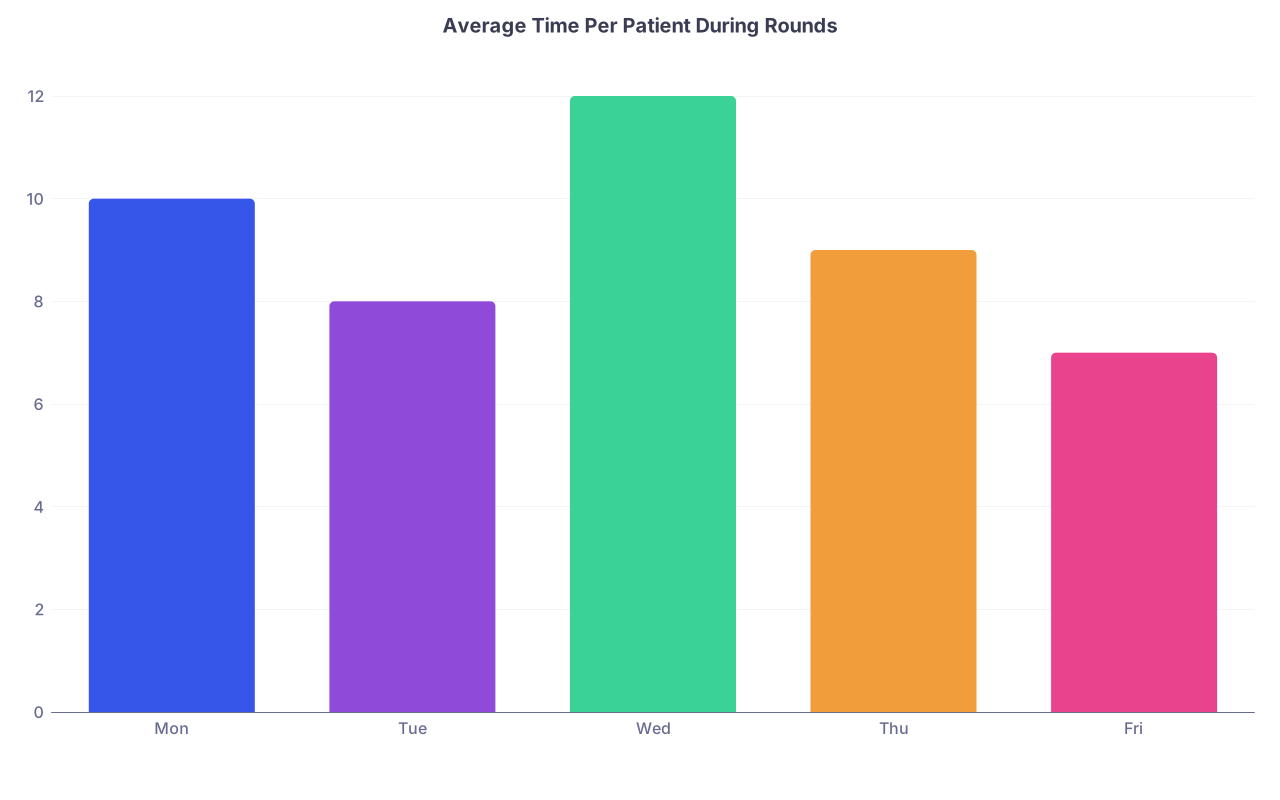
| Category | Value |
|---|---|
| Mon | 10 |
| Tue | 8 |
| Wed | 12 |
| Thu | 9 |
| Fri | 7 |
Then you do a blunt self-audit:
- Which patients took >15 minutes? Why?
- How many times did conversations drift into things that could have been handled by a post-round huddle?
- Which discipline never got to speak because you ran out of time?
You then adjust:
- Hard cap of 8–10 minutes per “stable” patient.
- Pre-identify 1–2 complex patients where you will invest 15 minutes and explicitly say so at the start (“We will spend extra time on Mrs. X and the complex discharge for Mr. Y”).
Also: start on time. If you wait 10 minutes past the scheduled start for that one always-late consultant, you’re teaching everyone else that punctuality is pointless.
High-Stakes Situations: ICU, Rapid Deterioration, or Family Conflict
Regular ward rounds are one thing. The stakes spike in:
- ICU interdisciplinary rounds
- The day after a rapid response or code
- Active family conflict about goals of care
Here, your communication has to slow down, be more explicit, and more emotionally intelligent.
ICU Rounds: Dealing With Volume and Complexity
In the ICU, every discipline has heavy content. If you let everyone go full detail, you are there all morning.
You must pre-negotiate brevity:
“Given our census, can I ask everyone to keep updates to what changed in the last 24 hours and anything affecting life support, sedation, or disposition? If we need a deeper dive, we’ll flag that case for a post-round conference.”
Then run an ICU-specific structure:
- Medical update (organ systems).
- Vent/respiratory details.
- Sedation/pain/delirium.
- Nursing perspective on comfort and safety.
- PT/OT for mobilization potential.
- Social work/palliative for family updates and goals.
You explicitly ask:
“Is there any change in how we are thinking about prognosis compared to yesterday?”
That question forces the team to confront drift. Otherwise, you just perpetuate yesterday’s plan by inertia.
Family Conflict Around Goals of Care
Interdisciplinary rounds often become the place where five different versions of “what the family wants” collide.
You:
“I am hearing mixed reports about the family’s wishes. Before we guess, I would like to clarify: who last spoke at length with them, and what exactly was said?”
Then you insist on one coherent plan:
“Let us schedule a family meeting this afternoon at 2 pm. I will be there with [attending] and [palliative or SW]. Nursing, if you can join for the first few minutes, that would be ideal so the family hears a consistent message.”
And you stop vague statements:
“We’ll see how he does” becomes:
“Given his current trajectory, we are worried that he may not recover the ability to breathe without the ventilator or return to independent living. We want to understand what he would consider an acceptable quality of life.”
Rounds should produce that level of clarity, or at least an explicit plan to achieve it.
Protecting Yourself: Avoiding Resident Burnout From Being the Default Coordinator
Let us be blunt: hospitals love when residents function as free bed-control managers, social workers, family therapists, and administrators. The risk is that you drown.
You need boundaries without being unhelpful.
Three specific moves:
Push back on unreasonable expectations with alternatives.
“I cannot personally call every SNF for all eight patients today and also manage admissions and cross-cover. I can, however, prioritize the two likely discharges and join social work for those calls.”
Delegate with clarity, not vagueness.
Bad: “Can someone call cardiology?”
Better: “Alex (intern), please page cardiology by 11 am to ask specifically about starting SGLT2 and whether they want to see him before discharge. Document their response in the chart.”Use your attending strategically.
“We are getting conflicting asks from nursing leadership and bed control about discharge timing. Can you help set expectations with them that while we will expedite where safe, we will not discharge patients over nursing objection without resolving their concerns?”
You do not have to absorb every systems failure personally.
Communication Patterns to Use and To Kill
Some phrases help you; some quietly sabotage you. Very concrete examples.
Phrases to Use
- “From your perspective at the bedside, what worries you most?” (to nursing)
- “What is the single biggest barrier to discharge today?” (to anyone)
- “I am hearing two different priorities—let me say them out loud and see if I have that right.”
- “Let us separate what must be decided right now from what can wait a few hours.”
- “To summarize what I think we are all agreeing on…” (then you actually summarize)
Phrases to Kill
- “We’ll see.” — Means “I have not thought about this.”
- “We can try.” — Means “I have not committed.”
- “They won’t let us.” — Who is “they”? Be specific or stop saying it.
- “Nursing discharged the patient too early.” — No. The team did. And you are the team lead during rounds.
- “Case management is blocking discharge.” — Lazy and usually wrong. Translate into the actual barrier: insurance, placement criteria, lack of family support.
Language shapes how the team blames or collaborates.
Practice Drills: How to Actually Get Better
You do not improve at this just by “trying harder.” You practice.
Three drills I have used with residents:
One-minute synthesis drill.
After rounds, pick one complex patient. Give yourself exactly 60 seconds to deliver a synthetic plan covering stability, discharge, safety, and unfinished decisions. Record it on your phone. Listen. Fix the clutter.
Conflict role-play with a co-resident.
Have a colleague pretend to be an upset nurse or PT who thinks discharge is unsafe. Practice the three-step script: name disagreement, anchor to shared goal, now vs later decision.
Rounds debrief once a week.
Ask your attending:
“From your standpoint, what is one thing I could tweak in how I run interdisciplinary rounds to make them more effective?”
Push for something specific, not “you’re doing fine.”
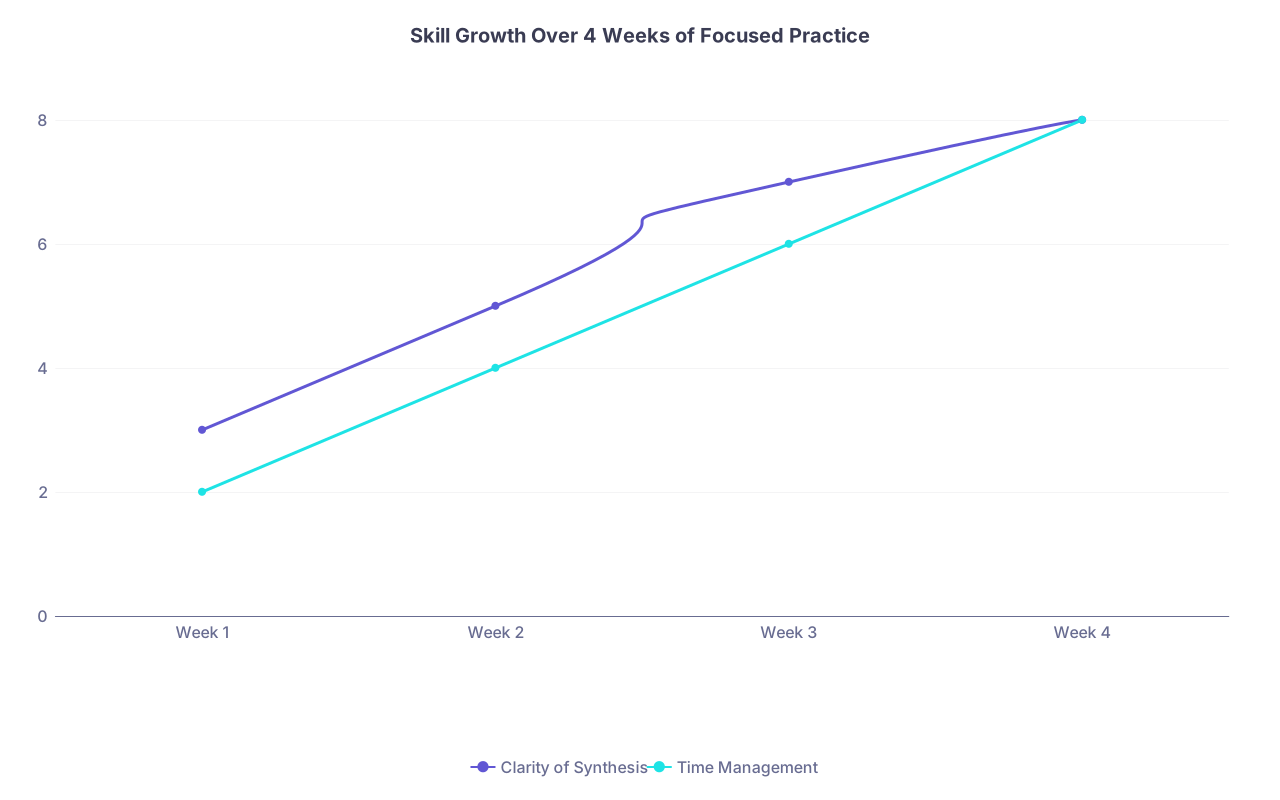
| Category | Clarity of Synthesis | Time Management |
|---|---|---|
| Week 1 | 3 | 2 |
| Week 2 | 5 | 4 |
| Week 3 | 7 | 6 |
| Week 4 | 8 | 8 |
Real-World Example: Transforming a Chaotic Rounds Culture
Let me show you how this looks in practice.
PGY-3 on a busy medicine service. 18 patients. Interdisciplinary rounds scheduled 9–10 am. In reality, they run 9:10–11:30. Nursing hates it. PT never stays. Case management checks out mentally halfway through.
Resident decides to change their approach.
Week 1 interventions:
- Starts exactly at 9:00 with whoever is present. No waiting.
- States structure: brief update → nursing → others → synthesis → tasks.
- Uses 4-box synthesis language out loud for each patient.
- Hard caps most patients at 7 minutes; 2 complex patients get 15 minutes by explicit announcement.
- Keeps a running list on a notepad of “post-round huddles” for deep issues.
By the end of the week:
- Average rounds length: down from 2+ hours to ~75 minutes.
- Nursing reports feeling “more heard” because their input is consistently first.
- PT starts showing up more often because they know they will get their 30 seconds of influence on discharge planning.
- The attending stops randomly teaching in the middle of social work updates and instead does a 15-minute teaching block after rounds on 1–2 selected cases.
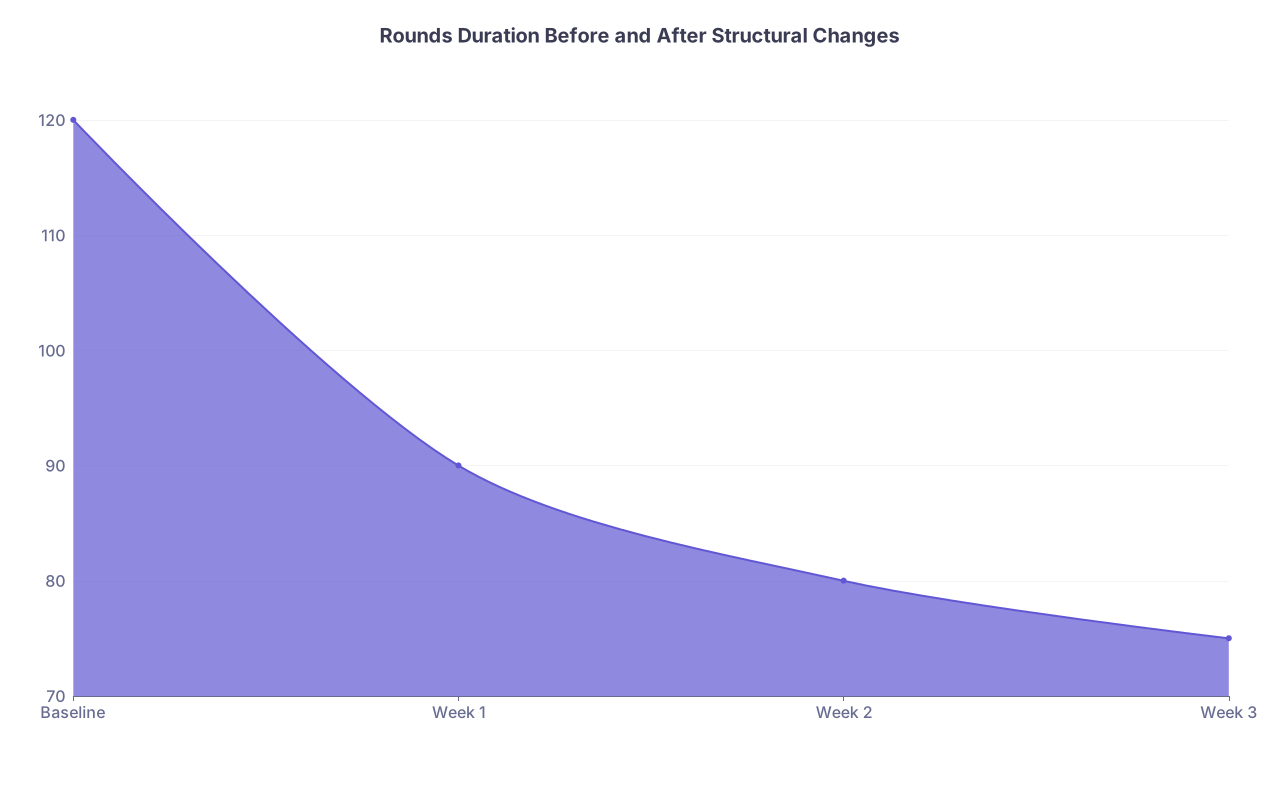
| Category | Value |
|---|---|
| Baseline | 120 |
| Week 1 | 90 |
| Week 2 | 80 |
| Week 3 | 75 |
Was every day clean? Of course not. Some days the ED floods you, or a patient codes. But the baseline chaos is gone. And the resident’s reputation shifts from “nice, competent” to “actually runs a unit well.”
That is what program directors remember when they write your letters.
Where You Go From Here
You are not going to walk in tomorrow and run flawless interdisciplinary rounds. That is not the point.
The point is to:
- Choose one structural change (nursing first, 4-box synthesis, explicit discharge timeframe).
- Choose one conflict script to try.
- Run them consistently for a week.
You will screw it up, adjust, and slowly build a reputation as the resident who can get a whole room moving in the same direction.
With that foundation, you are setting yourself up not just to “survive” residency leadership, but to step into chief roles, fellowship leadership, and eventually running your own service. The advanced techniques you are starting to practice on rounds—framing, synthesis, conflict management—are the same ones you will use in morbidity and mortality conferences, quality committees, and system-level work.
Those arenas come later. For now, your lab is the hallway outside room 18. Use it well.


