

The fastest way to lose authority as a senior resident is to mishandle a conflict with a consultant.
Not missing a diagnosis. Not fumbling a procedure. Losing your cool with a consultant in front of the team. That spreads through a hospital faster than MRSA.
Let me walk you through how to actually de‑escalate these conflicts so you keep your patients safe and your reputation intact, without becoming the doormat who accepts every ridiculous recommendation “to avoid conflict.”
1. Understand What You Are Actually Fighting About
Most senior residents think consultant conflict is about “medical disagreement.” It usually is not.
You are almost never arguing about whether DKA needs an insulin drip or whether a hip fracture needs ortho. You are fighting about:
- Control
- Workload
- Liability
- Status and respect
If you do not see those layers, you will argue facts while the consultant defends ego. You will lose.
Typical patterns I keep seeing:
Work-dumping conflict
- “This is not a consult for us.”
- Translation: “We are drowning and I am not taking this on.”
Territory conflict
- “Cardiology needs to admit this, not medicine.”
- Translation: “We are not becoming the default service for this class of train wreck.”
Face-saving conflict
- “Why did you call me this late? This is a morning consult.”
- Translation: “I feel blindsided and I am going to assert dominance.”
Standards-of-care conflict
- “I am not operating on this patient; the risk is too high.”
- Translation: “My mental risk-benefit calculation, medico-legal risk, and personal tolerance are different from yours.”
Recognize the type early. It changes your tactic.
If you treat all consultant tension as “they just do not understand the medicine,” you will push with more data, more labs, more guidelines. And the interaction gets hotter, not cooler.
2. The Golden Rule: Separate Clinical Goal from Emotional Energy
When a consultant is heated, you must consciously separate:
Clinical goal: What decision do you actually need from them?
Admit vs no admit. Procedure vs no procedure. Follow-up plan.Emotional energy: Whose fear, anger, fatigue, or ego is driving the temperature?
Often: theirs, sometimes yours, usually both.
Your job as senior is not to “win.” Your job is:
- Keep the patient safe.
- Protect the team.
- Maintain working relationships so tomorrow's consult does not start at DEFCON 2.
That requires you to absorb some emotional energy without reflecting it back.
I am not saying eat abuse. I am saying you must decide in real time:
“Do I want to be right in this argument, or do I want to get the patient what they need and keep our services functioning?”
Different outcomes.
3. Pre-Emptive De-Escalation: Set Up the Consult Correctly
Most conflicts start before the consultant even calls back. The way you page them loads the interaction.
| Situation | High-Conflict Setup | Low-Conflict Setup (Better) |
|---|---|---|
| Possible refusal to see | "We need you to admit this patient." | "We are requesting your help clarifying disposition and next steps." |
| Late-night call | "STAT consult – come now." | "Urgent question about management tonight vs safe to wait." |
| Gray-zone ownership | "This is clearly your patient." | "Borderline between our services – I want your input on where they fit best." |
| High-risk surgery consideration | "They need surgery." | "We are worried they might benefit from surgery; can I run the case by you?" |
You want to sound:
- Organized
- Non-accusatory
- Focused on a shared problem, not on assigning work
Consult Script That Lowers the Temperature
You do not need to be a poet. Just use a structure. Something like:
Who and why:
“Hi, this is Dr. X, senior on medicine. I am calling about a consult on Ms. Y, a 72-year-old with sepsis and possible cholangitis. I am worried she may need your help tonight.”20-second summary: “She came in hypotensive, lactate 5, has CBD dilation on CT, total bili 6. We started broad antibiotics and pressors, and GI thinks this may be obstructive.”
Clear question framed as partnership:
“My question is: do you think she needs emergent OR today vs can be stabilized overnight with plans for intervention tomorrow, and which service is most appropriate to own her?”Offer collaboration:
“If you are on the fence, I am happy to run more labs or imaging before you come down.”
This says: “I respect your time, I am not dumping, and I am thinking.” That alone de-escalates 50% of potential fights.
4. In-the-Moment De-Escalation: Real Phrases That Work
Let us get tactical. You are already in conflict. Voices are clipped. The fellow is annoyed. You can feel your own pulse in your ears.
Here is how you walk it back.
Step 1: Drop Your Defensiveness Physically and Verbally
- Lower your voice half a notch.
- Slow your rate of speech by about 20%.
- Sit if they are sitting; stand if they are standing. Avoid looming.
- Uncross arms, remove hands from pockets.
Simple line to reset:
“Let me pause for a second. I want to make sure I am explaining this clearly.”
You are signaling: I am switching from fight mode to collaborative mode. Most reasonably healthy adults respond to that.
Step 2: Acknowledge Their Perspective Without Surrendering
You do not need to agree. You need to show you heard.
Examples:
- “I hear that you are concerned this may not be a surgical issue.”
- “I understand nights are busy for you, and you get a lot of inappropriate consults.”
- “I see your point that they may be too high risk for surgery.”
Then you pivot:
“…and I am still worried about X because of Y.”
The structure is: acknowledgment then rationale. Never the reverse. If you argue first and validate second, nobody hears the second.
Step 3: Translate “No” into Something Actionable
When they say:
- “We are not admitting this patient.”
- “We are not taking them to the OR.”
- “This is not for us.”
You respond with:
“Given that, what is the safest plan you would recommend for this patient from your perspective?”
Now they must either:
- Offer a plan (which you can then refine), or
- Admit there is no safe plan without them, which exposes the problem without you attacking them.
If they dodge, keep tightening:
- “So to be explicit: you are recommending that Ms. X with [specific risk] stay on medicine/ED without [intervention] tonight, correct?”
- “If I document that in the chart as your recommendation, is that accurate?”
This is not a threat. This is clarity. And it cools some consultants down because it forces precise thinking instead of venting.
5. Specific High-Risk Scenarios and How to Handle Them
Let me break down a few classics that blow up regularly.
Scenario 1: “This Is Not Our Patient” – Ownership Fight
You: senior on medicine.
Them: cardiology fellow, furious that you are trying to “dump” a crash heart failure admit on them.
Common script you hear from them:
“This is a medicine problem, not a cardiology admit. We will consult. You admit.”
You do not respond with: “Well actually, your service took three similar patients yesterday…”
Instead:
Align on patient risk: “I agree they are high risk and complex, and they need a team that manages advanced heart failure and pressors regularly.”
Ask about capability and precedent: “From your experience, when patients are on inotropes with this degree of cardiomyopathy, are they usually on your service or ours here?”
Propose a compromise that feels collaborative: “I am willing to admit to medicine if you are comfortable with a very early consult and close involvement, but I want to be sure that is safe for the patient and consistent with how your team usually functions.”
If they still stonewall and you believe cardiology ownership is safer, escalate quietly:
- “Ok, I understand your position. I still have significant concerns about appropriate level of care. I am going to loop in my attending and ask that they speak directly with yours to clarify service expectations so we are all on the same page.”
You are not threatening, you are escalating the system issue up the hierarchy. That is your job as senior.
Scenario 2: “This Should Have Been Called Earlier” – Timing Fight
This one is almost always about emotion, not medicine.
Their line: “Why am I hearing about this at 2 am? This is ridiculous.”
Your temptation: defend your triage, point out how overwhelmed you are, explain boarding, ED volume, staffing.
Skip the essay. Try:
You:
“Fair point, this has evolved over the last few hours. I am catching you now because the situation changed with [new event: lactate bump, hypotension, new imaging]. Right now my main concern is [specific risk]. Can we focus on what is safest going forward?”
If they keep hammering timing:
“I agree the timing is not ideal. I can debrief with my team about earlier triggers for calling. My immediate ask is your help with X. Once we have a plan, I am happy to go back and review our process.”
You are not groveling. You are bracketing the process complaint and bringing them back to the clinical problem.
6. Using Structure: The “Three Asks” Technique
Sometimes direct disagreement will not move them. You need a structured escalation inside the conversation before you involve attendings.
I use a “three asks” method:
Ask for their plan in their framing
“Given your assessment that this is not a surgical abdomen, what is your recommended management and observation period before repeating evaluation?”Ask for contingency planning
“If the patient deteriorates—say, MAP drops below 60 or lactate climbs again—at what point would you want us to re-engage you or consider surgical intervention?”Ask for documentation clarity
“To avoid confusion, can I document that your recommendation is [plan A] with [contingency B if X occurs]?”
If at any step the answers are vague, circle back and narrow.
This has several side effects:
- It forces them into clinician mode instead of adversarial mode.
- It gives you clear documentation of shared thinking.
- It creates a path for re-consult that is pre-negotiated, lowering future tension.
7. Documentation as a De-Escalation Tool (Not a Weapon)
Residents swing between two extremes:
- Writing nothing because they are conflict-avoidant.
- Writing passive-aggressive consult notes that read like legal affidavits.
Both approaches are bad.
You want documentation that is:
- Clinically honest
- Non-accusatory
- Specific about recommendations and contingency plans
Example of bad documentation:
“ACS refused to take patient to OR despite clear evidence of peritonitis.”
That is confrontational, subjective, and will absolutely explode at M&M.
Better:
“ACS evaluated patient at bedside. Their assessment: abdomen soft, non-peritonitic, low suspicion for acute surgical abdomen at this time. Recommendation: continue resuscitation, serial abdominal exams q2h, repeat lactate in 4 h, re-page ACS for worsening exam, persistent lactate >4, or development of peritoneal signs.”
You have:
- Recorded their assessment
- Recorded their plan
- Created checkboxes for when to re-engage
If they did not come to the bedside and only discussed by phone, be precise and neutral:
“Discussed case with ACS senior by phone at [time]. Based on the described exam and imaging, they felt no immediate surgical indication. Recommendation…”
You are not calling them lazy. You are describing the mode of involvement. Subtle but critical.
8. Know When to Escalate and How to Do It Without Making Enemies
You will hit walls. Some consultants only respond to titles and institutional power. That is reality.
Your job is not to die on the hill of “I handled it alone.” Your job is to know when the risk to the patient or system exceeds your pay grade.
Clear escalation criteria
You should seriously consider involving attendings when:
- There is a direct clash between what you believe is safe and what the consultant recommends.
- The consultant’s refusal leaves you with no reasonable management plan.
- There is repeated pattern of unsafe behavior or hostility that affects multiple patients.
- You are being personally targeted or verbally abused beyond normal stress reactivity.
How to escalate without burning the relationship:
You:
“I appreciate your time. I still feel uncomfortable with this plan given [specific reason]. For safety, I am going to discuss this with my attending and ask that they connect with yours so we can all be aligned.”
Notice:
- You are not saying “I am calling my attending because you are wrong.”
- You are framing it as aligning teams for patient safety.
Then, when you call your attending, you do not lead with:
“Consultant is being unreasonable.”
You lead with:
- “Here are the objective facts.”
- “Here is what they recommend.”
- “Here is why I am uncomfortable.”
- “Here is what I asked and how they responded.”
Attendings are more likely to go to bat for you if you show you already tried structured de-escalation rather than pure arguing.
9. Teaching Your Juniors: Modeling in Real Time
As a senior, you are not just handling the conflict; you are teaching everyone watching what “normal” looks like.
Your intern hears you:
- Swear about neurosurgery behind closed doors.
- Slam the phone down.
- Document snarky comments.
Guess what they will do next year.
Flip it. Very concrete actions:
Before calling a high-risk consult, take 60 seconds with your intern:
“Ok, give me your one-liner, key data, and a specific question you will ask them.”
Let them pitch. Tighten it. Then call.After a heated conversation, debrief with them briefly:
“You heard that? I validated their concern about timing, then pushed for a clear plan and contingencies. Here is why.”When a consultant behaves badly, do not normalize it—name it accurately without dramatics:
“That tone was not appropriate. I am going to manage the immediate issue, but if this becomes a pattern, we will loop in faculty.”
You are quietly changing culture when you do this. That is leadership.
10. Subtle Power Moves That Lower Conflict Instead of Raising It
Power in the hospital is weird. Residents often try to “look strong” in exactly the ways that inflame conflict.
Here are moves that look like power but actually worsen things:
- “If you are not coming, I will document you refused.”
- “So you are okay with this patient crashing on the floor?”
- “Well, last week your team took a patient just like this…”
These are amateur lawyer lines. Consultants either dig in or go straight to your attending.
Better uses of power:
- Precision: You know the numbers, imaging specifics, and baseline. Nothing disarms a consultant like a resident who is absolutely on top of the case.
- Calm repetition: “Let me repeat what I am hearing to be sure I am accurate…” repeated calmly three times does more than any threat.
- Owning your uncertainty: “I am not sure whether I am over-calling this, but my worry is X. If you think I am wrong, walk me through your thought process so I can learn.” That disarms 80% of reasonable consultants.
And one more that residents underestimate:
- Face-to-face presence: A short, respectful in-person conversation at the bedside solves problems that 10 angry phone calls cannot. If geography allows, walk to their workroom and talk. Pace changes. Voices soften. Everyone remembers they are on the same team.
11. Common Pitfalls Senior Residents Fall Into
Let me be blunt. These are the repeat offenders I see every year.
Using the patient as a weapon
“If this patient dies, it will be on your hands.”
You absolutely lose moral and professional high ground when you say this. Do not.Public shaming
Complaining about consultants loudly in front of nurses, other services, or the patient/family. You think you are “advocating.” You are undermining team cohesion.Avoiding any conflict at all costs
Accepting clearly unsafe recommendations because you are afraid of escalation. You are not “easy to work with.” You are unsafe.Over-reliance on policy instead of judgment
“The policy says you have to admit this.” Policies help, but when interpreted rigidly at 3 am, they create absurd results. Always bring it back to the specific patient in front of you.Taking it personally
The neurosurgery fellow is not yelling because you, Dr. PGY‑3, are uniquely incompetent. They are exhausted, overloaded, and probably angry at their own system. You do not have to absorb their emotion as truth about your worth.
12. Putting It Together: A Sample De-Escalation Conversation
Let me stitch this into an actual interaction.
Setting: ICU overflow in ED. You are the senior on nights. You call surgery for a 68-year-old with suspected bowel ischemia, on pressors, lactate 7.
Surgery fellow (irritated):
“Why are you calling me now? This CT has been sitting for 3 hours.”
You:
“I agree this could have come earlier. The patient decompensated rapidly and we were stabilizing pressors and lines. Right now, my concern is that this may be ischemic bowel. CT shows pneumatosis and portal venous gas.”
Fellow:
“Well, from what you are saying, they are probably not an operative candidate. This is non-salvageable. I am not taking them to the OR at 2 in the morning for this.”
You (drop voice, slow pace):
“I hear that you are concerned they may be too high risk for surgery and that an operation may not change the outcome. I want to make sure I understand your recommendation clearly.”
Fellow (a bit calmer):
“Yeah. It sounds like they are going to die either way.”
You:
“So from your perspective, the safest plan is continued maximal support in the ICU without surgical intervention and early goals-of-care with the family, correct?”
Fellow:
“Yeah, exactly.”
You:
“Ok. To be explicit, there is no scenario where you would consider an exploratory laparotomy tonight, even if pressor requirement decreases?”
Fellow:
“Look, if they turn around significantly, we can re-discuss. But based on what you are saying now, no.”
You:
“That makes sense. I will document your impression and plan as you have described, and I will move quickly on family discussion and ICU transfer. If we see unexpected improvement in perfusion or lactate, I will re-page and reference this conversation so your team has context.”
No yelling. No threats. Clear plan. Clear documentation. You still protected yourself and the patient, and escalated only if needed.
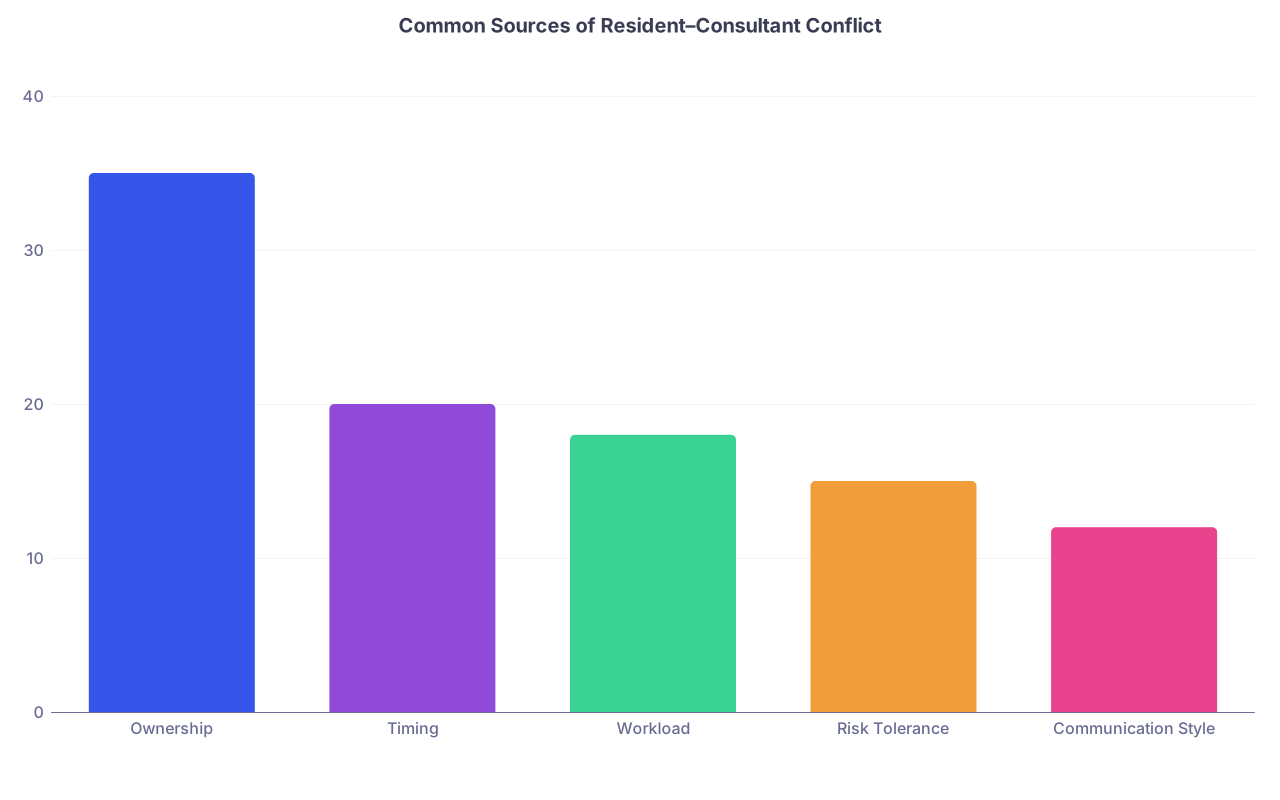
| Category | Value |
|---|---|
| Ownership | 35 |
| Timing | 20 |
| Workload | 18 |
| Risk Tolerance | 15 |
| Communication Style | 12 |
13. What To Practice This Month
If you want this to be muscle memory, not theory, pick one or two of these and deliberately practice them on your next several consults:
- Always call with a specific consult question instead of “please see and make recommendations.”
- When you feel heat, consciously lower your voice and add one acknowledgment line:
“I see why this feels frustrating on your end.” - Use the “Given that, what is the safest plan?” line any time a consultant says “no.”
- After any messy interaction, take 60 seconds and write a short, neutral summary capturing: their assessment, their plan, their contingency triggers.
- Debrief one conflict per week with your attending explicitly as a leadership/communication issue, not just a medical one.
Those reps change how you show up. And consultants notice.

| Step | Description |
|---|---|
| Step 1 | Identify conflict |
| Step 2 | Slow down and clarify goal |
| Step 3 | Clarify communication only |
| Step 4 | Validate consultant perspective |
| Step 5 | Ask for specific plan |
| Step 6 | Clarify contingencies |
| Step 7 | Escalate to attendings |
| Step 8 | Document and implement |
| Step 9 | Clinical risk high? |
| Step 10 | Plan still unsafe? |
FAQ (Exactly 5 Questions)
1. What do I do when a consultant is outright abusive or yelling?
You set a boundary, briefly and calmly. For example: “I want to work with you on this case, but I cannot do that productively while being yelled at. I am going to step away for a moment and will call back so we can focus on the patient.” If behavior repeats or crosses lines (personal insults, threats), you involve your attending and, if necessary, program or institutional leadership. You are not required to absorb abuse to get care for your patient. There is a difference between stressed tone and misconduct; treat them differently.
2. How do I handle disagreement in front of the patient or family?
You do not conduct your fight at the bedside. If a consultant starts disagreeing loudly in front of the patient, you redirect: “Let us step outside for a moment to clarify our thoughts, and then we will come back with a clear, unified plan for you.” Once outside, work through the disagreement, then return with consistent messaging. Patients do not need to witness intra-team politics; it erodes trust and increases anxiety.
3. Is it ever appropriate to go around a difficult fellow directly to their attending?
Yes, when patient safety is at stake and you have made a reasonable attempt to resolve the issue directly. Ideally you say something transparent: “I remain uncomfortable with this plan. For safety I am going to discuss with my attending and ask them to connect with yours.” Blind-siding the fellow by quietly calling their attending behind their back usually poisons the relationship. If the fellow is wholly unapproachable or unsafe, loop your own attending first and let them decide the next move.
4. How much should I document about the conflict itself in the chart?
Document the clinical content, not the drama. Record: who you spoke with, key elements of their assessment, their recommendations, and triggers for re-evaluation. Avoid editorial comments about attitude or “refusal” unless there is a clear, objective refusal to consider reasonable care. If you need to describe concerning behavior or patterns, that belongs in an incident report, email to leadership, or M&M preparation, not the clinical note.
5. What if my own attending undermines me in front of the consultant?
This is tricky and common. In the moment, do not argue with your attending in front of the consultant—that just escalates chaos. Let the attending run the interaction. Afterward, request a short debrief: “When we were talking with GI, I felt undercut when X was said. Can you help me understand how you saw that situation, and how you would want me to handle similar disagreements in the future?” Some attendings will adjust once they realize the impact; others will not. Either way, you are modeling mature feedback and gathering data for how to operate with that person.
You are not just “calling consults” anymore. As a senior, you are shaping how services relate to each other, how juniors learn to advocate, and how conflict either poisons or strengthens your hospital’s culture.
Master these de-escalation tactics now and you will not just survive difficult consultants—you will become the person everyone calls when the case, or the politics, get messy. The next step is learning how to drive proactive system changes with those same consultants so the worst conflicts never even reach you. That is the leadership level beyond residency—and that is a conversation for another day.


