

The way residents talk about “taking initiative” is almost completely different from how attendings judge it. And that disconnect quietly kills careers.
You think initiative means “doing more stuff.” Attendings think it means “fewer problems for me, better outcomes for patients, and a team that runs smoother without me micromanaging.” That’s the frame they’re using, every single day, whether they say it out loud or not.
Let me walk you through what we actually notice, what we silently downgrade you for, and why some residents get labeled “a star” after two days while others grind for three years and never break past “solid but unspectacular.”
The Hidden Formula: Initiative = Anticipation + Judgment + Reliability
The biggest misunderstanding: attendings are not impressed by effort alone. They’re impressed by whether your initiative makes their life and the patient’s course better without increasing risk.
In the workroom, you hear:
“Yeah, she really takes initiative – she volunteers to do everything.”
At the conference room table, after you leave, you’ll hear:
“She means well, but I don’t fully trust her judgment yet.”
That’s code. Here’s the mental formula most experienced attendings are running in the background:
Initiative = Anticipation + Judgment + Reliability – Supervision Cost
If you act without thinking through risk, you spike the “supervision cost” and you’re suddenly a liability, not an asset. Program directors know this. Chiefs know this. It’s why some very “hardworking” residents never get the top letters.
We’re watching for three big things when you “take initiative”:
- Do you anticipate needs before being told?
- Do you pick the right things to own, at the right scope for your level?
- When you step up, do we end up fixing, redoing, or apologizing for you?
If you want to know what attendings really remember about you, it’s this: did your initiative make them think, “I can trust this person with more,” or “I need to keep an eye on them.”
What “Good Initiative” Actually Looks Like On the Wards
Every PGY-1 thinks “initiative” means offering to write more notes and discharge summaries. That’s the floor, not the ceiling. Nobody gets talked about in promotions meetings because they volunteered to do another H&P.
The stuff that quietly turns heads is far more specific and a lot less glamorous.
1. Quiet, unprompted preparation that changes the day
Example I’ve seen over and over:
You’re on medicine wards. Attending is habitually five minutes late to rounds. A “normal” resident refreshes labs and scrolls Instagram. A resident with real initiative:
- Has already checked overnight events for every patient
- Has new vitals/labs pulled and flagged
- Has a one-liner plan revision in their head before the attending shows up
You don’t announce, “I took initiative and checked labs for everyone.” You just start presenting:
“On bed 12, Mrs. R’s creatinine bumped from 1.0 to 1.4 overnight after we increased her diuresis. I held this morning’s dose and ordered a repeat BMP for early afternoon. I’d propose backing down her Lasix to 40 IV daily and reassessing volume status later today.”
You did not wait to be told “check a creatinine.” That’s what we notice. The plan can be tweaked; the pattern is what sticks: this resident thinks ahead, acts within safe bounds, and I don’t have to drag them.
2. Bringing solutions, not just problems
Bad version:
“Her blood pressure’s low. What do you want to do?”
Better:
“Her pressure’s 82/48, MAP 58. She’s mentating well, warm, no chest pain. She’s sepsis on day 2 with 2 L already on board. I gave a 500 mL bolus, repeated vitals, and drew a lactate. MAP is now 66. I’m wondering if we should start low-dose pressors if she dips again.”
You already started a reasonable move that fits your level and the patient’s status. You didn’t just page and dump the stress on the senior or attending. That’s initiative we actually appreciate.
3. Owning the follow-through without prompting
Attendings hate “plan evaporation.” The resident who makes a plan on rounds and then… disappears. Orders not signed. Consults not called. Family not updated. That’s what gets you the comment:
“Seems smart, but I’m not sure they can run a list.”
Contrast that with the PGY-2 who, by 2 p.m., has:
- All consults placed
- Procedures scheduled or personally done
- Imaging clarified with radiology
- Pharmacy questions already reconciled
- Primary family member updated on major changes
And then at 3:30 p.m. appears in my doorway:
“Just a quick touch base – all consults saw, I documented recs, Mrs. K’s MRI is set for 5 pm, son updated for both bed 8 and bed 12, and I tightened up the med list on bed 5. Anything else you want done before signout?”
That’s the resident who gets the “this person can be a chief” email.
The Initiative Moves That Backfire (And They Really Do)
Let me be blunt: some of the things residents proudly call “initiative” are exactly what makes attendings say, “Not safe. Not ready.”
You want honesty? Here it is.
1. Practicing at the wrong level
If you’re an intern writing complex oncology chemo orders without checking with your senior? That’s not initiative. That’s dangerous. Or the PGY-2 on night float who independently decides to stop all anticoagulation in a post-op patient with “just a little” bleeding without looping in surgery.
We see this as: “They don’t understand their limits. That terrifies me.”
The residents who rise fast say variations of:
“I went ahead and did X and Y within my scope; for Z I’d like to run my plan by you first because it’s higher risk.”
We actually remember that language. It signals judgment, not insecurity.
2. Making work for everyone else
Common example: the “over-orderer.”
You think: “Look how thorough I am, I ordered the CT, MRI, full rheum panel, and a cardiac workup so I don’t miss anything.”
We think: “They shotgun-test because they don’t know what they’re looking for.”
Or the resident who “takes initiative” by putting in consults to three different services without a coherent question for any of them. Now our phones blow up all day, everyone’s annoyed, and your name becomes associated with chaos.
That goes in your file, figuratively if not literally.
3. Grandstanding in front of patients or consultants
Residents sometimes try to show “leadership” by correcting the attending or senior in front of patients, consultants, or nurses in a way that’s more about ego than patient care.
Trust me, we can tell the difference between, “Actually her creatinine was 1.6 yesterday, not 1.4” (helpful) and “Well, I was thinking sepsis from the beginning but…” (performative).
When you weaponize initiative to look smart, you lose trust. When you use it to protect the patient or clarify truth succinctly, you gain it.
What Attendings Actually Track Over Time (Even If They Don’t Say It)
Here’s the part nobody tells you in orientation: attendings are constantly pattern-matching. Not to your single “big” act of initiative, but to how your behavior trends over weeks.
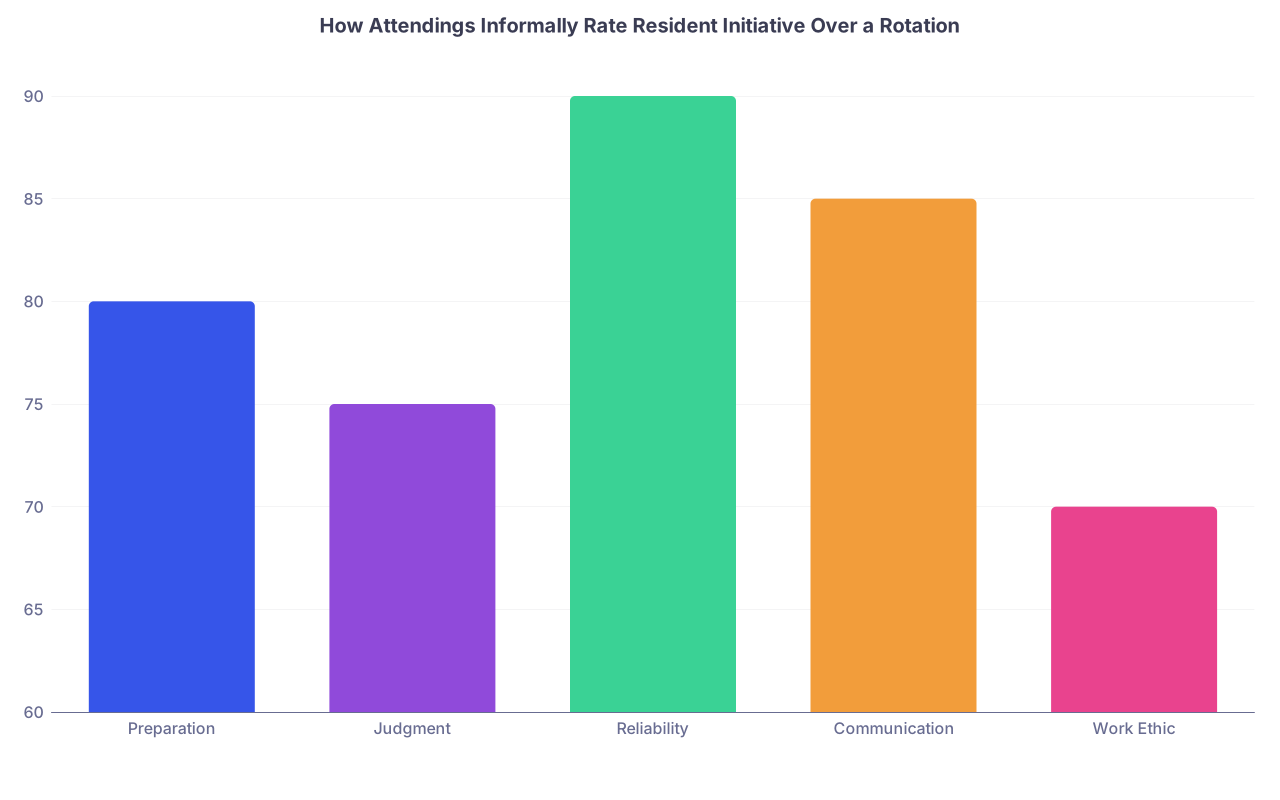
| Category | Value |
|---|---|
| Preparation | 80 |
| Judgment | 75 |
| Reliability | 90 |
| Communication | 85 |
| Work Ethic | 70 |
That’s roughly how an attending’s mental weighting looks. Work ethic matters, sure. But reliability and preparation often beat raw hustle.
What we remember:
- Do you close loops? If you say you’ll follow up on a culture or imaging result, do we ever have to ask you twice?
- Are you consistent on “boring” tasks? Notes done, orders clean, med rec correct, pages answered.
- Do you escalate before things crash? Not after.
The residents who get the strongest letters are not necessarily the flashiest. They’re the ones where an attending can write, “I never once had to worry about whether X would get done if this resident said they’d handle it.”
Program directors value that sentence more than a laundry list of procedures.
The Moves That Make Attendings Say: “This Resident Gets It”
Let’s get granular. Here are the specific behaviors that make most seasoned attendings quietly flag you as “one of the good ones.”
1. You pre-brief and debrief like a junior attending
Before rounds:
You don’t just skim charts. You mentally test drive the day.
You think: “Which patients might crash? Which ones can probably go home? Which families will be difficult? Which consults are inevitable?”
Then you act:
- You’ve prepped discharge paperwork for obvious near-discharges
- You’ve told the nurse on the sick patient: “Call me earlier, not later, if they look worse”
- You’ve already asked the night team: “Anyone you were worried about that I should keep a close eye on?”
After rounds, you don’t scatter. You reorganize the list and triage your own work without needing it spelled out. You don’t need kindergarten-level task assignments.
2. You protect the team’s time
Real initiative isn’t just about you and the attending. It’s about the team.
You notice that your co-intern is drowning in social work calls and notes. So you quietly take on an extra ED admission or knock out two of their discharge summaries without making a show of it.
Attendings notice when the whole team is less frantic. They may not know why at first. But when they see you consistently redirect chaos, you become the “glue” resident in their narrative of the month.
I’ve literally heard this in evaluation meetings:
“Honestly, the whole team functioned better when she was on. She just made things easier for everyone.”
3. You’re predictable in the best way
Initiative is only impressive if it’s consistent.
The intern who has one “hero day” and then disappears into inconsistency? Nobody trusts that. The resident who shows up every day with the list tight, the labs checked, the contingency plans thought through – that’s the one attendings talk about when chief selection comes up.
Specialty Differences: What Counts as Initiative Where
Not all “initiative” looks the same in surgery, EM, medicine, or pediatrics. The underlying principles are the same, but the manifestations differ.
| Specialty | What Attendings Notice Most |
|---|---|
| Internal Medicine | Anticipating workup and follow-up, clean list management, safe autonomy |
| Surgery | Owning the post-op course, knowing patients cold, being present and helpful in the OR |
| Emergency Medicine | Early triage sense, moving workups forward, smart escalation |
| Pediatrics | Family communication, developmental nuance, safety and gentleness with autonomy |
| ICU | Vigilant trend watching, timely interventions, reliable team communication |
On surgery
Surgical attendings don’t care that you volunteered to do five extra discharge summaries. They care that:
- You saw the post-op patient before them
- You recognized the tachycardia early and called them before the patient spiraled
- You know every drain, line, and post-op day for every patient without looking
Real initiative on surgery sounds like:
“I checked on all our post-ops at 5 a.m. Bed 3 has new tachycardia and borderline pressures; I already ordered a CBC, lactate, and repeat H/H, and I’d like to run the bedside ultrasound with you when we get to them.”
That’s how you go from “warm body” to “someone I’d hire.”
In the ED
In EM, initiative is about starting workups early and moving the dispo forward, not just picking up more charts.
Bad: picking up four low-acuity cases and parking for two hours doing nothing.
Good: one high-acuity chest pain case where you quickly order EKG/troponin/CXR, call cardiology at the right time, reassess, and push the case to either admission or discharge decisively.
EM faculty obsess over “throughput-minded” residents. Initiative there = you don’t let patients stagnate.
The Line Between Initiative and Overstepping: How to Stay On the Right Side
Here’s the internal checklist attendings use (whether they articulate it or not) when they see you taking initiative:
- Was this action within the resident’s level of training and competence?
- Did they consider risk/benefit, or just act to act?
- Did they communicate up and down the chain?
- Did things go smoother because they acted?
You can absolutely game this—ethically—by building one simple habit:
Before and after any “bigger” move, you frame it.
Before:
“Given X and Y, my thought is to do A and B now, and then if C happens, escalate to you. Does that sound reasonable?”
After:
“I went ahead and did A and B because of X and Y, and it worked out like Z. Anything you would’ve done differently that I should learn from for next time?”
We love that conversation. That’s a resident who grows aggressively but safely.

| Step | Description |
|---|---|
| Step 1 | Notice problem or need |
| Step 2 | Call senior or attending with suggestion |
| Step 3 | Take reasonable action |
| Step 4 | Document and inform team |
| Step 5 | Reflect and ask for feedback |
| Step 6 | Within my level? |
That’s the mental flowchart you want to internalize.
How Initiative Shows Up in Your Evaluations and Letters
Here’s another behind-the-scenes truth: faculty rarely write “shows initiative” in isolation. They pair it with a qualifier. That qualifier is your career.
I’ve seen all of these:
- “Shows outstanding initiative with excellent clinical judgment for level.” → Gold.
- “Shows strong initiative but occasionally oversteps clinical boundaries.” → Yellow flag.
- “Hardworking but requires significant direction for next steps.” → You think you’re crushing it; we think you’re not ready.
- “Reliable, anticipates needs, minimal supervision required.” → Chief/residency leadership material.
The story your “initiative” writes about you is what attendings use in letters, in fellowship ranking meetings, and in back-channel calls when someone asks, “Would you hire this person?”
How to Start Tomorrow: A Simple 3-Case Rule
You don’t need a personality transplant to look like someone who “takes initiative” in the right way. You just need deliberate reps.
Tomorrow, pick three patients. For each one, before seeing them, answer these silently:
- What’s the single most likely thing that could go wrong in the next 24 hours?
- What can I do now to reduce that risk or catch it early?
- What follow-up step do I need to own so it doesn’t get lost?
Then act, within your level, and tell your senior or attending:
“For Mr. X, I was worried about Y, so I did Z and I’ll follow it up by …”
Do that consistently for weeks. Suddenly you’re the resident we trust. The one we remember. The one we mention by name later.
FAQs
1. How do I show initiative without annoying my senior?
Loop them in early and frame your actions as support, not competition. “I went ahead and did X to move things forward; if you’d prefer I do it differently, let me know and I’ll adjust.” Most seniors are happy if your initiative lightens their load and doesn’t create new fires. If your senior is insecure or territorial, keep them even more informed and pick “low-risk, high-help” tasks (closing loops, clarifying orders, updating families with agreed-upon plans).
2. What if I’m worried about overstepping with attendings?
Use the “plan plus ask” model. “Given her exam and vitals, my thought is to do A and B now, then reassess in 2 hours. Would you be comfortable with that?” You’re still showing independent thought and initiative, but you’re explicitly respecting their oversight. Over time, once they trust your judgment, they’ll start saying, “Yes, just go ahead with what you think is right and let me know if it changes.”
3. Does taking on more patients automatically look like initiative?
Not if your care quality drops or you start missing details. Most attendings would rather see you run 6 patients flawlessly than 12 patients haphazardly. Volume is impressive only when paired with clean execution: accurate notes, no dropped tasks, early recognition of deterioration. If you want more patients, ask: “I feel comfortable with my current load and would like to challenge myself with one or two more if you think that’s appropriate.”
4. How do I recover if my “initiative” backfired once?
Own it directly and specifically. “I tried to be proactive with X and I realize now I misjudged Y. Here’s what I learned and how I’ll handle it differently.” Then for a while, bias toward extra communication and slightly more conservative scope. Attendings forgive errors much more readily when they see insight and behavior change. What scares us is residents who defend bad judgment and call it initiative.
Key points to walk away with:
- Attendings value initiative that lowers their cognitive load, protects patients, and makes the team more efficient.
- The best initiative is quiet, consistent anticipation with solid judgment and tight communication.
- Your “initiative story” is exactly what gets written into evaluations, whispered in back-channel calls, and used to decide who gets trusted, recommended, and eventually hired.


