

The average pre-round huddle on inpatient services is a waste of time. Not because the idea is bad, but because the execution is sloppy, unfocused, and leaderless.
You are going to fix that.
This is a playbook for running a tight, reliable, high-yield pre-round huddle as a resident. You will get:
- A specific script you can literally read on day one
- Exact timing and structure down to the minute
- Common failure modes and how to prevent them
If your team is constantly late to rounds, chasing tasks, or getting blindsided by “oh by the way” issues at 10:30, your huddle is either missing or broken. Let’s rebuild it.
1. Purpose: What a Pre-Round Huddle Is (And Is Not)
A pre-round huddle is a 5–10 minute, standing, structured check-in with your team before attending rounds. It exists for three reasons only:
- Align on the plan of the day for each patient
- Surface risks, bottlenecks, and surprises early
- Assign clear ownership for key tasks before the chaos starts
That is it.
It is not:
- A full case presentation
- A teaching session
- A venting circle about consults, nursing, or night float
- A free-form discussion where everyone riffs and nobody documents
If your “huddle” runs 25 minutes, includes full labs and imaging on every patient, and your attending joins halfway through—what you have is bad rounds, not a pre-round huddle.
Your goal as the resident leader:
Make this the most predictable, efficient five minutes of the day.
2. When and Where: Timing That Actually Works
The most common excuse I hear: “We do not have time for a huddle.”
Wrong. You do not have structure.
Here is the baseline timing that works on most internal medicine / peds / hospitalist-style services where rounds start at 8:30.
| Time | Activity |
|---|---|
| 6:30–7:30 | Personal prerounds / notes |
| 7:30–7:40 | Intern preround catch-up |
| 7:40–7:50 | **Pre-round huddle** |
| 7:50–8:20 | Final orders / pages / notes |
| 8:30 | Attending rounds start |
Key principles:
- Start time is fixed. Example: “Huddle is at 7:45 every day. Not 7:46. Not ‘when people get here.’”
- Everyone stands. In the workroom, hallway, or a corner of the ward. No laptops open. No one in patient rooms.
- Duration is capped. You announce that up front: “We have 8 minutes, we will end at 7:53.”
Where to do it:
- Quiet end of the hallway
- Team workroom with phones silenced
- Central station if that is the only workable spot (but explicitly say, “2 minutes only per block of four patients, let us go.”)
If your attending insists on starting attending rounds at 8 sharp, you pull everything earlier by 15–20 minutes. Same structure. Same duration.
3. Roles: Who Owns What During the Huddle
A lot of huddles fail because everybody is half-leading and nobody is really leading.
Here is the clean division:
Senior resident (or team resident)
- Owns: Timekeeping, agenda, pace, and decisions
- Phrase to memorize: “I am going to keep us moving so we finish in 8 minutes.”
Interns
- Own: 1-line updates and key overnight changes for their patients
- No full presentations, no monologues
Medical students
- Own: Specific contributions—e.g., “Jane is following AKI patients; she will flag any big creatinine jumps.”
- Do not make them summarize every patient; that slows and stresses everyone for little gain.
Pharmacist / nurse / case manager (if present)
- Own: Constraints and logistics
- “CT can only do two contrast studies this morning,” “Case management says SNF bed likely tomorrow,” etc.
Your job as resident: Protect the huddle. That means you:
- Cut off tangents
- Redirect deep clinical debates to rounds
- Park long issues (more on that later)
4. The Script: Exactly What to Say
Use this like a checklist. Print it, screenshot it, whatever.
Step 1: Open the Huddle (30–45 seconds)
You start on time, every time.
“Okay, let us start. We have 8 minutes. Goal is simple:
- plan of the day for each patient,
- any risks or bottlenecks,
- who owns which tasks.
Quick and focused. I will cut us off if we go deep; we can pick it up on rounds.”
Then:
- “Rapid census: we have X patients. Any admissions or transfers pending?”
- “Anyone not seen their patients yet?” (If so, note that but do not wait for them. They can still participate on known issues.)
Step 2: Patient-by-Patient Rapid Run (4–7 minutes)
You are aiming for 15–20 seconds per stable patient, 30–45 seconds for complex ones.
Format per patient:
Resident cues the intern by room or name.
“Room 612, Mrs. Johnson. Alex?”
Intern gives a 1-line status + one key overnight issue.
Format to enforce:
- Status: “Stable / improving / worse / new issue”
- Main problem: “Decompensated HF, day 3”
- Overnight: “Got 40 IV lasix, net negative 1.8 L, still on 2 L NC.”
Example:
“Mrs. Johnson, 72, decompensated HF, day 3.
Stable, breathing better, on 2 L NC, net negative 1.8 L overnight, no new events.”Resident adds or clarifies the “plan of the day” in 1–2 bullets.
“Plan of the day:
– Aim for another 1–2 L negative if BP tolerates;
– Switch to PO if still improving by afternoon;
– Push PT to see her before noon.”Identify any blockers / consults / discharges.
“Any labs or imaging that must happen early? Any consults we are waiting on?”
If yes, decide now: who is paging, when, and what you are asking.
Assign explicit task ownership (1 sentence).
“Alex, can you page cardiology by 8 to confirm their plan for discharge timing?”
If there is a nursing or PT dependency, call it:
“We need PT before noon—let us message them right after this.”
That is it. Move on.
You enforce brevity. If someone starts to give a full overnight narrative:
“Let us pause there. This is good context—save the details for rounds. For huddle, I just need: stable or worse, major overnight issue, and today’s main goal.”
You will feel rude the first couple days. Then your team will start matching your style.
Concrete Example: 8 Patients in 6 Minutes
Here is what “tight” looks like.
- 612 – Mrs. Johnson (HF): improving, on 2 L, net -1.8L → goal diuresis, maybe transition PO, PT before noon
- 614 – Mr. Smith (PNA): afebrile, down to RA, WBC improving → goal ambulate TID, confirm discharge tomorrow, call family today
- 616 – Ms. Nguyen (DKA): anion gap closed overnight → goal transition to SQ insulin before lunch, endocrine recs, diabetes teaching
- 618 – Mr. Lopez (GI bleed): Hgb stable 8.2, no more melena → goal advance diet, clarify scope findings, check with GI re: ASA restart
- 620 – Ms. Allen (AKI on CKD): creatinine slightly worse 3.1 → goal review meds with pharmacy, bladder scan, consider renal consult if still worsening by PM
- 622 – Mrs. Brown (new stroke): stable neuro, slight improvement in right arm → goal MRI today, PT/OT/ST early, SNF paperwork start
- 624 – Mr. Green (sepsis): febrile overnight, lactate now normal → goal narrow abx once cultures finalize, check lines, repeat exam on rounds
- 626 – Ms. Davis (failure to thrive): minimal PO intake → goal nutrition consult, clarify goals of care with patient and daughter, consider palliative involvement
You capture that in a quick team to-do list or whiteboard as you go. The huddle is the planning; the next 30 minutes is execution.
5. Standardized “Mini-Scripts” You Can Steal
To keep things consistent, use a few fixed phrases.
For opening status:
- “Stable, no significant overnight events.”
- “Worse—new oxygen requirement / hypotension.”
- “Improving—less pain, better PO, vitals stable.”
For plan of the day:
- “Main goal before noon is…”
- “No major changes; continue current plan, focus is discharge planning.”
- “Decision point today is X vs Y; we will decide on rounds after seeing labs/imaging.”
For blocking time-wasters:
- “Let us park that; we will talk about it on rounds.”
- “This is a good teaching case; we will come back to it after we see her.”
- “We are drifting into details. For now, what do we need done before 10 a.m.?”
6. Handling Discharges, Sick Patients, and New Admissions
Your huddle must reflect priorities. Do not treat a stable COPD day 7 like a fresh GI bleed.
1. Discharge Candidates
For every potential discharge, explicitly say:
“Discharge candidate today? Yes / No / Maybe tomorrow.”
If “Yes,” you state:
- “Checklist: meds reconciled, discharge summary started, follow-up booked, teaching done, DME arranged.”
Then assign:
- “Jane, start her discharge summary right after huddle; aim to have it 80% done before rounds.”
You do not want to be signing discharges at 4:45 p.m. because nobody named it out loud at 7:45 a.m.
2. Unstable or Concerning Patients
For any patient flagged as “worse”:
“This is a priority patient on rounds. They go first.”
Then:
- “Before rounds: someone re-examine, recheck vitals, review labs, and consider early interventions.”
Sometimes that is you:
“I will swing by 618 right after this and reassess. If anything looks off, I will call the attending before rounds.”
That is leadership. Not waiting for the attending to discover the problem at 10:30.
3. New Admissions / Overnight Events
If you had one or two late admissions:
Do a 30-second high-level summary, not a full presentation.
“New admission 630, 58-year-old with suspected PE, on heparin, stable right now.
Goal this morning: confirm imaging, clarify echo, discuss duration of anticoagulation on rounds.”
If you have unseen admissions:
“We have 2 pending charts we have not fully reviewed. After huddle, I will look at both and we will prioritize which one to see before rounds.”
7. Documentation and Visuals: Making the Huddle “Stick”
A huddle without a written trace becomes vapor by 9 a.m.
You need a simple, visible capture system:
- Small whiteboard in the team room
- Shared note in the EMR labeled “Team Plan of the Day” (even a rough one)
- Paper list on a clipboard that the resident carries
Structure that list like this:
- One line per patient
- Columns: “Today’s goal / Time-sensitive tasks / Owner”
Example:
| Patient | Today’s Goal | Time-sensitive Task | Owner |
|---|---|---|---|
| Johnson | Optimize diuresis | Page cardiology by 9 | Alex |
| Smith | Prep for discharge | Call daughter before 11 | Jordan |
| Nguyen | Transition off insulin gtt | Call endocrine by 8:30 | Resident |
Then every couple of hours you or the intern glance at it:
- “What is still undone?”
- “What is blocked?”
- “What changed?”
This is how teams stop dropping consults, missing time-sensitive imaging slots, and forgetting to call families.
8. Common Pitfalls (And How to Fix Each One)
Here is the ugly truth: most of the reasons huddles fail are predictable and avoidable.
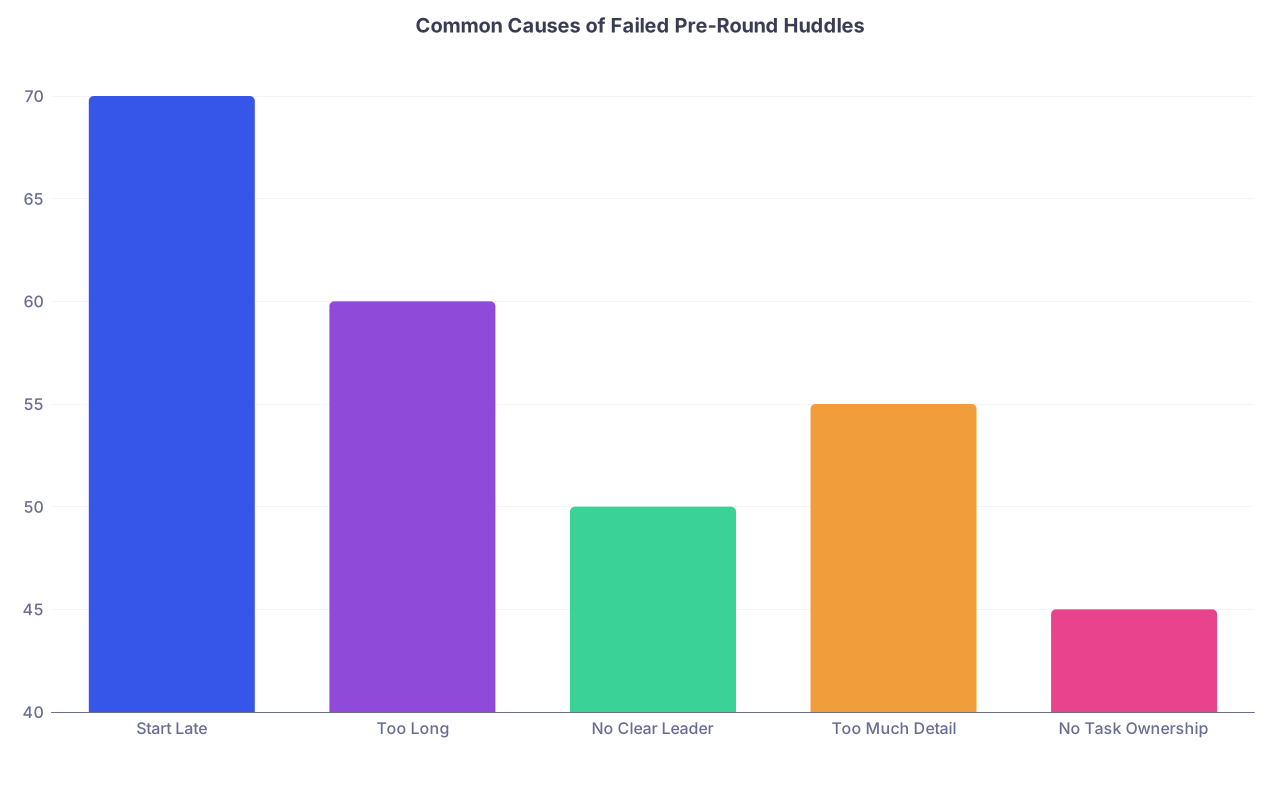
| Category | Value |
|---|---|
| Start Late | 70 |
| Too Long | 60 |
| No Clear Leader | 50 |
| Too Much Detail | 55 |
| No Task Ownership | 45 |
Pitfall 1: Starting Late Every Day
Symptoms:
- “We are waiting for X person again.”
- Rounds start late, everyone is behind from step one.
Fix:
Set a hard start time and normalize starting with whoever is present.
Phrase:
“We start at 7:45 sharp every day. If you are running behind, join when you can, but we will not delay for anyone.”
After two days, people adjust.
Pitfall 2: Turning Huddle into Mini-Rounds
Symptoms:
- Full H&P retells
- Teaching questions
- Attending gets involved in long diagnostic discussions before rounds
Fix:
Re-anchor purpose out loud:
“Quick reminder: this is just for plan of the day and urgent issues. Detailed discussion on rounds.”
Use explicit interruption phrases:
“This is a great question—let’s hit it when we are at the bedside.”
“For now I only need: stable or not, and today’s main goal.”
Pitfall 3: Nobody Owns Time
Symptoms:
- You look up and it has been 18 minutes
- Rounds start late, tasks not delegated
Fix:
Resident wears a badge or uses phone timer (discreetly).
Break the huddle into micro-blocks:
“We have 8 minutes for 12 patients. That is about 40 seconds per patient. I will move us along.”
At 5 minutes, call a time check:
“We are at 5 minutes; we have 4 patients left. High-yield only.”
Pitfall 4: Tasks Are Named But Not Owned
Symptoms:
- “We should call GI,” but nobody actually calls GI
- Imaging “needs to be ordered” but never is
Fix:
Every task must have three things:
- Specific action (“Call GI and clarify if they want colonoscopy today”)
- Owner (“Alex”)
- Timing (“by 9 a.m.”)
You hardwire this:
“Okay, who is owning that? Alex—by when can you get that done?”
If no one volunteers, you assign.
Pitfall 5: Emotional Dumping
Symptoms:
- Long complaints about consult services
- Rehashing night float decisions
- Sarcastic commentary about administration
Fix:
Allow 3–5 seconds to vent, then cut it off:
“I hear you—that was rough. Let us handle that offline so we can get through the list. For now, what needs to happen today?”
If the team culture is becoming chronically negative, set a rule:
“We will save gripe sessions for after rounds. Huddle is for solutions only.”
9. Teaching and Feedback Without Derailing the Huddle
You can still teach and give feedback without blowing up your timeline.
Here is the structure:
During huddle:
- Max 10-second teaching pearls only if they relate directly to a decision today.
- Example: “For AKI, just remember: hold ACEi/ARB until creatinine stabilizes. We will discuss more on rounds.”
After huddle or during walking time to first patient:
- Ask a quick question: “Okay, if Mrs. Johnson’s creatinine worsens, what would you check first?”
- Debrief 1 key case.
End of day:
- 3-minute review: “What went well with our huddle today? What should we change tomorrow?”
Rapid feedback script:
“We finished huddle in 9 minutes—not bad. Next time, let us try even shorter status updates, less detail on labs. Over the week you will get the hang of it.”
This trains interns and students to be efficient communicators. Which attending notice. And appreciate.
10. Adapting the Huddle to Different Services
The core framework holds, but you tweak for context.
ICU / Step-Down
- Huddle may be longer (10–15 minutes) because every patient is complex.
- Focus more on:
- Ventilator changes
- Pressor / sedation goals
- Procedures and imaging logistics
Still the same principle: status, plan of the day, ownership.
Surgical Services
- Heavy focus on:
- OR schedule (who, when, where)
- Post-op checks (POD 0 and 1 priorities)
- Wound checks, drains, lines
You might say:
“Main goal this morning is to see all post-ops before 9 and round on pre-ops quickly.”
Night Float to Day Team
You can treat sign-out as a form of huddle if you are smart:
- End sign-out with:
“Okay, for today your three big priorities are: Ms. Allen’s discharge, Mr. Green’s blood culture follow-up, and Ms. Davis’s goals of care conversation.”
Then your morning huddle with your own team refines that into specific tasks.
11. A Simple Visual: Pre-Round Huddle Flow

| Step | Description |
|---|---|
| Step 1 | Start on time |
| Step 2 | State goal and time limit |
| Step 3 | Run patient list |
| Step 4 | Clarify plan of day |
| Step 5 | Brief status update |
| Step 6 | Assign tasks and owners |
| Step 7 | Time check at midpoint |
| Step 8 | Capture tasks on list |
| Step 9 | End huddle on time |
| Step 10 | Discharge or high risk? |
Tape a simplified version of this in the team room. It reminds everyone what “good” looks like.
FAQ (exactly 2 questions)
1. What if my attending refuses to respect the pre-round huddle and keeps interrupting or starting their own version?
Have a direct, respectful hallway conversation early in the rotation: “I have been trying to standardize a 5–8 minute pre-round huddle with the team to make rounds smoother—just to align on plan of the day and critical tasks. If we start it at 7:45 and finish by 7:53, would you be okay if we handle it before you join us?” Most attendings will say yes. If they still interrupt, revert to micro-huddles (2–3 minutes) with just residents and interns right before rounds, focusing on high-risk patients and clear task ownership.
2. How do I introduce a formal huddle to a team that has never done it and is skeptical?
Do not make a big speech. Just say on day one: “Let us try a 7:45 quick huddle the next couple days—5–8 minutes, standing, just to set the plan of the day and make sure we do not miss discharges or critical tasks. If it is useless, we will stop.” Then run it well: start on time, end on time, keep it tight, and make someone’s day easier (for example, finish a discharge by noon because you flagged it early). Once people feel the benefit, the resistance disappears.


