
The way most residents respond when a co-resident is struggling is passive, vague, and unsafe. You are expected to “keep an eye on them” when you should be running a clear, structured leadership response.
This is not about being nice. This is about patient safety, team reliability, and whether your colleague makes it through residency with their license and their sanity intact.
Below is a practical, stepwise plan I have seen work in real programs – medicine, surgery, EM, pediatrics. Use it, adapt it, but do not improvise this in the moment.
Step 1: Recognize the Red Flags Early
You cannot help what you do not clearly see. Start with pattern recognition, not vibes.
Common “struggling resident” patterns:
Performance changes
- Suddenly late to sign-out multiple days in a week
- Repeatedly missing pages or messages
- Racking up medication or order errors
- Falling behind on notes and discharges every single call
- Getting more “FYI” emails from attendings and chiefs
Behavior and demeanor
- Quiet resident becomes irritable, snappy, or cynical overnight
- Previously chill person now crying in the call room or bathroom
- Unusual withdrawal from group lunches, teaching, or post-call breakfasts
- “Dark humor” that crosses into genuine hopelessness
Physical and emotional signs
- Looks exhausted even post-call
- Noticeable weight gain or loss over a month or two
- Smell of alcohol on breath at sign-out or early in the day (yes, this happens)
- Shaky, tearful, or panicked during routine tasks
Administrative signals
- Remediation meetings
- Failing or borderline evaluations across multiple rotations
- Program director or chief suddenly “checking in” with them a lot
You are not diagnosing them. You are identifying risk. When in doubt, treat it as real.

Step 2: Decide Your Immediate Priority – Safety First
Before you launch into supportive friend mode, you need to answer one question:
“Is there an acute safety risk here?”
Safety has two angles:
- Patient safety
- Personal safety (self-harm, impairment, uncontrolled anger)
If you see any of the following, you move fast and up the chain:
- They are clearly impaired on shift (slurred words, unsteady gait, smell of alcohol, obvious intoxication, or high)
- They talk openly about wanting to die, self-harm, or “not wanting to be here anymore”
- They are making repeated dangerous clinical errors and do not seem aware of them
- They walk out mid-shift and disappear without communication
- They express thoughts about harming someone else
In those situations, your “leadership response” is not a heart-to-heart. It is escalation:
- Pull them aside briefly and out of patient areas.
- Tell them plainly what you are concerned about (“You seem impaired / unsafe to work right now”).
- Call:
- Chief resident on call
- Or attending on duty
- Or program director if after hours and there is no clear chain defined
- Document the facts for yourself: time, what you saw, who you called.
If you are hesitating because you “do not want to get them in trouble,” remind yourself: cover-ups and silence are what destroy careers. Early, documented help is usually how people keep them.
For non-acute situations (most cases), you can move to a structured support conversation.
Step 3: Have the Conversation – Privately, Directly, and Short
This is the part most residents botch because they ramble, talk about themselves, or wait until the person is in total collapse.
You need a 10–20 minute, focused, private conversation. Not an hour-long therapy session.
Basic framework that works:
Choose the right time and place
- Private workroom, empty conference room, or call room
- Off the main floor, away from nurses’ station, away from others
- Not in the middle of a code or family meeting
- If on call, time it right after a relative lull, not at absolute chaos peak
Open with an observation, not a judgment
- “I have noticed you have been running behind and leaving late this week.”
- “You seemed pretty upset after rounds the last few days.”
- “You look wiped out, even more than post-call tired.”
Then ask a direct, open question
- “What is going on?”
- “How are you actually doing?”
- “Is something bigger going on behind the scenes?”
Then shut up and listen.
- No interrupting with your own stories.
- No “silver lining” nonsense.
- Let them talk. Most people will fill the silence.
Name the struggle out loud
- “This sounds like burnout plus being overwhelmed with the service load.”
- “This sounds like you are dealing with depression symptoms.”
- “This sounds like you are scared about failing and losing your spot.”
You are not their therapist. You are their colleague who is willing to see what others are ignoring.
Step 4: Triage the Problem – What Kind of Struggle Is This?
Not all struggling residents need the same response. Leadership means you sort the problem into a bucket quickly so you know what to do next.
Here are the common categories and what usually helps:
| Type of Struggle | Primary Need | Who Must Be Involved |
|---|---|---|
| Skill / Knowledge Deficit | Coaching, targeted teaching | Senior, attending, chiefs |
| Burnout / Overload | Workload adjustment, support | Chiefs, PD, wellness |
| Mental Health (depression/anxiety) | Professional treatment, schedule protection | PD, GME, mental health |
| Personal Crisis (family, finances, divorce) | Flexibility, time, problem-solving | Chiefs, PD, maybe GME |
| Professionalism / Behavior | Accountability plus support | PD, chiefs, HR/GME |
Quick triage questions you can ask:
- “Is this mostly about you not knowing what to do clinically?”
- “Is this more about feeling overwhelmed and exhausted?”
- “Is anything happening outside the hospital – family, money, relationship stuff?”
- “Have you been treated for depression or anxiety before?”
You will almost never get a perfect, clean answer. That is fine. You just need direction.
Step 5: Build a Mini-Plan With Them (Not For Them)
This is where most well-intentioned residents fail. They listen, nod a lot, say “I am here for you,” and then… nothing changes.
You need to leave the conversation with a short, concrete “for the next 1–2 weeks” plan.
Keep it simple. Three parts:
Capacity and safety for the next few days
- “Do you feel safe to continue this shift?”
- “Are there any tasks right now that feel beyond what you can handle?”
- “Do you need to step away for an hour, or do we need coverage for you?”
Specific work adjustments
- If they are drowning:
- You: “I am taking admissions for the next 2 hours; you focus on finishing your notes and stabilizing current patients.”
- Ask the senior: “Can we adjust the task distribution today? X is behind and we need to redistribute.”
- If they are behind clinically:
- “For complex admits, let us pre-round together for a few days. I will walk the first 1–2 plans with you.”
- If they are drowning:
A formal follow-up step
- “I want you to email the chiefs today to set up a quick meeting.”
- “Would you be willing to schedule a visit with the resident mental health clinic this week?”
- “I am going to check in with you again on Friday after sign-out.”
Put it into one short statement:
“So here is our plan: I will cover the next admission, you finish your current notes, then we will see the next new patient together. Tonight you will email the chiefs about meeting this week. I will check in with you Friday.”
That is a leadership response. Clear, bounded, and time-based.
Step 6: Decide When and How to Escalate
You are not the endpoint. You are the early detection system.
Common mistake: waiting for “proof” or a full story before you tell anyone. Do not do that.
Here is a simple rule:
If their struggle is impacting patient care, team function, or their personal safety, you escalate.
Who you loop in depends on severity and local culture, but typical pattern:
For mild / early concerns:
- Talk to your senior on service.
- Or quietly talk to a chief resident you trust.
For moderate concerns:
- Chiefs plus program director or associate PD.
- This is appropriate when:
- Multiple attendings are complaining.
- They are falling behind consistently.
- You hear them talk about not wanting to go on, though not acutely suicidal.
For severe concerns:
- Attendings and PD immediately
- GME office or physician health program if there is impairment, self-harm risk, or repeated dangerous behavior.
When you escalate, give facts, not drama:
- “Over the past week, X has been late 4 of 5 days, struggles to finish notes, and has missed several pages. Yesterday, they told me they feel hopeless and are thinking about quitting.”
- “On call last night, X was tearful multiple times, had trouble formulating basic plans, and seemed emotionally overwhelmed. I am concerned this is beyond normal fatigue.”
You are not betraying your co-resident. You are preventing the kind of disaster that ends with an email saying “we are deeply saddened to inform you…”
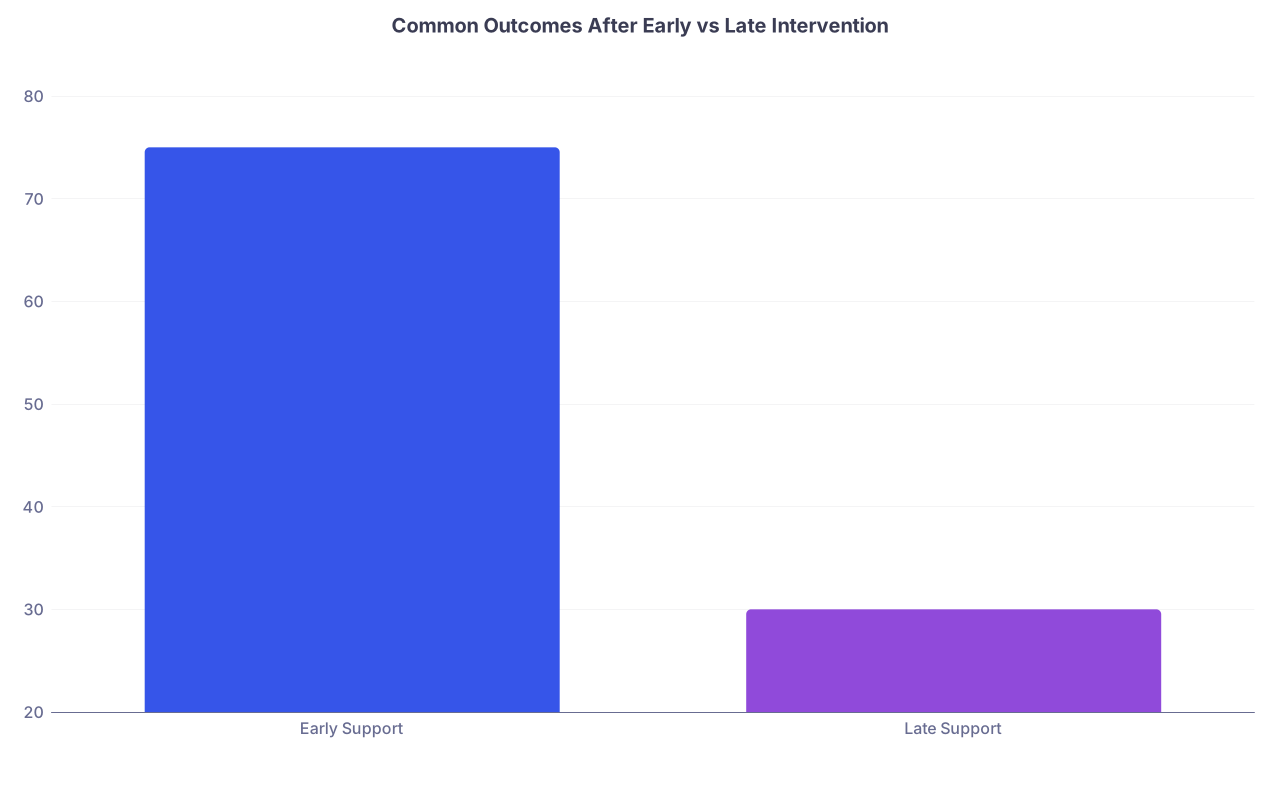
| Category | Value |
|---|---|
| Early Support | 75 |
| Late Support | 30 |
(This kind of pattern is exactly what I have seen: when people get help early, they usually stay and improve. When it is late, half are gone within a year.)
Step 7: Protect Your Role and Your Boundaries
You are a co-resident, not a therapist, lawyer, or martyr.
Leadership does not mean sacrificing your own training or mental health to carry someone indefinitely.
Clear boundaries:
Your job is:
- Notice problems early
- Start the conversation
- Help create a short-term action plan
- Escalate to the right people
- Provide basic ongoing peer support
Your job is not:
- Offering medical advice about meds, diagnoses, or treatment plans for their mental health
- Covering every one of their shifts for months
- Keeping secrets about safety issues
- Arguing with the PD about disciplinary decisions you do not fully see
If supporting them is starting to break you, say so:
- To leadership:
- “I want to help X, but I am starting to feel burned out by the extra coverage. We need a more sustainable plan.”
- To the co-resident:
- “I care about you, but I am not equipped to be your only support. I need you to connect with [mental health / PD / chief] so we can get more help on board.”
Step 8: Use the System That Already Exists (Stop Reinventing)
Most decent programs and hospitals already have some version of support infrastructure. Residents just do not use it until they are desperate.
You, as a near-peer leader, should know what is actually available.
Typical tools:
Confidential mental health services for trainees
- Often through GME or an external contracted group
- Usually fast-tracked for residents (48–72 hours)
- Sometimes free or heavily discounted
Leave options
- Medical leave (for mental or physical health)
- Family leave (family illness, death, birth, etc.)
- Short schedule modifications or day-off swaps via chiefs
Academic remediation plans
- Structured coaching for clinical reasoning, time management, or communication
- Sometimes involves extra supervision on certain rotations
- It feels punitive, but frequently these are what keep people from being fired
Wellness and peer groups
- Balint groups, debrief groups after codes, peer support programs
- These are hit-or-miss depending on your institution, but sometimes helpful as a “bridge”
You do not need to know every policy. You just need to know where to point:
“Our GME has a confidential counseling service for residents. Here is the number. They see a lot of people in our program; you would not be the first.”
“You might qualify for a brief medical leave or step-back month. Let us have you talk to the PD about that explicitly.”

| Step | Description |
|---|---|
| Step 1 | Notice Red Flags |
| Step 2 | Private Conversation |
| Step 3 | Call Chief or Attending |
| Step 4 | Short Term Plan |
| Step 5 | Notify Chiefs PD |
| Step 6 | Monitor and Support |
| Step 7 | Connect to Services |
| Step 8 | Safety Risk? |
| Step 9 | Impacting Care? |
Step 9: Adjust the Day-to-Day Work to Prevent Further Damage
You cannot fix depression in a week. You can absolutely fix how the next few shifts feel.
This is where real leadership shows up on the ground: micro-adjustments on the team.
Practical moves you can implement or advocate for:
Rebalance the workload temporarily
- You or another strong resident takes an extra admission or two.
- Let the struggling resident handle stable follow-ups rather than every new sick admit.
- Assign them discrete, manageable tasks with clear endpoints.
Pair them up
- Do joint pre-rounding on new or complex patients.
- Have them present to you before going to the attending for a few days.
- Make sure there is always someone senior they can ask, rather than leaving them as “the only one”.
Increase structure
- Help them create a prioritized to-do list for each shift:
- Triage sickest patients
- Time-sensitive orders
- Discharges
- Notes
- Use check-ins:
- “At 10:00, we regroup for 5 minutes and see where you are stuck.”
- Help them create a prioritized to-do list for each shift:
Protect their sleep when possible
- On call: let them sleep the first block if you are more resilient that night, then swap next call.
- Post-call: do not guilt them into staying “to help” once they are officially done.
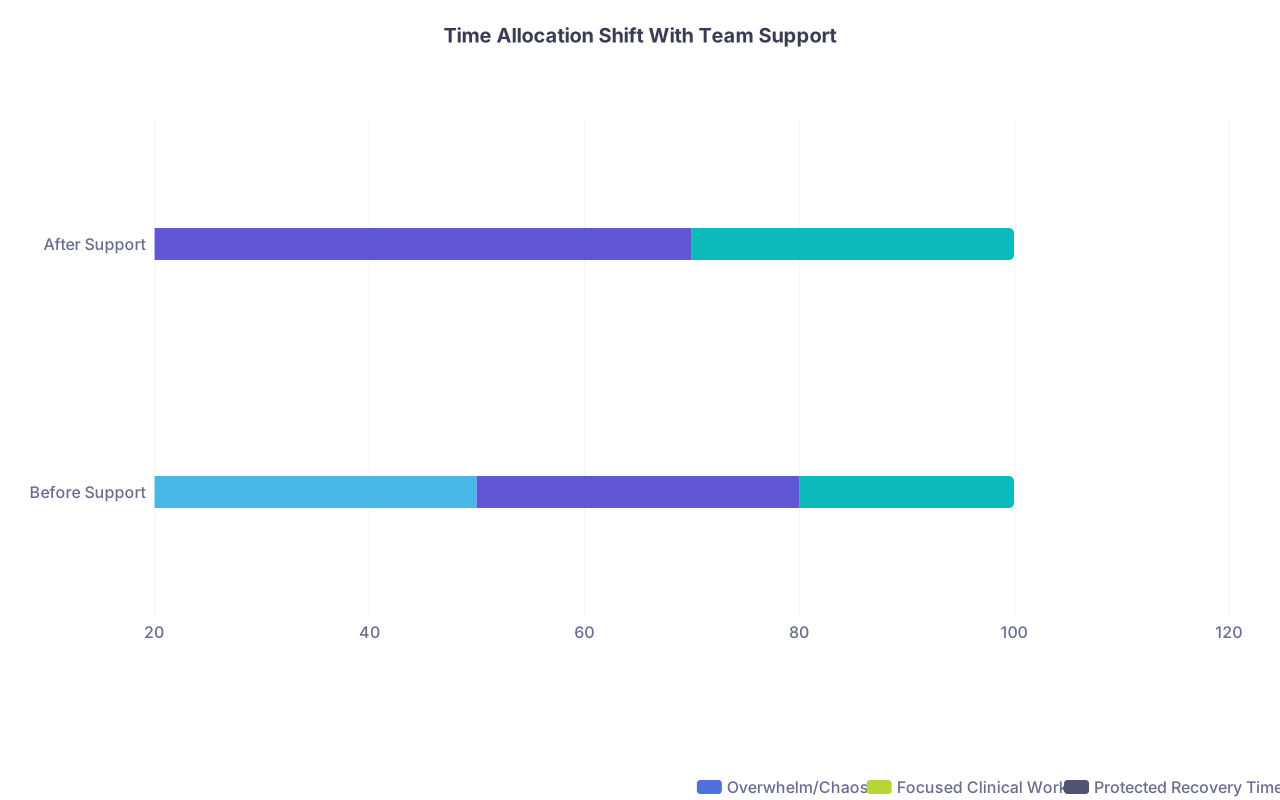
| Category | Overwhelm/Chaos | Focused Clinical Work | Protected Recovery Time |
|---|---|---|---|
| Before Support | 50 | 30 | 20 |
| After Support | 20 | 50 | 30 |
You are not lowering standards. You are stabilizing a team member so they can eventually meet them.
Step 10: Follow Up – This Is Not a One-Off
One conversation and one heroic shift do not fix a struggling co-resident. This takes weeks to months.
Minimal but effective follow-up plan:
Short-term (1 week)
- Check in once or twice: “How is this week going compared to last?”
- Confirm they actually contacted whoever they said they would (chiefs, therapist, PD, etc.).
Medium-term (1–3 months)
- Watch for actual change:
- Are they less behind?
- Are attendings quieter about concerns?
- Does their mood / affect look a bit more stable?
- If nothing is improving, you escalate again: “We tried X, Y, Z, but they are still clearly struggling.”
- Watch for actual change:
Long-term (beyond 3 months)
- Some residents will need ongoing accommodations or a slower trajectory.
- Your job shifts to: keep treating them like a full colleague, not forever “the problem resident.”

Common Mistakes You Must Avoid
If you remember nothing else, at least avoid these.
Minimizing or normalizing everything
- “We are all burned out, you will be fine.”
- Translation: “I do not want to engage with this.”
- Reality: sometimes this is not “normal residency stress.” It is depression, or a brewing disaster.
Keeping dangerous secrets
- If they say, “Do not tell anyone, but I have been drinking before call,” your answer is:
- “I care about you, and that is exactly why I cannot keep that to myself. We need to get you help, and that involves leadership.”
- If they say, “Do not tell anyone, but I have been drinking before call,” your answer is:
Taking on the savior role
- You cover every shift. You rewrite every note. You “protect” them from feedback.
- Eventually, you burn out, and they still fail because the system never truly engaged.
Publicly shaming or gossiping
- Workroom jokes, texting other residents about “how incompetent X is,” venting to nurses about them.
- You just turned a fixable performance problem into a reputation death spiral.
Never giving them real feedback
- Some “struggling” residents genuinely do not understand how others see them.
- You need to say: “Here is what the team is actually noticing: A, B, C.”
A Realistic Example: Putting It All Together
You are a PGY-2 on wards. Your co-intern has:
- Been late 3 of the last 4 days
- Missed several nurse pages
- Broken down crying in the stairwell yesterday
Here is what a leadership response looks like in practice:
You pull them into an empty conference room after rounds.
You say:
- “I have noticed this week has been really rough – late starts, missing pages, and yesterday you were really upset in the stairwell. What is going on?”
They tell you:
- They are not sleeping, dreading work, and thinking they “cannot do this” and “everyone would be better off if they were not here.” No specific plan for self-harm, but clearly hopeless.
You triage in your head:
- Not acutely suicidal, but definitely depressed and overwhelmed. This is affecting care.
You propose a short-term plan for the day:
- “For the rest of today, I will take the next two admissions. You focus on stabilizing your existing patients and finishing those notes. At noon we regroup and see where you are.”
You say directly:
- “This is beyond normal stress. I think you need real support. I would like us to talk to the chiefs together today. Will you come with me?”
You walk with them to the chief office after lunch.
- You present facts: “Here is what we have seen this week. I am worried about them.”
Chiefs and PD loop in mental health and adjust the upcoming schedule.
- Maybe lighter rotation next month, formal counseling, possibly short leave.
You check in five days later:
- “How is it going since meeting with the chiefs? Any better with sleep or anxiety?”
That is leadership. Not dramatic. Not heroic. Just systematic, early, and firm.

Quick Summary: What You Actually Need To Do
Notice early, do not ignore patterns.
Performance change, emotional breakdowns, repeated errors – these are not “normal.”Have a brief, private, direct conversation.
State what you see, ask what is going on, listen without fixing.Build a short-term plan and escalate appropriately.
Stabilize the shift, loop in seniors / chiefs / PD, and connect them to real resources. Then follow up.
That is how you respond when your co-resident is struggling – not as a bystander, but as an actual leader.