
The myth that “good leadership” only comes with a title is dangerous. Residents quietly rescue dysfunctional rotations every day—and most do it without ever being called “chief” or “team leader.”
Here is the blunt truth: if you are on a disorganized rotation and you are suffering, your patients are suffering too. Waiting for the attending, program, or hospital to “fix the system” is a losing strategy. You have more control than you think, even as a PGY-1.
This is about how you quietly rebuild flow from inside the chaos—without burning yourself out or declaring some grand quality-improvement project. Just practical, repeatable moves that work on real inpatient teams.
Step 1: Diagnose the Chaos Like a Clinical Problem
You would not treat sepsis with “be more organized.” Same for a broken rotation. You need a differential.
For 3–5 days, do not try to fix everything. Observe and write down patterns. Literally jot notes in your sign-out doc or a tiny notes app: “10:15 – still not rounded. 11:30 – consults still not placed. 3:00 – meds not reconciled.”
You are looking for specific failure points in three buckets:
- Time failures
- Communication failures
- Responsibility failures
1. Time failures – where the day bleeds out
Common patterns I see over and over:
- No clear start time for pre-rounds → interns show up at different times, data incomplete
- Attending arrives, rounds begin, but half the patients are not seen because notes, vitals, or labs are not ready
- Rounds drag on past noon → pages pile up, discharges stall, orders delayed
- Nobody protects a “discharge block” → dispo always slips to 3–5 PM
Write down exactly when:
- Rounds actually start vs supposed to start
- First discharge order gets placed
- First note gets signed
- First consult gets called
This is your “time culture.” You cannot fix flow if you do not know where the day dies.
2. Communication failures – information in the wrong place
Classic fractures:
- The list exists in 4 places: EMR, someone’s notebook, a random text thread, and half-remembered verbal updates
- Daily plan changes after rounds and nobody updates the list
- Nurses have no idea what the new plan is until 4 PM
- Consults get called with insufficient information; they call back, no one picks up
Again, observe:
- How many places hold the “real” plan?
- After rounds, does anyone summarize the day?
- Do you see frequent “Wait, what is the plan again for 624B?” conversations?
3. Responsibility failures – who owns what?
Where rotations really break:
- “Everyone” is following up important labs → no one actually does
- New admissions are assigned verbally and people forget
- Discharges are “team jobs” → they get done last, badly
- Procedures are mentioned but not explicitly assigned
You want to catch phrases like:
- “Can someone check on…”
- “We should probably…”
- “Let’s remember to…”
Those are red flags. If nobody’s name is attached, assume it will not happen.
Step 2: Build a Minimal Structure That Does Not Depend on the Attending
You do not need permission to organize your own work. You also do not need a 15-tab Excel monster. You need three concrete tools:
- A single, reliable team list
- A predictable daily timeline
- A simple ownership system
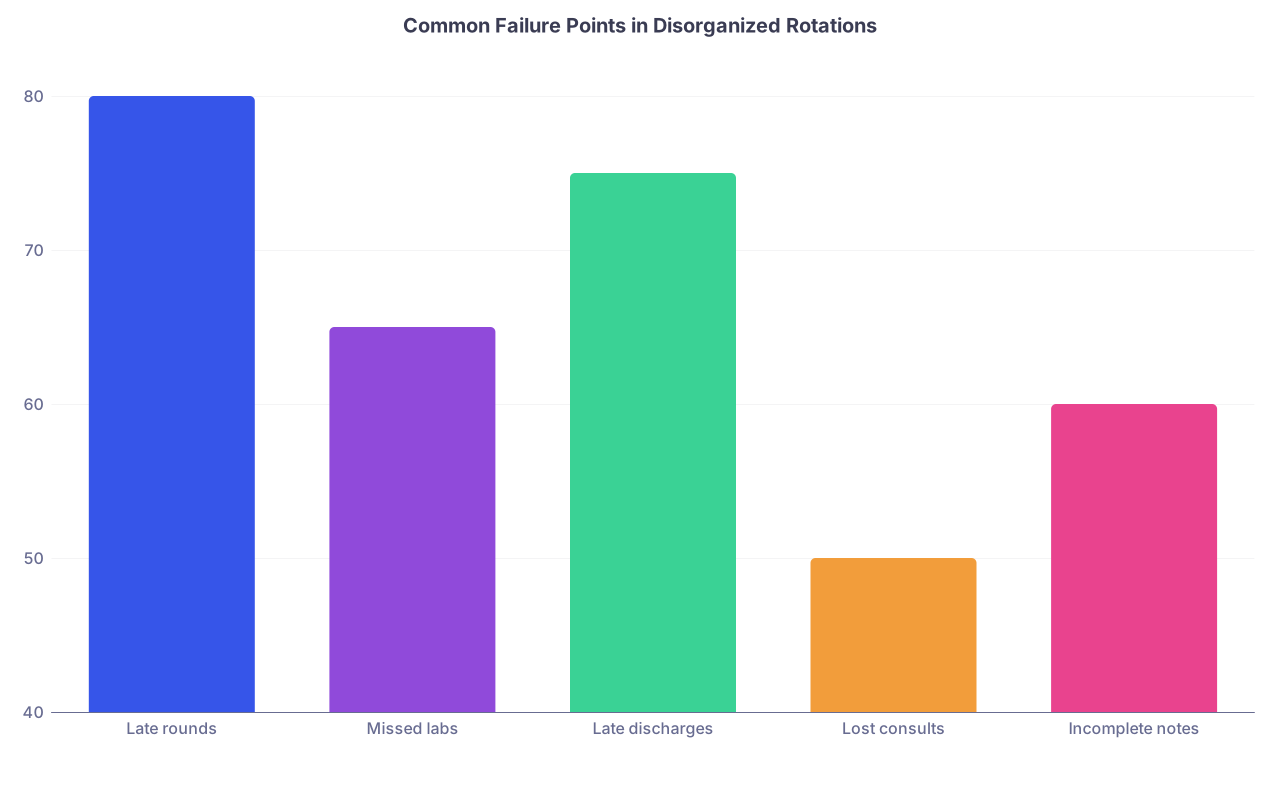
| Category | Value |
|---|---|
| Late rounds | 80 |
| Missed labs | 65 |
| Late discharges | 75 |
| Lost consults | 50 |
| Incomplete notes | 60 |
Tool 1: One list to rule them all
If your team already has a decent shared list, use that. If not, build one today. It can be:
- EMR “Patient List” with standardized columns, or
- A shared document (OneNote, Google Docs, hospital-approved system), or
- At worst, a very structured printed list that gets updated twice daily
Essential columns that quietly fix chaos:
- Room / Name / MRN
- Primary problem(s)
- Overnight issues
- Today’s priorities (1–2 bullet points max)
- Discharge target: “likely today / tomorrow / >48h / TBD”
- Action boxes:
- Labs to follow today
- Imaging/consults pending
- Discharge tasks (med rec, scripts, follow-up, paperwork)
- Assigned owner initials
You do not need 20 fields. You need the ones that drive action. Every patient should have a one-line “If you forget everything else, remember this” summary.
During the first 10 minutes in the morning, quickly update this list with:
- New labs
- Overnight events
- Revised discharge predictions
This becomes your operational brain.
Tool 2: A default daily schedule (that you quietly steer)
You probably cannot dictate when your attending rounds. But you can shape the blocks around that.
Draft a “default” team day and live by it unless something unusual happens:
| Time | Block |
|---|---|
| 06:30–07:30 | Pre-rounds / data gather |
| 07:30–08:00 | Huddle and list update |
| 08:00–11:00 | Bedside/board rounds |
| 11:00–12:00 | Orders, discharges, calls |
| 12:00–13:00 | Lunch + teaching |
| 13:00–15:30 | Notes, follow-ups, admits |
| 15:30–16:00 | PM check-in / sign-out prep |
You adapt this to your service, but keep the principle:
- A defined huddle
- A defined orders/discharge block
- A defined PM tidy-up
You do not go into a day with “We will see how it unfolds.” You go in with “This is our default flow unless there is a code or disaster.”
How you quietly steer this:
- Propose: “Since we usually start rounds around 8:30, can we huddle at 8:10 as a team to update the list and identify discharges? I can keep it to 5 minutes.”
- Start doing it even if only one other resident joins. Success is contagious.
Tool 3: Explicit task ownership
Adopt a simple rule: No task leaves the conversation without a name and time.
During rounds or workroom discussions:
- Bad: “We need to call cardiology.”
- Better: “I will call cardiology by 11.”
- Or: “John, can you call cardiology by 11? I will put it in the list next to your initials.”
Make this visible on the list. Example notation:
- “Cardiology consult – J, by 11”
- “CT abd/pelvis order – S, before rounds”
- “Discharge summary – R, by 2 PM”
Quietly enforce this in your own language:
- “Who should own that?”
- “Let me put a name and time next to that so we do not lose it.”
You are not being bossy. You are doing cognitive offloading for a stressed team.
Step 3: Run a 10-Minute Morning Huddle That Changes Everything
The single highest-yield leadership move for a disorganized service: a micro-huddle before or right at the start of rounds.
You do not wait for the attending. You run it as a resident-level operation.

| Step | Description |
|---|---|
| Step 1 | Arrive |
| Step 2 | Update vitals and labs |
| Step 3 | Open team list |
| Step 4 | Identify likely discharges |
| Step 5 | Assign key tasks |
| Step 6 | Set admission and cross coverage plan |
| Step 7 | Start rounds with attending |
Target length: 5–10 minutes. Stand up. No deep dives. Script it:
- Quick census run
- “We have 16 patients. Two new overnight in 6B and 7C.”
- Discharge candidates
- “Likely discharges today: 612A, 615B, maybe 722 if PT clears.”
- Assign ownership: “Jane will own 612A’s discharge, I will own 615B.”
- Critical follow-ups
- “We must check: MRI on 610, blood cultures on 603, echo read on 718.”
- Attach names and times.
- Admissions / cross-coverage plan
- “Pager coverage: I will take calls during rounds; you cover cross-cover until 10, then we switch.”
- Teaching priorities (optional but powerful)
- “Two-minute teaching later on hyponatremia for our intern, if there is time.”
You are not “changing the schedule.” You are giving the day a spine.
Residents who do this for one week turn a drifting, reactive team into a focused one. Without any policy changes. Just by making the implicit explicit.
Step 4: Fix Rounds Without Fighting the Attending
Attending style is like weather. You cannot control it. But you can dress appropriately and carry an umbrella.
There are three main rounding pathologies:
- Rounds that start late and wander
- Rounds that are too detailed and bog the team down
- Rounds that are chaotic with no consistent order
You do not fix these with confrontation. You fix them by structuring what you can.
Problem A: Rounds start late and nothing is ready
Your move:
- Use pre-round time ruthlessly:
- Pre-chart high-yield data: new labs, imaging, overnight events
- Pre-write a skeleton plan for stable patients
- Flag 2–3 “should discharge today” patients with brief arguments (VSS, PO intake, mobility, follow-up)
- When attending arrives:
- Be ready with, “We have 3 likely discharges today; I suggest we see them first to avoid delays.”
You are framing the day around what matters. Most attendings will accept this because they hate late discharges too.
Problem B: Rounds drowning in minutiae
I have seen attendings spend 18 minutes dissecting chronic back pain on a patient admitted for pneumonia. Everyone suffers.
Your leverage:
- Concise presentations. Train your interns and students:
- One-liner with reason for admission
- Overnight events
- New data that changes management
- Today’s main question
If they start tangents, gently redirect before attending jumps:
- “Her chronic back pain is stable at baseline and not the focus of today’s plan.”
If attending goes long anyway, your job is to:
- Keep a running “to-do” section on the list
- Whisper to your co-resident: “I will update orders while you stay in the room” or vice versa
- Use “rounding roles”: one talks, one updates EMR, one updates list
Problem C: No consistent order; people constantly lost
If the rounding path jumps arbitrarily, people lose track.
You suggest a subtle structure:
- “We have 8 on 6B, 5 on 7C, and 3 on 8A. If we start with 6B, we can see both discharges there first and then move up.”
Or:
- “Can we go by sickest first, then discharges, then stable patients? That might help us move discharges earlier.”
Again, you are not dictating. You are offering a plan. Most attendings are relieved someone thought ahead.
Step 5: Reclaim the Middle of the Day (Where Work Actually Happens)
Fixing rounds is half the battle. The other half is not letting 11:00–16:00 dissolve into disorganized firefighting.
Think in terms of cycles, not a vague “afternoon.”
Cycle 1: 11:00–13:00 – Execute what was decided
Right after rounds, do not sit down and “start notes” blindly.
Run a 2–3 minute micro-huddle:
- What must be done in the next 2 hours?
- Discharge work
- Time-sensitive consults
- High-risk lab follow-ups
- Who will do what?
Example:
- “Jane: focus on 612 and 615 discharges. I will call GI and cards for 603 and 718. Med student will draft the note for 610 and call pharmacy for med rec on 722.”
Protect discharge work here. If you push discharges to after lunch, they slide to 3–5 PM, and everyone stays late.
Cycle 2: 13:00–15:00 – Deep work and documentation
This is the time for:
- Notes that actually synthesize, not just regurgitate
- Reassessing unstable patients
- Following up on morning orders
- Teaching if bodies are not literally on fire
You protect this window by:
- Splitting pager duty: one resident carries primary pager for 60–90 minutes while the other does uninterrupted notes, then swap
- Informing nursing: “From 1–3 we are splitting who is on pager so at least one of us is always in the chart getting stuff done.”
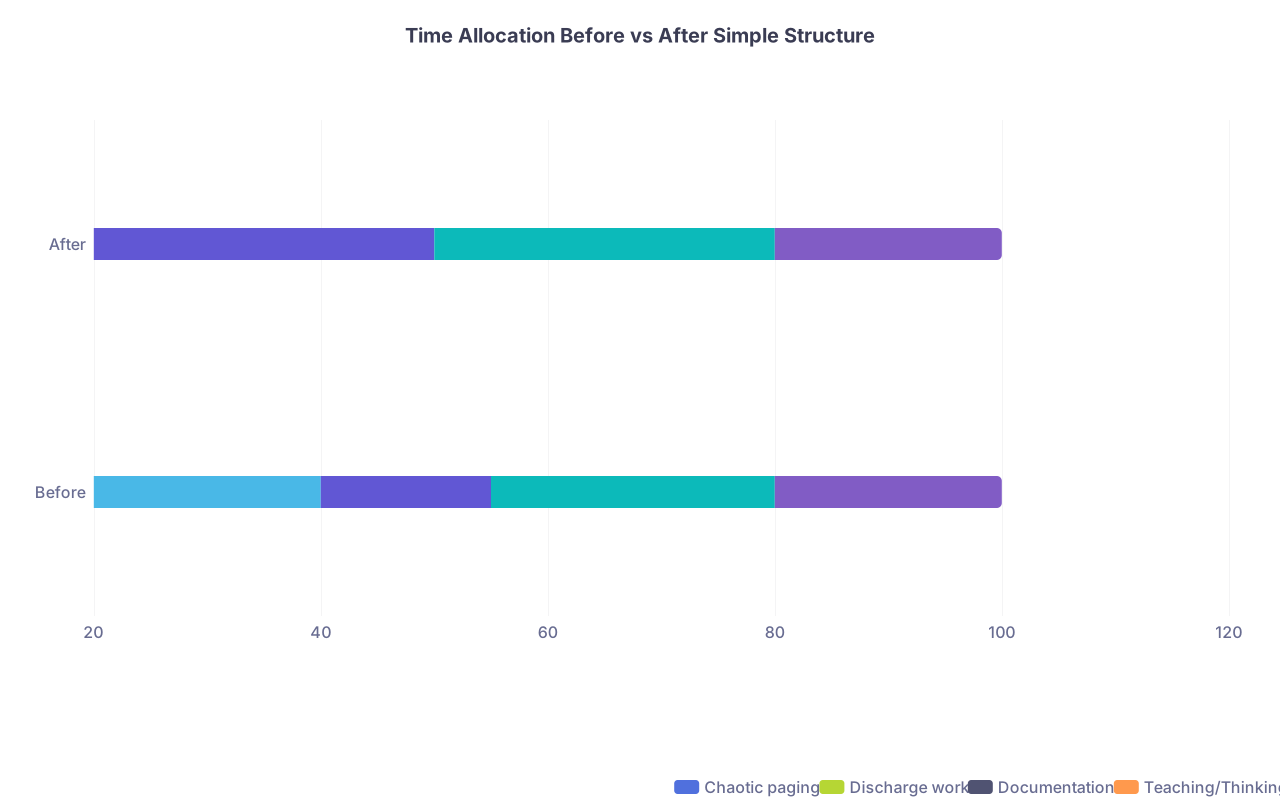
| Category | Chaotic paging | Discharge work | Documentation | Teaching/Thinking |
|---|---|---|---|---|
| Before | 40 | 15 | 25 | 20 |
| After | 20 | 30 | 30 | 20 |
Cycle 3: 15:00–16:30 – Close the loop and prepare sign-out
At 15:30 or so, grab whoever is around for another 5-minute check-in:
- “Any critical tasks not done?”
- “Any patients who got worse, new labs we were waiting for?”
- “What will hurt us overnight if we do not address it now?”
You are trying to avoid:
- 17:30 “Oh, we never checked the CT that came back at noon”
- Night float getting destroyed by predictable but unaddressed issues
If you do this consistently, your sign-out becomes cleaner, and your own evenings shorten.
Step 6: Use Micro-Leadership With Interns and Students
You do not need to give a “leadership talk.” You show it by giving people clear, doable, bounded responsibilities.
Interns flail on disorganized rotations because everything feels urgent and nothing feels defined. Fix that for them.
Give ownership, not random tasks
Instead of:
- “Can you help with notes?”
- “Can you follow up some labs?”
Try:
- “You own 612A and 615B today. Before noon, your goals:
- Make sure each has a clear ‘today’ problem list
- Med rec updated
- Discharge to-do list started on the list Then we will review your plans together.”
Or for students:
- “You are the specialist on 610’s hyponatremia today. Read one UpToDate summary and be ready to explain tomorrow why we chose fluid restriction over hypertonic.”
You are turning amorphous work into clear domains. People perform better when they know what “done” looks like.
Protect them from unnecessary chaos
Leadership is also about shielding.
- Intercept pointless scut when you can
- Help them prioritize:
- “Skip the full-page review of his psoriasis. Focus on why his oxygen needs went up and what we are doing about it.”
You become the internal “triage officer” for your team’s cognitive load.
Step 7: Communicate With Nursing and Consultants Like a Grown-Up
The most disorganized teams I have seen treat nurses and consultants as afterthoughts. Then they wonder why everything is delayed.
You fix this with extremely simple, respectful communication.
With nursing
Do two things consistently:
Early heads-up about discharges
- “These two are high-likelihood discharges today. If you need anything from us to make that easier—orders, wound care, PT—tell us before noon.”
Closed-loop communication on big plan shifts
- “We just changed 603 to NPO and started insulin gtt. If anything looks off with his sugars, please page me directly.”
You do not spam them with tiny updates. You inform them of things that change their work.
With consultants
Most chaotic rotations waste consultant time, which then boomerangs back as delay.
Your approach:
- Before you call:
- Write down: why the patient is here, what changed, what specific question you are asking
- When you call:
- Start with one line: “This is Dr. X from medicine about a 63-year-old with new NSTEMI; we are asking if you recommend cath today or tomorrow.”
- Then brief relevant info only.
And then—this is critical—write down:
- Who you spoke with
- What they recommended
- Any “if/then” conditions
Put it in:
- The list (brief), and
- The note (full)
No more 17:00 “Did cards ever call back?” conversations. You know, because you tracked it.
Step 8: Make Changes Quietly Sustainable
You can run a “heroic week” of organization and then collapse. That is not leadership. That is a performance.
You want to build structures that survive your off days and your eventual rotation change.

Automate and offload
- Create simple templates:
- Admission and progress note templates that force you to list “Today’s priorities”
- A standard sign-out structure with: active issues, to-do, if-then plans
- Save your list format so the next person can reuse it
- Teach one intern or co-resident how to run the morning huddle; let them try it
Normalize the culture, not your personality
You do not want the story to be “Rotation was smooth because Jane was there.” You want:
- “On this service we:
- Run a quick huddle.
- Have one shared list.
- Attach a name to every task.
- Protect a discharge block.”
Say things like:
- “We usually…” not “I like to…”
- “On our team, we…” not “I prefer when…”
That small language shift signals: this is team culture, not your personal quirk.
A Realistic Weekly Implementation Plan
If you try to do everything tomorrow, you will fail. Here is a sane rollout.
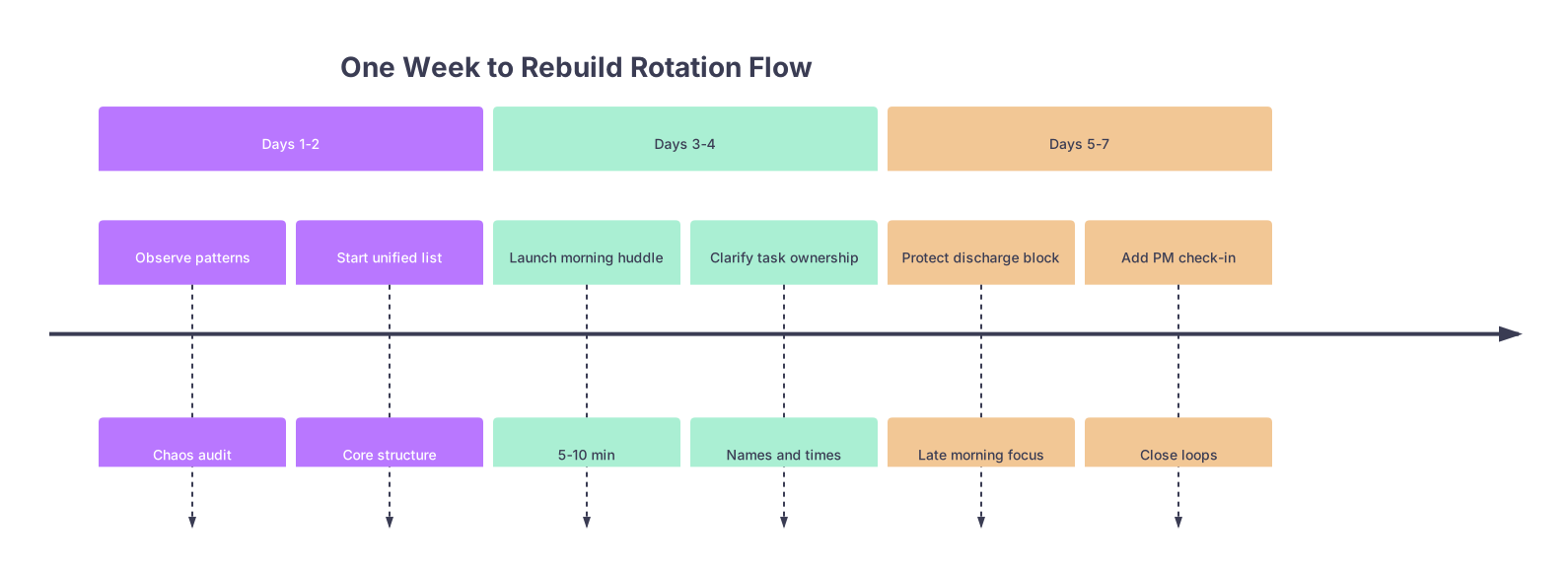
| Period | Event |
|---|---|
| Days 1-2 - Observe patterns | Chaos audit |
| Days 1-2 - Start unified list | Core structure |
| Days 3-4 - Launch morning huddle | 5-10 min |
| Days 3-4 - Clarify task ownership | Names and times |
| Days 5-7 - Protect discharge block | Late morning focus |
| Days 5-7 - Add PM check-in | Close loops |
Days 1–2
- Observe and write down the worst friction points
- Build or clean up the unified team list
- Start gently assigning explicit owners to tasks
Days 3–4
- Introduce a 5–10 minute morning huddle
- Try to structure rounds indirectly (order of patients, discharge-first)
- Start doing a tiny PM check-in with whoever is still there
Days 5–7
- Protect late morning for discharge work and time-sensitive tasks
- Clean sign-outs using your now-better list and follow-up tracking
- Ask one intern or student to co-run huddles so the culture spreads
By the end of a week, the rotation will not become a perfectly oiled machine. But it will feel less like drowning and more like swimming in rough water. That is progress.
Common Pitfalls (and How to Avoid Them)
Pitfall 1: Overcomplicating your system
Residents underestimate how tired their future selves will be. If your system requires 15 clicks and four spreadsheets, you will abandon it by Friday.
Fix:
- One list. Few columns. Update twice daily.
- One short huddle. One short PM check-in.
Pitfall 2: Acting like a mini-attending
If you start telling people what to do without listening, you will get quiet resistance.
Fix:
- Ask: “What is hardest for you right now?” Then design the structure to help that.
- Invite: “Does this huddle help or slow you down? What would make it more useful?”
Leadership is not a performance; it is a service.
Pitfall 3: Waiting for perfect buy-in
You don’t need 100% team enthusiasm to start. If one other resident or intern sees the value, you have enough to begin.
Others will often come around when they realize:
- Discharges are smoother
- They get out earlier
- Fewer disasters hit at 17:00
People follow results.