
The biggest leadership mistake residents make with QI is trying to hide a failed project instead of weaponizing it.
You are not judged on whether every QI project “works.” You are judged on whether you think, act, and recover like a leader when it does not.
Here is how to turn a QI flop into a leadership win, step by step.
1. Reframe the “Failure” Immediately
A QI project only truly fails in two situations:
- Nothing changes.
- No one learns anything.
If you collected data, tried an intervention, and discovered something that does not work in your system, you already have value. The leadership question is: can you convert that value into something visible, structured, and shareable?
First move: stop describing it as “my failed QI project” and start calling it:
- “Cycle 1 of our sepsis order set initiative”
- “Pilot PDSA for discharge summary turnaround”
- “Phase 1: data from our early mobility attempt”
Language matters. You are signaling to others—and to yourself—that this is an iteration, not a dead end.
Quick reframe script when your PD, APD, or attending asks how it went:
“Our initial intervention did not move the primary metric the way we expected, but we identified three specific process barriers and have a second-cycle plan to address them.”
Translated: I think like a systems person. I own the outcome. I know the next step.
That is leadership.
2. Do a Real Post‑Mortem, Not a Blame Session
Most residents skip this or do it badly. They either:
- Hand-wave: “The nurses did not buy in.”
- Self-blame: “I guess I am just bad at QI.”
Both are amateur moves. You need a structured, emotionally boring post-mortem.
Step-by-step post-mortem protocol
Block 60–90 minutes. Invite only core stakeholders (your faculty mentor, 1–2 key residents, 1 nurse or pharmacist if they were central).
Bring:
- Run charts / before-and-after data
- Process map if you made one
- Brief one-slide summary of the intervention
Then walk through four questions:
What did we actually do?
- Not what you planned, what actually happened.
- Example: “We aimed for 80% adoption of the new discharge checklist, but chart review shows it was used in only 35% of eligible discharges.”
What changed in the system? Even if the outcome did not.
- Did documentation improve?
- Did people’s awareness of the problem increase?
- Did any micro-process get easier/harder?
What blocked the intervention?
- Use “Five Whys” on each barrier.
- Example:
- Why did checklist use stay low?
→ Because residents found it duplicative. - Why duplicative?
→ It repeated elements already in the EMR discharge navigator. - Why was it separate?
→ Because we could not get IT to build the fields in Epic. - Why not?
→ We never involved the analyst early, and the build request came in too late.
- Why did checklist use stay low?
What did we learn that would change the next cycle?
- Identify 3–5 concrete design lessons.
- Example: “Any future intervention must be embedded directly in the EMR workflow, not as a separate paper or electronic tool.”
Write this up in a one-page “Post‑Cycle Review” document and have everyone in the room sign off. This becomes your leadership artifact.
3. Extract the Leadership Narrative
You are not just fixing a project; you are building a professional story.
Program directors, future employers, and fellowship committees rarely care that your CLABSI rate dropped from 2.3 to 1.8 per 1000 line days. They care whether you can:
- Frame a problem
- Rally people
- Execute
- Learn
- Adapt
You want to build that arc very explicitly.
Convert your project into a leadership arc
Use this simple five-part structure when talking or writing about the project:
Context
- “On our medicine service, we identified delays in antibiotic administration for septic patients, with a median time of 210 minutes to first dose.”
Action
- “I led a multidisciplinary QI effort involving residents, ED nurses, and pharmacy to test a new sepsis order set and triage alert.”
Obstacle / Failure
- “Our first PDSA cycle did not improve door-to-antibiotic time. In fact, we saw increased alert fatigue and lower order set utilization than baseline.”
Analysis
- “We performed a structured post‑mortem and discovered three key issues: alert timing was misaligned with nursing workflow, the order set was too long, and pharmacy was left out of the design.”
Leadership Response / Next Step
- “I convened a smaller design group, front-line nurses and a pharmacy rep, and we redesigned the order set to auto-populate and reduced options by 40%. We are now entering cycle 2 with clearer ownership and a plan to integrate it into ED huddles.”
Now it sounds like leadership, not failure.
4. Make the Failure Useful to the System
If your QI “failure” lives only in your personal regret folder, it is wasted. If it becomes shared institutional learning, you have just demonstrated systems leadership.
You want to turn your project into something other people can stand on.
Practical ways to do that
Create a one-page “What We Tried” brief
Sections:
- Problem statement
- Intervention
- What we expected
- What actually happened
- Key barriers
- What we would do differently next time
Aim for something that a chief resident or quality officer could skim in 2 minutes and learn from.
Offer a 10-minute teaching segment
Ask your chief or PD:
“Can I do a short ‘What did not work’ QI case at morning report or resident conference?”
Then present it like a case:
- Present the “before”
- Present the intervention briefly
- Show the unchanged (or worse) graph
- Ask the room: “What would you change?”
- Close with what you actually learned
You just modeled psychological safety and mature leadership in front of your peers.
Feed it into the formal QI structure
If your hospital has:
- QI committee
- Patient safety council
- Departmental quality meeting
Email the chair with:
- Your one-page brief
- A short note: “Happy to spend 5 minutes on the agenda to share lessons and avoid others repeating this design.”
Most places are starved for genuine learning that is not sterile, so this is welcomed.

5. Tighten Up Your QI Mechanics (So Next Time You Look Like a Pro)
A lot of “failed” QI projects are not failures of leadership, they are failures of technical design. You can fix those.
Here is a simple checklist I use when I review resident QI projects that cratered:
| Failure Point | Fix You Control as Resident |
|---|---|
| No clear owner | Name a project lead and backup explicitly |
| Vague aim statement | Use SMART aim with a concrete number and deadline |
| No baseline data | Pull 3–6 months of pre-intervention data |
| Intervention too complex | Strip to 1–2 behavior changes max |
| No front-line input | Involve at least 2 end users before implementation |
Walk your project backward through that lens. You will see where the wheels came off.
Tighten the aim
If your original aim was:
“Improve communication during handoffs.”
That is not an aim; that is a wish.
Leadership move: sharpen it.
“By June 30, increase the rate of documented high-risk item handoff (anticoagulation, drips, pending imaging) in the cross-cover note from 40% to 80% for general medicine patients.”
Even if you miss that target, you are now speaking like someone who understands measurement and accountability.
Fix the “ownerless” project
Resident QI projects often fail because no one is clearly in charge. A committee of three interns all “owning it” means nobody does.
You fix this by:
- Naming a project lead (you or someone else)
- Assigning a specific attending sponsor
- Having a clear escalation chain: resident lead → chief resident or QI director → department chair (if needed)
Write it down in your project charter. If you did not have one, retroactively create it and use that as a talking point: “One of our lessons was that unclear ownership killed momentum; we are correcting that in cycle 2.”
6. Turn the Project into a CV and Interview Asset
Here is the honest truth: reviewers get bored reading “Successfully reduced X by Y%” twenty times. A sophisticated, analyzed failure stands out.
Rewrite your CV bullet
Do not write:
- “Led QI project to improve discharge documentation (project ongoing).”
This says nothing. Instead:
- “Led multidisciplinary QI initiative to improve discharge documentation; first-cycle intervention did not improve timeliness, prompting structured failure analysis and redesign of EMR workflow for second-cycle testing.”
You just:
- Showed leadership
- Showed comfort with failure
- Showed understanding of cycles
Use it as an interview story
Any leadership, QI, or fellowship interview will have some version of:
- “Tell me about a time something did not go as planned.”
- “Describe a project that failed.”
Your QI project is perfect.
Structure your answer as:
- Brief context and your role
- What you tried
- How it failed or underperformed
- What you personally did in response
- How that changed your approach to future projects
Example:
“As a PGY-2 I led a project to reduce unnecessary telemetry on our medicine service. We created new ordering guidelines and did resident education, but telemetry utilization stayed essentially flat. I realized I had not involved nursing and admitting in the design, so the new process created friction and was quietly bypassed. I convened a post‑mortem with night float, admitting, and charge nurses, and we redesigned the workflow so that telemetry eligibility was clarified at admission rather than at 2 AM when staff were stretched. That experience shifted how I approach QI—I now treat front-line staff as co-designers, not just end users.”
That is exactly how leaders talk.
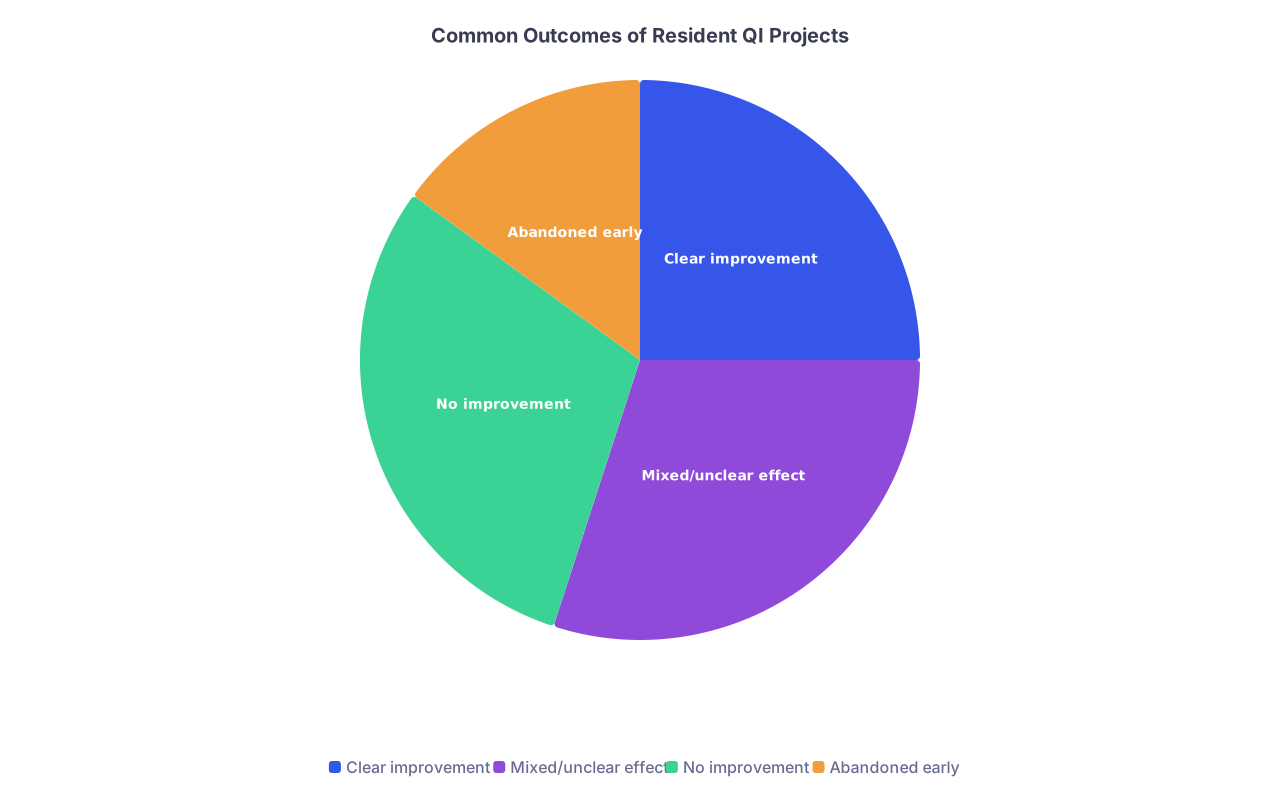
| Category | Value |
|---|---|
| Clear improvement | 25 |
| Mixed/unclear effect | 30 |
| No improvement | 30 |
| Abandoned early | 15 |
7. Protect Your Reputation When Things Go Sideways
Some residents worry: “If this project failed, will I be seen as unreliable?”
Only if you disappear, blame, or minimize. The way you handle the aftermath is what people remember.
Actions that hurt your leadership image
- Ghosting your faculty mentor once data look bad
- Blaming nursing, IT, or “the system” without owning your part
- Quietly abandoning the project without any close-out
Actions that help your leadership image
Proactive debrief email
Example to your attending mentor:
“Dr. Smith, I completed our post-intervention data pull. We did not see improvement in the primary outcome and, in fact, had lower adoption than expected. I have drafted a one-page summary of what we tried and what we learned. Could we schedule 20 minutes to review and decide whether to proceed with a second cycle or hand this off to the departmental QI team?”
This screams maturity.
Visible close-out
- Give a 5–10 minute update at:
- Resident QI conference
- Division meeting
- Explicitly label it “Cycle 1 results and lessons.”
- Give a 5–10 minute update at:
Offer to help shape the next attempt
You can say:
“Even though the first approach did not work, I am happy to help whoever takes this on next avoid our design mistakes. I can share our data and brief.”
Your reputation becomes: “The resident who handled a messy project like an adult and made it easier for the next person.”

| Step | Description |
|---|---|
| Step 1 | Intervention fails |
| Step 2 | Reputation damage |
| Step 3 | Trust decreases |
| Step 4 | Leadership credibility increases |
| Step 5 | New cycle or handoff |
| Step 6 | System learning |
| Step 7 | How do you respond |
8. Salvage Academic Value: Poster, Abstract, Talk
QI that “fails” is still publishable. Often more interesting than the perfect-success posters with suspiciously clean run charts.
What you have:
- Clear problem
- Intervention description
- Data pre and post
- Analysis of why it did not work
- System-level lessons
That can become:
- Hospital quality day poster
- Regional ACP or society meeting abstract
- Resident research day oral presentation
How to frame a “negative” project for submission
The title is everything. Do not write:
- “Attempt to reduce readmissions with new discharge form.”
Write:
- “Why our discharge checklist did not reduce readmissions: lessons from a resident-led QI initiative.”
And in your conclusion section, avoid “no significant difference; more study needed.” That is lazy.
Write something like:
- “Although the discharge checklist did not reduce 30-day readmissions, we identified misalignment with existing EMR workflows and inadequate PCP follow-up infrastructure as key barriers. Future interventions should prioritize integrating discharge tools into existing documentation systems and co-designing processes with primary care teams.”
That sounds like someone people should listen to.

9. Build a Mini-QI Portfolio, Not a One-Off Project
Strong leaders in residency do not just have “a QI project.” They have a pattern.
You can turn one failed project into the seed of that pattern.
Build a simple QI portfolio document
One or two pages with sections:
- Projects attempted
- Brief bullet each:
- Aim
- Your role
- Outcome (improved / neutral / worse / not completed)
- Brief bullet each:
- Top 5 QI lessons you learned
- Example:
- “Do not fight the EMR; embed changes in existing workflows.”
- “Ask nurses first; they usually know why previous attempts failed.”
- Example:
- How you changed your approach over time
- Show evolution from naive to more strategic.
This is gold for:
- Semi-annual meetings with your program director
- Fellowship or job interviews
- Conversations with hospital QI leadership
You are not “the resident with the project that failed.” You are “the resident who built a QI learning curve.”
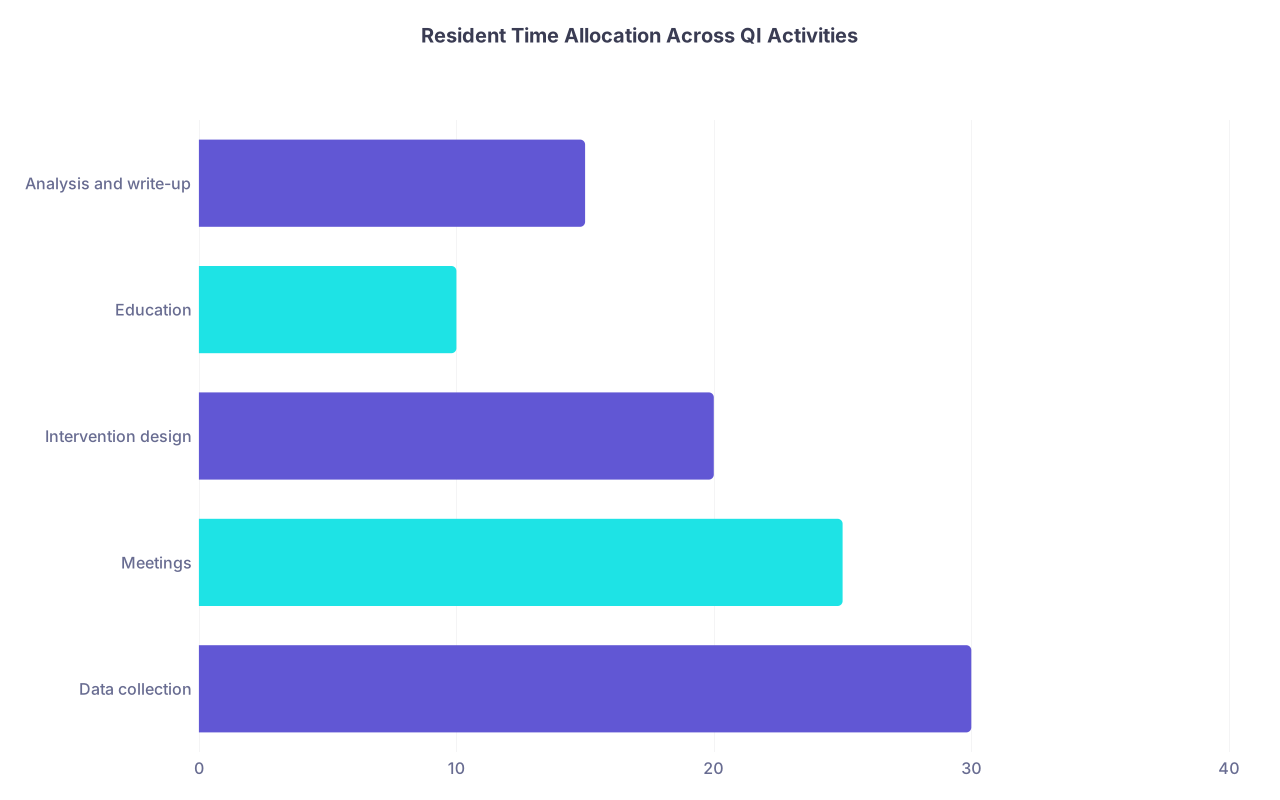
| Category | Value |
|---|---|
| Data collection | 30 |
| Meetings | 25 |
| Intervention design | 20 |
| Education | 10 |
| Analysis and write-up | 15 |
10. Concrete 7-Day Recovery Plan After Your QI Project Fails
If you want something brutally practical, here is your week-long protocol to flip the narrative.
Day 1–2: Own and Understand
- Pull and clean your post-intervention data.
- Create a 1-slide run chart or table.
- Draft a one-paragraph summary: “We aimed to do X by Y. We did Z. Result: [brief].”
Day 3: Post-mortem
- Schedule a 45–60 minute meeting with:
- Faculty mentor
- 1–2 residents
- 1 front-line stakeholder (nurse/pharmacist)
- Use the 4-question structure from Section 2.
- Capture notes in a one-page document.
Day 4: Reframe and Plan
- Rewrite your project description into a leadership arc.
- Decide deliberately:
- Continue to cycle 2 with revised plan; or
- Close out and transition to QI team / next resident.
- Draft either:
- A brief cycle 2 plan; or
- A handoff note to QI leadership.
Day 5–6: Visibility
- Email PD or chief: ask for 5–10 minutes at a relevant meeting to share “What We Tried and What We Learned.”
- Draft 3–5 slides:
- Problem
- Intervention
- Data (no improvement)
- Why it failed (your analysis)
- Lessons / Next steps
Day 7: Career Integration
- Update:
- CV bullet to reflect leadership and learning.
- Your personal statement draft (if applying soon) with 2–3 sentences on this.
- Write a 250-word version of the story for future interviews.
You just converted “my QI project failed” into:
- A visible leadership moment
- A teaching opportunity
- A career story
- A system learning artifact
That is exactly what strong residents do.