

Your toxic team is not “just residency culture.” It is a leadership failure you can fix.
I have watched brilliant residents become burned-out, cynical, or outright cruel because nobody ever showed them how to lead. Attendings look away. Chiefs hope “it’ll sort itself out.” Meanwhile, interns cry in call rooms and patient care quietly suffers.
You are not powerless here. You do not need a chief title to change the trajectory of a team.
This is a step‑by‑step playbook for fixing a toxic resident team from the inside—whether you are the senior on service, a co-resident, or even an intern stuck in the middle.
Step 1: Diagnose the Exact Type of Toxicity
Vague labels like “toxic culture” are useless. You need a working diagnosis.
Most dysfunctional resident teams fall into a few recognizable patterns. Identify your team’s dominant type:
| Toxic Pattern | Core Problem |
|---|---|
| Sniper Team | Constant criticism, no safety |
| Ghost Team | Avoidant, no communication |
| Hero-Martyr Team | Overwork, shame, no boundaries |
| Clique Team | In-group/out-group behavior |
| Chaos Team | Disorganized, reactive |
1. Sniper Team
Symptoms:
- Sarcasm as default language (“Nice job on that note… not.”)
- Public shaming on rounds
- Eye-rolls, sighs, mocking behind people’s backs
- People stop volunteering, ask fewer questions, hide mistakes
This team is unsafe psychologically. Learning shuts down.
2. Ghost Team
Symptoms:
- People disappearing (“Where is the senior?” / “No idea.”)
- Handoffs rushed or skipped
- Text-only communication with no face time
- Everyone “doing their own thing” with minimal coordination
This team is fragmented. Patients fall through cracks.
3. Hero‑Martyr Team
Symptoms:
- Bragging about how late they stayed or how many notes they wrote
- People punished (socially) for going home on time
- No one takes breaks; guilt for using days off
- Constant “I’ll just do it myself” from seniors
This team burns people out and teaches terrible habits.
4. Clique Team
Symptoms:
- Inner circle of friends, and everyone else is peripheral
- Social conversations that exclude some team members
- Opportunities (procedures, presentations) given only to favorites
- People whispering or texting each other in front of others
This team breeds resentment and disengagement.
5. Chaos Team
Symptoms:
- No clear roles for the day
- Multiple people doing and redoing the same work
- Orders missed, tasks forgotten
- Every day feels reactive and fire‑drill mode
This team is exhausting and unsafe, even if people are “nice.”
Action: Write down which pattern (or two) best fits your team and 3 concrete behaviors that prove it. You will target those, not vague “toxicity.”
Step 2: Create a Non‑Negotiable Baseline of Safety
You cannot build anything on top of an unsafe foundation. Your first goal is not “make everyone like each other.” It is: people do not get humiliated, ignored, or undermined.
2.1. Set a New Standard Out Loud
If you are the senior or de facto leader, you must say it plainly. Ideally on day 1 or as soon as you notice the problem.
Use a short script during a team huddle:
“Here is how I want this team to run.
- We do not shame people for not knowing things. We teach.
- We do not talk badly about each other to patients, nurses, or other services.
- We surface problems early; no one gets punished for raising concerns.
If I slip, I want you to call me on it. I will do the same. That is the deal.”
Say it in your own voice, but keep the structure: clear expectations + personal accountability.
If you are not the senior, you can still do a lighter version:
- “I know I am just the intern, but what really helps me learn is no-shame questions and clear feedback. I would love if we could keep feedback direct but not sarcastic.”
You are planting a flag: sarcasm and humiliation are not “just how it is.”
2.2. Stop Public Humiliation Immediately
This is non‑negotiable. When someone takes a shot at another team member in public (rounds, hallway, patient room), you intervene.
Two levels of response:
In the moment, short and clean
- “Let’s keep feedback constructive.”
- “We can talk about that after rounds.”
- “We are focusing on the patient right now.”
Afterwards, direct conversation
- “Earlier on rounds when you said X to Y, it came across as personal and shaming. That is not how I want this team to operate. If you have concerns, bring them to me or address them respectfully.”
Do not overtalk. Calm, brief, firm. You will feel like you are “making a big deal.” You are not. You are resetting a boundary.
Step 3: Build a Simple, Predictable Daily Structure
Most chaos and passive‑aggressive behavior flourishes in ambiguity. People do not know what is expected, so they either overcompensate, underperform, or attack.
Fix this by imposing a minimalist structure. Not a 10‑page protocol. Three pillars:
- Clear roles
- Clear communication channels
- Clear check‑in points
3.1. Define Roles For the Day
Every morning, 2–3 minutes. You as senior (or unofficial coordinator) say:
- “Today’s roles:
- Intern A – admits until 3 pm, then cross‑cover handoff
- Intern B – discharges + follow‑up calls
- MS3 – prerounds on beds 1–4, focus on H&P details
- I’ll run the list and handle complex communication with consults”
Say it out loud. Make sure everyone knows what “success” looks like for their role:
- “For discharges, success is: summary done, scripts sent, appointments scheduled before 2 pm.”
- “For admits, success is: H&P + initial orders within 45 minutes of patient arrival.”
3.2. Standardize Communication Rules
You do not need a committee. Just two or three rules:
When to page vs text vs in-person
- Urgent clinical issue: page or call.
- Clarification / non‑urgent: text.
- Feedback / conflict: in person or video, never text.
Team group chat norms
- No venting about nurses, other services, or patients in the group.
- No shaming or sarcasm about mistakes.
- Use it for: updates, coverage needs, quick logistics.
If someone violates the norms, you call it out quickly:
- “Let’s keep the group chat for logistics. If you are frustrated, come talk to me directly.”
3.3. Add Two Short Daily Huddles
Fifteen minutes total can change the entire tone of a rotation.
Pre‑round huddle (5 minutes)
- “Here’s the plan for the day.”
- Identify sickest patients and which tasks need early attention.
- Reconfirm roles.
End‑of‑day micro‑debrief (5–10 minutes)
- “What went well today?” (one concrete example)
- “What felt rough or frustrating?” (one team or system issue)
- “Any ideas for how we want to run tomorrow differently?”
You are not running group therapy. You are iterating your workflow and giving people a sanctioned place to voice frustration before it leaks out sideways.
Step 4: Address the People Driving Toxicity
Every toxic team has “nodes” – one or two people whose behavior shapes the atmosphere. Sometimes it is the senior. Sometimes a malignant co‑resident. Occasionally an attending.
You cannot tiptoe around these individuals forever and expect change.
4.1. Private, Direct Feedback to the Key Offender
Use this structure. It works:
Observation (specific, neutral)
- “On rounds this morning, when the intern could not recall the sodium, you said, ‘Do you even read your labs?’ in front of the team and the nurse.”
Impact (on team and patient care)
- “After that, the intern stopped speaking up, and we almost missed the rising creatinine because they were afraid to say they had not checked again yet.”
Request (concrete behavioral change)
- “Going forward, I need you to give that kind of feedback privately, and focus it on the task not the person. For example, ‘We need to make sure labs are checked before rounds. Let’s build a system for that.’”
Collaboration / buy‑in
- “Does that feel doable? If not, what would help?”
Expect defensiveness. Stay calm.
Bad response you will hear:
- “Everyone is too sensitive.”
- “This is just how surgery is.”
- “If they cannot handle it, they should not be here.”
Good, firm reply:
- “You are entitled to your opinion about culture. On this team, for this month, we are not doing public shaming. That is not optional. I need your help to model that.”
You are not asking permission. You are informing them of the standard.
4.2. When You Are the Problem (And You Know It)
Maybe you are reading this and thinking, “I am the sarcastic senior. I am the one snapping at interns at 3 am.”
Fine. That is fixable if you own it.
Do this tomorrow:
At huddle:
- “I realized I have been short and sarcastic when tired. That undermines trust. I am working on it. If you catch me doing it, tell me in the moment or after; I will not punish you for it.”
Create an explicit replacement behavior:
- Instead of “What were you thinking?” → “Walk me through your thought process.”
- Instead of sigh/eye‑roll → silent 5‑second pause, then specific question.
You will slip. When you do, repair quickly:
- “I was too harsh earlier. That was not fair. Let me reset and go over the case with you properly.”
Your credibility goes up when you admit fault and change behavior. Not down.
Step 5: Install Micro‑Interventions for Each Toxic Pattern
Now we get tactical. Here is how you attack each pattern with specific, short interventions.
5.1. Fixing the Sniper Team
Core problem: psychological safety is shot. People are waiting to be attacked.
Interventions:
Ban sarcasm in teaching.
State plainly:- “During rounds, let us assume any question is asked in good faith. No sarcastic comments about people not knowing something.”
Normalize “I don’t know” + follow‑up.
- Senior: “If you say ‘I do not know’ and then follow up with looking it up and reporting back, that is success here.”
Model vulnerable behavior as leader.
- “I do not remember the latest guidelines on that. I will look it up after rounds and send an article.”
Use “we” language for errors.
- Not “You missed that potassium.”
- “We did not recheck that potassium. Tomorrow let us build a lab checklist so we do not miss that again.”
5.2. Fixing the Ghost Team
Core problem: people operate in silos and avoid contact.
Interventions:
Mandatory brief face‑to‑face check‑ins.
- “No one leaves for the day until we have a 3‑minute check‑out: who is signing out what, any loose ends, any concerns.”
Shared visible task board.
Use a whiteboard or shared document with:- Each patient
- Key tasks
- Initials of who owns it
Now no one can say, “I thought someone else was doing it.”
Explicit coverage rules.
- “If you need to leave the floor for more than 20 minutes (procedure, imaging, whatever), you tell the team who is covering your pages.”
5.3. Fixing the Hero‑Martyr Team
Core problem: self‑sacrifice is glamorized, boundaries are punished.
Interventions:
Publicly valuing efficient, sustainable work.
On debrief:- “Win of the day: intern B finished discharges by 1 pm and actually sat down to eat. That is the standard I want.”
De‑glorify suffering.
When someone brags:- “I stayed until 11 pm finishing everything myself.” Response:
- “That is not what I want. If you are drowning, I want you to call for help at 8 pm, not martyr yourself until 11.”
Create explicit “ask for help” trigger.
- “If any one of us has more than 3 open tasks after 5 pm, we say it out loud and we redistribute. No heroes.”
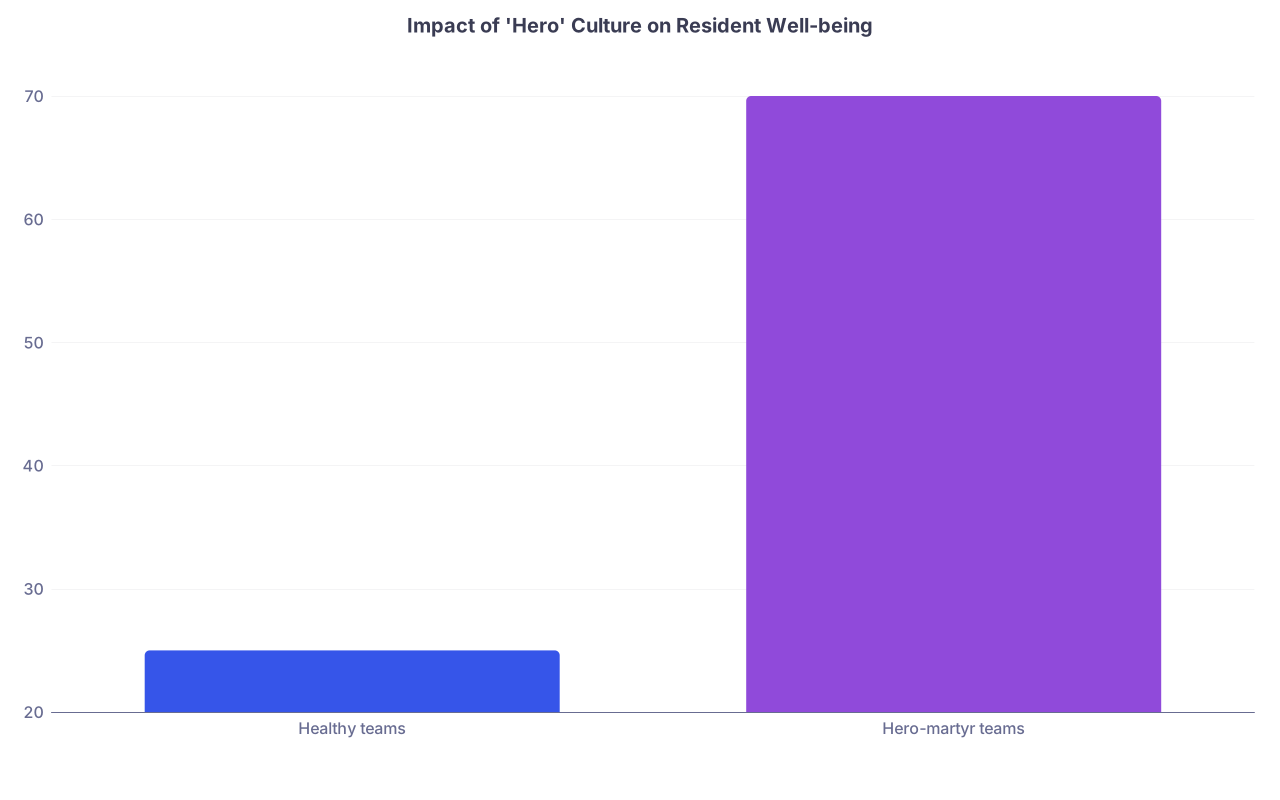
| Category | Value |
|---|---|
| Healthy teams | 25 |
| Hero-martyr teams | 70 |
(Imagine these as percentage of residents reporting burnout symptoms. I have seen numbers like this in wellness surveys, rotation after rotation.)
5.4. Fixing the Clique Team
Core problem: inclusion and opportunities are uneven.
Interventions:
Equal access to high‑value opportunities.
- Make a simple rotation list for procedures: “Next central line → intern A, then intern B, then student.”
Stops “who I like” from determining exposure.
- Make a simple rotation list for procedures: “Next central line → intern A, then intern B, then student.”
Conversation norms.
- “Social talk is fine, but if you are referencing inside jokes or people someone does not know, give 1‑sentence context or steer back to shared topics.”
Sidebar rule.
- “No side‑texting about team members during work. If you have feedback or a concern, bring it to the person or to me.”
You are not policing friendships. You are flattening the impact of cliques on work and learning.
5.5. Fixing the Chaos Team
Core problem: disorganization, no plan, constant rework.
Interventions:
Daily “top three” for the team.
At morning huddle:- “Top 3 priorities today: 1) get bed 12 to CT, 2) turn around four discharges, 3) call family meetings on 3 and 7.”
One shared patient list owner.
- One person (usually senior) is responsible for list accuracy. Others contribute but there is a clear owner.
Brief pre‑round triage.
- Before seeing patients: “Who is sickest? Who needs to be seen first? Who can safely wait?”
Stops the daily pattern of seeing stable patients while your GI bleed sits unaddressed.
- Before seeing patients: “Who is sickest? Who needs to be seen first? Who can safely wait?”
Step 6: Use Formal Power Wisely (When Needed)
Sometimes the toxicity is beyond your scope as a single resident. Maybe:
- An attending screams at the team.
- A co‑resident is consistently unsafe or abusive.
- Nurses or other services are being disrespected.
You will need backup. That does not mean running to leadership with every conflict. It means using the chain of command intentionally.
6.1. Document Before You Escalate
Write down:
- Date, time, and setting
- Exact words or behaviors
- Impact (on patient care, education, or safety)
- Any witnesses
One or two lines per episode. You are building a pattern, not a novel.
6.2. Choose the Right Person to Approach
Options typically include:
- Chief resident
- Program director or associate PD
- Rotation director or site director
- GME / ombudsperson (for severe or repeated abuse)
Pick the lowest level that has real authority and that you trust.
6.3. Use a Problem‑Solution Framing
When you talk to them, do not just vent. Frame it like this:
- “We have a problem on X rotation. Specific behaviors: [three brief examples]. Impact: [missed labs, team members crying on service, RRT almost missed].
I have already tried [setting expectations, private conversation].
Here is what I think would help: [attending aware of pattern, switching team assignments, facilitated meeting].
Can you help us make this safer and more functional?”
You are not “complaining.” You are leading.
Step 7: Protect Yourself While You Fix Things
One hard truth: you cannot always fully “fix” a toxic team in 4 weeks. Some cultures are deeply entrenched. Some people are not interested in changing. You manage what you can control, and you prevent collateral damage to yourself.
7.1. Decide Your Line in the Sand
Before rotations:
- What will you tolerate (e.g., occasional grumpiness, mild disorganization)?
- What will you not tolerate (e.g., racist or sexist comments, yelling, unsafe orders)?
When a line is crossed, you take one of these actions:
- Immediate boundary and feedback
- Escalation to chief / PD
- Removal from situation if acutely unsafe
7.2. Build Micro‑Support Systems
Do not try to handle a toxic month alone.
Identify 1–2 “outside” people:
- Co‑resident, mentor, therapist, partner.
- Tell them in advance: “This month may be rough. Can I send you a short debrief text a few evenings just to not carry it all alone?”
Limit rumination:
- 10‑minute rule: you get 10 minutes after shift to vent or write. Then you close the file for the night.
7.3. Protect Your Reputation and Evaluations
Toxic environments sometimes twist narratives. So you counter with clarity:
Communicate proactively with attendings:
- “Here is how I am helping structure the team: daily huddles, role assignments, etc.”
- Use specific examples of leadership when you ask for feedback.
Capture your leadership efforts in e-mails:
- Quick recap to attending or chief:
- “Today we tried a new system with a 5‑minute end‑of‑day debrief. It seemed to reduce missed tasks. Planning to continue this week.”
- Quick recap to attending or chief:
If things later blow up, you have a documented pattern of constructive leadership, not drama.
Frequently Asked Questions
1. What if I am just an intern—do I really have any power to change a toxic team?
Yes, you do, although your leverage is smaller. You can:
- Model non‑toxic behaviors consistently (no gossip, no shaming, direct questions).
- Ask for structure: “Can we quickly assign roles so I know what to prioritize?”
- Give upward feedback in a non‑threatening way: “When you did X, it really helped me. More of that would make this month much better.”
- Quietly refuse to participate in mocking or gossip. Silence is a statement.
You probably will not “fix” a malignant senior, but you can often soften the edges of a bad rotation and protect future interns by documenting significant issues to chiefs or PDs.
2. How do I give feedback to a toxic attending without getting destroyed on my evaluation?
Direct confrontation with a chronically abusive attending is usually high‑risk for trainees. Use a layered approach:
- Focus on behaviors and patient impact, not personality (“When teaching is mostly public criticism, I find I participate less and miss learning opportunities.”).
- Use group feedback mechanisms if available (anonymous rotation evaluations, chief‑facilitated debriefs).
- If behavior crosses a line (yelling, discrimination), document specifics and bring them to a trusted chief or PD asking, “What is the safest way to address this?”
You are not obligated to “fix” abusive faculty at the cost of your career. You are obligated to patients and your own safety.
3. My co‑resident is liked by attendings but cruel to juniors and nurses. What works in that situation?
You are dealing with a “punching down” dynamic. Strategy:
- Collect concrete examples with dates, witnesses, and impact.
- Have a private conversation once: describe behavior, impact, request. Gauge their response.
- If no real change, involve allies—nurses, other residents, chief. Frame it as a pattern that undermines team function and patient care, not a personality clash.
- Bring to chief or PD with a solution bias: “Could they do a professionalism remediation rotation? Could we keep them away from supervising interns until they complete training on feedback and communication?”
These situations are common, and leadership often acts only when they see a clear pattern with documented impact.
4. How long does it realistically take to turn around a toxic team?
If you have positional authority (senior resident, chief) and the toxicity is mild‑to‑moderate, you can change the tone in 3–5 days by:
- Setting expectations out loud
- Installing daily huddles
- Stopping public shaming immediately
- Redistributing work fairly
More severe, entrenched patterns or malignant individuals take longer—months to years—and often require program‑level interventions. Your job as a frontline leader is to:
- Stabilize the immediate environment as much as you can.
- Protect yourself and your juniors.
- Feed accurate signals and data up the chain of command.
Do this: think about your current or next rotation. Write down the one toxic pattern that worries you most (sniper, ghost, hero‑martyr, clique, or chaos) and pick exactly one intervention from this article to try on day 1. Then build from there.


